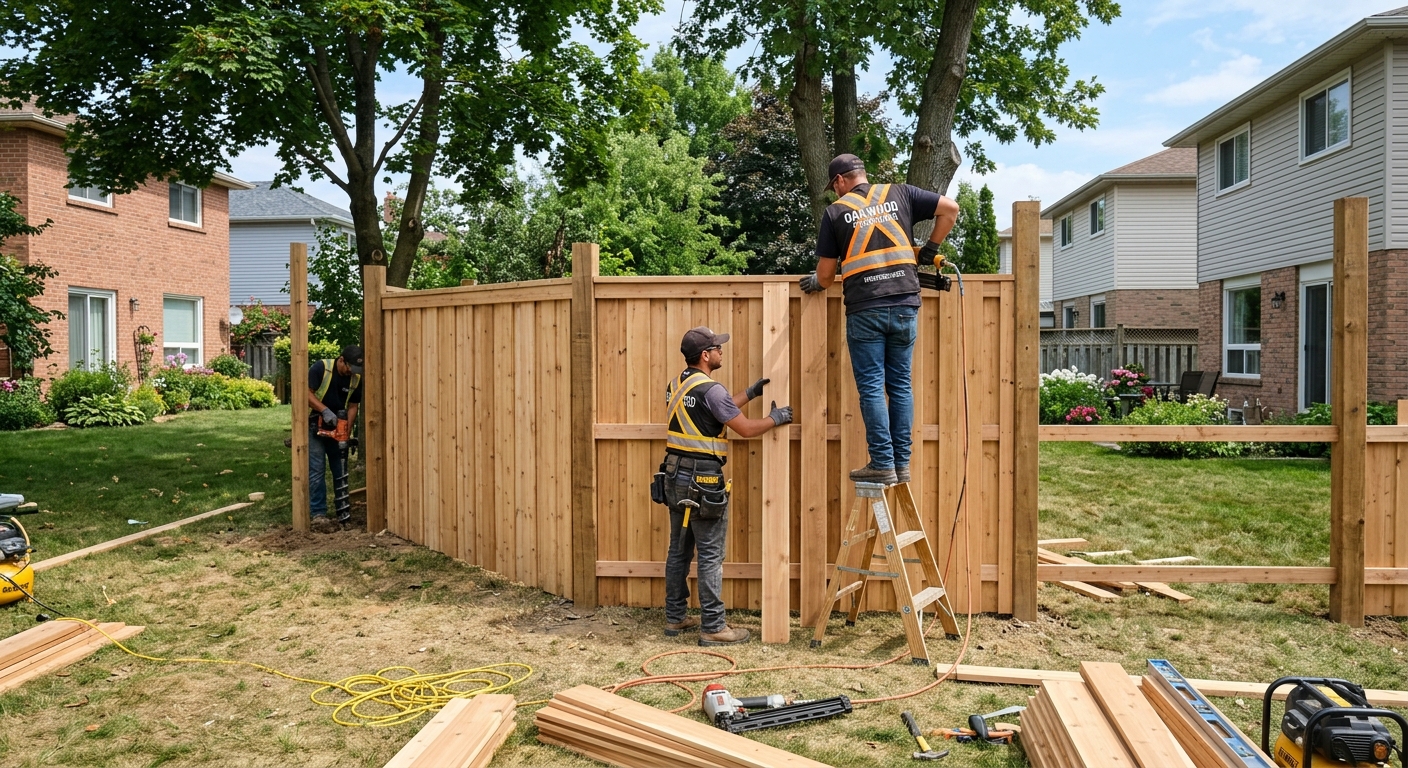
Fencing options and costs in Forest Hill North
In Forest Hill North, the right fencing choice usually comes down to privacy, curb appeal and how much upkeep you’re willing to take on. With a population of 12,806 (Statistics Canada, 2021 Census), the neighbourhood has a steady stream of homeowners improving front yards and adding privacy barriers to back gardens, especially around school-adjacent blocks and the busier corridors. Forest Hill North is also a mature, established area—many properties are older or have long-standing landscaping plans—so fence replacements and upgrades are common, and that drives demand for reliable crews.
Toronto’s frost conditions are a major cost shaper. Contractors commonly plan for a frost line around 42"–48", and that means posts typically need to be set minimum 3.5–4 feet deep for stability—particularly for 6–8 ft privacy fences. On top of that, mixed soils in the GTA often mean concrete-set posts (more labour and ready-mix), which pushes wood and vinyl projects toward the higher end of the local price bands. If you’re in the tighter-access pockets near the Forest Hill area (where driveways, mature trees, and narrow side yards can limit equipment), expect slightly higher labour for post installation and panel hauling.
Because material prices and fastening systems also affect wind resistance and panel racking, quotes can vary even when fence length is the same. Use the table below as a starting point before you compare contractor estimates.
| Material |
Lifespan |
Maintenance |
Privacy Rating |
Price per Linear Foot |
| Pressure-treated pine (standard wood) |
10–15 years |
Stain/seal every 2–3 years; replace warped boards |
High (solid panels/close pickets) |
$65–$120 |
| Cedar (natural rot resistance) |
15–20 years |
Annual inspection; stain/clean every 2–3 years |
High (solid boards/close spacing) |
$75–$130 |
| Vinyl / PVC (no-maintenance) |
20–30 years |
Wash occasionally; check for hardware tightness |
High (solid privacy styles) |
$75–$130 |
| Chain-link (galvanized steel) |
20–30 years |
Occasional tensioning; rinse; spot-serve rust checks |
Low–Medium (screening needed for privacy) |
$45–$85 |
| Aluminum ornamental |
25–40 years |
Minimal; wash and check gate hinges |
Low (decorative spacing) |
$90–$160 |
| Composite / recycled material |
20–30 years |
Low; periodic cleaning and hardware checks |
High (board-style systems) |
$100–$175 |
Prices are estimates only and vary by project scope, site access and material selection.
What affects the price of fencing in Forest Hill North
In Forest Hill North and across the Toronto economic region, two contractors can quote the “same” fence and still land 30–50% apart. The usual reasons are how each quote handles frost-depth footing, post setting, hardware, and whether allowances are included for gates, removals, and disposal. Labour rates and material lead times also vary—especially when schedules are tight near the start of the spring build season—so timing can move the number even if you choose the same material.
Frost depth is the biggest Ontario driver. In Southern Ontario, the design frost line is commonly taken around 42"–48", and best practice is to set posts roughly 4–6 inches below the design frost depth to prevent heaving. That often means posts going 1.5–2.0 m into the ground with longer lumber and more concrete/holes. Those extra costs push many privacy fences into the higher end of the local bands—wood often tracking the $65–$120 range and vinyl commonly landing around $75–$130 when you add concrete-set posts and gate hardware.
Toronto wind isn’t Prairie-level, but solid panels still rack in gusts, so contractors may use heavier posts (and closer spacing) to keep the fence from “walking.” On top of that, typical Forest Hill North conditions can change costs: mature tree roots can force extra hand-digging, clay-heavy soil can increase the labour needed to keep holes stable, and uneven yards may require stepped panel layouts. On the other hand, straight runs with clean access can bring costs down by reducing labour and minimizing the number of post adjustments.
| Price Factor |
Why It Matters |
Cost Impact |
| Fence length in linear feet |
More posts, rails, and panels required |
Major (typically the primary driver of the total) |
| Post depth required |
Frost line determines hole depth and required lumber length |
Moderate to major; deeper holes increase labour + ready-mix |
| Post setting method |
Concrete set resists frost heave better than gravel pack or driven posts |
Moderate; concrete usually adds cost but improves long-term stability |
| Material choice |
Vinyl hardware, cedar labour, and chain-link grading all affect pricing |
Moderate to major; affects both material and installation time |
| Gate count and type |
Gates need heavier frames, hinges, and often stronger posts |
Moderate to major (each gate adds time, hardware, and materials) |
| Grade and terrain |
Slope may require stepping or raking; uneven grade increases layout time |
Moderate; more cutting and custom alignment |
| Old fence removal and disposal |
Demolition time, disposal fees, and hauling access |
Moderate; can swing the quote depending on debris volume |
| Permit fees and survey / property line locate |
Locates reduce encroachment risk and rework |
Low to moderate; biggest impact if a locate reveals changes |
Permits & regulations in Ontario
In Ontario, fencing can require a building permit when it’s taller than typical bylaw thresholds. As a practical guideline used by many homeowners and contractors, rear yard fences are often regulated once they exceed about 2.0 m (6.5 ft), while front or corner areas are commonly around 1.0–1.2 m (3–4 ft). The exact trigger can vary by local rules, so your contractor should verify the applicable bylaw before mobilizing.
Regardless of permit status, all fencing must respect property lines and municipal setback requirements. Before you dig any post hole, call for utility locates through the proper one-call service (Ontario One Call). In addition, get a survey or at least a property pin locate so you’re building inside your boundaries; this reduces costly disputes if your older fence or landscaping encroaches. Shared fence ownership rules are generally handled under Ontario’s line-fences framework, and that matters if you’re replacing a fence that sits on, or near, a shared boundary.
What usually requires a permit: installing a fence above the height threshold (especially when it becomes visually significant in rear/side areas). What typically does NOT: like-for-like replacement under the threshold height, small garden fences, or short boundary updates—assuming you stay within height limits and setbacks.
To verify a contractor in Forest Hill North, ask for their Ontario business details, liability insurance and WSIB/WCB coverage. Where to look: (1) confirm the contractor’s standing through Ontario business/regulated trade listings (via the appropriate provincial search tools), (2) request a certificate of insurance showing general liability and the correct insured named, and (3) ask for WSIB/WCB clearance or account documentation. Avoid anyone who can’t provide proof up front.
Choosing the right fence material for Forest Hill North
Choosing a fence material in Forest Hill North is really about matching your priorities to Toronto’s winter swings and freeze–thaw cycles. Pressure-treated pine is the budget-friendly starting point, but you should plan for staining or sealing every 2–3 years to slow grey weathering and reduce surface checking. Cedar is often a better-looking option with natural rot resistance; it still benefits from maintenance, but it typically weathers more gracefully than standard pine. Vinyl/PVC is the low-upkeep choice—no staining—but it can be affected by extreme cold if the system isn’t designed and installed with correct expansion allowances and solid post support. Chain-link has the longest practical life for the money, yet it offers low privacy unless you add slats or a privacy screen.
Post depth matters no matter what you pick. In the Toronto frost window (commonly taken around 42"–48"), concrete-set posts are strongly recommended so the footing sits below frost influence. For 6–8 ft privacy fences, this typically means a deeper excavation (roughly 1.5–2.0 m into the ground) and more labour than a shallow or driven-post approach.
Here’s where the price difference is justified: if you budget around the $65–$120 range for pressure-treated wood, you may spend less upfront, but expect maintenance and earlier board replacements. If you step into vinyl/PVC territory—often around $75–$130—you’re paying more at the start, but you’re buying time and convenience, particularly if you don’t want periodic staining in an established, mature-planting yard. Aluminum is a good mid-range pick for style and longevity, but it won’t give privacy like solid wood or vinyl.
| Material |
Cold Tolerance |
Lifespan |
Annual Maintenance |
Best For |
Price Band |
| Pressure-treated pine |
Good with proper sealing; boards can check in freeze–thaw |
10–15 years |
Clean + inspect; plan stain/seal every 2–3 years |
Budget privacy with routine homeowner upkeep |
$65–$120 |
| Cedar |
Very good; handles Ontario damp cycles well |
15–20 years |
Light inspection; stain/clean every 2–3 years |
Premium look and rot resistance on privacy runs |
$75–$130 |
| Vinyl / PVC |
Good when installed with correct hardware allowances |
20–30 years |
Wash as needed; hardware check |
Low-maintenance privacy for long stays at home |
$75–$130 |
| Chain-link |
Good; metal remains stable in cold |
20–30 years |
Minimal; rinse and tension check |
Security and pet control on a budget |
$45–$85 |
| Aluminum ornamental |
Excellent; no rust when powder-coated |
25–40 years |
Minimal wash; inspect gate hinges |
Appearance and durability with open views |
$90–$160 |
| Composite / recycled material |
Good in cold; quality depends on system design |
20–30 years |
Low; periodic cleaning and hardware checks |
Low-maintenance privacy with a long horizon |
$100–$175 |
How to choose a fencing contractor in Forest Hill North
Choosing the right contractor in Forest Hill North starts with proof. In Ontario, you should verify: (1) liability insurance—ask for a certificate showing general liability with an effective date and the correct business name; (2) WSIB/WCB coverage—request a clearance letter or coverage documentation so you know workers are protected on-site; and (3) their business standing/registration details through Ontario search tools, plus the ability to reference prior similar GTA fence installs.
Next, get 2–3 itemised written quotes. A fair quote separates labour and materials: post installation approach, concrete quantities/setting method, rail/panel counts, gate framing, hardware upgrades, and disposal. Avoid lump sums that don’t show whether the quote includes concrete-set posts down to frost-depth recommendations, utility locate costs, or old fence removal hauling.
Read the scope carefully for exclusions: Who supplies and hauls waste? Is the permit pull included or billed separately? Are tree/root obstacles handled as “extra” work? Ask about warranty specifics—workmanship warranty length (for posts, alignment, and fastening), manufacturer warranty on the materials, and whether the warranty is transferable to you if ownership changes.
For payment schedule, never agree to pay more than about 10–15% upfront. Hold back the final payment until the fence is fully complete, gates operate correctly, and site cleanup is done. Also, require a written start date and a completion estimate tied to weather windows.
- Confirm liability insurance certificate and request the exact insured business name.
- Ask for WSIB/WCB clearance or coverage documentation before work begins.
- Require two itemised quotes showing post depth approach and concrete-set method.
- Check whether labour includes layout, string-line alignment, and gate alignment.
- Confirm disposal/haul-away is included (or priced separately).
- Ask who orders/arranges utility locates prior to digging post holes.
- Verify warranty terms: workmanship coverage and the start date.
- Ensure manufacturer warranty details are written (material defects vs installation issues).
- Get a schedule for materials delivery so you don’t pay “on faith.”
- Require a payment plan with a small deposit and a clear completion holdback.
- Ask how they handle slopes: stepping vs racking, and how it’s measured.
- Insist on permits only when required, and have it stated in the quote scope.
In Forest Hill North, watch for red flags such as: quoting driven posts only (no frost-depth plan) for tall privacy fences; refusing to provide proof of insurance or WSIB/WCB; giving only one lump-sum without a labour/material breakdown; changing scope after deposit without a signed change order; and vague warranty language that doesn’t clearly separate workmanship from product coverage.
Frequently asked questions — fencing in Forest Hill North
What fence style offers the best wind resistance in Forest Hill North?
In Forest Hill North, the most wind-stable approach is usually a solid privacy fence built with heavier posts, proper post spacing, and correctly set footings below the frost line. Even though Toronto doesn’t have the extreme open-field wind of the Prairies, taller solid panels can rack in gusts, so you want stronger framing and tight hardware rather than very wide gaps. For solid styles, vinyl or wood privacy systems often perform well when they use concrete-set posts (typical in the GTA due to frost heave risk) and when the rails are aligned square to reduce twisting. If you’re worried about wind, avoid overly lightweight picket spacing that becomes “sail-like” and confirm the contractor’s panel and post sizing for your height. For pricing context, a privacy run commonly sits in the local wood/vinyl bands (around $65–$120 for wood and $75–$130 for vinyl), with gates and post depth affecting the final total.
How much does a fence cost in Forest Hill North?
Fence costs in Forest Hill North typically follow the same GTA price bands, but the final number changes with frost-depth concrete set, gate count, and site access. As a starting point, wood privacy fences are often quoted in the $65–$120 range, while vinyl/PVC usually lands around $75–$130 once you include proper post installation and hardware. Chain-link is commonly lower at $45–$85, and ornamental aluminum tends to be higher at $90–$160 because of the materials and fencing style. Your quote should itemise labour and materials rather than relying on a single lump sum—especially for concrete-set posts down around 1.5–2.0 m for frost stability in the Toronto climate. If you have an older fence that needs removal, or if you’re on uneven ground that requires stepped panels, those details can push you toward the top half of the band.
How deep should fence posts be for Forest Hill North's frost?
For Forest Hill North, post depth is designed around Southern Ontario frost conditions, commonly taken at roughly 42"–48". Best practice is to set posts about 4–6 inches below the design frost depth to reduce frost heave and long-term leaning. In practical terms, that often means excavating roughly 1.5–2.0 m into the ground for privacy fence heights (especially 6–8 ft). Because the GTA has mixed soils and frequent freeze–thaw cycles, most experienced contractors recommend concrete-set posts rather than driven posts or shallow gravel packs for tall panels. Concrete placement and correct alignment matter just as much as the hole depth—your contractor should explain how they keep the post plumb and stable while the concrete cures. If a quote proposes shallow setting for a tall fence, that’s usually the first sign you may be paying less today but more later.
Wood vs vinyl vs aluminum fence — which is best?
There isn’t one “best” option in Forest Hill North—it depends on what you value most: privacy, upkeep, or appearance. Wood (often pressure-treated pine) is typically the best budget route within the $65–$120 band, but it requires staining/sealing every 2–3 years to limit weathering. Cedar can look better and resist rot more naturally, often landing in similar Toronto pricing once the system is built for frost-stable posts. Vinyl/PVC is the low-maintenance privacy pick (commonly $75–$130), but it should be installed with appropriate hardware and allowances for cold temperature movement. Aluminum ornamental is excellent for longevity and curb appeal (commonly $90–$160), but it generally won’t provide the same privacy as solid wood/vinyl panels. If your goal is maximum privacy and you want fewer maintenance tasks, vinyl or cedar/wood privacy with concrete-set posts usually makes the most sense.
Do I need a permit to build a fence in Ontario?
In Ontario, a permit is often required when the fence exceeds common height thresholds—commonly around 2.0 m (6.5 ft) for rear yards and about 1.0–1.2 m (3–4 ft) for front or corner areas. The exact requirement can vary based on where the fence sits and how local bylaws classify it, so your contractor should verify the applicable rule for your specific location in Forest Hill North before digging. Even when permits aren’t required, your fence must stay within property lines and meet municipal setback requirements. Also, before post holes are dug, you should ensure utility locates are completed through the proper one-call process, and it’s wise to confirm boundary pins (survey/property locate) to avoid encroachment disputes. Shared fence ownership on boundaries is guided by Ontario line-fences principles, which can affect who pays if the fence is a shared structure.
How long does a wood fence last in Forest Hill North?
A wood fence’s lifespan in Forest Hill North typically depends on material quality, proper post setting below frost influence, and how consistently the wood is maintained. With pressure-treated pine installed with concrete-set posts and reasonable panel design, it’s commonly expected to last around 10–15 years. If you choose cedar and maintain it appropriately, a longer range of 15–20 years is often realistic. Without correct frost-depth installation—especially for 6–8 ft privacy fences—posts can heave or loosen over time, shortening the fence’s usable life regardless of the wood species. Maintenance is also a major factor: plan for staining/sealing every 2–3 years to reduce grey weathering and surface cracking. If you want predictable longevity in this Toronto climate, ensure your contractor details the post depth, concrete set approach, and the maintenance expectations in writing—before you sign.