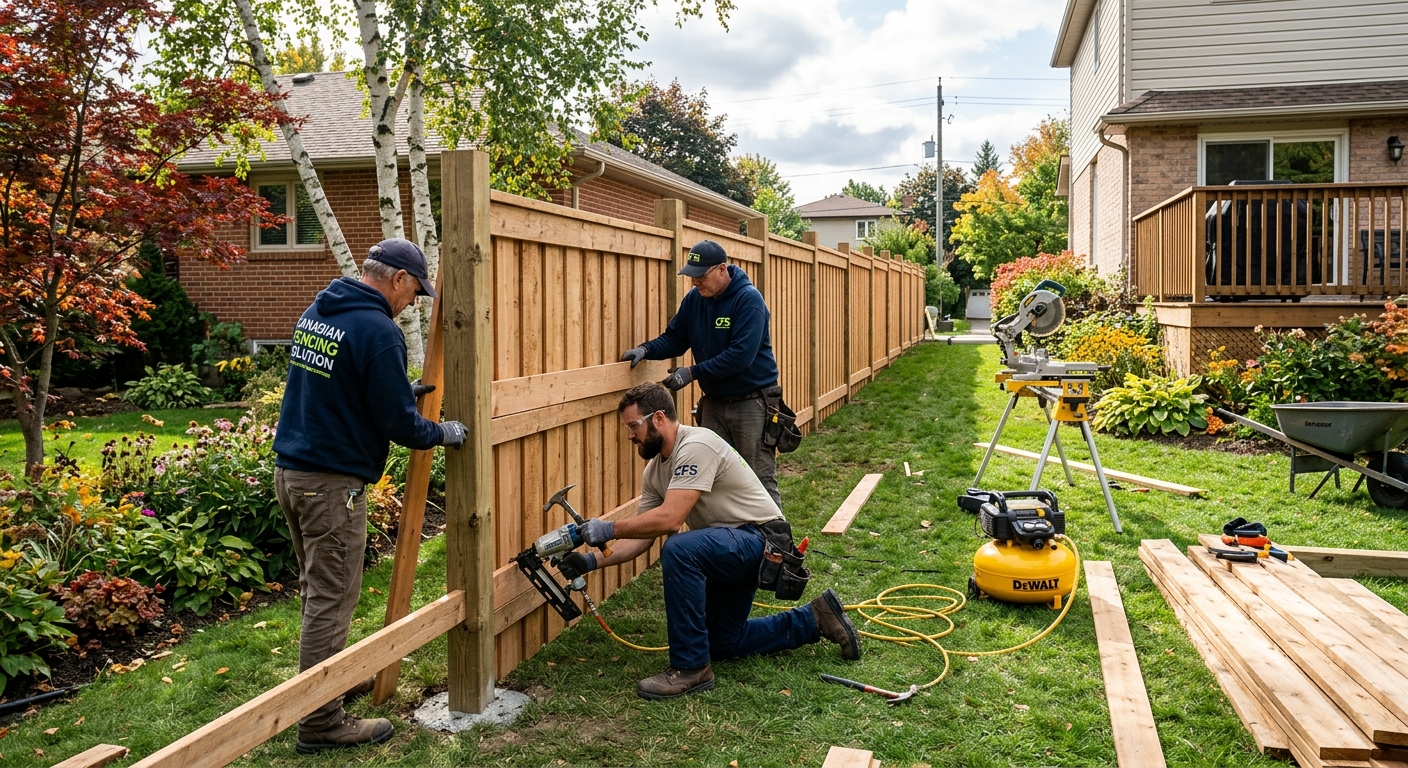
Fencing options and costs in Junction Area
Junction Area, Ontario homeowners typically shop for fencing with two things in mind: privacy and long-term durability through freeze–thaw cycles. With a population of 14,366 (Statistics Canada, 2021 Census), the area supports steady demand for contractor crews, especially around family-oriented residential pockets and near the Junction transit corridor where properties often back onto busy lanes. In practice, detached and semi-detached homes create the most fencing projects because owners are more likely to invest in backyard boundaries, gates, and privacy upgrades rather than relying on shared frontage fencing.
In Toronto’s market, pricing is shaped by frost depth and how fences are built to resist racking and uplift. Southern Ontario is commonly planned around a frost line of about 42"–48", so most projects require post holes set roughly 3.5–4 feet down for 6–8 ft privacy fences—often with concrete-set posts in clay and mixed soils. That means higher labour time and ready-mix costs compared with simple driven-post builds. Material availability also matters: cedar and composite are often priced higher during peak seasons, while chain-link remains the fastest-to-source option.
If you’re in a higher-demand zone such as the Junction Triangle–adjacent blocks, you’ll usually find more scheduling flexibility for common materials like wood and vinyl. For a clearer comparison across options, use the table below for typical installed ranges in Junction Area.
| Material |
Lifespan |
Maintenance |
Privacy Rating |
Price per Linear Foot |
| Pressure-treated pine (standard wood) |
10–15 years |
Stain/seal every 2–3 years; inspect posts yearly |
High (solid boards) |
$65 – $120 |
| Cedar (natural rot resistance) |
15–20 years |
Optional staining; wash and re-seal as needed |
High (solid boards) |
$80 – $135 |
| Vinyl / PVC (no-maintenance) |
20–30 years |
Rinse as needed; check fittings after winter |
High (solid privacy styles) |
$75 – $130 |
| Chain-link (galvanized steel) |
25–35 years |
Occasional tightening and repaint if needed |
Low–medium (privacy add-ons available) |
$45 – $85 |
| Aluminum ornamental |
25–40 years |
Low; rinse and spot-check anchors |
Low (open pickets) |
$90 – $160 |
| Composite / recycled material |
20–30 years |
Low; periodic cleaning, no staining |
High (solid privacy boards) |
$95 – $170 |
Prices are estimates only and vary by project scope, site access and material selection.
What affects the price of fencing in Junction Area
Even when you request “the same” fence, Junction Area quotes can swing by 30–50% across Toronto and the wider Ontario market. The reason isn’t only the material—it’s how the job is built for local conditions and how crews price labour, equipment time, and risk. Posts, excavation, concrete (or not), gate hardware, and disposal can change your total quickly, and contractor availability can tighten during spring and early summer installation windows.
Start with frost depth: Southern Ontario is often planned with a design frost line around 42"–48", and best practice is to set posts roughly 4–6 inches below that design depth. Practically, that often means 1.5–2.0 m into the ground and concrete-set posts for 6–8 ft privacy fences. Longer posts increase material cost and add excavation and concrete volume—especially in clay and mixed soils common around Toronto.
Wind and panel stiffness also matter. While the GTA isn’t as open-field windy as the Prairies, solid privacy fences still rack under gusts, so stronger posts and closer post spacing (often 6–8 ft centres) can raise costs. By contrast, chain-link can remain a lower-cost option with lighter installation complexity.
Concrete examples: (1) If your yard needs 3.5–4 ft concrete-set post depth, a wood privacy job that might land near the $65 – $120 band can climb toward the higher end due to extra concrete and longer posts. (2) A sloped lot that needs stepped panels may add labour for racking adjustments and stronger rails, pushing higher-end builds toward $75 – $130 for vinyl/PVC. (3) Replacing a fence with concrete footings or removing old embedded posts can add disposal and demolition time, which frequently offsets any “savings” from choosing a cheaper finish.
| Price Factor |
Why It Matters |
Cost Impact |
| Fence length in linear feet |
Main material and labour driver (posts, rails, panels) |
Largest swing; increases cost proportionally |
| Post depth required |
Frozen soil requires deeper setting to prevent heaving |
Longer excavation + more posts = higher total |
| Post setting method |
Concrete-set posts reduce movement vs gravel-only or driven posts |
Concrete and labour add cost; improves stability |
| Material choice |
Vinyl/cedar have different hardware, expansion behaviour, and lifespan |
Shifts you across wood/vinyl/chain-link/aluminium bands |
| Gate count and type |
Gates require heavier frames, hinges, latches, and alignment |
Each gate can add significant labour and hardware |
| Grade and terrain |
Slopes need stepped/raked sections and extra labour for rails |
More cuts, braces and adjustments; higher price |
| Old fence removal and disposal |
Embedded posts and debris affect demolition time and landfill fees |
Can add hours or a full truckload fee |
| Permit fees and survey / property line locate |
Required documentation affects schedule and compliance |
Small to moderate cost; prevents costly rework |
Permits & regulations in Ontario
In Ontario, fence permit requirements typically depend on height and location. As a homeowner, plan for a building permit if your fence exceeds common thresholds such as about 2.0 m (6.5 ft) at the rear and around 1.0–1.2 m (3–4 ft) at the front or corner. Municipal setback bylaws also apply, meaning the fence must sit on your property and respect local rules for distance from lot lines, streets, or easements. When in doubt, ask your contractor to confirm permit needs for the exact proposed height and placement before excavation starts.
Before any digging, arrange utility locates by calling Ontario One Call (and have contractors reference the locate marks on-site). Then confirm your property line using a survey or by locating your property pins—this helps avoid disputes that are common when older fences drifted over time. Shared boundary and line-fence ownership rules are addressed under provincial line-fences legislation, so it’s smart to coordinate with neighbours when replacing or altering fencing along a shared line.
Licence and coverage checks are part of responsible contracting in Junction Area. You should verify: (1) the contractor’s Ontario licence status via the relevant online registry for their trade/registration, (2) a current certificate of liability insurance showing sufficient coverage for fencing work, and (3) WSIB coverage clearance where applicable. Request the certificates directly, confirm coverage expiry dates, and keep copies for your records. Step-by-step, you can also ask for a signed agreement listing start date, scope, disposal, and warranty terms before any deposit is taken.
Choosing the right fence material for Junction Area
Choosing the right fence material in Junction Area is mostly matching your priorities—privacy, low maintenance, and lifespan—to Ontario’s freeze–thaw winters and the Toronto market’s building practices. For many homeowners, pressure-treated pine is the budget starting point, but it needs staining or sealing every 2–3 years to slow greying and surface wear. Cedar is naturally more rot-resistant and looks better longer, yet it still benefits from periodic maintenance to keep the finish and reduce moisture damage around post tops and fasteners.
Vinyl/PVC is a strong “set it and forget it” option: it’s typically no-maintenance beyond rinsing, and it won’t rot like wood. However, extreme cold snaps can cause brittleness in cheaper lines, so it’s important to choose quality product and correct installation—especially around gate areas and fence top caps. Chain-link is the lowest initial cost and lasts a long time, but it offers minimal privacy unless you add privacy slats or an alternative screen. Aluminum ornamental fences look sharp and resist rust, but they’re usually open-style for appearance rather than full privacy. Composite or recycled boards can provide privacy with low maintenance, though the upfront cost is often higher than treated pine.
For post durability in Toronto, post depth matters. With frost planning around 42"–48", concrete-set posts are commonly recommended for 6–8 ft privacy fences to prevent heaving in clay/mixed soils. Wind and snow load considerations also affect how heavy the posts and rails must be; solid privacy styles need stronger framing and appropriate spacing.
Example: if your privacy goal points you to vinyl in the $75 – $130 band but you compare against pressure-treated pine in the $65 – $120 band, the extra upfront cost can justify itself when you want fewer maintenance weekends and a longer service life through winters in the Junction Area.
| Material |
Cold Tolerance |
Lifespan |
Annual Maintenance |
Best For |
Price Band |
| Pressure-treated pine |
Good with proper staining and sealed tops |
10–15 years |
Light inspection; stain/seal every 2–3 years |
Budget privacy with routine upkeep |
$65 – $120 |
| Cedar |
Good; holds up well to moisture cycles |
15–20 years |
Wash and re-seal as needed; check posts |
Natural look, better rot resistance |
$80 – $135 |
| Vinyl / PVC |
Very good with quality product and correct hardware |
20–30 years |
Minimal; rinse and inspect fittings |
Low maintenance privacy in winter |
$75 – $130 |
| Chain-link |
Excellent; galvanized resists corrosion |
25–35 years |
Occasional tightening; touch-ups if needed |
Security with lowest initial cost |
$45 – $85 |
| Aluminum ornamental |
Excellent; won’t rust like steel |
25–40 years |
Low; rinse and check anchors after freeze-thaw |
Appearance + durability (semi-private) |
$90 – $160 |
| Composite / recycled |
Good; stable boards with proper installation |
20–30 years |
Minimal cleaning; inspect rails and fasteners |
Privacy with low maintenance |
$95 – $170 |
How to choose a fencing contractor in Junction Area
Choosing the right fencing contractor in Junction Area comes down to verification, paperwork, and a clearly itemised scope. In Ontario, the installer should be able to show current proof of liability insurance (certificate of insurance with coverage that fits construction risk). For worker protection, confirm the contractor’s WSIB coverage where applicable—ask for a WSIB clearance letter or current status confirmation. If they can’t provide these documents on request, treat that as a major warning sign. Also verify the contractor’s Ontario registration/licensing relevant to their trade through the appropriate online registry and match the name exactly to the proposal.
Next, request 2–3 itemised written quotes. A strong quote breaks out labour and materials rather than one lump sum, and it should specify post depth, setting method (concrete-set vs alternatives), hardware grade, rail counts, gate framing, and whether old fence removal and disposal are included. Review what’s excluded: for example, tree/root obstructions, utility daylighting costs, or additional survey work if pins can’t be located. If the contractor says “we’ll figure it out later,” you’re likely to pay later.
Warranty matters for workmanship and for the product. Ask for the workmanship warranty length (how long they’ll repair fence installation issues) and the manufacturer warranty details (what’s covered for boards, rails, or components). Confirm if the warranty is transferable if you sell your home.
On payment schedule, never pay more than 10–15% upfront. Use milestone payments tied to concrete work, rail installation, then completion. Hold back the final balance until the fence is fully complete, gates align properly, and cleanup is done. Get a written start date and completion estimate so you can plan around Ontario winter transitions and spring turnaround.
- Provide a written quote with linear feet measured and a clear fence layout reference.
- Specify post depth and whether posts are concrete-set (common in Toronto due to frost heave risk).
- List the exact material grade/brand (cedar quality, vinyl thickness, aluminum finish, chain-link gauge).
- Confirm fence height measured from finished grade, including how slopes will be stepped or raked.
- Include gate count and type (walk-through vs double drive gate) and the hardware brand/model.
- State whether demolition of the old fence is included, including embedded-post removal.
- Confirm disposal/landfill fees are included (or show a line item).
- Require utility locate responsibility: who calls Ontario One Call and who marks the line on-site.
- Ask for warranty terms for labour workmanship and manufacturer coverage separately.
- Verify liability insurance and WSIB/WCB clearance status before signing.
- Get start date, completion estimate, and weather-delay policy in writing.
- Use a payment schedule with only small upfront deposits and a final holdback until completion.
Red flags in Junction Area include contractors who: (1) will not provide insurance/WSIB clearance on request, (2) quote “driven posts” without discussing frost-depth stability for a 6–8 ft privacy fence, (3) provide a non-itemised lump-sum with unclear exclusions like disposal or permits, (4) ask for large deposits upfront (more than ~15%), and (5) skip a site walk to mark property lines and grade transitions.
Frequently asked questions — fencing in Junction Area
How long does fence installation take in Junction Area?
In Junction Area, typical fence installs take 1–3 days for smaller runs (around 20–60 linear feet), and 3–7 days for longer privacy fences with multiple gates or sloped yards. The schedule depends heavily on excavation and curing time for concrete-set posts. In Southern Ontario, teams also plan around spring weather—rain can slow trenching and concrete placement, while heat waves can affect curing speed. If you’re replacing an old fence with embedded posts, demolition and disposal can add a day or more. Most contractors can confirm a date after a site measure, because they’ll verify post depth needs for frost considerations and note any access constraints near laneways.
Can I install a fence on a slope in Junction Area?
Yes, you can install a fence on a slope in Junction Area, but the method matters for both appearance and stability. Most crews will use stepped panels or raked sections so the fence top remains level (or follows the slope consistently, depending on the design). On privacy fences, racking stress increases if the rails aren’t properly braced, so expect the contractor to adjust post spacing and rail heights. For concrete-set posts, deeper holes may still be required where ground drops, which can slightly increase excavation time and cost. If your quotes differ, ask whether the contractor is stepping panels (cleaner finish) or forcing an uneven top line (often leads to callbacks). A clear slope plan in the written scope prevents surprises.
What is the most weather-resistant fence for Junction Area's climate?
For Junction Area’s freeze–thaw winters, the most weather-resistant choices are typically vinyl/PVC (quality lines) and cedar, when paired with correct post depth and hardware installation. Vinyl doesn’t rot and handles moisture cycles well; cedar resists rot naturally, though it still benefits from maintenance to keep fasteners and end-grain protected. For maximum structural stability, concrete-set posts are commonly recommended for tall privacy fences because frost heave can shift posts if they’re too shallow. Chain-link is also very durable in Ontario winters, but it won’t provide privacy unless you add slats or screening. In many Toronto-area bids, vinyl/PVC commonly lands around the $75 – $130 per linear foot band depending on height and gate count.
How do I prevent wood fence rot in Junction Area?
To prevent rot in Ontario, focus on three weak points: post bottoms, trapped moisture at the tops, and fastener issues. Make sure the fence uses correct post depth and is properly concrete-set where required for frost stability—movement cracks the seal around posts and accelerates rot. For pressure-treated pine, stain/seal on a schedule (often every 2–3 years) to reduce grey weathering and water intrusion, and re-check after heavy winters. Use compatible fasteners and don’t mix incompatible metal types that can cause corrosion at joints. Keep ground contact minimal by using proper detailing around post bases and rail bottoms. If you notice soft boards near the bottom rails or a post that wiggles, address it early—small repairs are usually cheaper than section replacement.
What is the cost per linear foot for fencing in Junction Area?
Installed fencing costs in Junction Area usually align with the local Toronto economic region price bands. Common ranges you’ll see: chain-link around $45 – $85 per linear foot, pressure-treated wood around $65 – $120, vinyl/PVC around $75 – $130, and aluminum ornamental around $90 – $160. Your specific quote will depend on fence height, privacy style, gate count, post depth (often set deeply with concrete for tall privacy fences), and whether old fencing removal and disposal are included. If you’re comparing two quotes that both “sound right,” ask for the itemised breakdown so you can compare concrete, hardware, and labour—not just the materials.
Should I repair or replace my old fence in Junction Area?
Repair is usually worth it when the posts are solid (no wobble), the rails are mostly straight, and damage is limited to a few boards or localized sections. Replace is often smarter when you see widespread post rot at the base, multiple leaning sections, missing footings, or panels that have sagged due to frost-related movement. In Junction Area, many older fences were installed closer to grade or with less rigid post-setting, so rot and shifting are common after repeated winters. A contractor should assess post stability first; if posts are compromised, replacing sections may not hold. When the price difference is close, replacement can be a better value—especially if you can upgrade to concrete-set posts and stronger framing. Always get a written recommendation with before/after measurements.