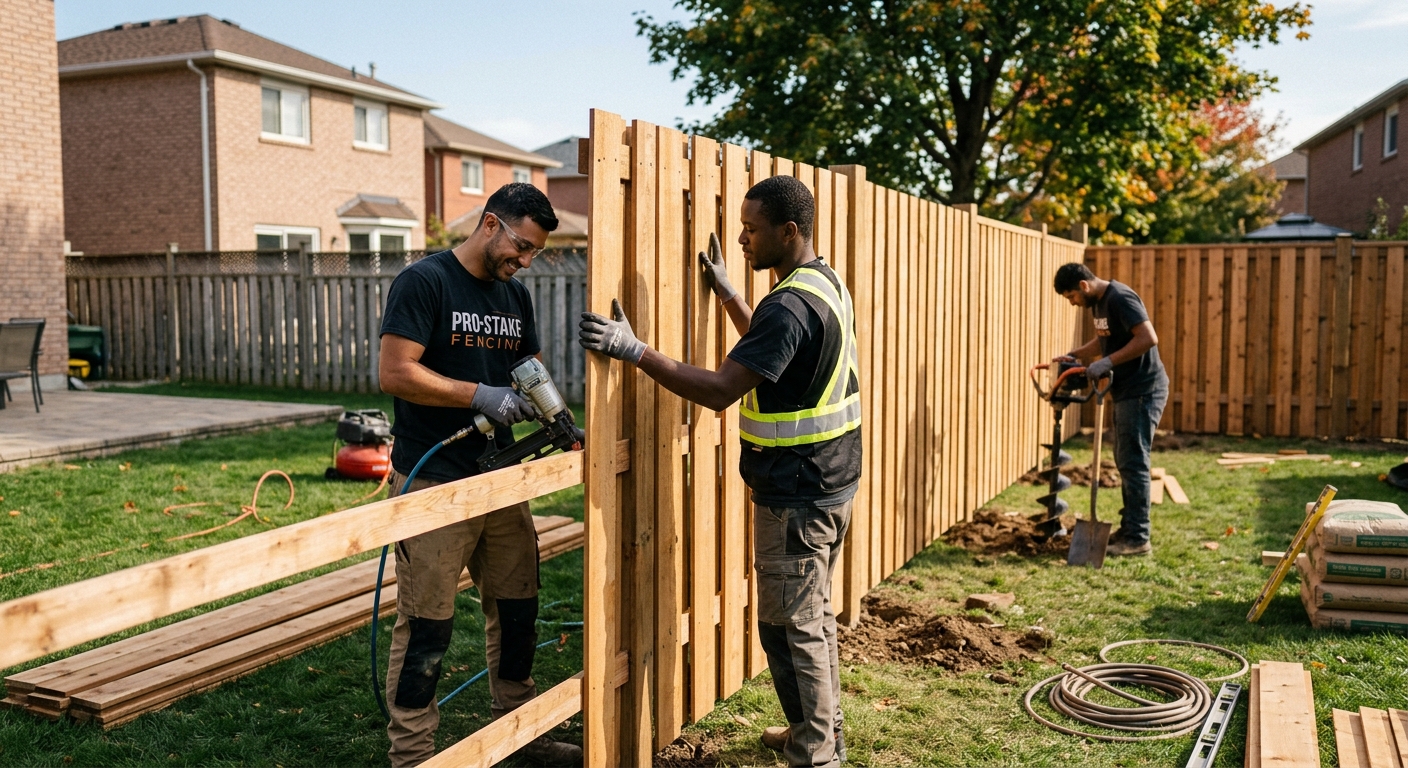
Fencing options and costs in Mississauga Beach
Mississauga Beach is a small community with a big mix of property styles—though its total population is 4,662 (Statistics Canada, 2021 Census), the housing pattern means fencing demand is driven by how many private lots need boundary definition, privacy, and safe yards. In practical terms, each older housing block and each detached property becomes a potential fencing customer, especially where front-year maintenance and back-yard privacy matter for day-to-day living. Contractors also stay busy because the Toronto economic region dictates standard build methods: post depth, panel rigidity, and winter-proof installation details are expected—so quotes tend to be consistent once site access and fence length are confirmed.
In Southern Ontario, pricing is shaped heavily by freeze behaviour. The commonly used frost-line rule of thumb for this part of Ontario is about 42"–48", which translates into setting posts roughly 3.5–4 feet deep for typical 6–8 ft privacy fences. That depth, plus clay and mixed soils common around the GTA, pushes most builders toward concrete-set posts rather than simple driven posts, increasing labour and ready-mix costs but improving long-term stability. Wind still matters, too: while the GTA isn’t prairie-exposed, taller solid panels need tighter spacing and heavier hardware to reduce racking and uplift.
In Mississauga Beach, demand is especially strong around established residential strips where yards back onto open space and where homeowners want reliable privacy screening through winter storms. Next, here’s a clear comparison of common materials and what they typically cost per linear foot.
| Material |
Lifespan |
Maintenance |
Privacy Rating |
Price per Linear Foot |
| Pressure-treated pine (standard wood) |
10–15 years |
Stain/seal every 2–3 years |
High (solid boards) |
$16 – $25 |
| Cedar (natural rot resistance) |
15–20 years |
Light staining every 2–4 years |
High (solid boards) |
$19 – $32 |
| Vinyl / PVC (no-maintenance) |
20–30 years |
Rinse as needed (no painting) |
Medium-High (solid styles) |
$20 – $35 |
| Chain-link (galvanized steel) |
20–35 years |
Occasional tension check |
Low (see-through) |
$11 – $18 |
| Aluminum ornamental |
30+ years |
Occasional cleaning |
Low-Medium (open pickets) |
$18 – $38 |
| Composite / recycled material |
20–30 years |
Minimal cleaning; no staining |
High (solid privacy boards) |
$22 – $40 |
Prices are estimates only and vary by project scope, site access and material selection.
What affects the price of fencing in Mississauga Beach
In the Toronto economic region, it’s common to see two quotes for the same “6 ft privacy fence” swing by 30–50%. The biggest driver is that fencing isn’t just material pricing—it’s frost-safe installation details, soil conditions, and how much labour it takes to build straight, plumb panels with correct post depth. When contractors assume different site realities (tight gate access, rocky clay, long transport distances, or whether they’re allowed to reuse sections), costs change quickly.
Local cold is a major reason. The frost line in Southern Ontario is commonly taken at about 42"–48", and best practice is to set posts about 4–6 inches below the design frost depth to prevent heaving. In practical terms, that often means posts need to be set roughly 1.5–2.0 m into the ground in colder Ontario conditions. Concrete-set posts are usually recommended, which increases labour time and ready-mix costs, and it also means longer posts and more digging. If your site requires deeper holes than a “standard” assumption, that can push your project toward the higher end of wood fencing bands such as $65 – $120 per segment equivalent, or vinyl/ PVC bands like $75 – $130 when the crew is doing heavier-duty privacy panels with closer spacing.
Two concrete examples from Mississauga Beach and nearby GTA builds: (1) clay-heavy ground often needs bigger, properly spaced footings and careful backfill compaction—faster driven-post work usually won’t last; (2) if your fence line passes through frost-susceptible low spots, you’ll get extra dig time and rework to keep the rails level. Chain-link may look cheaper on paper, but if you still need concrete-set corner posts and top rails for stability, the cost advantage narrows.
| Price Factor |
Why It Matters |
Cost Impact |
| Fence length in linear feet |
The total number of posts, rails, and panels scales directly with length |
Highest impact (primary driver) |
| Post depth required |
Frost line determines hole depth and the length of materials |
Moderate-High impact in cold winters |
| Post setting method |
Concrete vs. gravel pack vs. driven posts changes labour, excavation, and stability |
High impact (often the difference between low and high quotes) |
| Material choice |
Vinyl/PVC, cedar, and chain-link differ in installation hardware and handling |
Moderate impact (can shift by product tier) |
| Gate count and type |
Hinged gates need stronger framing, hardware, and often diagonal bracing |
Moderate-High impact |
| Grade and terrain |
Slopes require stepped panels, raked sections, or added labour to keep tops consistent |
Moderate impact |
| Old fence removal and disposal |
Demolition time, hauling fees, and extra dump charges can be significant |
Moderate impact (high on cluttered or long lines) |
| Permit fees and survey / property line locate |
Accuracy and compliance depend on proper locate work and any applicable permits |
Low-Moderate impact, but can be critical |
Permits & regulations in Ontario
In Ontario, fences can fall under permit requirements when they exceed certain height thresholds. A common guideline is that fences taller than about 2.0 m (6.5 ft) in the rear and around 1.0–1.2 m (3–4 ft) in the front or corner areas may require a building permit, depending on the municipality’s bylaw and location on the lot. Regardless of permit needs, every fence must respect property lines and municipal setback rules. Also remember: shared fence ownership and responsibilities are handled under Ontario line-fence principles, so it’s smart to confirm where your boundary sits before you order materials.
Before any digging, call for utility locates through Ontario One Call to mark buried services. A survey or property-pin locate is strongly recommended if you don’t already know your exact boundary line—fences placed even a small distance over can trigger costly disputes.
What typically requires a permit: new fence builds above those common height thresholds, and any changes that increase height in regulated front/corner zones. What typically does not: like-for-like replacements of the same height and position where no variance is involved, and small accessory railings that don’t reach regulated height limits.
Step-by-step verification for homeowners in Mississauga Beach: (1) ask for the contractor’s Ontario licence/registration details (where applicable) and business number; (2) request a current certificate of insurance for liability; (3) confirm WSIB coverage (or valid clearance) for workers on site—do not accept “we’re good” answers; (4) keep copies of documents for your records and request it before work starts.
Choosing the right fence material for Mississauga Beach
Choosing a fence in Mississauga Beach is mostly about matching material to your priorities—privacy, low maintenance, budget, and how long you want to avoid repairs. The Toronto climate matters: freeze-thaw cycles and wet seasons can be hard on fasteners and exposed wood, and winter wind can stress tall panels. That’s why post-depth installation (often concrete-set) is as important as picket material in this region.
Pressure-treated pine is typically the budget starting point, but it needs staining or sealing every 2–3 years to reduce grey weathering and slow surface checking. Cedar costs more upfront but resists rot naturally and typically looks better longer; it still benefits from periodic maintenance. Vinyl/PVC is attractive if you want no painting and easy cleaning, but very cold snaps can make installers choose the right system and leave appropriate expansion gaps—otherwise you can see cracking at stress points. Chain-link is the lowest-cost, long-life option, but it won’t give privacy unless you add slats or plantings. Aluminum ornamental is a good “no-rust” look with mid-range cost, but it won’t provide solid privacy.
For tall privacy fences, Toronto’s frost-line guidance (about 42"–48") usually means posts should be set around 3.5–4 feet deep, and many contractors recommend concrete-set posts for stability in clay/mixed soils. When wind and snow load strain panels, heavier posts and closer spacing reduce racking.
Example: if you’re comparing a wood privacy fence priced near $65 – $120 versus vinyl privacy closer to $75 – $130 in this region, the extra cost can be justified when you want to skip staining for years and keep appearance consistent through wet springs. If you’re handy with seasonal upkeep, pressure-treated pine can make sense—just budget time for maintenance.
| Material |
Cold Tolerance |
Lifespan |
Annual Maintenance |
Best For |
Price Band |
| Pressure-treated pine |
Good with proper installation and sealing |
10–15 years |
Low spring check + stain every 2–3 years |
Budget privacy with willingness to maintain |
$65 – $120 |
| Cedar |
Very good; naturally resists rot |
15–20 years |
Light staining every 2–4 years |
Premium look with moderate maintenance |
$75 – $130 |
| Vinyl / PVC |
Good; system must handle expansion in cold |
20–30 years |
Rinse/inspect; no painting |
Low-maintenance privacy |
$75 – $130 |
| Chain-link |
Excellent (galvanized steel) |
20–35 years |
Occasional tension/hardware check |
Security on a budget |
$45 – $85 |
| Aluminum ornamental |
Excellent; no rust in freeze-thaw cycles |
30+ years |
Minimal cleaning |
Attractive perimeter without solid privacy |
$90 – $160 |
| Composite / recycled |
Good; handles Ontario wet-cold cycles |
20–30 years |
Minimal cleaning; inspect for hardware |
Solid privacy with low maintenance |
$90 – $160 |
How to choose a fencing contractor in Mississauga Beach
When you choose a fencing contractor in Mississauga Beach, focus on proof—not promises. First, verify Ontario compliance: ask for their liability insurance certificate (confirm it covers fencing work and includes the correct named insured), then confirm WSIB coverage or obtain a clearance letter if they’re self-covered or exempt. You should also check for the contractor’s business identity and any trade registrations where applicable, and ensure their work crew is covered before they start digging.
Next, get 2–3 itemised written quotes. Not a lump sum—ask for a breakdown showing labour, posts/rails, panels or mesh, gate frames and hardware, concrete and excavation, and whether disposal is included. Scope clarity prevents the common “quote creep” that adds 10–20% mid-job due to assumptions about access, soil conditions, or how much of the old fence is removed. Make sure the quote states whether permits are included (if required), whether property line locating/survey costs are included, and what happens if utilities are encountered or if the site isn’t accessible as expected.
Warranty matters: confirm a workmanship warranty length (how long they stand behind installation), and separate product/manufacturer coverage where relevant. Ask if warranties are transferable and what conditions void coverage (for example, improper staining schedules for wood systems). For payment, avoid large upfront deposits—never more than 10–15%—and agree on a holdback until completion and final cleanup. Finally, get a written start date and an estimated completion timeline based on fence length, gate count, and expected access.
- Provide an itemised quote (labour, materials, concrete, posts, rails, gates, hardware).
- Confirm disposal/haul-away is included or clearly excluded.
- State post depth approach for Toronto-area frost protection.
- Include gate hardware specs (hinges, latch type, bracing method).
- Show what’s included for slopes: stepped vs. raked panel method.
- Request utility-locate responsibility (who calls Ontario One Call and when).
- Ask about rail alignment and how they keep fences level after frost cycles.
- Verify liability insurance certificate current and in the correct amounts.
- Confirm WSIB clearance/coverage before any work begins.
- Ask for warranty terms: workmanship vs. manufacturer, plus transferability.
- Agree on payment schedule with a holdback until final walkthrough.
- Confirm timeline in writing, including cure time for concrete-set posts.
Red flags I see in Mississauga Beach: (1) “We’ll just drive posts in” for a privacy fence without discussing frost depth and concrete-set stability; (2) quotes that aren’t itemised and won’t explain labour vs materials; (3) no proof of insurance/WSIB clearance when asked; (4) vague timelines (“a few days”) without access and post cure considerations; and (5) refusal to put warranty terms and exclusions in writing.
Frequently asked questions — fencing in Mississauga Beach
How long does fence installation take in Mississauga Beach?
Most fencing installs around Mississauga Beach can be finished in a single workweek, but it depends on length, gate count, and especially post setting. For privacy fences with concrete-set posts (recommended in Southern Ontario where frost depth is commonly around 42"–48"), crews often need extra time for excavation, setting, and concrete curing before panels and gates are aligned. If you’re removing an old fence, add time for demolition and disposal. A smaller chain-link run can go faster, while tall solid fences with multiple gates typically take longer because hardware and bracing need careful setup. Your best estimate comes from your contractor’s itemised quote and a site walkthrough that confirms access and soil conditions. (Statistics Canada, 2021 Census)
Can I install a fence on a slope in Mississauga Beach?
Yes—slope is common around the GTA, and fencing can be built to follow grade. The key is how the contractor handles the transition: stepped panels (each section changes height) or raked panels (following the slope continuously). Stepped fencing is often simpler to install cleanly and can help reduce stress on rails; raked sections can look seamless but require careful layout so tops stay consistent and posts remain properly seated at correct frost depth. In Mississauga Beach, clay and freeze-thaw can amplify movement if post holes aren’t excavated properly and backfilled correctly. When slopes are moderate, costs usually land within typical bands such as $65 – $120 for wood depending on height and access; steeper yards can push labour up because layout time increases.
What is the most weather-resistant fence for Mississauga Beach's climate?
For long-term weather resistance in Ontario, metal-based systems often perform very well: chain-link with galvanized steel can last 20–35 years, and aluminum ornamental is also built to resist rust and freeze-thaw cycles. If you want solid privacy with strong cold performance, vinyl/PVC or quality composite privacy boards can hold up well because they don’t rot or require painting. That said, the “most weather-resistant” outcome still depends on installation: posts set at the right depth for frost protection (often around 3.5–4 feet) and correct hardware spacing for wind stability. In practice, many homeowners choose vinyl/PVC privacy for low maintenance rather than re-staining wood every few years. Pricing typically sits in the Toronto region around $75 – $130 for vinyl/PVC, depending on height, style, and gate count.
How do I prevent wood fence rot in Mississauga Beach?
Preventing rot comes down to keeping water away from the wood and protecting the post base. First, insist on correct post depth and concrete-set posts where recommended for frost protection in Southern Ontario—proper installation reduces the movement and moisture cycling that accelerates rot. Second, use quality pressure-treated lumber rated for ground contact, and ensure boards aren’t trapped against soil or standing water. Third, maintain the finish: pressure-treated pine should be stained or sealed every 2–3 years (cedar often 2–4 years) to reduce grey weathering and water penetration. Finally, keep vegetation and sprinklers from wetting the fence face. If you’ve got an existing fence, fix damaged boards early rather than waiting—small failures spread quickly once water gets into the system.
What is the cost per linear foot for fencing in Mississauga Beach?
Pricing in Mississauga Beach generally follows the Toronto region material bands, but the per-foot number depends on privacy height, posts (concrete-set vs driven), and gates. As a practical expectation, wood privacy and similar standard projects often land around $65 – $120 in the regional pricing band (with cedar and premium wood tending higher within that range), while vinyl/PVC privacy typically sits around $75 – $130. Chain-link can be lower, often around $45 – $85, and aluminum ornamental usually runs higher, commonly $90 – $160. For accurate per-linear-foot numbers, request an itemised quote that shows the linear footage used for posts and the panel spacing, not just one overall estimate.
Should I repair or replace my old fence in Mississauga Beach?
Repair makes sense when the posts are solid and well seated, rails aren’t failing, and the fence line is mostly straight. Replacement is usually the better option if you have post rot at ground level, repeated leaning panels, or multiple failing sections—especially if the fence is already uneven due to frost movement and water intrusion. In Mississauga Beach’s winter conditions, once the base is compromised, repairs may only hold for a season or two unless the post setting method is corrected. A simple cost check: if only a few boards or pickets are damaged, repairs can be cheaper, often delaying the larger labour of post work. If several posts need rebuilding or the fence is out of alignment, replacement often becomes the most cost-effective long-term decision—similar projects typically fall within the regional wood and vinyl bands like $65 – $120 for wood or $75 – $130 for vinyl depending on height and gate count.