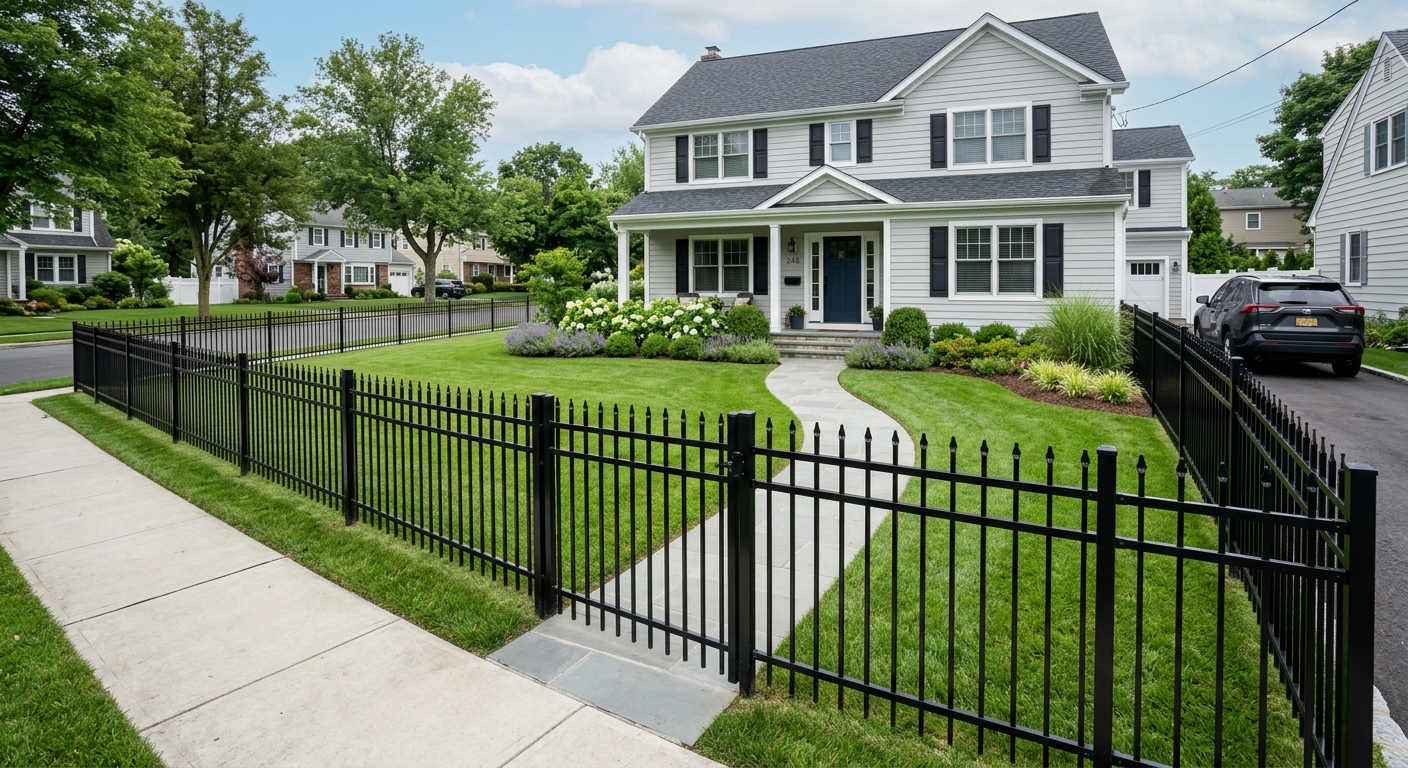
Fencing options and costs in Erin
In Erin, choosing a fence is often about matching your budget to the reality of local weather and the type of homes you’re protecting. With 90.0% of households in the area owning their homes and detached properties making up 91.5% of dwellings (Statistics Canada, 2021 Census), it’s no surprise that demand for backyard privacy and boundary fencing is strong—especially in family neighbourhoods like the Erin Meadows area, where larger lots and mature trees create space for 6 ft privacy installs.
In the Kitchener–Waterloo–Barrie market, pricing is shaped heavily by the freeze–thaw cycle. The design frost line typically means concrete-set posts with deeper holes (often in the 42–48 inch range or deeper depending on exact frost depth at your location) to prevent heaving and early leaning. That deeper post requirement increases both labour time and concrete/materials per post, so “same fence, different site” can land you in a different price band. At the same time, contractors plan for wind and racking resistance—so privacy panels often need tighter post spacing (commonly around 6–8 ft centres for many wood and vinyl privacy styles).
Below is a quick cost-and-performance comparison to help you shortlist materials before you request an itemised quote.
| Material |
Lifespan |
Maintenance |
Privacy Rating |
Price per Linear Foot |
Price Range |
| Pressure-treated pine (standard wood) |
10–15 years |
Stain/seal every 2–3 years |
High (solid/close pickets) |
$45–$70 |
$45 – $70 |
| Cedar (natural rot resistance) |
15–25 years |
Light staining as needed every 2–4 years |
High (solid/close pickets) |
$55–$85 |
$55 – $85 |
| Vinyl / PVC (no-maintenance) |
20–30 years |
Occasional wash; no staining |
High (privacy panels) |
$55–$90 |
$55 – $90 |
| Chain-link (galvanized steel) |
20–30 years |
Minimal (spray/wash as needed) |
Low–Medium (option for slats) |
$35–$60 |
$35 – $60 |
| Aluminum ornamental |
25–40 years |
Occasional rinse; repaint rarely |
Medium (open pickets) |
$60–$110 |
$60 – $110 |
| Composite / recycled material |
25–35 years |
Wash annually; no staining |
High (privacy boards) |
$75–$120 |
$75 – $120 |
Prices are estimates only and vary by project scope, site access and material selection.
What affects the price of fencing in Erin
Fence quotes in the Kitchener–Waterloo–Barrie region can swing by 30–50% for what looks like the “same fence” because the hidden cost is in the ground work: post depth, concrete volume, and how many posts you need for strong privacy panels. Ontario jobs also tend to include traffic and site-access realities—narrow side yards, mature trees, and frequent need for stepped layouts—all of which add labour even when the design looks straightforward. When you compare Erin to other Ontario communities with different soil firmness and frost-depth assumptions, the labour and materials per post are what move the needle; the basic material brand rarely explains the whole difference.
Two conditions in particular drive cost. First is frost-line depth: contractors typically set posts about 4–6 inches below the design frost depth to prevent heaving. In cold Ontario conditions, that often means posts going roughly 1.5–2.0 m into the ground with concrete setting, longer boards, and higher auger time—so deeper holes raise total cost. Second is wind/racking: while Erin isn’t as exposed as Prairie open fields, gusts across farms and new subdivisions still require sturdier rails and tighter spacing (often 6–8 ft centres for many privacy styles). On the other hand, areas with looser soil sometimes reduce auger effort, and good access can reduce time for moving materials.
Concrete examples from typical Erin pricing: replacing a 60 ft run of chain-link may stay closer to the $35–$60 band because post depth is the main cost, while a comparable 60 ft 6 ft privacy wood run frequently lands in the $45–$70 band—and can climb toward cedar or vinyl pricing when longer concrete-set posts and heavier panel hardware are included. If your yard has older fencing to remove, disposal can add another cost block, but it’s often offset by smoother post-hole locations once the line is cleared.
| Price Factor |
Why It Matters |
Cost Impact |
| Fence length in linear feet |
Every additional foot adds posts, rails, and labour time |
High (primary driver) |
| Post depth required |
Frost line determines hole depth and needed post length |
High (concrete + auger time) |
| Post setting method |
Concrete-set versus gravel pack changes materials and installation time |
Medium–High |
| Material choice |
Vinyl and composite cost more up front than chain-link; cedar needs different boards |
Medium–High |
| Gate count and type |
Drive-through (double) gates require stronger frames and hardware |
Medium–High |
| Grade and terrain |
Slopes require stepped/raked sections and extra labour to keep the line level |
Medium |
| Old fence removal and disposal |
Hauling, deconstruction, and debris handling add time and equipment |
Low–Medium |
| Permit fees and survey / property line locate |
Work can require documented property confirmation and admin time |
Low–Medium |
Permits & regulations in Ontario
In Ontario, fences above a height threshold—typically 2.0 m (6.5 ft) at the rear and 1.0–1.2 m (3–4 ft) at the front or corner—often require a building permit. Even when a permit isn’t required, your fence must be built within your property lines and in line with municipal setback rules. Because Erin properties vary widely by lot shape, corner placement, and landscaping, I recommend confirming the fence location and height before anyone digs. Also remember: if your fence line is a shared boundary, shared fence ownership expectations fall under provincial line-fences legislation.
Before post holes: call utility locates (Ontario One Call) so you avoid underground services. Then, get a survey or property line locate showing where your pins are. This is one of the most reliable ways to prevent encroachment disputes—especially where older fences may not be perfectly on the line.
For contractor verification in Erin: check that the company can legally contract in Ontario and carries liability insurance. Ask for a current certificate of insurance and confirm the policy lists your worksite address. Also verify WSIB coverage (or the applicable status if they don’t require WSIB for their situation) and request proof in writing. If the contractor cannot provide clear documentation on insurance and WSIB/WCB coverage, treat it as a red flag.
Typically, a like-for-like fence repair or replacing damaged sections on the same footprint usually doesn’t trigger a new permit—but changing height above thresholds, moving the fence line, or installing a new high fence in regulated areas often does.
Choosing the right fence material for Erin
In Erin, selecting the right material is about balancing privacy, low maintenance, and how well the fence survives deep freeze–thaw cycles. Pressure-treated pine is usually the budget-friendly choice, but it typically needs staining every 2–3 years to limit grey weathering and maintain surface protection. Cedar offers better natural rot resistance and looks great, but it still benefits from periodic finishing—particularly where snow sits against the boards or where airflow is limited. Vinyl/PVC is popular for “set it and forget it” installs; however, extreme cold can make vinyl brittle if you don’t have the right system hardware and proper installation clearances. Chain-link is the lowest upfront option and lasts a long time, but it doesn’t provide privacy unless you add slats or plant screening. Aluminum ornamental is rust-resistant and durable, yet it’s mainly a curbside boundary look rather than full privacy.
For Kitchener–Waterloo–Barrie conditions, concrete-set posts are generally the safer approach for privacy fences, because deeper post holes help prevent heaving. That means planning for frost-depth-driven augering and enough concrete per post, regardless of whether you choose wood, vinyl, or metal. Wind and snow load can also stress rails—so tall privacy fences often need tighter post spacing (commonly 6–8 ft centres) and straight, properly tensioned hardware to reduce racking.
A simple dollar example: if you’re comparing standard wood versus vinyl for a 60 ft run, wood often fits the $45–$70 per linear foot band, while vinyl commonly lands in the $55–$90 band. If you stain wood every 2–3 years and want fewer weekend projects, the extra upfront cost of vinyl can be justified—especially on a fence line that’s hard to access or shaded where moisture lingers.
| Material |
Cold Tolerance |
Lifespan |
Annual Maintenance |
Best For |
Price Band |
| Pressure-treated pine |
Good (with proper concrete-set posts and staining) |
10–15 years |
Low–Moderate (stain/seal every 2–3 years) |
Best budget privacy with routine upkeep |
$45–$70 |
| Cedar |
Good (natural rot resistance) |
15–25 years |
Low–Moderate (finishing as needed every 2–4 years) |
Appearance + rot resistance for privacy |
$55–$85 |
| Vinyl / PVC |
Very good (proper system installation required) |
20–30 years |
Very low (wash/inspect annually) |
Low maintenance privacy in cold climates |
$55–$90 |
| Chain-link |
Excellent (metal performs well in freeze–thaw) |
20–30 years |
Very low |
Security and pet containment |
$35–$60 |
| Aluminum ornamental |
Excellent (no rust) |
25–40 years |
Low (rinse; repaint rarely) |
Curb appeal and durable boundary fencing |
$60–$110 |
| Composite / recycled |
Good (follow system specs for cold movement) |
25–35 years |
Low (wash annually) |
Privacy with reduced maintenance |
$75–$120 |
How to choose a fencing contractor in Erin
When you’re hiring a fencing contractor in Erin, I treat paperwork as part of the job quality. Start by verifying Ontario licensing where applicable for their contracting category, and make sure they carry liability insurance for property damage and injuries. Ask for a current certificate of insurance (with your address listed or clearly applicable to the work) and confirm the policy is active for the project dates. Next, verify WSIB/WCB coverage: request proof directly, don’t rely on verbal assurances. If they have a certificate clearance letter or equivalent proof for the coverage status, ask for it and keep it with your quote package.
Then get 2–3 written, itemised quotes. A good quote breaks out labour and materials separately (posts, rails, panels, gate hardware, concrete, disposal, and any locating/survey costs). Avoid lump-sum-only pricing unless exclusions are crystal clear. Read the scope carefully: confirm whether permits are included, whether utility locate costs are covered, and whether old fence removal and disposal are included (and how they’ll handle nails/salvage).
Warranty matters in fencing because Ontario winters punish weak workmanship. Ask for the workmanship warranty length (for example: post set integrity and panel alignment) and the manufacturer warranty for the product. Confirm whether warranties are transferable to subsequent owners.
For payment schedule: never pay more than 10–15% upfront. Use milestones and hold back a meaningful portion until the fence is complete and cleaned up. Finally, get the start date and an estimated completion window in writing—fencing is seasonal, and reliable contractors plan around weather and cure times for concrete-set posts.
- Confirm proof of liability insurance (active coverage, clear project applicability).
- Verify WSIB/WCB coverage in writing (request certificates/clearance letters).
- Ask if they use concrete-set posts for 6 ft privacy fences in cold Ontario conditions.
- Require an itemised quote: labour, posts, concrete, rails, panels, hardware, gates.
- Clarify whether the quote includes utility locates and any locating/property pins.
- Confirm old fence removal and disposal are included (or list as a separate line item).
- Ask how they handle slopes (stepped vs. raked) and whether panels remain aligned to grade.
- Verify warranty details: workmanship length, product warranty, and transferability.
- Check for start date and completion estimate in writing.
- Use a payment schedule that never exceeds 10–15% upfront.
- Confirm gate installation hardware is included (hinges, latches, posts reinforcement).
- Ask who is responsible for repairs if a fence line needs adjustment after locate.
In my experience around Erin, four or five red flags show up fast: (1) they won’t put insurance and WSIB proof in writing, (2) they price privacy fences without addressing post depth/frost considerations, (3) they give a single lump-sum with unclear exclusions (especially permits/disposal/locates), (4) they ask for large upfront payments beyond 10–15%, and (5) they can’t explain warranty terms in plain language.
Frequently asked questions — fencing in Erin
Can I install a fence on a slope in Erin?
Yes, fencing on slopes is common in Erin, but it changes how the fence is built. Contractors typically use stepped sections (each panel level “steps” up or down) or raked systems that follow the grade. For privacy fences, I generally prefer stepped construction to keep pickets level and reduce strain on rails in freeze–thaw conditions. Before digging, a good installer will confirm your grade, set string lines, and plan the layout so the fence stays consistent with property line locations. If your yard is near a corner where height rules are tighter, slope doesn’t change the permit/height thresholds—so it’s best to confirm the intended height and location during quoting.
What is the most weather-resistant fence for Erin's climate?
For Erin’s cold Ontario winters, concrete-set posts and a corrosion-resistant material system are the main weather-resistance factors—not just the fence “brand.” Among common options, vinyl/PVC privacy and cedar tend to perform very well when installed with proper post depth for frost and good hardware alignment. Aluminum ornamental is also extremely durable because it won’t rust, though it’s typically more about appearance than full privacy. If you’re budget-focused, pressure-treated pine can last well, but it requires staining/sealing every 2–3 years to resist moisture cycling. A chain-link fence is also long-lasting and weather-ready, but it won’t give privacy unless you add slats or screening.
How do I prevent wood fence rot in Erin?
Wood rot prevention starts underground and at the board-to-ground interface. In Erin, rot risk increases when posts sit too shallow or when water collects around fence feet. That’s why concrete-set posts with appropriate post depth for Ontario frost conditions are standard for most privacy installs. Above ground, ensure boards have proper airflow and avoid trapping water against bottom rails; contractors usually keep a consistent gap or use a design that won’t hold standing water. Use the right fasteners rated for exterior exposure and stain/seal on a schedule—often every 2–3 years for pressure-treated pine—rather than waiting until the wood looks grey and rough. If you’re comparing costs, spending in the $45–$70 band on pressure-treated pine can still be a smart value if you maintain it.
What is the cost per linear foot for fencing in Erin?
Typical installed pricing in Erin generally falls within the regional Ontario bands. Wood privacy fencing commonly lands in the $45–$70 per linear foot range, while vinyl/PVC is often $55–$90 per linear foot depending on height, panel type, and gate complexity. Chain-link is usually the most economical at $35–$60 per linear foot, and aluminum ornamental commonly comes in around $60–$110 per linear foot. Final cost varies most with linear footage, post depth requirements for freeze–thaw, gate count, and whether old fence removal/disposal is included. If you want a tight budget, ask for an itemised quote that shows concrete, post quantity, and hardware lines—those details are where surprises usually hide.
Should I repair or replace my old fence in Erin?
Repairing can make sense if the fence posts are sound, rails are straight, and damage is limited to a small number of panels. In Erin, however, many older fences are affected by years of moisture cycling and frost movement, which can loosen posts and cause leaning. If you notice multiple wobbly posts, widespread rot at the board bottoms, or repeated gate sagging, replacement is usually the better long-term value. A practical approach is to ask a contractor to assess and quote both options: targeted repairs and full replacement, with itemised post/hardware recommendations. The decision also depends on maintenance appetite—pressure-treated pine replacement may fit the $45–$70 band, while a lower-maintenance vinyl route can be higher upfront.
How do I handle a fence dispute with neighbour in Ontario?
Start with communication and documentation. In Ontario, shared boundary expectations are guided by provincial line-fences legislation, so don’t assume “first installer owns the problem.” Gather your contract, photos, and any property line locate/survey info you have, then compare it to where the fence is actually built. If the dispute involves height or setbacks, confirm the fence dimensions against the applicable thresholds and municipal rules before spending on major changes. A good next step is to request a professional site assessment for whether posts are on the line and properly set (post depth and heaving can shift alignment over time). If you can’t resolve it directly, consider mediation or legal advice—especially when encroachment is involved.