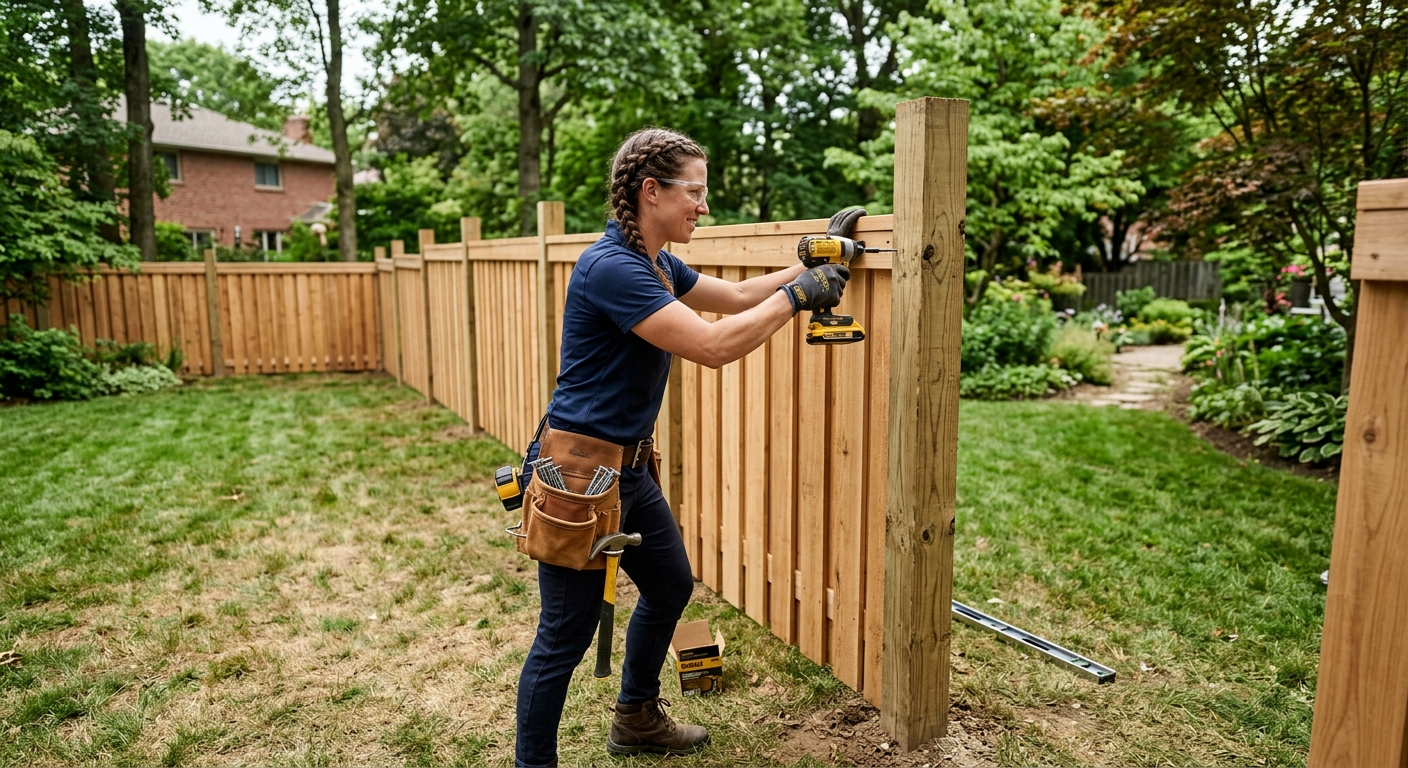
Fencing options and costs in Greater Napanee
Fencing options in Greater Napanee range from budget-friendly chain-link to long-life metal and low-maintenance vinyl, and pricing typically tracks both material choice and ground conditions. With 73.7% of local dwellings being single-detached homes, each detached property is a common target for boundary upgrades—especially in older neighbourhoods where homeowners refresh aging yards. The demand is also supported by homeowner households representing 72.0% of households in the area (Statistics Canada, 2021 Census), so there’s steady work for contractors who can install, replace, and remove existing fencing.
In the Kingston–Pembroke economic region, frost line depth is a real cost driver. Contractors usually set posts below the design frost depth—often by digging holes about 36–48 inches deep—then concrete-set structural posts and gates to reduce heaving. Clay and silty soils near the St. Lawrence and Bay of Quinte can hold moisture and amplify freeze–thaw movement, so labour and concrete usage are commonly higher than in drier soils. Wind exposure also matters near Lake Ontario and Bay of Quinte gusts; privacy fences may need tighter post spacing or sturdier frames, which can lift the project total.
Trade activity is especially noticeable around Napanee’s more established residential pockets such as the south end near the downtown core and along older subdivision streets, where many homes were built before 1981 (64.2% of dwellings, Statistics Canada, 2021 Census). Those older lots often have settled, leaning, or rot-damaged fence lines that need removal and structural re-builds.
Below is a practical comparison of common fencing materials and typical installed price bands per linear foot for Greater Napanee projects.
| Material |
Lifespan |
Maintenance |
Privacy Rating |
Price per Linear Foot |
| Pressure-treated pine (standard wood) |
10–15 years |
Stain/seal every 2–3 years |
Medium–High (solid boards) |
$55–$95 |
| Cedar (natural rot resistance) |
15–25 years |
Stain or preserve every 2–4 years |
High (solid boards) |
$70–$115 |
| Vinyl / PVC (no-maintenance) |
20–30 years |
Rinse annually; no staining |
Medium–High (panel dependent) |
$75–$140 |
| Chain-link (galvanized steel) |
20–40 years |
Occasional rinse; tighten hardware |
Low (see-through) |
$40–$80 |
| Aluminum ornamental |
25–40 years |
Wash occasionally |
Low–Medium (decorative spacing) |
$80–$160 |
| Composite / recycled material |
20–30 years |
Rinse annually; check fasteners |
High (board style) |
$95–$150 |
Prices are estimates only and vary by project scope, site access and material selection.
What affects the price of fencing in Greater Napanee
In Greater Napanee and the wider Kingston–Pembroke region, two quotes for what looks like the “same fence” can differ by 30–50% once you price in frost-depth post installation, soil moisture behaviour, gate complexity, and whether removal and disposal are included. That range is common across Ontario because labour availability, material sourcing, and site conditions vary from lot to lot—even when the fence length is similar. For example, a straight run in easy topsoil is one job; the same length with rocky ground, tight access, or a multi-gate driveway opening is another.
Frost line depth sets how deep posts must be set. In southern/eastern Ontario, a common planning assumption is about 1.2 m (4 ft) to reduce heaving, so contractors typically set posts roughly 4–6 inches below that design depth. In practice, that often means posts in the 1.0–1.5 m range depending on surface grade, requiring longer posts and more concrete for structural runs. Those requirements push labour and material costs upward, particularly for privacy fences that need more robust bracing.
Two local condition examples in and around Napanee that move costs: (1) clay/silty pockets near drainage lines can require deeper augering plus extra concrete to keep posts stable through freeze–thaw cycles; (2) yards with a slope may need stepped or raked panels, increasing labour time and sometimes additional framing. Meanwhile, simpler sites with good truck access and consistent footing can keep projects closer to base bands such as $55–$95 for wood or $75–$140 for vinyl/PVC.
| Price Factor |
Why It Matters |
Cost Impact |
| Fence length in linear feet |
Every additional foot adds materials, posts, rails, and labour time. |
Primary driver; can swing total by hundreds to thousands. |
| Post depth required |
Frost behaviour dictates hole depth and post length to reduce heaving. |
Often adds concrete, augering time, and longer lumber/metal. |
| Post setting method |
Concrete-set posts vs gravel pack vs driven posts changes stability and longevity. |
Concrete setting typically increases per-foot cost. |
| Material choice |
Vinyl resins, cedar boards, and metal frames have very different unit costs. |
Shifts projects between common bands like wood vs vinyl/PVC. |
| Gate count and type |
Gates require heavier hardware and usually stronger posts. |
More gates often means higher labour and structural materials. |
| Grade and terrain |
Slopes require stepped/raked installation and extra framing time. |
Can add labour and additional rails/posts. |
| Old fence removal and disposal |
Hauling and disposal costs plus demo labour are often overlooked. |
Can add significant cost if there’s rot, multiple layers, or tight access. |
| Permit fees and survey / property line locate |
Some high fences or corner/rear conditions may trigger paperwork and locate work. |
Variable add-ons; increases total especially on boundary disputes. |
Permits & regulations in Ontario
In Ontario, fence permit requirements are usually triggered by height. A common threshold homeowners run into is fences above roughly 2.0 m (6.5 ft) at the rear and around 1.0–1.2 m (3–4 ft) at the front or corner—though the exact application can depend on local bylaw rules. Regardless of whether you need a permit for your Greater Napanee project, fences must be built within the property line and comply with municipal setback requirements.
Before you dig, call for utility locates using Ontario One Call. Even if it’s “just a post hole,” you can damage buried services and create delays. Next, verify your property line before installing: many homeowners choose a survey or at least a locate of pins so the new fence doesn’t end up over a line, which is one of the most common sources of neighbour disputes. Shared fence ownership is also a real consideration; line-fences concepts generally involve shared responsibility for maintenance depending on how the fence is established.
Licence checks matter too. When hiring in Ontario, verify the contractor’s business details and insurance before work starts. For fencing, you should confirm liability insurance and that the contractor has proper coverage for their workers (WSIB/WCB coverage). Ask for a Certificate of Insurance (COI) made out to you and check that coverage is active on the job date. A reputable contractor can also provide their clearance letter where applicable and will answer questions about coverage without hesitation.
Choosing the right fence material for Greater Napanee
Choosing a fence material in Greater Napanee should start with your priorities: privacy, low maintenance, lifespan, and your budget for structural durability in freeze–thaw conditions. Pressure-treated pine is the budget-friendly starting point, but it typically needs staining or sealing every 2–3 years to reduce grey weathering and keep boards looking sharp. Cedar offers a more attractive look and better natural rot resistance, and it often lasts longer—though it still benefits from periodic staining/preserving. Vinyl/PVC is popular for “wash-and-forget” ownership; it won’t rot, and annual rinsing is usually enough, but extreme cold can make it slightly more brittle if quality and installation details aren’t right. Chain-link is usually the lowest upfront cost and can last decades, but it provides low privacy unless you add privacy slats or a secondary screen. Aluminum ornamental fences don’t rust and handle Ontario winters well, but they’re more about appearance than privacy.
Because Kingston–Pembroke sites often experience frost movement, the post-depth plan matters as much as the material. If you’re building privacy fencing, many contractors concrete-set posts (especially at gates and structural sections) and use deeper holes around the 36–48 inch range to help prevent heaving. In damp clay areas, that concrete setting is frequently what keeps panels plumb through seasonal cycling.
Wind and snow loads are secondary but still relevant near Lake Ontario and Bay of Quinte gusty areas: heavier boards and tighter post spacing can reduce racking on tall runs. A concrete example: for a typical homeowner run where wood might land closer to $55–$95 per linear foot, moving to vinyl at $75–$140 per linear foot can be justified if you want to eliminate annual staining and you’re staying in the property long-term—especially on fences that are difficult to access.
| Material |
Cold Tolerance |
Lifespan |
Annual Maintenance |
Best For |
Price Band |
| Pressure-treated pine |
Good with proper post depth and concrete-set structural sections |
10–15 years |
Stain/seal every 2–3 years (not really “annual”) |
Budget privacy with achievable upgrades |
$55–$95 |
| Cedar |
Good; resists rot during freeze–thaw when installed correctly |
15–25 years |
Stain/preserve every 2–4 years |
Longer-lasting natural look |
$70–$115 |
| Vinyl / PVC |
Good in Ontario; quality install reduces risk in extreme cold |
20–30 years |
Rinse once a year; inspect fasteners |
Low-maintenance fencing |
$75–$140 |
| Chain-link |
Very good; galvanized steel withstands freeze–thaw well |
20–40 years |
Occasional rinse and hardware tightening |
Security and keeping costs down |
$40–$80 |
| Aluminum ornamental |
Excellent; powder-coated frames handle winter cycles |
25–40 years |
Wash as needed (often annual) |
Appearance and durability |
$80–$160 |
| Composite / recycled |
Good; performance depends on product spec and installation |
20–30 years |
Rinse annually; check hardware |
Privacy with reduced rot risk |
$95–$150 |
How to choose a fencing contractor in Greater Napanee
Choosing a fencing contractor in Greater Napanee comes down to verifying coverage, insisting on itemised quotes, and making sure the installation plan fits our local frost and soil conditions. In Ontario, confirm the contractor has liability insurance—ask for a Certificate of Insurance (COI) before they start. You should also check worker coverage: fencing work is physically demanding, and installers may be working in trenches/post holes, so WSIB/WCB coverage should be in place. How to check: request the COI and ensure it matches the contractor’s legal business name; verify dates and limits are current. If they provide a clearance letter or coverage confirmation, keep it with your paperwork.
Next, get 2–3 written, itemised quotes—not a single lump sum. You want a breakdown that separates labour from materials, plus line items for posts, rails, gate hardware, concrete, and any disposal/removal. Scope clarity matters: ask whether permits (if needed), utility locate scheduling, and post-hole coring/augering are included. Warranty should be separate for workmanship and for the product: confirm how long the workmanship warranty lasts, whether it’s transferable if you sell, and what happens if a gate sags or a post line shifts within the first season.
Payment schedule should be conservative. Avoid paying more than 10–15% upfront; hold back the remainder until the fence is complete, gates operate properly, and cleanup is done. For timelines, have the start date and completion estimate written into your contract.
- Provide a written quote with linear footage, post spacing, and gate specs.
- Show whether posts are concrete-set, gravel-packed, or driven—and where.
- Confirm who schedules utility locates before digging.
- Check COI liability insurance is current and named correctly.
- Confirm WSIB/WCB coverage (or clearance documentation where applicable).
- Ask if disposal and haul-away are included for removed fencing.
- Verify the quote includes any raking/stepping for sloped yards.
- Request warranty terms in writing, including workmanship vs product warranty.
- Ensure gates include proper hardware for longevity (hinges, latches, closing alignment).
- Confirm permit/locate responsibilities if height thresholds or boundary locate are involved.
- Do not accept “verbal-only” change orders; everything should be documented.
- Use a payment schedule with a small upfront deposit and holdback until final inspection.
In Greater Napanee, watch for red flags like: a contractor who won’t provide COI/coverage documentation; quotes that don’t specify post depth or setting method; pricing that ignores gates and hardware until after installation starts; a vague “lifetime” warranty that doesn’t separate product vs workmanship; and crews that begin digging before utility locates and boundary confirmation.
Frequently asked questions — fencing in Greater Napanee
Who owns and maintains a shared fence?
In Greater Napanee, shared fence responsibility typically depends on how the fence was originally established and what the boundary agreement looks like between neighbours. In practical terms, many shared fences are treated as jointly maintained—neighbours may split costs for repairs, replacements, and ongoing upkeep. Before signing off on any replacement, confirm whether the fence is actually on the boundary and whether both sides agreed to the change, especially if you’re building a taller privacy fence that may fall into municipal permit territory (commonly around 2.0 m at the rear, with lower thresholds near front/corner areas). If there’s any doubt, get a property line locate or survey, then communicate in writing about who pays for what. (Statistics Canada, 2021 Census)
How do I find my property line before fencing?
Before fencing in Ontario, don’t rely on “it looks like the line.” The simplest path in Greater Napanee is to locate your property pins using a survey or a property line locate service. If pins exist, a proper locate gives you confidence that your fence won’t encroach on a neighbour’s land. This is especially important on older lots where fence lines may have shifted over decades. Also call for utility locates (Ontario One Call) before any post-hole digging so you don’t hit buried services. If your municipality requires it (often depending on height and placement), having the locate done early prevents rework and boundary disputes.
What's the most low-maintenance fence?
For low-maintenance ownership in Greater Napanee, vinyl/PVC is usually the first choice because it doesn’t need staining and doesn’t rot like untreated wood. A properly installed vinyl/PVC fence typically fits the local market bands around $75–$140 per linear foot, which is why homeowners who want to avoid repeated staining often move to it. Cedar and pressure-treated pine can also be low-maintenance in the sense that they’re durable, but they still perform best with periodic preservative/stain to prevent grey weathering and surface checking. Chain-link is also maintenance-friendly and long-lasting, but you’ll lose privacy unless you add slats or screening.
How tall can my fence be in Greater Napanee?
Ontario rules often relate fence height to whether permits are required and where the fence sits on the lot. A common planning threshold is around 2.0 m (6.5 ft) at the rear, and roughly 1.0–1.2 m (3–4 ft) at the front or corner, where approvals may be required. Greater Napanee homeowners should confirm the exact local bylaw requirements for their specific location (front/corner/rear) and fence height. If you’re building a taller privacy fence that exceeds the threshold, expect a permit process and potentially a more detailed boundary/placement check. If your current fence is already tall and in place, replacement may still require a new review depending on the municipality’s requirements.
Should fence posts be set in concrete here?
In Greater Napanee, many contractors recommend concrete-setting at least structural posts (corners, line end posts, and especially gate posts) because frost movement and clay moisture can cause heaving without solid anchoring. While not every post needs concrete, deeper holes set below the design frost depth—often around 36–48 inches—help reduce winter lift. Contractors then choose concrete set where strength and alignment matter most. This is one reason quotes can vary: the labour and materials for drilling/augering, longer posts, and concrete increase the total. If you’re comparing options, ask every bidder what hole depth they’re using and how many posts are concrete-set, then compare apples to apples.
What's the best fence for privacy?
The best privacy fence in Greater Napanee is usually a solid board design in a material that resists our freeze–thaw conditions—either pressure-treated pine for budget runs or vinyl/PVC for low maintenance. For a strong privacy result, you’ll generally want a solid privacy style with tight spacing and sturdy framing, particularly if your yard is exposed to wind gusts near the Lake Ontario/Bay of Quinte corridor. Cedar provides a natural look and rot resistance, while vinyl/PVC can be a good “set it and forget it” option. In local pricing, you’ll typically see budget wood in the $55–$95 range per linear foot, while vinyl/PVC privacy fences are more commonly in $75–$140. The right choice depends on how long you plan to stay and how much maintenance you’re willing to do.