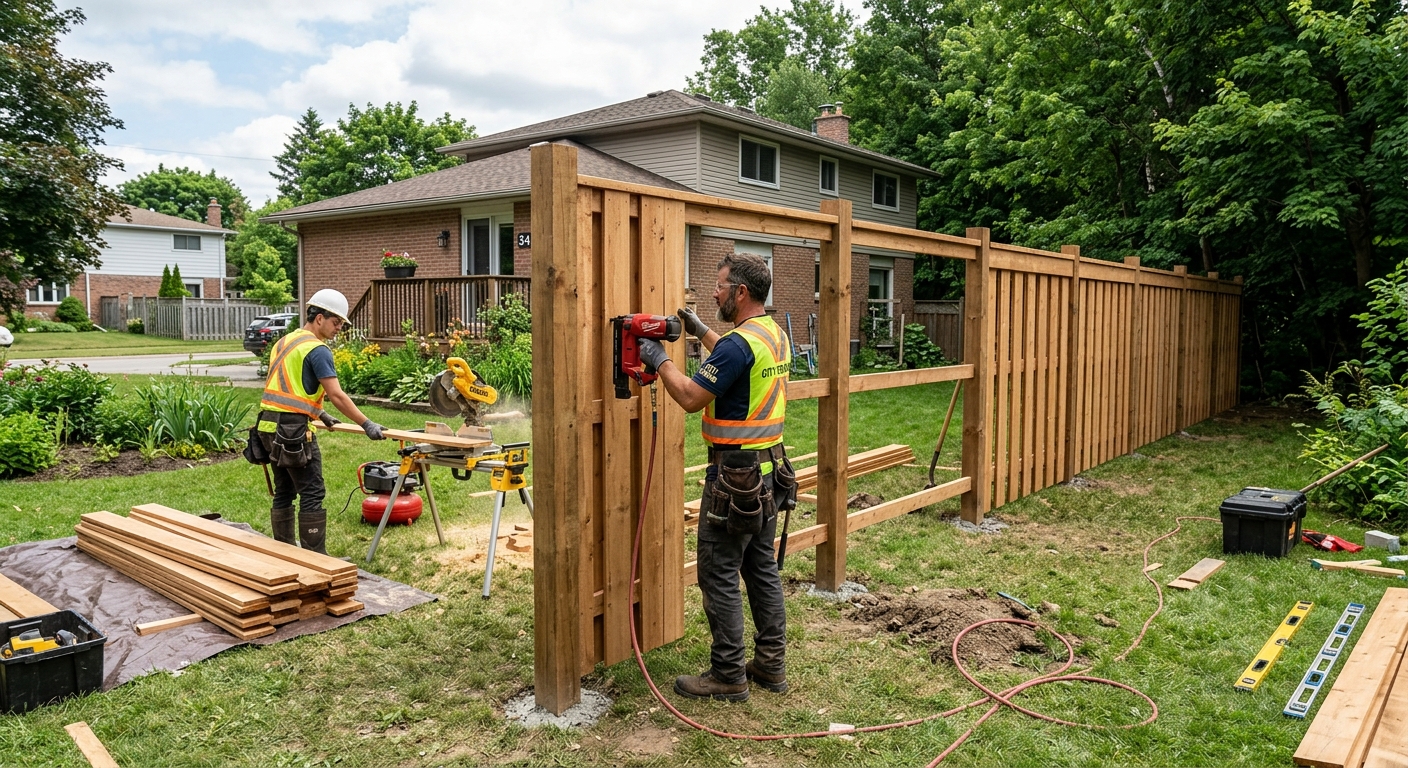
Fencing options and costs in Bluewater
Fencing options in Bluewater depend on what you’re trying to solve—privacy, pets, boundary control, or curb appeal—and then on the realities of installing posts in Southern Ontario soil. With 82.5% of local homes being single-detached houses (Statistics Canada, 2021 Census), demand is steady because most properties can benefit from perimeter upgrades. That matters in Bluewater because long back and side runs are common, and those extra linear feet quickly move the total price into the next band.
In the Stratford–Bruce Peninsula region, frost depth is a primary cost driver. Practical residential fence builds typically set posts about 0.9–1.2 m (3–4 ft) deep, using concrete footings in many cases, so the post stays below winter frost and won’t heave in clay or mixed soils. When you see higher quotes in open areas (farm edges and more exposed lots), it’s often because crews tighten post spacing, increase post size, and use stronger rails/hardware for wind load.
Wood, vinyl and ornamental metal are all popular, but availability and install speed can vary by season. Contractors are especially busy around the residential and rural fringe areas where properties are larger and access is more challenging—one common pressure point is the boundary fencing demand around the outskirts and country lots near local road allowances. From there, the best way to compare pricing is to look at typical lifespan and per-foot ranges across materials, which is summarized below.
| Material |
Lifespan |
Maintenance |
Privacy Rating |
Price per Linear Foot |
| Pressure-treated pine (standard wood) |
10–15 years |
Stain/paint every 2–3 years |
High (solid board) |
$18–$28 |
| Cedar (natural rot resistance) |
15–25 years |
Seal/stain as needed (about every 3–4 years) |
High (solid board) |
$24–$38 |
| Vinyl / PVC (no-maintenance) |
25–35 years |
Rinse wash; occasional panel replacement |
Medium to High |
$26–$44 |
| Chain-link (galvanized steel) |
20–30 years |
Minimal (spray/rinse, occasional tension checks) |
Low (no privacy) |
$16–$26 |
| Aluminum ornamental |
25–40 years |
Minimal (wash; inspect gates) |
Low to Medium |
$28–$52 |
| Composite / recycled material |
20–30 years |
Low (rinse; occasional cleaning) |
High (solid styles) |
$26–$48 |
Prices are estimates only and vary by project scope, site access and material selection.
What affects the price of fencing in Bluewater
In Bluewater and across the Stratford–Bruce Peninsula region, even “the same” fence can land 30–50% apart once you account for frost setting, wind exposure, and what’s happening on-site. A contractor might quote the material mid-range, while another includes deeper post excavation, upgraded hardware, or concrete setting for mixed soils. That’s why your per-foot cost can swing even when the linear footage is close.
The biggest driver is post depth. In Southern Ontario, the design frost line is commonly referenced around 1.2 m (4 ft), and crews typically set posts about 4–6 inches below that design depth to reduce heaving risk—meaning posts often go roughly 1.5–2.0 m into the ground in practice depending on depth rules, soil conditions, and design approach. Deeper holes require longer posts, more concrete and re-bar supports in many builds, and more labour time. That can push wood installations from the lower end of the local band (about $55–$85) toward the higher end when concrete-set posts are required.
Wind exposure is the second lever. While prairie-style gusts aren’t the norm, open farm fields and the Lake Huron influence can still create higher lateral loads, so contractors may tighten post spacing and use heavier rails for privacy wood or vinyl fences. On the other hand, a sheltered urban lot with easier access and shorter runs can keep costs near the mid-range of vinyl/PVC pricing (about $75–$115).
Concrete examples in Bluewater: (1) clay/mixed soils can increase excavation time and the need for full concrete-set posts to prevent movement; (2) sloped properties often require stepped or raked panels, which increases layout and labour; (3) lots with mature trees or limited truck access can mean smaller equipment setups and more hand-digging, raising labour. With many homes built before 1981 (60.5% locally; Statistics Canada, 2021 Census), older property lines, narrower easements, and mature landscaping can also affect access and disposal scope—both of which show up in your quote.
| Price Factor |
Why It Matters |
Cost Impact |
| Fence length in linear feet |
Labour and materials scale directly with total runs |
Major: often the largest share of the estimate |
| Post depth required |
Frost line determines hole depth and post length |
Moderate to Major: deeper setting typically adds concrete, time, and waste |
| Post setting method |
Concrete vs. gravel pack vs. driven posts changes excavation and hardware |
Major: concrete-set posts cost notably more than shallow or non-concrete installs |
| Material choice |
Different rail systems, panel hardware and bracket costs |
Moderate: vinyl and cedar usually exceed standard pressure-treated wood; chain-link is typically lowest |
| Gate count and type |
Drive-through gates require stronger frames and more hardware |
Moderate to Major: gates often add the most expensive line items after fence length |
| Grade and terrain |
Slopes require stepping or raking and careful alignment |
Moderate: extra layout time, cut materials, and labour |
| Old fence removal and disposal |
Demolition, dump fees, and haul-off time |
Moderate: can add substantial costs on longer runs |
| Permit fees and survey / property line locate |
Paperwork and locate work can be needed depending on height and exact placement |
Small to Moderate: varies by scope, lot history, and municipality rules |
Permits & regulations in Ontario
In Ontario, fences may require a building permit if they exceed height thresholds that are commonly cited as about 2.0 m (6.5 ft) for rear yards and roughly 1.0–1.2 m (3–4 ft) for front yards or corners, and the requirement can also be influenced by the municipality’s specific bylaw and exact location. Even when a permit isn’t required, every fence must respect property lines and municipal setback rules.
Before digging any post hole, call for utility locates through Ontario One Call so underground services are marked. Then, confirm boundary positions: ideally use a survey or a property-pin locate so the fence doesn’t drift onto a neighbour’s land. Where fences are shared or adjoining, shared-fence expectations are guided by provincial line-fences legislation and your local practices—so it’s worth clarifying in writing who maintains what.
Typical “does require a permit” examples in Ontario: very tall fence heights that trigger the local threshold, and any fence with site conditions that make the installation materially different from a standard backyard run (such as unusual placement near a corner lot). Typical “often does not” examples: standard-height privacy fencing that sits clearly within property lines and conforms to municipal setback rules.
To verify a contractor for Bluewater homeowners, ask for proof of Ontario licensing (where applicable), liability insurance and WSIB/WCB coverage. Look for a current clearance letter or coverage documentation from the insurer/board and ensure the certificate lists your contractor’s legal name, active dates, and appropriate jobsite coverage.
Choosing the right fence material for Bluewater
Choosing a fence material in Bluewater is mostly about aligning your priorities—privacy, maintenance level, budget, and lifespan—with the way Southern Ontario winters treat wood and posts. Pressure-treated pine is usually the most budget-friendly starting point, but it’s not “set and forget”: to prevent grey weathering and keep it looking good, it typically needs staining or sealing about every 2–3 years. Cedar offers a more attractive finish and better natural rot resistance, though it still benefits from periodic sealing to manage colour loss and surface cracking.
Vinyl/PVC is popular for low upkeep, yet it’s sensitive to extreme cold impacts—panels can crack if struck hard, and installation details matter in freeze-thaw cycles. Chain-link is the most economical and durable option, but it provides low privacy unless you add slats or privacy mesh. Aluminum ornamental fencing is a strong choice for curb appeal because it won’t rust, and it works well where you want an open look without the maintenance of wood.
For the Stratford–Bruce Peninsula climate, post-depth strategy matters more than most people expect. Because frost can reach roughly 1.2 m (4 ft) and installers commonly set posts about 0.9–1.2 m (3–4 ft) deep (or deeper depending on design/soil), many fences end up needing concrete-set posts at residential depth ranges—especially for heavier systems or exposed lots. Where wind and snow load are concerns, stiffer rails and closer post spacing help reduce panel bounce, particularly for privacy wood and vinyl “solid” styles.
Price justification example: if a standard pressure-treated pine privacy run lands near the wood band (about $55–$85 per linear foot locally), moving to vinyl/PVC (often $75–$115) can make sense when you want fewer maintenance visits and longer visual consistency—especially if you’re tired of staining around older landscaping. If budget is the main goal and privacy is handled with landscaping, chain-link can be the most cost-efficient base, but it won’t meet privacy expectations by itself.
| Material |
Cold Tolerance |
Lifespan |
Annual Maintenance |
Best For |
Price Band |
| Pressure-treated pine |
Good (if posts and fasteners are installed correctly) |
10–15 years |
Low to moderate (plan 2–3 year staining cycle) |
Budget privacy with willingness to maintain |
$55–$85 |
| Cedar |
Good (natural rot resistance, but still seasons) |
15–25 years |
Low to moderate (seal/stain every 3–4 years) |
Premium look and better weather performance |
$70–$105 |
| Vinyl / PVC |
Good (can crack if impacted; generally stable in cold) |
25–35 years |
Very low (rinse wash as needed) |
Low-maintenance privacy |
$75–$115 |
| Chain-link |
Excellent (galvanized steel handles freeze-thaw well) |
20–30 years |
Very low (periodic tension checks) |
Security and pets with minimal visual coverage |
$35–$55 |
| Aluminum ornamental |
Excellent (won’t rust; handles Ontario freeze cycles well) |
25–40 years |
Very low (wash and inspect) |
Front yard appeal and defined boundaries |
$90–$150 |
| Composite / recycled |
Good (durable surfaces; performance depends on product) |
20–30 years |
Low (routine cleaning) |
Privacy look with reduced upkeep |
$85–$135 |
How to choose a fencing contractor in Bluewater
Choosing a contractor in Bluewater should start with proof you can verify. In Ontario, ask whether the company carries current general liability insurance and whether their workers are covered under WSIB (for Ontario work). To check: request an insurance certificate (certificate of insurance) showing your contractor’s legal name, policy effective/expiry dates, and that the policy covers the type of fencing work being performed. For WSIB, request clearance documentation or an official confirmation letter that matches the contractor entity you’re hiring.
Next, get 2–3 itemised written quotes. You want a breakdown that separates materials (posts, rails, panels, hardware, concrete), labour (layout, excavation, setting, assembly), and extras like gate hardware, waste removal, and any rework allowance. A lump-sum quote without a scope checklist makes it easier for costs to change after work begins.
Read the scope carefully for exclusions: is demolition included? Is disposal included (dump fees/haul-off)? Will the contractor provide a property-line locate or clarify if you must arrange it? Confirm warranty details: workmanship warranty length (for installation), product/manufacturer warranty terms, and whether the warranty transfers if you sell the home. Ask about a clear payment schedule—never pay more than 10–15% upfront; hold back part of the total until the fence is complete and gates are operational. Timing matters: request a start date and a completion estimate in writing, including how weather or frost conditions may affect scheduling.
- Confirm insurance certificate and verify active dates match the project term.
- Ask for WSIB coverage proof for workers on site.
- Verify the quote includes post-depth approach and whether concrete-set posts are allowed where needed.
- Ensure the quote lists linear feet, exact gate count, and gate type (walk-through vs double).
- Check if fence removal and disposal are included or billed separately.
- Confirm who locates utilities and who handles damage responsibility if markings are missed.
- Ask whether they provide a layout plan and mark corner posts before building.
- Look for included hardware quality (hinges/latches, rail connectors, tension hardware).
- Verify how they handle sloped yards (stepped vs raked panels) and whether it changes pricing.
- Request warranty terms in writing (workmanship + manufacturer/product).
- Review payment schedule: 10–15% max upfront; holdback until completion.
- Make sure the contract states start/completion windows and weather contingencies.
Red flags I see with fencing contractors in Bluewater include: quotes that don’t specify post depth or setting method; “material-only” pricing that hides gate, concrete, or disposal costs until after digging; no proof of WSIB/insurance or insurance that doesn’t match the hiring entity; unwillingness to provide a written scope and timeline; and warranties that only cover materials but not installation labour.
Frequently asked questions — fencing in Bluewater
What fence style offers the best wind resistance in Bluewater?
In Bluewater and the Stratford–Bruce Peninsula region, the most wind-stable setups are the ones that resist lateral load without acting like a solid sail. For many yards, a well-braced privacy fence with good post spacing plus stronger rails/hardware performs better than flimsy boards with wide gaps. If you’re in a more exposed area (open farm edges or lots with fewer wind breaks), contractors often tighten post spacing and increase post size to reduce panel bounce. A properly tensioned chain-link fence also holds up well in wind because it “lets wind through,” which lowers pressure, even though it doesn’t provide privacy. For cost context, chain-link often starts around the lower local band (about $35–$55 per linear foot), while wood privacy commonly lands in the $55–$85 range.
How much does a fence cost in Bluewater?
Fence pricing in Bluewater typically follows per-linear-foot material bands plus labour changes driven by post depth, gate count, terrain, and access. As a practical guide, wood installations often fall in the local range of about $55–$85 per linear foot, while vinyl/PVC commonly runs around $75–$115. Chain-link is usually the lowest at roughly $35–$55, and aluminum ornamental fences generally sit higher, around $90–$150. For context, deeper frost-safe post setting and concrete work are common contributors to the higher end of any band, especially where soil conditions require full-set posts. If your quote seems low compared with neighbours’ experiences, ask what post-setting method is included and whether gates/disposal are accounted for. (Statistics Canada, 2021 Census)
How deep should fence posts be for Bluewater's frost?
For Bluewater homeowners, frost protection is key. Southern Ontario’s design frost line is often referenced around 1.2 m (4 ft), and installers commonly set fence posts about 4–6 inches below that design depth to help prevent heaving. In practical residential installs across the Stratford–Bruce Peninsula region, that means many posts end up roughly 0.9–1.2 m (3–4 ft) deep, and in colder/soil-challenging sites you may see deeper concrete-set requirements. Clay and mixed soils can increase the need for full concrete footings and careful hole prep. The right depth can vary by fence weight, hardware, and your specific site conditions, so it’s worth asking your contractor to explain how they’re achieving frost-safe footing depth in your quote.
Wood vs vinyl vs aluminum fence — which is best?
“Best” depends on what you value most, especially in Ontario’s freeze-thaw winters. Wood (pressure-treated pine or cedar) is often the best fit for initial budget and a traditional look; however, wood needs periodic staining/sealing to prevent grey weathering and keep it looking clean—plan on maintenance every 2–3 years for treated pine. Vinyl/PVC is usually best for low maintenance and consistent appearance, but you still want solid installation practices and attention to impact resistance in extreme cold. Aluminum ornamental is best when you want a rust-resistant, low-maintenance look (especially front boundaries), but it won’t give the privacy level of solid boards. If your goal is privacy and long-term upkeep, vinyl or cedar privacy often justify their higher upfront cost compared to basic wood. As a reference point, wood privacy commonly sits around $55–$85 per linear foot, vinyl around $75–$115, while aluminum ornamental may run $90–$150.
Do I need a permit to build a fence in Ontario?
In Ontario, permit needs commonly depend on fence height and location. A practical guideline homeowners often run into is that fences above about 2.0 m (6.5 ft) in the rear yard, or roughly 1.0–1.2 m (3–4 ft) in the front or corner areas, often trigger a building permit requirement in many municipal contexts. Even if a permit is not required, your fence must still meet property line rules and municipal setback requirements. Before any digging, call Ontario One Call for utility locates and consider getting a survey or property-pin locate so you don’t encroach. Because municipal rules can vary, the safest route is to ask your contractor to confirm whether your proposed height and placement require a permit for your specific Bluewater lot before they mobilize.
How long does a wood fence last in Bluewater?
A properly installed wood fence in Bluewater can last roughly 10–15 years for standard pressure-treated pine and about 15–25 years for cedar, assuming good post setting and periodic maintenance. The biggest drivers of longevity are: correct frost-safe post depth (to reduce heaving), quality hardware and fasteners, and how well the fence is sealed/stained over time. If you skip maintenance, wood can grey and surface check faster, and in wet seasons it can accelerate deterioration at bottom rails and post interfaces. In neighbourhoods with older landscaping or restricted access, installation details can also affect lifespan—poor drainage near the base or cut corners on concrete-set posts can shorten life. If you’re comparing options, treated wood is often the lower-cost band (about $55–$85), while cedar typically costs more but extends the service life.