Fencing options and costs in Brantford
In Brantford, choosing the right fence usually starts with matching your budget to your yard’s conditions. With 60.6% of local dwellings being single-detached homes, there’s a steady base of homeowners replacing aging fences, especially as many houses were built before 1981—meaning lots of boundary lines still run alongside older wooden rails and posts. That combination of detached-home demand and older fencing stock helps explain why quotes are competitive in busy areas, but also why contractors get booked up quickly in peak seasons.
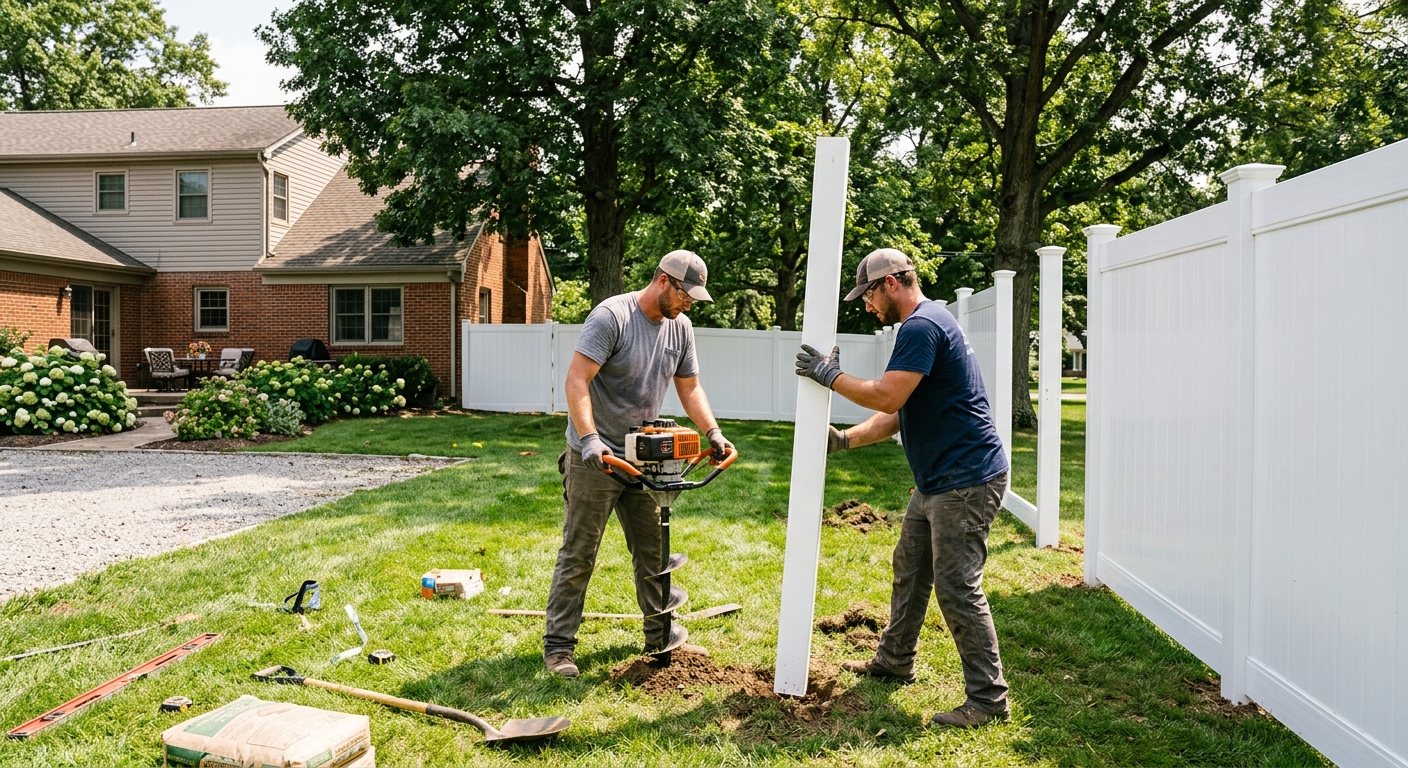
Pricing in the Hamilton–Niagara Peninsula isn’t just about the fence material. Frost penetration in southern Ontario is commonly estimated around 1.2 m (4 ft), so installers must set posts below the frost line to reduce frost heave and long-term leaning. In Brantford, that typically means deeper post holes and, for long-term stability, concrete-set posts are common—especially in heavier clay soils where drilling time increases. On top of that, wind exposure around hilltop and near-water lots can drive tighter post spacing or heavier hardware, which can raise material and labour costs even when the fence height stays the same.
You’ll also feel market demand in neighbourhoods like West Brant, where lot sizes and mature trees often mean more layout work, careful routing around landscaping, and frequent gate upgrades for side yards. Once you’ve got the basics on frost depth and local demand, comparing materials side-by-side makes the next step easier—see the table below for typical lifespan, upkeep, privacy, and pricing.
| Material |
Lifespan |
Maintenance |
Privacy Rating |
Price per Linear Foot |
| Pressure-treated pine (standard wood) |
10–15 years |
Stain/seal every 2–3 years |
7/10 (with solid boards) |
$18–$26 |
| Cedar (natural rot resistance) |
15–25 years |
Light staining every 3–4 years |
8/10 (with solid boards) |
$22–$32 |
| Vinyl / PVC (no-maintenance) |
20–30 years |
Rinse only; no painting |
8/10 (solid or semi-solid) |
$25–$38 |
| Chain-link (galvanized steel) |
20–35 years |
Occasional wash; fix bent sections |
3/10 (low) |
$14–$20 |
| Aluminum ornamental |
25–40 years |
Wash 1–2 times per year |
5/10 (decorative) |
$28–$45 |
| Composite / recycled material |
20–30 years |
Rinse only; replace damaged boards as needed |
7/10 (solid infill options) |
$26–$40 |
Prices are estimates only and vary by project scope, site access and material selection.
What affects the price of fencing in Brantford
In the Hamilton–Niagara Peninsula, two quotes for the “same” fence can still differ by 30–50% because post installation details and access conditions change what the crew has to do on-site. Material costs fluctuate too, but the bigger swing is usually the ground work: drilling, setting depth, and how long it takes to get the line straight and level around driveways, trees, and grade changes. That’s why a typical wood fence price band of $45–$80 per linear foot for installation can stretch upward when frost-depth requirements and clay soils add time, or when gates and removal are included.
Frost is the main technical cost driver. A practical rule in Ontario is to set posts roughly 4–6 inches (100–150 mm) below the design frost depth to reduce frost heave risk. In cold winters, that commonly means deeper holes and longer posts—often around 1.5–2.0 m in the ground for 6 ft residential fences—plus concrete-set posts for long-term stability. That combination increases material for posts and adds labour for drilling and mix, which can narrow the gap between wood and low-maintenance options in some situations.
Wind exposure also matters. Even though Brantford isn’t an open-Prairie site, hilltop and lakeshore lots can still experience gusts that strain lighter panels. Contractors may tighten post spacing, use heavier rails, or select styles with better airflow, which can raise installation time. For example, a cedar privacy fence on a clay-heavy side yard often costs more than expected because deeper, concrete-set posts slow the install. Conversely, a short chain-link perimeter with minimal gates can land near the lower band of $35–$60 because there’s less labour-intensive fitting.
Homes built before 1981 are more likely to have older fence lines, buried remnants, and uneven settled grades—small issues that can add hours of digging and alignment work. With median household income at $79,500 (2020), many Brantford homeowners still choose durable long-term setups, especially when repeated freeze–thaw cycles would otherwise force earlier repairs.
| Price Factor |
Why It Matters |
Cost Impact |
| Fence length in linear feet — the primary cost driver |
Every extra foot adds posts, rails, and labour time |
Major (drives most of the total) |
| Post depth required — frost line determines post length and hole depth |
Deeper holes prevent frost heave and leaning |
Major (adds drilling + concrete) |
| Post setting method — concrete vs. gravel pack vs. driven posts |
Concrete-set posts resist heaving and movement longer |
Medium to major (depends on soil) |
| Material choice — vinyl vs. cedar vs. chain-link |
Different material costs and hardware needs |
Medium (vinyl/aluminum higher) |
| Gate count and type — walk-through vs. drive-through (double) |
Gates require stronger framing and heavier hinges/locks |
Medium to major |
| Grade and terrain — sloped yards require stepped or raked panels |
More measuring, cutting, and custom rail setups |
Medium |
| Old fence removal and disposal |
Hauling and labour increases project time |
Medium |
| Permit fees and survey / property line locate |
Some installs need approvals and accurate boundary confirmation |
Low to medium (site-dependent) |
Permits & regulations in Ontario
In Ontario, permits can apply when the proposed fence height exceeds typical thresholds—commonly around 2.0 m (6.5 ft) at the rear and 1.0–1.2 m (3–4 ft) at the front or corners, though requirements depend on the specific municipal rules and your exact lot context. In Brantford, as elsewhere in Ontario, you also must respect property lines and municipal setback bylaws. If your design goes near a property line, take boundary confirmation seriously: even a few inches of encroachment can become a dispute later.
Before anyone digs post holes, you should have utility locates completed through Ontario One Call. This step is essential for safety and to prevent expensive damage to buried services. If you don’t already have a recent survey, consider obtaining a survey or at minimum a property line locate based on your pins, so you’re not building over or under the boundary.
Regarding who owns and maintains a shared fence: line-fences rules are governed by provincial line-fences legislation, and many homeowners handle shared boundary fencing through an agreement on upkeep and cost sharing. Practically, installers should confirm whether fencing is shared or solely on your lot before they start.
To verify a contractor before signing in Ontario, ask for: (1) proof of business licensing/registration with the proper online registry entry for their entity, (2) a current certificate of insurance naming you as additionally insured, and (3) WSIB coverage for workers (or WCB clearance where applicable). A clear paper trail and matching company details are your best safeguards.
Choosing the right fence material for Brantford
Choosing a fence in Brantford comes down to balancing privacy, low maintenance, and long-term value in a freeze–thaw climate. Pressure-treated pine is the budget-friendly route, but it typically needs staining or sealing every 2–3 years to prevent grey weathering and surface degradation. Cedar is more naturally rot resistant and looks great on mature lots, yet it still benefits from periodic staining to maintain colour and reduce warping at exposed edges.
Vinyl/PVC offers no painting and is often preferred for year-round appearance, but in extreme cold it can become more brittle than wood if installed with poor alignment or inadequate hardware spacing. Chain-link is the lowest initial cost and lasts a long time, but it provides limited privacy unless you add slats, planting, or privacy screens. Aluminum ornamental fences are attractive and won’t rust, making them a strong choice where you want an open look with clear visibility.
The Hamilton–Niagara Peninsula’s frost penetration drives how posts must be installed across materials. For typical 6 ft residential fences, most professional crews set posts 1.5–2.0 m into the ground (often with concrete) to sit below the frost zone. That means the post depth and setting method are often as important as material selection. If your soil is heavy clay or the grade changes across the line, concrete-set posts usually reduce movement and callbacks—especially after multiple winter cycles.
For a practical example: if you’re comparing a wood fence installation in the $45–$80 band versus vinyl in the $70–$120 band, vinyl’s higher upfront cost can be justified when you want 15–20 years of “set it and forget it,” and you’re tired of annual staining work. If you’re planning to sell in a shorter timeframe, pressure-treated pine can still be the better fit—provided posts are installed correctly to address frost heave early.
| Material |
Cold Tolerance |
Lifespan |
Annual Maintenance |
Best For |
Price Band |
| Pressure-treated pine |
Good (with proper sealing) |
10–15 years |
Stain/inspect every 2–3 years |
Best value privacy on a tighter budget |
$45–$80 |
| Cedar |
Good (rot resistance) |
15–25 years |
Light staining/cleaning every 3–4 years |
Natural look with improved longevity |
$55–$90 |
| Vinyl / PVC |
Moderate to good (installation critical) |
20–30 years |
Wash/rinse as needed |
Low-maintenance privacy and appearance |
$70–$120 |
| Chain-link |
Good |
20–35 years |
Occasional wash and repairs |
Security with minimal visual obstruction |
$35–$60 |
| Aluminum ornamental |
Good (no rust) |
25–40 years |
Rinse 1–2 times per year |
Curbsides, front yards, decorative boundaries |
$80–$150 |
| Composite / recycled |
Good (frost stable with correct supports) |
20–30 years |
Rinse only; inspect hardware |
Solid privacy with low upkeep |
$85–$130 |
How to choose a fencing contractor in Brantford
Start by verifying Ontario requirements and coverage. Ask for the contractor’s Ontario business registration details and confirm the company name matches on invoices and insurance documents. For liability insurance, request a certificate of insurance (COI) showing adequate coverage and that you’re listed as additionally insured for the duration of the job. For worker coverage, confirm WSIB status (or the appropriate WCB coverage) and ask for proof—this protects you if there’s an on-site injury.
Next, insist on 2–3 itemised written quotes rather than a single lump sum. A proper quote breaks out labour, materials, post setting method (concrete vs. gravel pack), gate hardware, and any disposal/removal costs. Make sure the scope clearly states whether permits and utility locates are included or if you’re responsible. If a quote doesn’t mention excavation depth below the frost zone or assumes “tamped backfill only,” treat it as a red flag for long-term stability in Brantford’s freeze–thaw cycles.
Check warranty terms too. You want a workmanship warranty for the installed fence (often at least 1 year, sometimes longer) and a separate manufacturer/product warranty for materials. Ask if the warranty is transferable if you sell your home.
For payment scheduling, never pay more than 10–15% upfront. Use a holdback until the fence is complete, straight, and hardware is adjusted. Finally, require a start date and an estimated completion timeline in writing—fencing schedules can slip due to weather and curing time for concrete-set posts.
- Confirm business details match the quote and invoice.
- Request COI for liability insurance before work begins.
- Verify WSIB/WCB coverage and ask for proof.
- Demand itemised pricing: labour + materials + hardware.
- Ask for the post depth plan and whether posts are concrete-set.
- Confirm gate framing, latch/hinge type, and swing clearance.
- Clarify how slopes will be handled (stepped vs. raked panels).
- Ask whether utility locates and protection are included.
- Confirm whether old fence removal and disposal are quoted.
- Check if permit pull (if required) is included in the scope.
- Use a payment schedule with a holdback until completion.
- Get workmanship warranty length in writing.
Red flags in Brantford include: (1) quotes that don’t specify post depth or concrete setting for frost stability, (2) pressure to pay the majority upfront before any paperwork or site prep, (3) vague scope language like “install as needed” without measurements or gate details, (4) missing or expired insurance/WSIB proof, and (5) no clear plan for disposal of old fencing and debris.
Frequently asked questions — fencing in Brantford
How deep should fence posts be for Brantford's frost?
For Brantford (southern Ontario), frost penetration is commonly estimated around 1.2 m (4 ft), so posts need to sit below the frost line to prevent heaving and leaning. In practice, many residential installs set posts about 4–6 inches (100–150 mm) below the design frost depth, which often puts typical 6 ft fence posts roughly 1.5–2.0 m into the ground depending on your soil and local conditions. Because clay soils can hold moisture and expand during freeze–thaw cycles, concrete-set posts are frequently used for long-term stability. If a contractor proposes shallow holes or only tamped backfill, it’s a major risk for the first winter cycle. This is also why “same fence, different quote” happens—post depth and setting method drive labour and material costs.
Wood vs vinyl vs aluminum fence — which is best?
There isn’t one best fence for everyone in Brantford, but the “best” choice usually matches your maintenance tolerance and privacy needs. Wood (pressure-treated pine) often lands in the $45–$80 installation band, while vinyl/PVC typically runs $70–$120 because of higher material cost. Cedar looks premium and can last longer than basic pine, but it still needs periodic staining. Aluminum is usually $80–$150 and is great for front yards or decorative boundaries where rust resistance and a clean look matter more than privacy. Climate-wise, the frost line affects every material because the critical factor is how posts are set—concrete-set posts are commonly chosen for stability. If you want maximum low-maintenance with solid privacy, vinyl often wins; if you want value and you’re okay with staining, wood can be the smarter budget play.
Do I need a permit to build a fence in Ontario?
In Ontario, permits may be required when fence height exceeds typical thresholds—often around 2.0 m (6.5 ft) at the rear and about 1.0–1.2 m (3–4 ft) near the front or corners, but the exact triggers depend on the municipality and your lot situation. In Brantford, you still must follow municipal setback bylaws and respect property lines. Regardless of permit requirements, you must complete utility locates before digging post holes (Ontario One Call). Also consider getting a survey or locate your property pins before fencing—older neighbourhoods and long-established boundary lines can be easy to misread. For shared boundary issues, provincial line-fences rules influence ownership and maintenance responsibilities. If your contractor says “no permits ever,” ask them to confirm the height and location against your specific site rules.
How long does a wood fence last in Brantford?
In Brantford’s freeze–thaw winters, a wood fence’s lifespan depends heavily on installation quality, not just the lumber. Pressure-treated pine is commonly expected around 10–15 years when posts are set correctly below the frost zone and the fence is installed level with proper bracing. If posts are too shallow or only tamped backfill is used, frost heave can start loosening posts within a few seasons. Cedar can last longer—often 15–25 years—because of better natural rot resistance, but it still benefits from maintenance. Maintenance matters: expect staining or sealing roughly every 2–3 years for pine and every 3–4 years for cedar to reduce surface breakdown and keep boards from warping. The fastest way to shorten service life is to skip sealing and ignore drainage around post holes.
Who owns and maintains a shared fence?
For shared fence situations, ownership and maintenance are handled under Ontario’s provincial line-fences framework. Practically, that means you may be responsible for portions of the fence depending on the boundary agreement, cost-sharing arrangements, and who benefits from the fence’s location. Before building or replacing, it’s important to confirm whether the fence is actually on a shared boundary line or solely on your property—using a survey or property pin locate where needed. In many cases, neighbours agree on repairs and replacement timing, but the legal baseline is what guides disputes if an agreement can’t be reached. If you’re planning a replacement in an older Brantford neighbourhood (where fences are often legacy installations), I recommend talking to the neighbour early and having the scope documented in writing.
How do I find my property line before fencing?
To fence accurately in Ontario, the safest approach is to confirm your property pins or get a survey. If you have pin markers, a property line locate can map the boundary based on those pins, which helps prevent encroachment. If the pins aren’t clear, a survey gives definitive corner-to-corner information and is especially helpful in older areas where fences may not align with current interpretations. For Brantford homes built long ago, it’s not unusual to find old fence posts that drifted over time, or sections that don’t match today’s boundary. Once you have the line, mark it before any post hole digging. Also remember: do utility locates first (Ontario One Call) so staking the line and digging posts doesn’t risk buried services. This is one of the best ways to avoid disputes that can add weeks and cost.