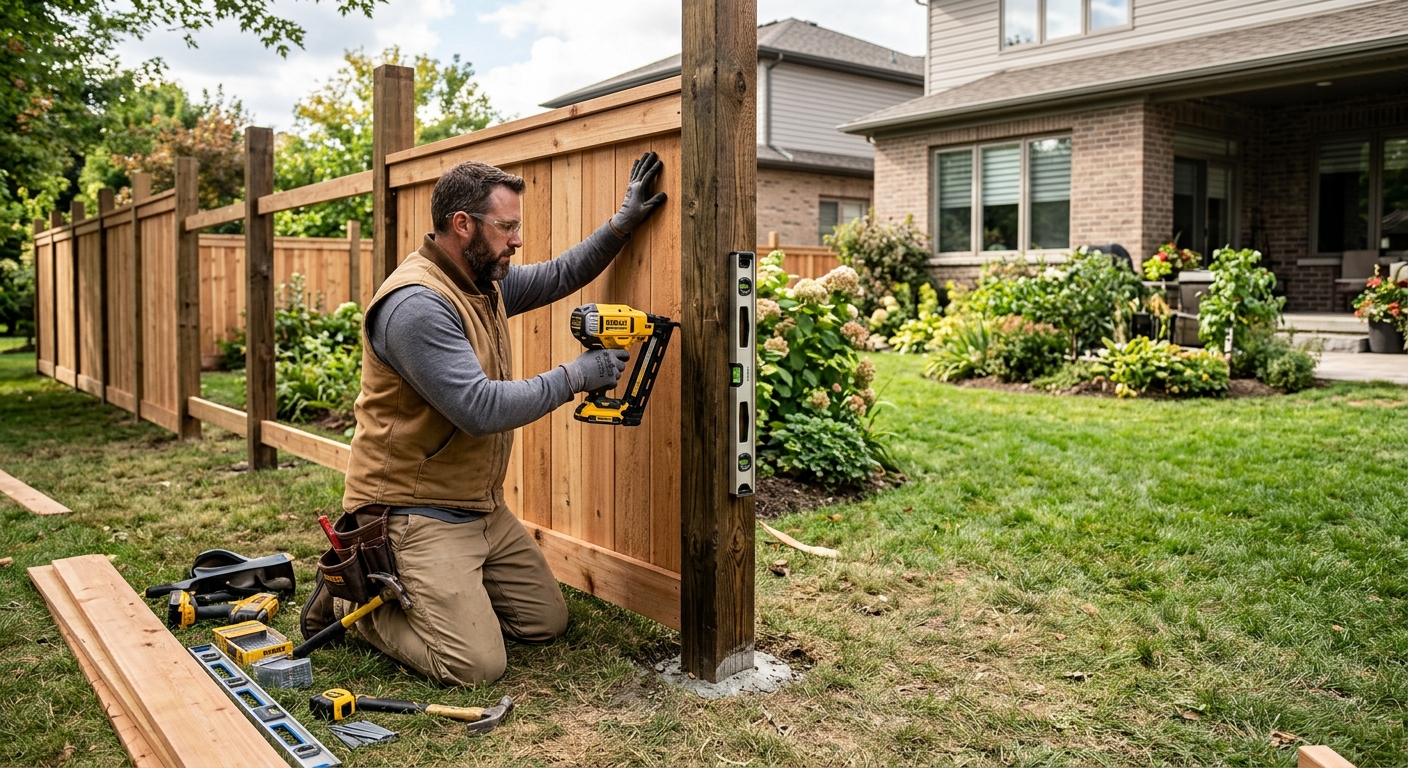
Fencing options and costs in New Toronto
Fencing in New Toronto is usually planned around two realities: how fast you want the look installed and how long it must hold up through Ontario winters. With a 2021 population of 11,463 in the area profile (Statistics Canada, 2021 Census), local demand is steady because many properties in the Toronto housing market turn over planning every spring—especially in neighbourhood pockets where homeowners refresh backyards. New Toronto is also close enough to the wider Greater Toronto build cycle that contractors often book early, and that scheduling pressure can tighten availability for demolition and post excavation.
On top of timing, frost depth drives real cost. In Southern Ontario, the design frost line is commonly treated at about 42"–48", so posts for 6–8 ft privacy fences are typically set around 3.5–4 ft deep (with concrete-set posts in most stable builds). That deeper footing requirement increases both labour and ready-mix costs, but it reduces the chance of heaving or leaning. In areas of New Toronto with more exposure—such as the edges near larger arterial roads and open corners—panel racking is a bigger concern, so post sizing and spacing are selected more carefully.
For many homeowners, the quickest way to compare options is to look at lifespan, maintenance, privacy level, and the typical installed price per linear foot. Once you match your priorities (privacy vs. maintenance vs. budget), the table below makes it easier to sanity-check quotes from multiple contractors in the New Toronto area.
| Material |
Lifespan |
Maintenance |
Privacy Rating |
Price per Linear Foot |
| Pressure-treated pine (standard wood) |
10–15 years |
Stain/seal every 2–3 years |
High (solid panels) |
$65–$120 |
| Cedar (natural rot resistance) |
15–25 years |
Seal/stain as needed (often every 3 years) |
High (solid panels) |
$75–$135 |
| Vinyl / PVC (no-maintenance) |
25–30 years |
Wash only; no staining |
High (solid privacy styles) |
$75–$130 |
| Chain-link (galvanized steel) |
20–30 years |
Occasional rinse; tension checks |
Low–Medium (screening optional) |
$45–$85 |
| Aluminum ornamental |
25–40 years |
Rinse occasionally; no rust |
Low–Medium (open pickets) |
$90–$160 |
| Composite / recycled material |
20–30 years |
Minimal cleaning; no staining |
High (solid privacy styles) |
$100–$170 |
Prices are estimates only and vary by project scope, site access and material selection.
What affects the price of fencing in New Toronto
In Toronto, you can easily see the same fence design priced 30–50% differently between quotes. The biggest reasons aren’t “how fancy the material is”—it’s how your specific site forces extra excavation, stronger framing, and more labour time. In New Toronto and the surrounding Toronto economic region, most installs assume concrete-set posts for long-term stability. That means your quote can move a lot depending on access (how easily a crew can reach the back line), how much the crew must dig below frost expectations, and how the contractor handles waste and disposal.
Frost line depth sets how deep posts must be set to prevent heaving. In cold Ontario, posts often go 1.5–2.0 m into the ground when built to local best practice, with concrete setting that increases both material and labour time. Even a “small” privacy upgrade from a 6 ft to an 8 ft solid fence can trigger heavier posts and closer spacing, which raises cost. Wind exposure in the GTA isn’t as extreme as the Prairies, but racking still matters, so panel style and post size affect framing labour. That same trade-off is where some contractors cut corners—lighter posts or gravel-only settings can look fine at install, then shift after freeze-thaw cycles.
Concrete examples: (1) a straightforward straight run with good access might land closer to the wood band of $65–$120 per linear foot, while (2) a fenced line requiring stepped panels on a slope and deeper concrete footings can push toward the higher end of that range. Similarly, a vinyl privacy fence may sit around the $75–$130 band in easy yards, but complex gate locations and heavier post reinforcement can push a project above that band. Housing-stock age also matters: older properties often have more buried services, mature landscaping, and older fence foundations to remove—adding labour before new posts are even set.
| Price Factor |
Why It Matters |
Cost Impact |
| Fence length in linear feet |
The primary driver of labour, posts, rails and materials |
Largest swing in total cost |
| Post depth required |
Frost line determines hole depth and post length for Ontario winter stability |
Can materially increase concrete and excavation time |
| Post setting method |
Concrete vs. gravel pack vs. driven posts changes strength and long-term movement risk |
Concrete-set posts typically cost more but reduce failures |
| Material choice |
Vinyl, cedar, and chain-link vary in raw cost, hardware, and install time |
Moves you between budget and premium bands |
| Gate count and type |
Drive-through double gates require stronger framing and more hardware |
Often adds significant labour and reinforcement |
| Grade and terrain |
Sloped yards require stepped or raked panel solutions |
Extra layout, cutting, and material waste |
| Old fence removal and disposal |
Hauling, dump fees, and demolition time affect total scope |
Frequently increases cost by several hundred to over a thousand+ |
| Permit fees and survey / property line locate |
Ontario permit and locating requirements prevent encroachment disputes |
Variable; can add measurable administration costs |
Permits & regulations in Ontario
In Ontario, fences can require a building permit depending on height and location. As a practical rule homeowners use for planning, fences above a height threshold—typically around 2.0 m (6.5 ft) at the rear and about 1.0–1.2 m (3–4 ft) at the front or corner—often trigger a permit review. Regardless of permit status, every fence must respect property lines and municipal setback bylaws. Because fencing is built on land, not inside a home, the biggest compliance risks usually come from encroachment and from missing utility clearance before digging.
Before you dig any post holes in New Toronto, call for utility locates. Ontario One Call is the standard referral service for buried lines, and it should be done before excavation so crews can protect gas, electrical, and communication services. Next, obtain a survey or locate your property pins. Even when the lot looks “obvious,” older boundaries and previous landscaping can be misleading, and disputes are costly after the fact. Shared fence ownership rules are handled under Ontario line-fences legislation, which is why documenting shared boundaries matters when your fence sits on or near a dividing line.
What typically DOES require a permit: taller fences near the rear that exceed the local threshold, and any situation where you’re changing height substantially. What typically does NOT: like-for-like replacements that stay under the applicable height thresholds and remain within property line/setback rules.
To verify a contractor, ask for (1) proof of Ontario registration/licensing where applicable, (2) liability insurance certificate of insurance (COI) naming you as additional insured if possible, and (3) WSIB coverage (or WCB clearance/number, depending on the contractor’s classification). Look at the contractor’s registry listing online, then confirm the COI’s policy effective dates and coverage limits match your project start window.
Choosing the right fence material for New Toronto
Choosing a fence material in New Toronto is mostly about matching your priorities (privacy, maintenance, lifespan and budget) to how Southern Ontario winters treat wood and plastics. Pressure-treated pine is the budget-friendly approach, but it needs staining or sealing every 2–3 years to slow greying and surface checking in freeze-thaw cycles. Cedar has better natural rot resistance and looks cleaner longer, yet it still benefits from sealing on a schedule—especially for posts that sit in damp soil. Vinyl (PVC) is genuinely low maintenance, but in extreme cold it can become brittle if the installer doesn’t follow proper expansion spacing or uses undersized posts. Chain-link is the longest-lifecycle “set and forget” option for budget, but it offers low privacy unless you add slats or screening.
For privacy-heavy backyards, the Toronto frost practice is a key part of material performance: posts must be set at minimum about 3.5–4 ft deep (in line with frost line expectations). Concrete-set posts are generally recommended for 6–8 ft privacy fences because they resist movement after the freeze-thaw cycle. Aluminum ornamental fencing looks great and doesn’t rust, but it’s not a privacy solution unless you pair it with landscaping or screen panels. Wind and snow load don’t create Prairies-level extremes in the GTA, but racking is still a factor for taller solid styles, so heavier posts and closer spacing matter.
A concrete example: if you’re deciding between wood and vinyl privacy at similar heights, wood may land closer to the $65–$120 band, while vinyl typically starts above that and often sits in the $75–$130 band. Spending the difference can be justified when you want to stop ongoing staining work and you expect to keep the fence for 20+ years. If you’re cost-sensitive and plan to maintain proactively, pressure-treated pine can make sense—just budget time and products for regular upkeep.
| Material |
Cold Tolerance |
Lifespan |
Annual Maintenance |
Best For |
Price Band |
| Pressure-treated pine |
Good with proper post depth and staining |
10–15 years |
Low-cost work; typically 1–3 times every few years |
Budget privacy where homeowners will maintain |
$65–$120 |
| Cedar |
Very good; resists rot in mixed moisture |
15–25 years |
Seasonal inspections; seal/stain as needed |
Better appearance with moderate maintenance |
$75–$135 |
| Vinyl / PVC |
Good if installed with correct expansion and post sizing |
25–30 years |
Wash/rinse; minimal touch-ups |
Low-maintenance privacy for Toronto winters |
$75–$130 |
| Chain-link |
Excellent |
20–30 years |
Occasional rinse and hardware checks |
Security with long service life |
$45–$85 |
| Aluminum ornamental |
Excellent |
25–40 years |
Wash/spot cleaning |
Attractive front/side boundaries |
$90–$160 |
| Composite / recycled |
Good; depends on product specs and post support |
20–30 years |
Minimal cleaning; rare repairs |
Privacy with reduced upkeep |
$100–$170 |
How to choose a fencing contractor in New Toronto
When you hire a fencing contractor in New Toronto, verification is as important as the price. Start with Ontario licence/registration details where applicable, and confirm liability insurance using the certificate of insurance (COI). Ask for proof of WSIB coverage and/or the correct WCB clearance documentation for the contractor’s staff/classification. You can typically check the contractor’s business registration/online listing for status, then match the COI effective dates to your planned install window—expired insurance is a common red flag. Also ask whether subcontractors will be used, and get their coverage documentation if they’re part of the crew.
Next, get 2–3 itemised written quotes (not lump sums). A good fence quote breaks out posts and rails, panels/pickets, hardware, concrete and excavation, gate frames, demolition, and disposal. Scope should clearly state what’s included: permit pull responsibility (if required), utility locate confirmation, and whether post holes are concrete-set to Ontario frost expectations. Warranty matters too: ask for the workmanship warranty length (how long the installer stands behind alignment and fastening), the product/manufacturer warranty, and whether the warranty is transferable if you sell your home. Finally, payment terms should be reasonable—never pay more than 10–15% upfront, and keep a holdback until the fence is complete, cleaned up, and any punch-list items are corrected. Request an agreed start date and completion estimate in writing so you understand what “schedule” means for your yard.
- Ask for COI showing liability coverage and policy dates matched to your project.
- Confirm WSIB/WCB coverage (or clearance letter) before work begins.
- Get proof of Ontario business registration/status from the contractor’s listing.
- Request itemised pricing: posts, concrete, rails, panels, hardware, and gates separately.
- Verify post depth approach aligns with frost line best practice and concrete-set installation.
- Confirm panel style and post spacing for privacy height to reduce racking.
- Ask who calls for utility locates and whether it’s included in the scope.
- Clarify demolition: removal of old fence, hauling, and disposal fees.
- Check whether permits are included or if you’re responsible for pulling them.
- Review slope handling: stepped vs. raked panels and how they’ll be measured.
- Ensure a written workmanship warranty (alignment, fastening, and post stability).
- Avoid large deposits; hold back until completion and walkthrough sign-off.
Red flags in New Toronto: “quote by text only” with no itemised scope, vague statements like “we set posts properly” without frost-depth specifics, no proof of liability insurance or WSIB/WCB coverage, and contracts that demand 50%+ upfront or omit disposal and gate hardware details.
Frequently asked questions — fencing in New Toronto
How long does fence installation take in New Toronto?
Most fence installs in New Toronto take anywhere from a half-day to several days depending on length, gate count, and whether you’re removing an old fence. A simple, straight run with easy access can be completed quickly, but deeper post holes (set to frost expectations with concrete) add time because excavation and setting must be done carefully. If your yard is sloped, stepped panels require extra layout, which can extend the schedule. For larger privacy projects, crews may stage materials and finish in phases to keep the work area manageable. If you’re comparing quotes, ask for a start date, a completion estimate, and whether demolition and disposal are included in the timeline (Ontario projects often include these steps as separate tasks).
Can I install a fence on a slope in New Toronto?
Yes, but the method matters for both appearance and stability. In New Toronto, yards with grade changes are typically handled with stepped panels (each panel level changes) or raked panels (continuous slope). Stepped solutions usually reduce stress on rails in freeze-thaw cycles because the framing remains square to the ground at each section. A raked approach can work well when done by experienced crews with the correct measurements and hardware. Before signing a contract, make sure your quote states which method they’ll use and how they’ll handle corners and gates so the fence doesn’t end up uneven. Also confirm whether additional framing materials and cutting are included, since slope work can shift pricing within the same material choice band.
What is the most weather-resistant fence for New Toronto's climate?
In Ontario’s freeze-thaw winters, the most weather-resistant option is often vinyl (PVC) for low-maintenance longevity, or chain-link for long service life when installed correctly. Vinyl performs well when posts are set deep enough and hardware is installed with proper expansion considerations. Chain-link is also very durable, especially with galvanized steel, though it won’t provide privacy without screening. Wood can be weather-resistant too, but it depends on maintenance: pressure-treated pine typically needs staining/sealing every 2–3 years to reduce grey weathering and surface breakdown, and cedar still benefits from periodic sealing. For many New Toronto homeowners, a practical compromise is a vinyl privacy fence in the approximate $75–$130 per linear foot band, especially if you want fewer maintenance tasks during winter and spring.
How do I prevent wood fence rot in New Toronto?
Rot prevention starts at the post and drainage details. First, ensure posts are set to frost-safe depth and that concrete-set posts are used for stability in Ontario conditions; a fence that shifts can create gaps that trap moisture around base boards. Second, choose quality lumber and proper grade—then seal ends and any cut points. For pressure-treated pine, homeowners should plan on staining/sealing every 2–3 years to keep water from penetrating the surface layers during thaw periods. Third, keep vegetation trimmed away from the fence line so airflow reduces persistent dampness. Finally, don’t ignore hardware: loose fasteners can let boards flex and stay wet. If you’re budgeting, remember that repairs can cost more over time than a preventive maintenance plan.
What is the cost per linear foot for fencing in New Toronto?
In New Toronto, installed costs vary by material, fence height, and site conditions, but typical bands for the Toronto economic region are fairly consistent. Wood fence installation often falls around $65–$120 per linear foot, vinyl/PVC around $75–$130 per linear foot, chain-link around $45–$85 per linear foot, and aluminum/metal around $90–$160 per linear foot. Your final number depends on whether posts must be concrete-set for frost stability, how many gates you have, and whether there’s demolition/disposal. If you’re trying to compare quotes, ask the contractor to provide a per-linear-foot rate that is based on the same scope (including concrete setting, rail/hardware, and removal). That’s the quickest way to avoid “apples-to-oranges” pricing.
Should I repair or replace my old fence in New Toronto?
It depends on how the fence has failed and what the base structure is doing. In New Toronto and the broader Toronto region, many older fences begin to lean due to post movement from freeze-thaw cycles and soil moisture. If only a few boards are rotted or a couple rails are loose, repair can be cost-effective—especially if posts are still straight and secure. If multiple posts are shifting, the fence is out of plane, or you see widespread rot at the bottom edges, replacement is usually the better long-term investment. Also consider gate hardware: if a gate sags, it often needs more than board-level repairs. When you request bids, ask contractors to assess whether concrete-set posts are needed for the replacement sections so you’re not rebuilding the same failure pattern.