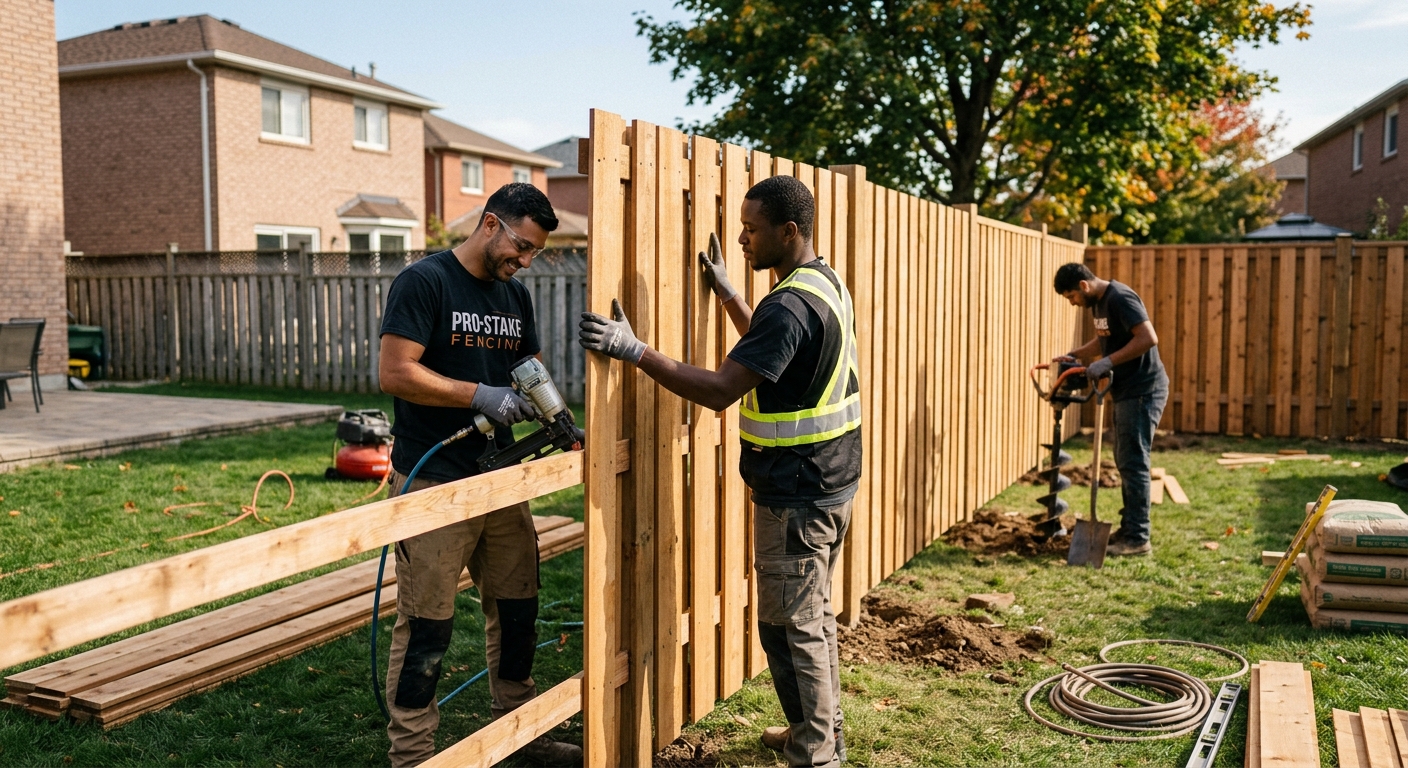
Fencing options and costs in Beechborough-Greenbrook
Beechborough-Greenbrook is a friendly, residential pocket of the Toronto economic region, with homeowners numbering around 6,577 people (Statistics Canada, 2021 Census). In practical terms, that stable owner-occupied mix tends to keep steady demand for boundary fencing, especially along older side-lot lines where backyards get upgraded for privacy and pet safety. Because the GTA’s housing stock is long-established, you’ll also see frequent fence replacements where boards have warped or posts have loosened after years of freeze-thaw cycles.
Pricing here is driven by Ontario’s climate realities: frost heave risk is a major cost driver. Contractors typically plan for the frost line at roughly 42"–48" in Southern Ontario, which means holes are often deeper—commonly set about 3.5–4 feet—to hold posts steady on mixed clay and loam soils. For taller 6–8 ft privacy fences, that usually pushes projects toward concrete-set posts and heavier hardware so panels resist racking and wind-driven movement.
In neighbourhood pockets such as the Beechborough Village side of the community, fence work is especially in demand when homeowners add privacy screens, pet runs, or gate upgrades. You’ll usually see quote differences based on access (gate locations, driveway width, need for haul-off), and how much old fence removal is required before new posts and rails go in.
Below is a homeowner-friendly comparison of common materials, expected performance, and typical installed pricing for Beechborough-Greenbrook—then you can match options to your budget and timeline.
| Material |
Lifespan |
Maintenance |
Privacy Rating |
Price per Linear Foot |
| Pressure-treated pine (standard wood) |
10–15 years |
Stain/seal every 2–3 years; inspect posts yearly |
High (solid boards) |
$65–$120 |
| Cedar (natural rot resistance) |
15–25 years |
Seal every 2–4 years (grey weathering still possible) |
High (solid boards) |
$85–$135 |
| Vinyl / PVC (no-maintenance) |
25–30 years |
Wash as needed; check gate hardware |
High (solid panels) |
$75–$130 |
| Chain-link (galvanized steel) |
20–35 years |
Rinse/inspect tension and corner posts |
Low–Medium (privacy inserts optional) |
$45–$85 |
| Aluminum ornamental |
30–40 years |
Occasional rinse; tighten hardware |
Low–Medium |
$90–$160 |
| Composite / recycled material |
20–30 years |
Minimal; follow manufacturer cleaning guidance |
High (depending on slat/board design) |
$95–$155 |
Prices are estimates only and vary by project scope, site access and material selection.
What affects the price of fencing in Beechborough-Greenbrook
In Beechborough-Greenbrook, you’ll commonly see fence quotes for the “same” job land 30–50% apart across the Toronto area and wider Ontario. The gap usually isn’t the material alone—it’s how deep the posts must be set, what kind of end/corner structure is required, whether concrete-set foundations are included, and how much labour goes into removal, re-lining, and gate hardware.
First, frost line depth sets how deep posts must go. In cold Ontario winters, posts are often installed about 4–6 inches below the design frost depth to prevent heaving. In practice, that commonly means setting posts about 1.5–2.0 m into the ground. Once you move to 6–8 ft privacy heights, that deeper hole requirement plus heavier rails and posts increases both material (longer posts, more hardware) and labour time (excavation and concrete volume). That’s why wood privacy fences often land near the mid-range of the wood band (for example, roughly $65–$120 per linear foot), while upgraded systems such as vinyl privacy may price higher to reflect panel and post specifications (often within $75–$130 per linear foot).
Second, local wind exposure affects construction. While the GTA is not as windy as prairie open fields, taller solid panels still need closer post spacing (commonly 6–8 ft centres) to reduce racking and uplift. Third, soil mix matters: clay can hold moisture and increase freeze-thaw stress, while better-drained sites can reduce instability. In Beechborough-Greenbrook, projects on wetter low spots often require additional footing attention to keep posts plumb.
Concrete examples from the neighbourhood: a straight run with good access and minimal grading typically reduces labour by simplifying layout and rail alignment; a yard with a slope or retaining edge may require stepped/raked panels, extra labour, and potentially upgraded post layout. If you’re demolishing an old fence and hauling it away, disposal plus extra time for careful post extraction can add noticeable cost. When you add gate count—especially a drive-through double gate—you’ll see the structural hardware and alignment work reflected in the final number.
| Price Factor |
Why It Matters |
Cost Impact |
| Fence length in linear feet — the primary cost driver |
Materials and labour scale directly with footage |
Major |
| Post depth required — frost line determines post length and hole depth |
Deeper set equals more excavation and concrete |
Major |
| Post setting method — concrete vs. gravel pack vs. driven posts |
Concrete-set improves long-term stability in clay/mixed soils |
Medium–Major |
| Material choice — vinyl vs. cedar vs. chain-link |
Different components, hardware, and longevity targets |
Medium |
| Gate count and type — walk-through vs. drive-through (double) |
Gates require heavier posts, bracing, and precise alignment |
Major for double gates |
| Grade and terrain — sloped yards require stepped or raked panels |
Extra cuts, rail adjustments, and layout time |
Medium |
| Old fence removal and disposal |
Extraction time, landfill fees, and potential concrete footing breaks |
Medium–Major |
| Permit fees and survey / property line locate |
Some heights or boundary work triggers administrative steps |
Low–Medium (but can be decisive) |
Permits & regulations in Ontario
In Ontario, fence rules are usually tied to height thresholds and local setback bylaws, and they can require a building permit depending on your location and how the fence is classified. In the Toronto area, a common guideline homeowners plan around is that fences above about 2.0 m (6.5 ft) at the rear and roughly 1.0–1.2 m (3–4 ft) at the front or corner often trigger permitting requirements. Even when a permit isn’t required, the fence still has to respect property lines and any municipal setback requirements.
Before you dig any post holes, call for utility locates (Ontario One Call). This is non-negotiable—buried services and irrigation lines are common in established Toronto neighbourhoods. Next, get a survey or a proper property pin locate so your contractor can measure from the correct boundary. That helps avoid encroachment disputes, especially where older fences may have been placed inconsistently over the years.
Shared fence ownership is also a key homeowner consideration. Boundary fences are often governed by provincial line-fences principles—meaning responsibility can be shared depending on the fence location and the “who built/maintains” facts for that boundary.
How to verify a contractor for Beechborough-Greenbrook: check their Ontario licence status through official provincial online resources, request a current certificate of liability insurance (and verify the expiry date and coverage limits), and confirm whether they provide WSIB coverage documentation where applicable. A certificate of insurance and, if provided, a WSIB clearance letter should align with the work scope and dates. Ask for these before work starts so you’re protected if delays or site incidents occur.
Choosing the right fence material for Beechborough-Greenbrook
Choosing a fence material in Beechborough-Greenbrook is mostly about matching your priorities—privacy, low maintenance, budget, and lifespan—to Ontario’s freeze-thaw climate. Pressure-treated pine is the budget-friendly route, but it needs staining or sealing every 2–3 years to limit grey weathering and surface checking. Cedar has better natural rot resistance and typically looks warmer and more “finished,” yet it still benefits from periodic sealing for best appearance and longevity. Vinyl/PVC is popular for low upkeep because it doesn’t require painting, but in extreme cold it can become brittle and may require proper installation technique and compatible hardware. Chain-link is the lowest upfront cost and often the longest-lived option for a secure perimeter, though it offers limited privacy unless you add slats or vegetation. Aluminum ornamental fencing is attractive and rust-resistant, with mid-range pricing, but it’s not a privacy fence by design.
Ontario’s frost line is a practical equalizer: regardless of material, Toronto-area best practice usually means concrete-set posts for long-term stability, especially for taller privacy designs. That deeper installation—often around the 3.5–4 ft range in Southern Ontario planning—keeps posts from shifting during winter heave. For solid fences, wind and snow loading considerations also influence post size and spacing; closer spacing reduces racking when snow drifts push sideways or when spring storms hit.
To justify price differences: if you’re choosing between standard pressure-treated wood and vinyl privacy, you might compare wood near $65–$120 per linear foot versus vinyl around $75–$130. The extra cost for vinyl is often worth it when you want fewer maintenance weekends and more consistent appearance over 20+ years. If you prefer a natural look and can maintain it, cedar can be a strong middle ground, particularly on visible backyard boundaries where aesthetics matter.
| Material |
Cold Tolerance |
Lifespan |
Annual Maintenance |
Best For |
Price Band |
| Pressure-treated pine |
Good (with proper sealing and post protection) |
10–15 years |
Inspect yearly; stain/seal every 2–3 years |
Lower upfront cost with planned upkeep |
$65–$120 |
| Cedar |
Good (naturally rot resistant) |
15–25 years |
Inspect yearly; seal every 2–4 years |
Better natural look + moderate maintenance |
$85–$135 |
| Vinyl / PVC |
Good when installed with correct expansion allowances |
25–30 years |
Wash as needed; check gate hardware |
Low maintenance privacy |
$75–$130 |
| Chain-link |
Very good (metal durability) |
20–35 years |
Inspect tension and post caps occasionally |
Security on a budget (privacy with inserts) |
$45–$85 |
| Aluminum ornamental |
Very good (powder-coated systems) |
30–40 years |
Rinse/inspect hardware; touch-ups if needed |
Curb appeal without rust concerns |
$90–$160 |
| Composite / recycled material |
Good (follow manufacturer cold-weather specs) |
20–30 years |
Minimal; periodic cleaning |
Premium look with low maintenance |
$95–$155 |
How to choose a fencing contractor in Beechborough-Greenbrook
Choosing the right contractor in Beechborough-Greenbrook starts with proof. In Ontario, verify licensing status through the appropriate online registry, and ask for a certificate of liability insurance showing active coverage for the current term. For workers on your property, request WSIB/WCB coverage documentation (or the contractor’s clearance letter where applicable) so you know the trades involved are properly covered. Don’t accept “it’s covered” verbally—ask to see the certificate and confirm the policy dates and coverage amount match the scope of work.
Then get 2–3 written quotes that are genuinely itemised. Ask for a labour-and-material breakdown that includes post materials, rails, fasteners/hardware, removal and disposal, and any concrete footing allowance. A lump-sum quote with no post-setting or hardware detail is hard to compare—especially when concrete-set posts are required for frost stability in Southern Ontario. Also confirm what’s excluded: permit pull (if needed), tree cutting/root pruning, landscaping restoration, and whether they replace damaged sod or only level the grade.
Warranty matters in fencing because your risk is long-term movement and hardware failures, not just “materials.” Request the workmanship warranty length (and whether it covers post wobble, loose rails, and gate sagging), plus the manufacturer product warranty for the fence system. Ask if warranties are transferable to future owners, which can matter if you sell.
Payment schedule should be conservative: never pay more than 10–15% upfront. Hold back a portion until completion and final hardware checks.
Finally, ask for a start date and a completion estimate in writing, including weather-related contingency. Toronto-area freeze-thaw and rain can delay post holes and concrete pours, so a realistic timeline protects you.
- Provide Ontario licensing details or registry confirmation on request.
- Show a current liability insurance certificate (verify policy dates and coverage limits).
- Provide WSIB/WCB clearance documentation where applicable.
- Give itemised quotes: posts, rails, concrete allowance, hardware, labour, and disposal.
- State the post-setting method clearly (concrete-set versus gravel pack versus driven posts).
- Include gate specs: number of hinges/latches, bracing, and how they’ll prevent sag.
- Confirm whether permit fees (if required) and boundary locate/survey are included or extra.
- List exclusions in writing (tree roots, uneven grade, landscaping repair, concrete removal).
- Confirm colour/finish and whether cedar/vinyl/wood is installed with compatible fasteners.
- Provide a workmanship warranty and the exact coverage (posts, rails, alignment, gates).
- Use a staged payment plan: max 10–15% upfront; remaining tied to completion.
- Have a signed site plan with measurements and agreed fence line before digging.
Concrete red flags I look for in fencing contractors serving Beechborough-Greenbrook: (1) no written post-depth plan and no mention of frost-stable footings; (2) quoting too low without showing concrete, longer posts, or removal/disposal—then “change orders” appear; (3) refusing to provide proof of liability insurance or WSIB/WCB clearance; (4) vague warranties that don’t address post movement or gate sag; and (5) asking for large deposits (more than 20%) before any materials or layout are confirmed.
Frequently asked questions — fencing in Beechborough-Greenbrook
How long does a wood fence last in Beechborough-Greenbrook?
In Beechborough-Greenbrook, a well-built pressure-treated wood fence usually lasts around 10–15 years, while cedar can often stretch to about 15–25 years when it’s installed correctly and maintained. Longevity depends heavily on Ontario freeze-thaw performance: posts need to be set deep enough to prevent movement during winter heave, and fasteners must be corrosion-resistant. If the fence is a tall privacy style (6–8 ft), wind-driven racking can loosen rails faster if spacing is too wide. If you’re budgeting, expect pressure-treated pricing roughly in the wood band of $65–$120 per linear foot, but plan for periodic staining/sealing every 2–3 years to keep appearance and reduce surface checking.
Who owns and maintains a shared fence?
For shared fences in Ontario, ownership and maintenance are typically based on boundary line-fence principles and the actual facts of who built and maintains the fence on the boundary. In practice, many neighbours share the cost or upkeep, but the agreement may be informal unless there’s documentation or a clear understanding between parties. If there’s conflict, the key is to clarify the fence location against property line markers and to review any prior agreements you can obtain from both sides. Before starting a replacement in Beechborough-Greenbrook, it’s smart to talk with your neighbour early and, where appropriate, put the plan in writing (scope, cost split, material choice). That reduces misunderstandings—especially if one side wants a higher/privacy design.
How do I find my property line before fencing?
The safest method is to locate property pins with a survey or professional locate, then measure from those exact points for your fence layout. In established Toronto-area neighbourhoods, older fences sometimes don’t sit perfectly on the current boundary, which can lead to disputes if you build “off the fence line you see.” Start by checking any survey documents you already have; if you don’t, schedule a locate or order a new survey so your contractor can mark the line accurately. Before any post hole digging in Ontario, you also need utility locates through Ontario One Call so you don’t strike buried services. Doing these steps first typically avoids expensive rework and keeps your contractor’s install aligned to the correct boundary.
What's the most low-maintenance fence?
For most homeowners in Beechborough-Greenbrook, vinyl/PVC and properly installed aluminum are the lowest-maintenance options. Vinyl typically needs only periodic washing and occasional hardware checks for gates; it doesn’t require staining like wood. Aluminum ornamental fences also resist rust and usually only need rinsing and tightening. Chain-link is also low maintenance but doesn’t provide privacy unless you add inserts or landscaping. If you want a solid privacy look without routine staining, vinyl usually hits the best balance, and its common installed range is often around $75–$130 per linear foot. The trade-off is higher upfront cost versus pressure-treated pine, which is more budget-friendly but needs more routine upkeep.
How tall can my fence be in Beechborough-Greenbrook?
Height rules in Ontario are often tied to front/corner versus rear placement and whether a permit is needed. A practical guideline many homeowners follow in the Toronto area is that rear fences above roughly 2.0 m (6.5 ft) may require a building permit, while front/corner fences commonly have lower thresholds—often around 1.0–1.2 m (3–4 ft). Even when your fence height is allowed, it must still respect property line requirements and any municipal setback bylaws. Because exact requirements can vary by location, your contractor should confirm the applicable rules before you order materials. In Beechborough-Greenbrook, taller privacy fences also need stronger post spacing and stable footings to handle wind and Ontario freeze-thaw conditions.
Should fence posts be set in concrete here?
In Southern Ontario, including Beechborough-Greenbrook, concrete-set posts are the usual best practice for long-term stability—especially for 6–8 ft privacy fences and for yards with clay or mixed soils. The reason is frost heave: contractors plan post holes deep enough to sit below the frost line, commonly around 3.5–4 feet deep in practice, so the base stays stable through winter cycles. Concrete helps lock the post in place and reduces shifting that leads to leaning panels and sagging gates. While some sites can work with other methods under specific conditions, a concrete-set approach is often recommended because it improves durability and reduces early failures. If you’re comparing quotes, look for explicit concrete footing details—this is a common reason prices differ.