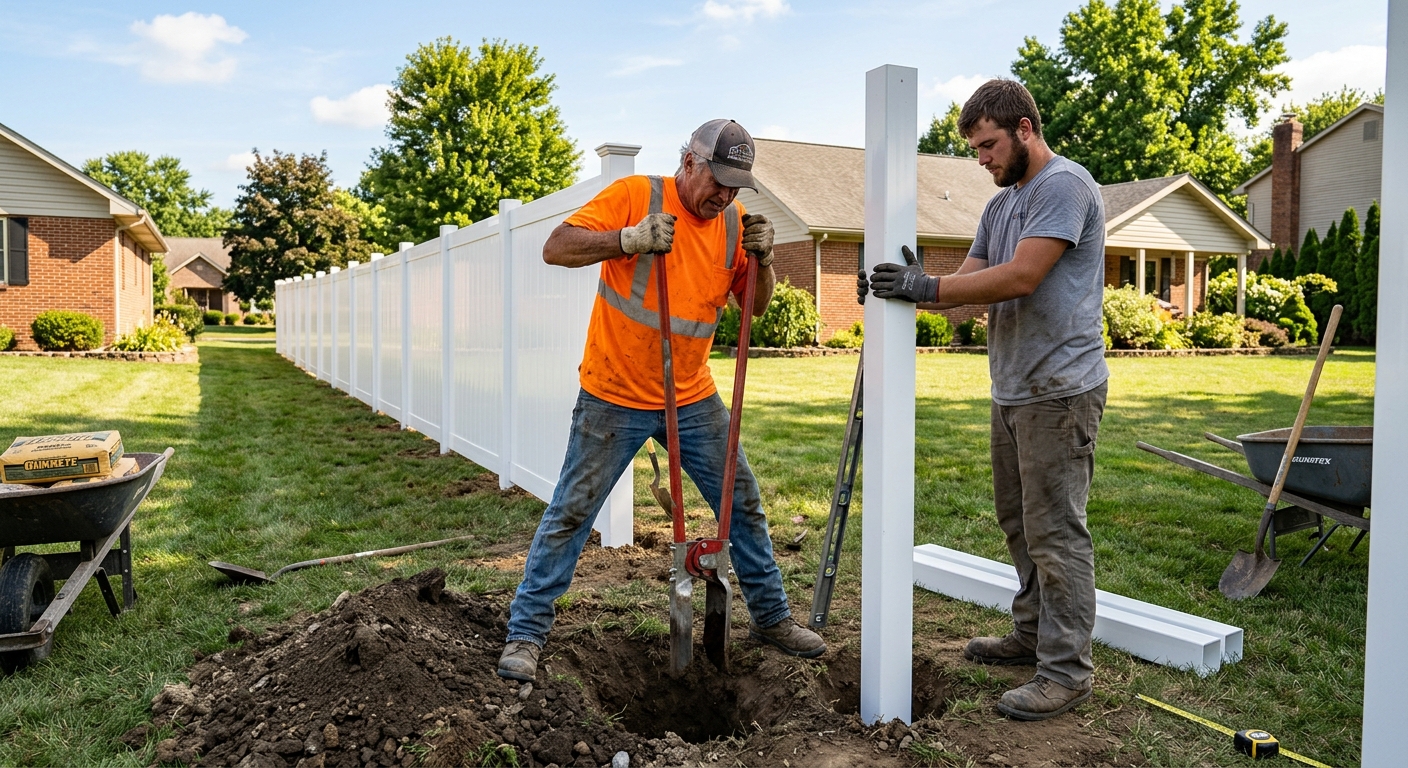
Fencing options and costs in Mount Olive-Silverstone-Jamestown
In Mount Olive-Silverstone-Jamestown, fencing demand follows what’s happening in the broader Toronto market—most notably the area’s large, established population of 32,954 residents (Statistics Canada, 2021 Census). In practical terms, more homes means more backyard renovations, new infill projects, and property boundary upgrades, especially where homeowners are trying to improve privacy for pools, gardens, and home offices.
Toronto-area properties typically expect a neat finished look, but the real cost driver is what the ground and weather require. Southern Ontario’s frost line is commonly estimated at about 42″–48″, so contractors usually set fence posts deeper (often 3.5–4 ft) and frequently use concrete-set posts to reduce long-term movement. That adds labour time and concrete/ready-mix costs, yet it prevents the leaning and gaps many people see after freeze-thaw cycles.
In neighbourhoods closer to the busier corridors and where yards feel more exposed—like the edges of the community around Silverstone and the Jamestown side—wind and seasonal yard drainage can push people toward heavier privacy panels, tighter post spacing, and stronger hardware. If you’re comparing options, start with the price bands that match your material choice, then verify post depth, gates, and removal scope. The table below outlines typical lifespan, privacy performance, and pricing for common materials in Mount Olive-Silverstone-Jamestown.
| Material |
Lifespan |
Maintenance |
Privacy Rating |
Price per Linear Foot |
| Pressure-treated pine (standard wood) |
10–15 years |
Stain/seal every 2–3 years |
High (good coverage with solid panels) |
$65 – $120 |
| Cedar (natural rot resistance) |
15–25 years |
Light staining/refresh every 2–4 years |
High (solid boards) |
$85 – $135 |
| Vinyl / PVC (no-maintenance) |
25–35 years |
Wash only (no staining) |
High (solid or semi-solid panels) |
$75 – $130 |
| Chain-link (galvanized steel) |
20–30 years |
Occasional rinse and hardware check |
Low (uses visibility) |
$45 – $85 |
| Aluminum ornamental |
30+ years |
Rinse; touch-up as needed |
Low to Medium (decorative pickets) |
$90 – $160 |
| Composite / recycled material |
20–30 years |
Minimal washing; inspect hardware |
High (solid style) |
$95 – $160 |
Prices are estimates only and vary by project scope, site access and material selection.
What affects the price of fencing in Mount Olive-Silverstone-Jamestown
For the same fence line in Mount Olive-Silverstone-Jamestown and the wider Toronto region, two quotes can differ by 30–50% because fencing pricing isn’t just material—it’s excavation depth, post setting method, wind-loading hardware, and how difficult your yard is to work in. In fast-moving GTA seasons, scheduling and crew availability can also affect labour rates, especially for privacy fences that need heavier posts and more bracing.
Start with the ground. Toronto’s frost line is commonly set around 42″–48″, and best practice is to set posts about 4–6 in below the design frost depth to prevent frost heave. In cold Ontario conditions, that typically means hole depths that land roughly 1.5–2.0 m into the ground—longer posts, deeper excavation, and often concrete-set footings rather than gravel packs. That alone can move a wood fence from the lower end of the $65–$120 range toward the mid-range once concrete, labour, and waste are included.
Next is wind behaviour and how the panels “rack” when loaded by storms. While the GTA doesn’t face Prairie open-field gusts, solid privacy fences still need proper post spacing (often 6–8 ft centres depending on height and framing) and good hardware to resist uplift. For higher privacy builds, heavier materials (cedar, vinyl, composite) and stronger post frames usually increase costs versus chain-link’s lighter engineering needs.
Two common examples in our area: (1) clay-heavy spots with poor drainage often require additional ground work and thicker concrete footing mixes; (2) yards with mature trees or narrow side access increase labour time for hauling boards and setting forms. If you’re replacing an old fence, disposal and demolition can add hundreds to over a thousand dollars depending on volume and accessibility—pushing projects above the lower end of the $75–$130 vinyl band or the $45–$85 chain-link band.
| Price Factor |
Why It Matters |
Cost Impact |
| Fence length in linear feet |
Most materials and labour scale directly with footage |
Major driver of total cost |
| Post depth required — frost line determines post length and hole depth |
Deep frost protection increases excavation and concrete |
Often pushes you from “budget” to “installed” pricing |
| Post setting method — concrete vs. gravel pack vs. driven posts |
Concrete-set posts improve stability in Ontario soils |
Concrete can add meaningful material and labour time |
| Material choice — vinyl vs. cedar vs. chain-link |
Product cost and framing requirements vary widely |
Can shift total budget by $/ft bands |
| Gate count and type — walk-through vs. drive-through (double) |
Gates require heavier posts, hardware, and alignment |
One drive-through gate can add a large portion of the job’s cost |
| Grade and terrain — sloped yards require stepped or raked panels |
More cutting, longer layout time, and extra hardware |
Increases labour; may change framing |
| Old fence removal and disposal |
Demolition adds labour and tipping fees/disposal logistics |
Can add hundreds to over a thousand |
| Permit fees and survey / property line locate |
Some fence heights and locations trigger permits and verified lines |
Added administrative and professional costs |
Permits & regulations in Ontario
In Ontario, fence permit requirements depend on height and where the fence sits on your lot. As a practical rule of thumb for Mount Olive-Silverstone-Jamestown homeowners, fences above a threshold—commonly around 2.0 m (6.5 ft) for rear yards and 1.0–1.2 m (3–4 ft) for front or corner locations—often require a building permit. Regardless of permit status, you must respect property lines and any municipal setback rules that apply to your address.
Before you dig any post holes, arrange for utility locates (Ontario One Call). If you’re unsure where your property pins/limits are, obtain a survey or have a property line locate done so you don’t build on a neighbour’s land—encroachment disputes are among the most expensive “surprise” issues we see. Shared fence ownership and line-fence responsibilities follow provincial line-fences legislation, so it’s worth documenting who’s maintaining what and getting neighbour agreement in writing where applicable.
What typically requires a permit: building a new fence above height thresholds and fences that fall under specific municipal requirements. What typically does NOT require a permit: replacing a fence in the same location and similar height/appearance, as long as it meets local bylaw requirements—still confirm with your municipality before starting.
To verify a contractor, check: (1) Ontario licensing/registration details via the appropriate provincial contractor registry entry if applicable for their trade scope; (2) a current certificate of liability insurance naming you as additional insured where offered; and (3) WSIB/WCB coverage—ask for clearance/coverage documents and confirm they’re valid for the project dates. A reputable contractor will provide copies up front.
Choosing the right fence material for Mount Olive-Silverstone-Jamestown
Choosing the right fence material in Mount Olive-Silverstone-Jamestown is about matching your priorities—privacy, low maintenance, budget, and realistic lifespan—to how Ontario weather stresses materials. Pressure-treated pine is the budget-friendly start, but the boards weather: you’ll typically need staining or sealing every 2–3 years to slow greying and protect the surface. Cedar looks better longer because of its natural rot resistance, yet it still benefits from periodic maintenance (often every 2–4 years, depending on sun exposure and moisture). Vinyl/PVC offers the most “set it and forget it” experience with washing rather than staining, but in extreme cold it can become more brittle if installed with poor spacing or if posts aren’t set correctly. Chain-link is the longest-lasting low-cost option and works well for pet runs and boundary marking, but it won’t provide privacy unless you add slats or landscaping. Aluminum ornamental balances appearance and durability with minimal rust risk, but it’s not a privacy fence by design. Composite/recycled panels can deliver strong privacy with minimal maintenance, though cost is usually closer to premium materials.
For Toronto conditions, frost protection matters no matter which material you choose. With an estimated frost line around 42″–48″, posts are commonly set deep enough to avoid heaving; in practice, that usually means concrete-set posts for typical privacy fence builds. If you choose a lighter material but the excavation depth and setting method are the same, you’ll still pay for proper installation.
A concrete example: if a 50 ft privacy fence is quoted at the wood band ($65–$120) and a vinyl install lands in the vinyl band ($75–$130), the cost gap may not be justified if you’re willing to maintain wood. But if you want decades with less upkeep, vinyl or composite often becomes the better value—especially when you factor repeat maintenance and the labour of repairing boards after freeze-thaw movement.
| Material |
Cold Tolerance |
Lifespan |
Annual Maintenance |
Best For |
Price Band |
| Pressure-treated pine |
Good with proper sealing and solid post depth |
10–15 years |
Inspect; plan stain/seal every 2–3 years |
Budget-first privacy with straightforward upkeep |
$65 – $120 |
| Cedar |
Good; resists rot where moisture exposure is high |
15–25 years |
Inspect; refresh stain every 2–4 years |
Better appearance and rot resistance |
$85 – $135 |
| Vinyl / PVC |
Very good if installed with correct bracing/allowance for contraction |
25–35 years |
Wash/rinse; check fasteners and level |
Low maintenance privacy in Ontario winters |
$75 – $130 |
| Chain-link |
Excellent; galvanized steel tolerates freeze-thaw |
20–30 years |
Occasional rinse; check tension and posts |
Security and pets with minimal cost |
$45 – $85 |
| Aluminum ornamental |
Excellent; no rust with typical exposure |
30+ years |
Light cleaning and hardware inspection |
Attractive boundaries without privacy |
$90 – $160 |
| Composite / recycled |
Good; performs well when posts are set correctly |
20–30 years |
Minimal washing; inspect hardware |
Privacy with reduced maintenance |
$95 – $160 |
How to choose a fencing contractor in Mount Olive-Silverstone-Jamestown
Choosing a contractor in Mount Olive-Silverstone-Jamestown should start with proof, not promises. First, confirm Ontario coverage and compliance: ask for their certificate of liability insurance (and verify policy validity dates), plus WSIB/WCB clearance or evidence of active coverage for workers on your site. Don’t accept “we’re covered” without documents—legitimate contractors will provide a copy of insurance and coverage paperwork before signing.
Next, request 2–3 itemised written quotes instead of one lump sum. Ideally the breakdown shows labour, excavation, post setting (including concrete), fencing materials, gate hardware, brackets/bracing, and any site prep. It should also specify what’s included for grading and how they handle slopes—stepped or raked panels—so you can compare like-for-like. Watch for exclusions like “permit not included,” “disposal extra,” or “soil not included,” which can quietly inflate the final price after the work is underway.
Warranty matters in fencing because Ontario freeze-thaw stresses everything. Make sure you get two warranties clearly stated: (1) workmanship warranty length (how long they stand behind installation), and (2) product/manufacturer warranty coverage (what’s covered and what voids it). Ask if the warranty is transferable if you sell your home.
On payments, never pay more than about 10–15% upfront. A practical approach is to hold back the balance until completion and final walkthrough. Also, require a written start date and an estimated completion timeline so you’re not stuck waiting mid-project.
- Provide proof of liability insurance before scheduling
- Provide WSIB/WCB clearance or coverage evidence
- Quote includes post depth and setting method (concrete-set vs gravel pack)
- Itemise gates separately (walk-through vs double drive-through)
- Confirm how they’ll handle sloped yards (stepped/raked panels)
- State whether permit pulling is included (when required)
- Specify demolition and disposal inclusions for old fence removal
- Show hardware details (hinges, latches, brackets) not just “standard”
- List materials and grades (e.g., pressure-treated grade, cedar thickness)
- Provide a workmanship warranty in writing
- Use a clear payment schedule with holdback until completion
- Schedule includes utility locate and mark-up of dig points
Red flags we commonly see in fencing jobs around Mount Olive-Silverstone-Jamestown: quoting without stating post depth or footing method; refusing to provide insurance/WSIB/WCB proof; offering only a lump sum with unclear inclusions; demanding a large upfront deposit (well over 15%); and starting excavation before utility locates or without confirming property line assumptions.
Frequently asked questions — fencing in Mount Olive-Silverstone-Jamestown
How do I handle a fence dispute with a neighbour in Ontario?
In Ontario, fence disagreements usually come down to property line location and responsibility for maintenance. Start by documenting everything: take photos of both fence lines, keep any prior correspondence, and measure distances from obvious reference points. If there’s any doubt about the boundary, get a survey or property line locate (pins) before you spend more money. For disputes tied to shared boundaries, Ontario’s line-fences legislation framework is often the reference point for responsibilities and cost-sharing—your best next step is to speak with a professional familiar with line-fence situations. Avoid unilateral removal of a neighbour’s portion unless you have a clear legal basis. If you’re in Mount Olive-Silverstone-Jamestown and the fence is above typical height thresholds near corners or front yards, confirm permit and bylaw requirements before making changes.
What fence style offers the best wind resistance in Mount Olive-Silverstone-Jamestown?
For Mount Olive-Silverstone-Jamestown, the “best” style for wind is usually the one built with proper post depth, correct spacing, and bracing—not just the material. Solid privacy fences can catch wind like a sail, so the key is heavier framing, tighter post spacing (commonly 6–8 ft centres depending on height), and sturdy gate hardware. In practice, a well-built wood privacy fence (often in the $65–$120 range) can perform very well when posts are concrete-set and hardware is rated for uplift. Vinyl and composite privacy can also handle wind well, but poor installation—like shallow post holes or wide spacing—causes racking and panel failure. If your yard is more exposed, consider a slightly more open design (or add kickers/diagonal bracing) where privacy allows.
How much does a fence cost in Mount Olive-Silverstone-Jamestown?
Fence cost in Mount Olive-Silverstone-Jamestown depends mostly on linear footage, fence height, gates, and how deep posts must be set for frost protection. In the Toronto region, many installed projects fall within common material price bands: chain-link often lands around $45–$85 per linear foot, while wood privacy is commonly $65–$120. Vinyl/PVC privacy typically sits around $75–$130, and aluminum ornamental is often higher at $90–$160 due to hardware and labour. Quotes can vary because concrete-set posts and deeper excavation increase labour and ready-mix costs, especially where soil conditions are challenging or where slopes demand extra layout time. Always ask for an itemised estimate so you can see excavation, concrete, materials, and gate inclusions.
How deep should fence posts be for Mount Olive-Silverstone-Jamestown's frost?
In Southern Ontario, contractors commonly treat the design frost line as about 42″–48″. To reduce frost heave risk, the usual best practice is to set fence posts so the bottom of the post sits roughly 4–6 inches below the design frost depth. In practical terms, that often lands around 1.5–2.0 m into the ground for typical privacy fence builds, depending on exact conditions and the fence height. For most stable results in Mount Olive-Silverstone-Jamestown, concrete-set posts are strongly recommended rather than simple driven posts—particularly in clay and mixed soils. Ask your contractor to specify hole depth, post length, and whether they’re using concrete to lock the footing in place.
Wood vs vinyl vs aluminum fence — which is best?
“Best” depends on what you want most. Wood (pressure-treated pine or cedar) can be a strong value and offers excellent privacy with solid panels; pressure-treated wood often fits the $65–$120 band but generally needs staining/sealing every 2–3 years to maintain appearance and limit weathering. Cedar costs more but can last longer with better natural rot resistance. Vinyl/PVC is a low-maintenance privacy option, typically in the $75–$130 range, with washing instead of staining—provided it’s installed with correct bracing and post setting for Ontario winters. Aluminum ornamental is durable and low-rust, usually in the $90–$160 range, but it doesn’t provide the same privacy because it’s designed for visibility. If privacy is your priority, vinyl/cedar/wood usually win; if durability with curb appeal matters most, aluminum is a great choice.
Do I need a permit to build a fence in Ontario?
In Ontario, you may need a permit depending on height and location. A common guideline for many municipalities is that fences above roughly 2.0 m (6.5 ft) at the rear and about 1.0–1.2 m (3–4 ft) at the front or corner often require a building permit. Even if a permit is not required, you still must comply with property line rules and municipal setbacks. Before digging, you must arrange utility locates through Ontario One Call. For Mount Olive-Silverstone-Jamestown, treat it as a “confirm first” situation: ask your contractor whether they’ll pull permits when required, and verify the plan for property line location (survey or locate) to avoid encroachment. A proper, written scope should also state whether permit costs are included and who is responsible.