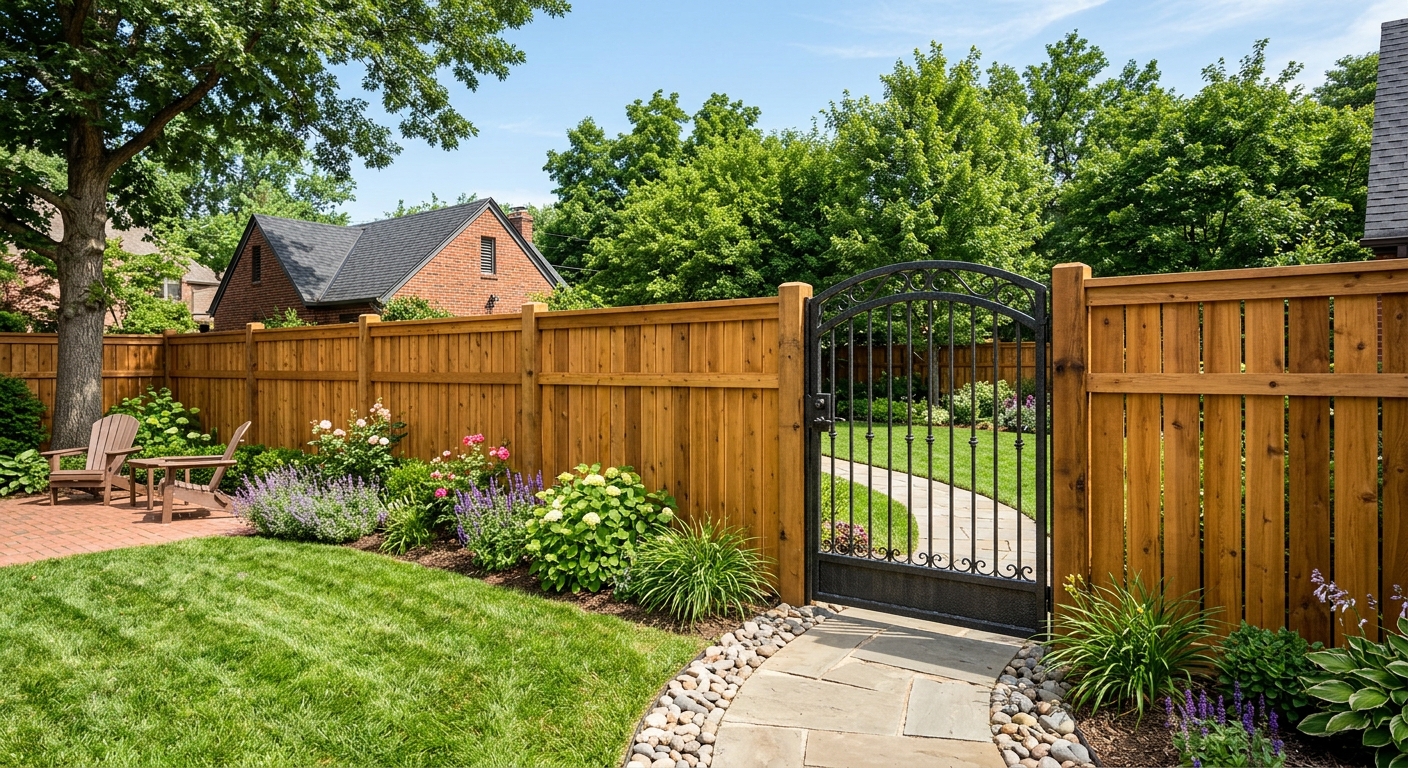
Fencing options and costs in Ingersoll
In Ingersoll, fence choices usually start with what you want the fence to do—privacy, security, or curb appeal—because the local housing mix is strongly weighted toward single-detached homes, which make up 71.2% of dwellings (Statistics Canada, 2021 Census). With 4,170 homeowner households (76.3% of households), there’s steady demand for replacement and boundary fencing across neighbourhoods. Many properties in town are also older (54.6% of homes built before 1981), so it’s common to see projects where posts have loosened after decades of freeze-thaw cycles and you’re replacing panels plus rebuilding footings.
In the London, Ontario region, pricing is shaped by frost depth and soil moisture. Contractors typically bury posts about 3 feet (roughly 0.9 m) in southern Ontario as a practical minimum, and where soils hold water (or where frost penetration is deeper), posts may be set deeper and in concrete to reduce heaving. That means labour and materials can rise quickly when access is tight, when holes need more concrete, or when clay-heavy ground requires extra spoil removal. If you’re near downtown Ingersoll or the north end along Oxford Street, installs often face narrower access from the laneway and more landscaping to work around—both factors that affect final cost and contractor availability.
Below is a cost-and-life comparison to help you decide which materials fit your budget and maintenance comfort level; then we’ll break down the biggest price drivers for Ingersoll projects.
| Material |
Lifespan |
Maintenance |
Privacy Rating |
Price per Linear Foot |
| Pressure-treated pine (standard wood) |
10–15 years |
Stain/seal every 2–3 years |
8/10 (board-on-board options) |
$40–$75 |
| Cedar (natural rot resistance) |
15–25 years |
Light staining or oil yearly or every 2–3 years |
9/10 (solid panel styles) |
$55–$95 |
| Vinyl / PVC (no-maintenance) |
20–30 years |
Rinse as needed |
8/10 (solid privacy styles) |
$60–$110 |
| Chain-link (galvanized steel) |
20–30 years |
Occasional washing; straightening as needed |
2/10 (security only) |
$25–$55 |
| Aluminum ornamental |
25–40 years |
Wash 1–2 times per season |
4/10 (open picket) |
$70–$120 |
| Composite / recycled material |
20–30 years |
Minimal—rinse and inspect annually |
8/10 (solid slats/boards) |
$75–$130 |
Prices are estimates only and vary by project scope, site access and material selection.
What affects the price of fencing in Ingersoll
In Ingersoll, two neighbours can receive quotes that differ by 30–50% for what looks like the “same fence” because contractors price for site conditions, not just the material on paper. In a London-area market, the biggest variables are how long the run is, how many corners and posts you have, and whether the job needs deeper frost-safe embeds, concrete setting, or extra labour to manage clay or waterlogged soil. Even within one municipality, access can change everything—wide equipment access versus hand-digging near shrubs, fences, or mature trees drives labour costs.
The frost line requirement is central. In cold Ontario, posts generally need to be set about 4–6 inches below the design frost depth to help prevent heaving during repeated freeze-thaw cycles. That commonly translates to deeper embeds (often in the 1.5–2.0 m range for certain setups or heavier soils), which can mean longer posts, more hole excavation, and more concrete if you’re going with concrete setting. Materials then scale with that labour: a wood run priced near the $40–$75 band can climb quickly if every post needs heavy embed work, while vinyl or PVC typically starts higher and becomes even more sensitive to post depth and gate complexity (often landing within the $45–$80 style regional range for many installs, depending on height and style).
In Ingersoll specifically, two common cost-impact examples are: (1) clay-heavy ground in wetter spots—holes take longer and disposal is more involved; and (2) yards built before 1981 with older shrubs, rock edging, or buried landscaping—can force careful excavation and reworking of foundations. If you’re replacing an older fence, removal and hauling add cost, but it also lowers future risk by allowing new posts to be set to current frost-safe practice.
| Price Factor |
Why It Matters |
Cost Impact |
| Fence length in linear feet |
Most costs scale directly with total footage |
High (primary driver) |
| Post depth required |
Frost line determines hole depth and post length |
High in freeze-thaw risk areas |
| Post setting method |
Concrete vs. gravel pack affects stability and labour |
Medium to high |
| Material choice |
Vinyl/cedar/aluminium have different installed costs and lifespan |
Medium to high (varies by style) |
| Gate count and type |
Drive-through/double gates require more hardware and stronger posts |
High if multiple gates |
| Grade and terrain |
Sloped yards require stepped frames or raked panels |
Medium |
| Old fence removal and disposal |
Hauling time and disposal fees add labour and costs |
Medium (can become high) |
| Permit fees and survey / property line locate |
Some projects need permits and locating to avoid boundary errors |
Low to medium |
Permits & regulations in Ontario
In Ontario, whether a permit is required typically depends on fence height and placement. As a practical rule used by many Ontario municipalities, fences above about 2.0 m (6.5 ft) at the rear and around 1.0–1.2 m (3–4 ft) at the front or corners often trigger a building permit requirement, especially when the fence is solid or changes sight lines near streets. Regardless of permit requirements, you must respect property lines and any municipal setback rules tied to your address.
Before digging any post hole, call for utility locates through Ontario One Call. This step is non-negotiable for homeowner safety and contractor readiness—damaged underground services can turn a straightforward job into a costly delay. Also consider obtaining a survey or at least a property pin locate so you know where your boundary actually sits; it prevents encroachment disputes and reduces the chance of “fence moved” rework.
Shared fence ownership is governed by Ontario’s line-fences framework—meaning the neighbour relationship and exact location matter if you’re building, repairing, or replacing a boundary fence.
To verify an Ontario contractor in Ingersoll, ask for their Ontario business information and check licensing details online (where applicable), request proof of liability insurance, and confirm WSIB coverage (or WCB coverage as it applies to workers under the proper coverage system). You can also request a clearance letter if they employ workers. Step-by-step: (1) ask for certificate of insurance, (2) confirm coverage limits, (3) request WSIB/WCB proof, (4) ensure the quote references who pulls permits (if needed) and who handles inspections or paperwork.
Choosing the right fence material for Ingersoll
Choosing the right fence material in Ingersoll is mostly about balancing privacy and appearance with how much maintenance you’re willing to do through Ontario’s wet-to-freeze cycles. Since many homes are detached (71.2% of dwellings), homeowners often want a longer boundary run—so small savings per linear foot can become big across a full yard line. At the same time, older homes (54.6% built before 1981) commonly have mature landscaping, uneven grades, and older fence footprints—conditions that make correct post depth and solid post-setting more important than the material alone.
Pressure-treated pine is usually the lowest upfront option, but it needs staining or sealing every 2–3 years to reduce grey weathering and surface cracking. Cedar looks great and resists rot better naturally, but it still benefits from periodic sealing to keep it looking even and to protect the surface through snowmelt and freeze-thaw. Vinyl/PVC is popular because it’s essentially low maintenance, yet extreme winter cold can be harder on thin sections—meaning you want proper framing and quality components. Chain-link is the most budget-friendly and lasts long, but it provides very little privacy unless you add screening plants or privacy slats. Aluminum ornamental gives long-life curb appeal with no rust, but it’s not a privacy fence. Composite/recycled options often sit in the mid-to-high price tier with good durability and low maintenance.
For frost-safe builds in the London region, posts often need frost-depth-aware embeds—sometimes with concrete setting—because moving posts drive panel sagging over time. If you’re comparing budgets, a wood privacy run might start around the $40–$75 per-foot band, while vinyl or PVC frequently lands higher; the extra can be justified if you value maintenance-free ownership and plan to stay in the home long enough to “amortize” the higher material cost.
| Material |
Cold Tolerance |
Lifespan |
Annual Maintenance |
Best For |
Price Band |
| Pressure-treated pine |
Good (with proper staining) |
10–15 years |
Inspect + reseal/stain as needed |
Budget privacy fencing |
$40–$75 |
| Cedar |
Good (natural rot resistance) |
15–25 years |
Light oil or stain upkeep |
Attractive privacy with less rot risk |
$55–$95 |
| Vinyl / PVC |
Very good (quality components matter) |
20–30 years |
Rinse; inspect fasteners |
Low-maintenance privacy |
$60–$110 |
| Chain-link |
Good |
20–30 years |
Wash + check tension/repairs |
Security where privacy isn’t required |
$25–$55 |
| Aluminum ornamental |
Excellent (no rust) |
25–40 years |
Wash 1–2 times per season |
Curb appeal and perimeter definition |
$70–$120 |
| Composite / recycled |
Good (designed for cold climates) |
20–30 years |
Minimal; annual inspection |
Durable privacy with reduced upkeep |
$75–$130 |
How to choose a fencing contractor in Ingersoll
When you hire a fencing contractor in Ingersoll, verify three things first: Ontario business accountability, liability insurance, and worker coverage. Start by asking for a certificate of insurance showing general liability limits and making sure the work includes fencing installation and site work (not just “materials”). Next, confirm WSIB/WCB coverage—request proof and, if they employ workers, a clearance letter where available. You can typically check contractor registration information through the appropriate Ontario online resources, then match the company name on the insurance certificate and quote so it’s the same legal entity.
Then get 2–3 itemised written quotes—ideally line-by-line for posts, concrete/setting method, panels/slats, gates, hardware, labour, and haul-off. Avoid a single lump-sum number; fencing often changes in the field once access conditions and post-hole requirements are confirmed. Read what’s excluded: removal of the old fence, disposal, permit pulls, and whether labour includes adjustments if the ground isn’t level. Ask who is responsible for locating property pins and how they confirm the boundary before building.
Warranty matters in fencing because workmanship problems usually show up after the first freeze-thaw season. Request the workmanship warranty length and confirm whether the manufacturer warranty for panels, rails, or vinyl components is included and whether it’s transferable if you sell. For payment, never pay more than 10–15% upfront. Use a holdback until completion and final clean-up, especially around gates and post alignment. Finally, require a written start date and a completion estimate tied to weather windows.
- Proof of general liability insurance (request the certificate) matching the company name on your contract
- WSIB/WCB coverage proof and/or clearance letter if workers are involved
- Itemised quote with post quantity, post spacing, and setting method (concrete vs. gravel pack)
- Written scope of what’s included: gates, hardware, colour selection, and hardware corrosion rating
- Confirm whether old fence removal and disposal are included
- Permit responsibility in writing (if a permit is required for your height/placement)
- Schedule: start date, install window, and expected completion timeline
- Material warranty and workmanship warranty details in writing
- Who handles survey/pin locate if you need boundary confirmation
- Payment schedule with holdback (no large deposits)
- Site access plan for Ingersoll driveways/laneways and debris clean-up
- Post-hole plan acknowledging frost-safe depth and soil conditions
Red flags to watch in Ingersoll: (1) a quote that doesn’t specify post depth or setting method, (2) no proof of liability insurance or unclear WSIB/WCB coverage, (3) “we’ll figure permits later” without written responsibility, (4) lowball pricing that excludes old fence disposal or gate hardware, and (5) pressure to pay most of the job upfront or no written contract with warranty terms.
Frequently asked questions — fencing in Ingersoll
What is the most weather-resistant fence for Ingersoll's climate?
For Ingersoll and the wider London region, the most weather-resistant choices are typically chain-link and aluminum for their long service life through freeze-thaw and wet winters. Both materials tolerate cold without the same rot issues wood can face, and they resist rust when installed with proper galvanized or powder-coated components. If you want solid privacy with weather resilience, vinyl/PVC and quality composite can also perform very well, but the install details (especially post setting below frost influence and sturdy gate framing) matter as much as the material. In budget comparisons, many homeowners start chain-link around $25–$55 per linear foot for security-focused runs, while aluminum ornamental commonly sits in the higher band of about $70–$120 per linear foot.
How do I prevent wood fence rot in Ingersoll?
Wood rot usually starts where moisture collects: at the bottom of posts, in joints that trap water, and where ground contact is too close. In Ingersoll, the key is frost-safe post installation—posts should be set below the frost influence and ideally installed so water drains away rather than pooling around the timber. Use the correct treated lumber rated for ground contact, and consider concrete setting for posts where soil stays damp (clay-heavy areas after snowmelt). For the fence boards, keep up staining/sealing on a 2–3 year cycle so the surface sheds moisture. Also, check annually for leaning posts and broken pickets; once the fence opens up, wind-driven rain reaches more wood and accelerates rot.
What is the cost per linear foot for fencing in Ingersoll?
Pricing in Ingersoll generally follows the material-driven bands, but your final number depends on post depth, gate count, removal/disposal, and site access. For example, chain-link is commonly the lowest at about $25–$55 per linear foot, while wood privacy installations are often estimated in the $40–$75 range for many residential projects. Vinyl/PVC typically runs higher (often $60–$110 per linear foot depending on height and style), and aluminum ornamental is usually in the $70–$120 band because of materials and heavier hardware. If your yard needs deeper frost-safe embeds or concrete setting in challenging soil, labour and materials can push the project toward the upper end of those ranges.
Should I repair or replace my old fence in Ingersoll?
Repair can make sense when the structure is mostly sound—straight rails, intact hardware, and only a few boards that are splitting or rotting. But in Ingersoll, many older fences show deeper problems after freeze-thaw: posts loosen, sagging panels appear, and bottom rails hold moisture against the ground. If you find multiple wobbly posts, repeated lean, or widespread rot near the soil line, replacement is usually the more cost-effective long-term choice because a new installation can reset posts to frost-aware depth and restore proper alignment. Also consider how much is “hidden” behind shrubs and gates; sometimes repairs look fine until the next winter cycle. A contractor should be able to assess post stability (not just the visible boards) and give you a clear compare-and-contrast plan.
How do I handle a fence dispute with a neighbour in Ontario?
Fence disputes in Ontario are often really boundary or responsibility disputes. In Ingersoll, start by confirming the location of property pins or getting a survey/locate if there’s any doubt about the boundary line. Keep everything calm and factual—use photos, measurements, and any existing fence agreements or correspondence. Ontario’s line-fences framework governs shared fence ownership and responsibilities, but the practical first step is to document what portion of the fence is on your side versus theirs. If a fence is on/near the boundary, agree on a plan for correcting it rather than patching indefinitely. If you can’t agree, talk to a mediator or seek appropriate legal guidance. Avoid moving a fence first without clarity, because correcting an encroachment later is more expensive than doing the locate upfront.
What fence style offers the best wind resistance in Ingersoll?
Wind resistance isn’t just about strength—it’s about how the fence handles airflow. In general, solid fences can act like sails if they’re built too “open” in the wrong way or if posts aren’t deeply set, which can contribute to movement during storms. A well-built privacy fence with proper post depth and strong rails (often with concrete-set posts where needed) can be very stable, but if you want maximum airflow through the system to reduce wind load, chain-link or open aluminum picket can perform better in high gust conditions. That said, the best outcome usually comes from correct spacing, solid corner bracing, and robust gate hardware. For many homeowners, a chain-link security fence in the $25–$55 per linear foot range plus screening plants can be a practical balance when you want less wind “catch” without going to a fully solid barrier.