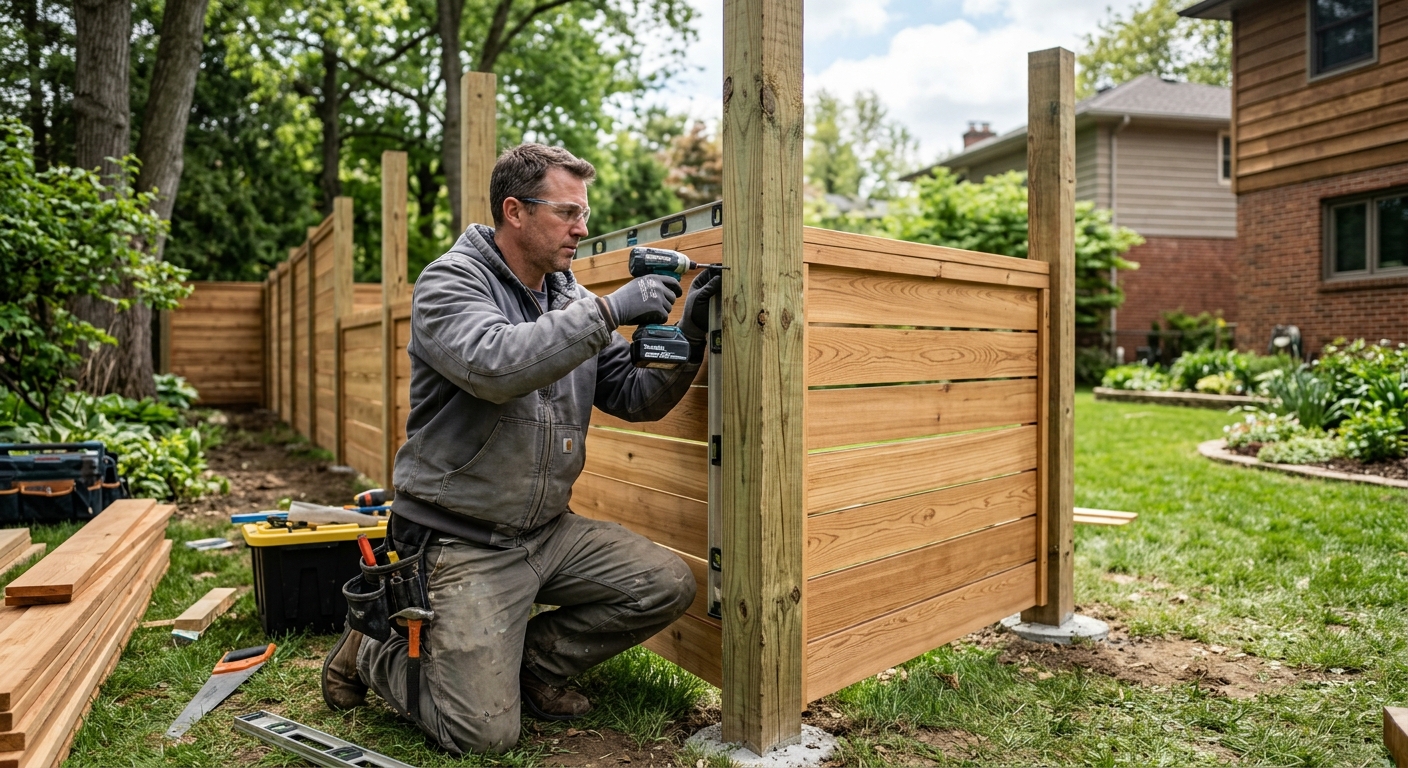
Fencing options and costs in Bracebridge
Bracebridge homeowners typically look for a fence that fits Muskoka reality: real privacy, solid posts, and materials that can handle freeze–thaw. With 5,755 homeowner households in the community (79.5% of households own), demand stays steady year-round—each single-detached property is often a long-term “keep and protect” purchase. The region’s housing stock also leans older; 46.4% of homes were built before 1981, so many yards have aging fences that need replacement, not just cosmetic fixes.
In Muskoka–Kawarthas, frost is a major cost driver. Our winters push the frost line to roughly 4 ft, which usually means setting posts about 42–48 inches deep to reduce frost heave and leaning over time. That affects not only labour, but also concrete quantity, excavation time, and sometimes longer boards and rails. In more exposed stretches—common near the lake and on open lots—you may also need stronger spacing and hardware, which nudges the per-foot price toward the top end of the band.
On the ground, we often see higher-intensity fence builds in neighbourhoods like Georgian Bay Estates and parts of Bracebridge’s more established residential pockets, where backyards tend to be deeper and gate installs are common. Once you know your preferred material, the range tightens; the table below gives a clear “what to expect” snapshot for common installed options.
| Material |
Lifespan |
Maintenance |
Privacy Rating |
Price per Linear Foot |
| Pressure-treated pine (standard wood) |
10–15 years |
Stain/seal every 2–3 years |
High (solid pickets/panels) |
$55–$80 |
| Cedar (natural rot resistance) |
15–25 years |
Light staining every 2–4 years (optional to let silver naturally) |
High (solid board configurations) |
$70–$95 |
| Vinyl / PVC (no-maintenance) |
20–30 years |
Wash as needed; no staining |
Medium to high (panel style dependent) |
$65–$95 |
| Chain-link (galvanized steel) |
20–30 years |
Rinse/inspect occasionally; tension checks |
Low to medium (screening optional) |
$40–$65 |
| Aluminum ornamental |
25–40 years |
Wash annually; inspect hardware |
Low (open pickets) |
$70–$110 |
| Composite / recycled material |
20–30 years |
Wash as needed; no painting |
High (board/panel systems) |
$80–$120 |
Prices are estimates only and vary by project scope, site access and material selection.
What affects the price of fencing in Bracebridge
In Bracebridge and the wider Muskoka–Kawarthas region, two quotes for the same “length of fence” can still differ by 30–50% once ground conditions, wind exposure, and the depth of post foundations are accounted for. Contractors in tighter-access backyards often spend more time on excavation, and longer posts mean higher material and more concrete. Labour also fluctuates across the region because crews may be booked solid during peak spring installs, especially when older fences built before 1981 are pulled and rebuilt at the same time.
The biggest technical driver is frost depth. Where Ontario frost can reach about 4 ft, posts generally need to be set 4–6 inches below the design frost depth to reduce heaving; in practical terms, that’s often 1.5–2.0 m into the ground. That depth affects everything: hole size, concrete volume, post length, and the number of truckloads for delivery. In colder years, or when the soil is clay-heavy and holds water, it can take longer for holes to be excavated and for concrete to cure properly.
Bracebridge yard exposure matters too. If you’re working near open lots or windier lake edges, we may tighten post spacing and use heavier rails and hardware to keep the fence from “working” in gusts. That can push a wood or vinyl install toward the high end of the $55–$80 (wood) or $65–$95 (vinyl) per-foot bands. By contrast, a sheltered in-town back lot with good access may land closer to the lower end.
Concrete examples: (1) clay pockets near older subdivisions often require careful augering and more labour time than sandy soil; (2) rock encountered during drilling can force rework or slower progress; (3) if you need a drive-through gate, the extra bracing and hardware usually adds cost beyond a simple walk gate—sometimes enough to shift the whole project upward by several thousand dollars even when linear feet stay similar.
| Price Factor |
Why It Matters |
Cost Impact |
| Fence length in linear feet |
Every material run and every post is calculated per foot |
Primary driver; typically scales directly |
| Post depth required |
Frost line determines hole depth and required post length |
Can significantly raise material + concrete costs |
| Post setting method |
Concrete, gravel pack, or driven posts change labour and longevity |
Concrete-set posts usually cost more but perform better in freeze–thaw |
| Material choice |
Vinyl vs. cedar vs. chain-link have different install complexity and component costs |
Mid-to-high variance across $40–$110+ per foot |
| Gate count and type |
Walk-through is simpler; double/drive-through needs stronger framing |
Commonly adds $1,000s even on similar fence lengths |
| Grade and terrain |
Slopes may require stepped panels or raked rails |
More labour and sometimes extra materials |
| Old fence removal and disposal |
Hauling, recycling, and disposal fees vary |
Can add notable cost vs. install-only jobs |
| Permit fees and survey / property line locate |
Paperwork and locating pins prevent encroachment issues |
Usually smaller than materials, but can add a few hundred to over $1,000 |
Permits & regulations in Ontario
In Ontario, fence rules are tied to height and location, and permits are often triggered when you’re installing taller fences. As a practical guideline, fences above roughly 2.0 m (6.5 ft) at the rear and about 1.0–1.2 m (3–4 ft) at the front or corner commonly require a building permit—requirements can also vary by municipal setback bylaws. Regardless of permit needs, all fences must respect property lines, municipal setback rules, and any easements that may run through your lot.
Before digging post holes, call Ontario One Call for utility locates. Failing to locate buried services is a real risk on fencing projects, especially in established neighbourhoods where services are older and may run close to boundaries. Next, obtain a survey or at minimum a property pin/locate before you set posts. This is the fastest way to reduce neighbour disputes and “offset” claims.
Shared fence boundaries are governed by Ontario’s line-fences legislation, which affects responsibility if a fence is on, or close to, the boundary. For homeowner steps: verify the permit requirement (if your planned height triggers it), confirm property line location, and ensure the contractor is using correct post locations and depths for frost performance.
To verify an Ontario contractor, ask for: (1) their Ontario business registration/credentials where applicable, (2) a current certificate of insurance showing general liability (and any relevant endorsements), and (3) proof of WSIB coverage status or clearance letter where they’re registered. Legit contractors can provide these documents quickly before you sign or schedule work.
Choosing the right fence material for Bracebridge
Choosing a fence in Bracebridge is mostly choosing what you’re willing to do every year. If your top priority is privacy, you’ll generally want solid picket or board-style panels. If your priority is low hassle, you’ll lean toward vinyl, aluminum, or composite. Climate matters here because Muskoka–Kawarthas freeze–thaw makes strong foundations non-negotiable: with a frost line around 4 ft, posts typically need to be set roughly 42–48 inches deep to help prevent frost heave and fence leaning. That makes even the “cheapest” fence more labour-intensive than in milder climates.
Pressure-treated pine is usually the most budget-friendly material, but plan on staining or sealing every 2–3 years to prevent grey weathering and surface checks. Cedar costs a bit more up front, yet it has better natural rot resistance and tends to look great longer; it still benefits from maintenance, especially on shaded north-facing sections. Vinyl/PVC is popular for no-maintenance ownership, but in extreme cold it can be more sensitive to movement—proper post setting, straight runs, and correct hardware matter. Chain-link is the lowest-cost, longest-life choice but offers limited privacy unless you add slats or an external screen. Aluminum ornamental offers durability and no rust, but because it’s open pickets, it won’t give the privacy of solid wood or vinyl panels. Composite/recycled systems can match privacy styles while avoiding paint, but they’re typically priced closer to premium wood or vinyl.
Concrete example: if a privacy wood option lands near the mid-to-upper $55–$80 per foot band, switching to vinyl often moves you into the $65–$95 per foot band. On a 100-foot run, that difference can be several thousand dollars—worth it if you want “wash and go” ownership and you’re not keen on repeated staining every few seasons.
| Material |
Cold Tolerance |
Lifespan |
Annual Maintenance |
Best For |
Price Band |
| Pressure-treated pine |
Good with proper staining and deep, concrete-set posts |
10–15 years |
Inspect seasonally; stain/repair every 2–3 years |
Budget privacy with classic look |
$55–$80 |
| Cedar |
Good; performs well in Ontario freeze–thaw when installed correctly |
15–25 years |
Light stain or protectant every 2–4 years |
Premium look and natural rot resistance |
$70–$95 |
| Vinyl / PVC |
Very good; needs correct installation to manage winter movement |
20–30 years |
Wash as needed; no painting |
Low maintenance privacy |
$65–$95 |
| Chain-link |
Excellent; galvanized steel tolerates cold well |
20–30 years |
Inspect tension and rinse periodically |
Security on a budget |
$40–$65 |
| Aluminum ornamental |
Excellent; non-rusting in Ontario winters |
25–40 years |
Wash annually; tighten hardware |
Durable curbside style |
$70–$110 |
| Composite / recycled |
Good; withstands freeze–thaw with proper framing |
20–30 years |
Wash/inspect periodically |
Privacy without painting |
$80–$120 |
How to choose a fencing contractor in Bracebridge
Start by verifying credentials. In Ontario, a legitimate fence contractor should provide proof of general liability insurance (certificate of insurance with your project named or coverage details clearly stated). Ask about WSIB coverage or provide a clearance letter showing their coverage status—this matters for worker safety and reduces homeowner risk if an on-site injury occurs. If they’ll be subcontracting, request insurance from the subcontractor as well, not just the prime.
Next, get 2–3 itemised written quotes. You want a breakdown that shows labour, materials, post depth/set method, gate framing, hardware grade, and whether removal/disposal is included. The quote should specify what’s excluded: tree trimming, ground levelling, rock removal, permit pulls (if required), survey/location assistance, and any adjustments for slopes or boundary corrections.
Warranty is another differentiator. Confirm the workmanship warranty length, whether it applies to posts and rail alignment, and how long product/manufacturer coverage lasts. Also ask if warranties are transferable if you sell your home—many owners appreciate this later.
Payment schedule should be conservative: never pay more than about 10–15% upfront. Hold back the balance until the job is complete and gate operation and alignment are verified. Finally, insist on a written start date and completion estimate, plus a plan for how weather delays (common in spring thaw and wet stretches) are handled.
- Ask for proof of general liability insurance (COI) before any work starts.
- Request WSIB coverage or clearance letter and confirm it’s current.
- Verify they’ve done similar Muskoka freeze–thaw builds (deep post set, correct hardware).
- Insist on itemised quotes: posts, rails, pickets/panels, concrete, gates, and labour.
- Confirm post depth and setting method in writing (concrete vs gravel pack).
- Check whether removal and disposal of old fence is included or billed separately.
- Ask who pulls permits if your planned height requires one.
- Confirm property line locating approach (survey pins/locate) to avoid boundary disputes.
- Get a detailed gate spec: swing direction, clearance, and hardware type.
- Clarify how slopes are handled (stepped vs raked) and what’s considered “level”.
- Review warranty details: workmanship + product warranty, and what triggers a claim.
- Use a staged payment: small deposit, then progress payments after key milestones.
Red flags to watch for in Bracebridge: they won’t state post depth or concrete setting in the quote; they quote a single lump sum with no itemisation; they ask for a large upfront payment (well beyond 10–15%); they can’t produce insurance/WSIB documents; or they avoid discussing property line location and permit requirements when your fence height or corner location may trigger them.
Frequently asked questions — fencing in Bracebridge
Should I repair or replace my old fence in Bracebridge?
In Bracebridge, the decision usually comes down to how many structural posts have failed and whether the fence is already leaning from freeze–thaw. If you have a few compromised sections (loose boards, minor rot at the bottom, or a sagging rail), repairing may be sensible and cheaper than a full install. However, if post holes have heaved or the fence line is significantly out of plumb, patchwork often costs more over time because each repair is fighting movement. A quick rule of thumb: if more than one-third of posts show looseness, rot at the base, or repeated movement after the freeze, replacement is usually the better value. Replacement can also correct foundation depth—mature builds sometimes weren’t set for the ~4 ft frost condition that drives today’s post-setting expectations (Statistics Canada, 2021 Census).
How do I handle a fence dispute with a neighbour in Ontario?
If there’s disagreement in Ontario about the fence location or who is responsible, start by locating the true boundary. In Bracebridge, the best move is to use your survey or locate property pins before you touch anything. Then share a copy of your measurements and any contractor site notes showing where the fence was proposed. For shared boundaries, Ontario’s line-fences framework governs responsibilities, but the practical first step is always to confirm the line. If the dispute is about height or setbacks, also check whether the fence triggers a building permit threshold (common for taller rear fences and lower front/corner limits). Avoid moving fences aggressively; instead, request a joint meeting and, if needed, have a surveyor confirm the boundary.
What fence style offers the best wind resistance in Bracebridge?
Wind resistance is less about “fancy” style and more about how the fence sheds air and how strongly it’s framed into the ground. For Bracebridge yards that feel gusty—especially nearer open lots—you generally want either a fence that allows controlled airflow (chain-link or aluminum with open pickets) or a privacy fence built like a proper wind structure with stronger posts and appropriate rail spacing. Solid privacy boards can catch wind like a sail, so the fix is stronger posts and correct spacing, not just thicker boards. That’s also why premium privacy installations tend to price higher than basic chain-link. If you’re trying to balance wind and cost, chain-link often comes in around $40–$65 per linear foot installed, while sturdier privacy wood typically lands closer to $55–$80.
How much does a fence cost in Bracebridge?
Bracebridge fence pricing usually depends on linear feet, gate count, and foundation conditions—not just the fence type. In the Muskoka–Kawarthas region, installed wood fencing is often in the $55–$80 per linear foot range, vinyl/pvc commonly lands in the $65–$95 range, and chain-link often starts lower around $40–$65. Higher-end options like aluminum ornamentals can reach $70–$110 per linear foot depending on details. The frost-driven post depth (often around the 42–48 inch setting zone) can move the job toward the top of the band when access is tight or rock/clay slows excavation. For a simple, sheltered backyard run with easy access and no removal, you may see lower pricing; for sloped yards, multiple gates, and removal/disposal, the total can climb quickly.
How deep should fence posts be for Bracebridge's frost?
For Bracebridge, plan around a frost line of about 4 ft. That typically means setting posts roughly 42–48 inches deep to reduce frost heave and leaning over time. In practical terms, many installed systems require about 1.5–2.0 m of post embedment depending on the measured frost depth assumptions, soil type, and how the local ground holds water. Concrete-set posts are commonly recommended in Ontario freeze–thaw conditions because they provide stable support when the ground cycles from frozen to thawed. Your contractor should specify post depth in the quote and explain the setting method (concrete vs. a gravel pack designed for drainage). If the quote is vague or suggests shallow holes, that’s usually a quality risk in Muskoka winters.
Wood vs vinyl vs aluminum fence — which is best?
There isn’t one “best” choice; the best material depends on your priorities and the realities of Bracebridge freeze–thaw. Wood (pressure-treated pine or cedar) is often the strongest option for privacy and traditional looks, with wood installs commonly in the $55–$80 range for many projects. The trade-off is maintenance: staining/sealing is typically needed every 2–3 years to prevent weathering and keep boards looking good. Vinyl/PVC is a great low-maintenance choice and often falls in the $65–$95 per foot range, but it still requires correct post depth and solid installation so components don’t shift in winter. Aluminum is durable and low-rust, commonly $70–$110 per foot, but it’s more for curb appeal and security than full privacy. If you want privacy first, wood or vinyl usually wins; if you want longevity with open airflow, aluminum or chain-link is strong.