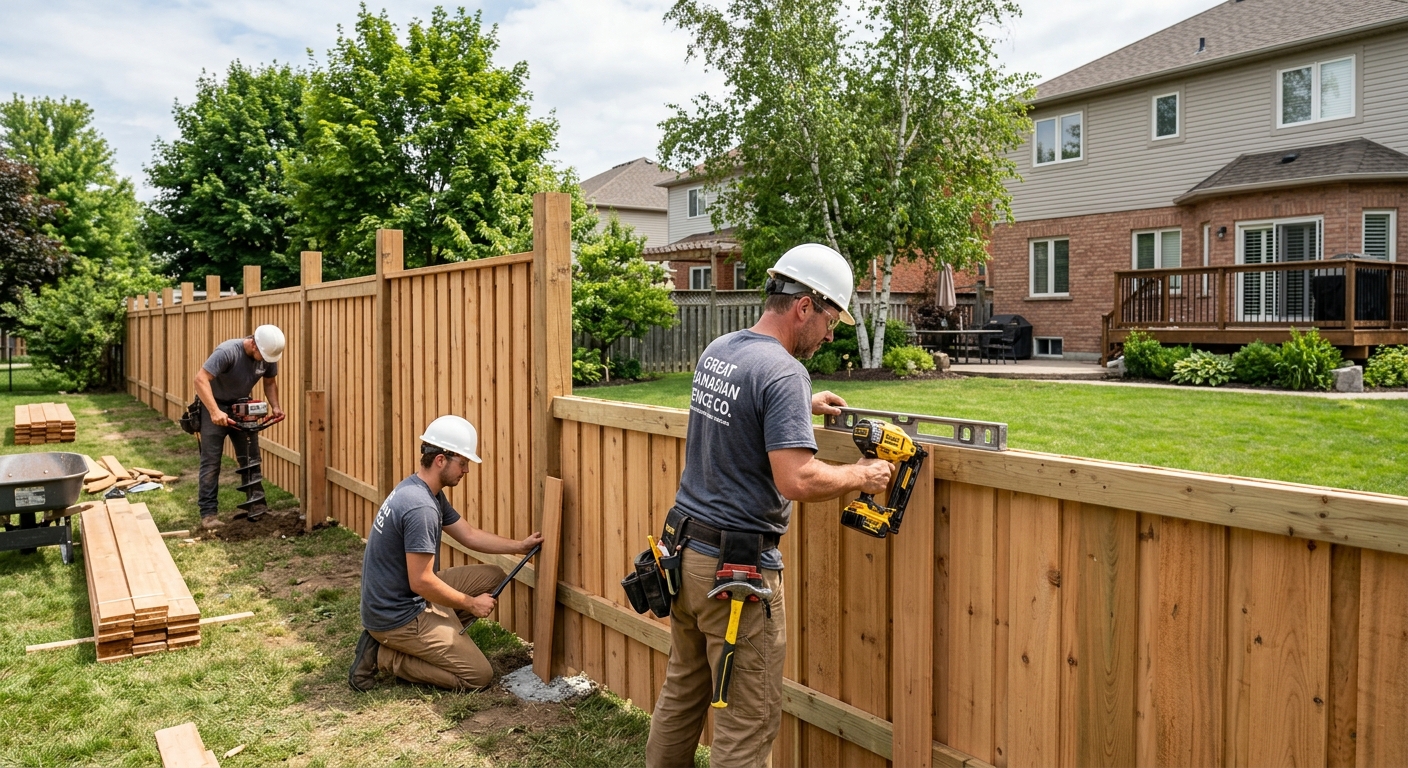
Fencing options and costs in Grand River North
Grand River North is a small community on the edge of the Toronto economic region, and fencing demand here tracks closely with homeownership and lot availability. With a population of 4,765 (Statistics Canada, 2021 Census), your immediate neighbour market is compact—but the work is steady when homes change ownership or homeowners upgrade older boundary fences. The housing stock in the wider GTA is typically built for year-round use, which matters because fencing in Southern Ontario must handle freeze-thaw cycles, wet winters, and spring thaw settling. That’s also why many estimates come back higher than you’d expect for “just replacing pickets.”
In this part of Ontario, contractors commonly treat the design frost depth as roughly 42"–48" in Southern Ontario, which pushes post-hole depth and concrete-set requirements for taller privacy fences. A 6–8 ft solid fence (wood or vinyl) needs deeper, more stable posts to reduce frost heave and long-term wobble. Labour availability can also affect pricing: during peak spring installs, crews often prioritize longer runs and easier access, so narrow gates, backyard driveways, and rail/berm-style yards can raise the per-linear-foot cost. If you’re near the older, more established residential pockets around the community core, you’ll often see more fence replacements—especially where there are aging pickets or panels that have begun to rack—because those failures show quickly during windy freeze-thaw weather.
Below is a practical comparison of common materials and what homeowners typically budget per linear foot in Grand River North, based on the Toronto-area price bands and local installation realities.
| Material |
Lifespan |
Maintenance |
Privacy Rating |
Price per Linear Foot |
| Pressure-treated pine (standard wood) |
10–15 years |
Stain/seal every 2–3 years; fastener checks |
8/10 (with solid boards) |
$65–$120 |
| Cedar (natural rot resistance) |
15–25 years |
Seasonal inspection; stain every 3–4 years |
9/10 (solid boards) |
$75–$130 |
| Vinyl / PVC (no-maintenance) |
20–30 years |
Occasional wash; no staining |
9/10 (solid privacy styles) |
$75–$130 |
| Chain-link (galvanized steel) |
20–30 years |
Rinse as needed; check tension and caps |
2/10 (limited privacy) |
$45–$85 |
| Aluminum ornamental |
25–40 years |
Wash/inspect; no rust typical |
4/10 (decorative pickets) |
$90–$160 |
| Composite / recycled material |
25–35 years |
Low-maintenance wash; inspect posts/hardware |
7/10 (panel styles vary) |
$90–$160 |
Prices are estimates only and vary by project scope, site access and material selection.
What affects the price of fencing in Grand River North
Homeowners in Grand River North often notice that two quotes for what looks like the same fence can land 30–50% apart once the fine print is compared. In the Toronto economic region, that spread is driven by how contractors price site conditions (access and grade), how deep they must set posts for Ontario’s freeze-thaw cycle, and how much extra labour is needed for gates, demolition, and disposal. Even small differences—like replacing a sagging fence line rather than installing new—can swing the estimate because labour time and materials (posts, concrete, hardware, fasteners) don’t scale evenly.
One of the biggest cost drivers is post depth. With frost conditions commonly planned around 42"–48" in Southern Ontario, many crews set posts about 4–6 inches below the design frost depth to reduce heaving. Practically, that means post holes often need roughly 1.5–2.0 m into the ground for taller runs, especially for 6–8 ft privacy fences. Concrete-set posts take more time and increase ready-mix and labour, even if the fence boards look “simple.” This is why wood and vinyl privacy jobs usually track closer to the upper end of the $65–$120 (wood) and $75–$130 (vinyl/PVC) bands once properly engineered for stability.
Local examples that raise or lower cost in Grand River North include: (1) heavier post requirements in windy open corners or where the fence line faces prevailing gusts—solid panels rack more unless posts and spacing are upgraded; (2) clay/mixed soils that don’t drain like sand, which can increase concrete setting time and require careful excavation; and (3) sloped lots where stepped panels or raked solutions take longer to lay out and install.
| Price Factor |
Why It Matters |
Cost Impact |
| Fence length in linear feet |
Most costs scale directly with run length (posts, rails, panels). |
Highest overall driver; can double total price if length doubles. |
| Post depth required |
Frost conditions set how deep posts must be set to prevent heaving. |
Deeper holes increase excavation, longer posts, and concrete volume. |
| Post setting method |
Concrete vs. gravel pack vs. driven posts changes stability and labour. |
Concrete-set typically adds labour and ready-mix costs for best longevity. |
| Material choice |
Vinyl/cedar/pressure-treated/chain-link all have different component and hardware needs. |
Vinyl and cedar generally cost more than chain-link; wood varies by grade. |
| Gate count and type |
Gates require heavier framing, hinges, latches, and often reinforced posts. |
Each gate can add a notable lump of labour and materials. |
| Grade and terrain |
Slopes require stepped or raked panel layout and extra measuring. |
Increases layout time and may require specialty hardware. |
| Old fence removal and disposal |
Demolition adds labour and disposal fees; also affects remaining usable materials. |
Can add significant cost, especially with concrete footings. |
| Permit fees and survey / property line locate |
Municipal rules and accurate locate work reduce disputes and rework. |
May add direct administrative costs and scheduling time. |
Permits & regulations in Ontario
In Ontario, fence rules depend on height, location on the property, and municipal bylaws. As a practical benchmark homeowners use in Grand River North, fences above roughly 2.0 m (6.5 ft) at the rear and above about 1.0–1.2 m (3–4 ft) at the front or corners often require a building permit. Even when a permit isn’t required for lower fences, you still must respect property lines and any setback requirements that your local bylaw imposes.
Before you dig any post holes, call for utility locates through Ontario One Call so crews can mark underground services. Then, confirm your boundary location: get a survey or at least a formal property line locate so posts aren’t installed over a neighbour’s easement/right-of-way. Ontario also has shared fence ownership principles under provincial line-fences legislation; if you’re upgrading a fence that serves as a boundary, it’s smart to clarify who pays for what before construction starts.
Here’s what typically DOES require a permit: taller privacy fences around or over the common height thresholds (rear and front/corner differences), fences that change drainage/structures (like significant retaining work tied to fencing), or projects needing municipal approval due to location. What typically does NOT require a permit: shorter decorative or perimeter fences below local thresholds, provided they stay within property lines and setbacks.
To verify a contractor in Ontario, check three things: (1) their Ontario licence/registration status via the appropriate provincial registry for fencing/contracting activity as applicable; (2) your certificate of insurance (ask for liability coverage naming you as an interested party if available) and verify it covers fencing construction; and (3) WSIB/WCB clearance—request proof/clearance documents and confirm they’re current. A reputable contractor won’t hesitate to provide these documents before you sign.
Choosing the right fence material for Grand River North
Choosing the right fence material in Grand River North comes down to matching your priorities—privacy, low maintenance, budget, and lifespan—to the reality of Toronto-area freeze-thaw weather. Pressure-treated pine is usually the budget-friendly option, but without proper staining it tends to grey and age faster in wet winters and variable spring freeze-thaw. Cedar has better natural rot resistance and a warmer look, but it still benefits from periodic staining to keep appearance and slow surface wear. Vinyl/PVC is popular for “set and forget” maintenance, but it can become brittle in extreme cold if the system isn’t installed with the right expansion considerations and proper post spacing.
Chain-link is the lowest initial cost and often the longest-lived from a structural standpoint—especially with correctly tensioned top rails and good corner bracing—but it provides very limited privacy unless you add slats, lattice, or plant screens. Aluminum ornamental fences are rust-resistant and mid-range to high cost; they’re an excellent choice for curb appeal and security without a lot of wind “sail” effect, but they won’t give the privacy of solid panels.
For post depth, Toronto frost conditions typically mean you should expect concrete-set posts for stable privacy runs. Deeper holes (often roughly 1.5–2.0 m into the ground for taller fences) reduce heaving and keep panel alignment straight over years. Wind and snow loads matter too: solid privacy styles need heavier posts (and closer spacing in many designs) to resist racking and uplift.
As a concrete value example: a pressure-treated privacy fence often lands nearer the wood range (commonly around $65–$120 per linear foot), while vinyl privacy typically sits higher (often $75–$130 per linear foot). The price difference can be justified if you’re trying to avoid frequent staining/repair cycles and want a cleaner appearance with minimal upkeep.
| Material |
Cold Tolerance |
Lifespan |
Annual Maintenance |
Best For |
Price Band |
| Pressure-treated pine |
Good (with proper seal/stain) |
10–15 years |
Light inspection; stain/finish every 2–3 years |
Budget privacy with active homeowner upkeep |
$65–$120 |
| Cedar |
Good (naturally rot-resistant) |
15–25 years |
Inspect fasteners; stain every 3–4 years |
Attractive privacy that resists rot |
$75–$130 |
| Vinyl / PVC |
Very good (if installed correctly) |
20–30 years |
Wash as needed; check posts/hardware |
Low-maintenance privacy in freeze-thaw climates |
$75–$130 |
| Chain-link |
Excellent (metal components) |
20–30 years |
Check tension; rinse occasionally |
Security and pet containment on a budget |
$45–$85 |
| Aluminum ornamental |
Excellent |
25–40 years |
Wash and inspect panels/fasteners |
Curb appeal and boundaries with good visibility |
$90–$160 |
| Composite / recycled material |
Good (system-dependent) |
25–35 years |
Low wash; periodic hardware checks |
Long-life privacy with minimal upkeep |
$90–$160 |
How to choose a fencing contractor in Grand River North
In Ontario, a good fence installer should be easy to verify before you sign anything. Start with licensing/registration: ask which Ontario licence (or trade registration) applies to their work and confirm it on the relevant online registry. Next, request a certificate of insurance—liability coverage should be active for the project period, and you want it to include fencing installation activities (not just general business). Finally, ask for WSIB/WCB clearance documentation; most reputable contractors provide a clearance letter or confirmation directly. If they can’t produce these documents quickly, that’s usually a sign they’ll cut corners later.
For pricing, get 2–3 itemised written quotes. You want the breakdown to show labour and materials separately (posts, rails, pickets/panels, hardware, concrete, and gate components). Avoid lump-sum quotes that don’t state: post depth assumptions, concrete vs gravel pack method, fence style/spec, and what happens at corners/grade transitions. Also confirm what’s excluded: permit pulls, locate/survey costs, old fence removal, disposal, and any landscaping reinstatement.
Warranty matters in a freeze-thaw climate. Ask for the workmanship warranty length (how long they stand behind installation), plus manufacturer warranty for the product. Clarify if warranties are transferable to future owners and whether adjustments are covered if panels shift after winter settlement.
Payment schedule should be sensible: typically no more than 10–15% upfront to cover mobilization, with the remainder tied to milestones. Hold back final payment until the fence is complete, straight, gates operate correctly, and cleanup is done. Get a written timeline with a start date and completion estimate so you can plan around delivery and weather.
- Verify their Ontario licence/registration online and match it to the quote.
- Request certificate of insurance and confirm it covers fencing installation.
- Ask for WSIB/WCB clearance (or equivalent clearance proof) and ensure it’s current.
- Get 2–3 itemised quotes with labour/material line items (not a single lump sum).
- Confirm post depth and setting method (concrete-set vs gravel pack) in writing.
- Confirm gate count, hardware type, and swing direction/clearance.
- Make sure grade solutions are specified (stepped vs raked panels) for sloped yards.
- Ask whether permit fees and property line locate/survey are included or excluded.
- Confirm demolition scope: removal of old fence, footer removal, and disposal included?
- Review warranty: separate workmanship vs product/manufacturer warranty terms.
- Avoid paying more than 10–15% upfront; use milestone payments.
- Get start and completion dates in the contract, including weather contingency notes.
Red flags in Grand River North include contractors who won’t show proof of insurance/WSIB/WCB, quotes that ignore post depth and simply “drive posts,” vague scope language (“remove/replace fence” without specifying materials or gate hardware), asking for large upfront payments, and missing a written timeline or providing a proposal without a detailed layout/spec sheet.
Frequently asked questions — fencing in Grand River North
What fence style offers the best wind resistance in Grand River North?
In Grand River North and the wider Toronto area, “wind resistance” usually comes down to how much surface area the fence presents and how well the posts and bracing are engineered. Solid privacy styles (wood or vinyl) can act like a sail if posts are undersized or spacing is too wide, especially where your backyard is exposed at corners. The most wind-stable outcomes typically come from properly sized corner posts, correctly set intermediate posts, and a design that uses the right rails/hardware for panel stiffness. If you’re worried about wind/racking, an open picket or aluminum ornamental fence often takes the edge off wind loading, while still providing boundary definition. For maximum stability with privacy, choose a solid panel system that specifies concrete-set posts and proper spacing rather than trying to reduce cost with driven posts.
How much does a fence cost in Grand River North?
Fence cost in Grand River North generally follows the Toronto economic region pricing bands, but your final number depends heavily on run length, gate count, and post depth for frost stability. As a quick planning reference, wood fence installation is commonly budgeted around $65–$120 per linear foot, vinyl/PVC privacy often lands around $75–$130, and chain-link security commonly sits in the $45–$85 range. Tall privacy fences usually cost more because they require deeper, concrete-set posts and heavier bracing to prevent racking. Site access also matters: if your yard is tight or demolition/disposal is included, labour increases. With smaller local population (4,765 in Grand River North, Statistics Canada, 2021 Census), contractors may still be busy during peak season, so booking early can help avoid schedule surcharges.
How deep should fence posts be for Grand River North's frost?
For Southern Ontario (including the Toronto economic region), the design frost depth commonly lands around 42"–48". Best practice is to set fence posts roughly 4–6 inches below the design frost depth to reduce frost heave, which is why many contractors recommend concrete-set posts for 6–8 ft privacy fences. That typically translates to post holes around 1.5–2.0 m into the ground, depending on soil conditions and fence height. The depth requirement matters because frost heave can tilt posts, which then makes panels drift, gates sag, and latches stop lining up. If a quote proposes shallow holes or “driven-only” posts for a tall solid fence, ask how they’re accounting for frost movement and whether they’ll engineer for concrete-set stability.
Wood vs vinyl vs aluminum fence — which is best?
The “best” choice in Grand River North depends on your priorities. Wood (pressure-treated pine) is often the lowest initial cost—commonly within $65–$120 per linear foot—but it typically needs staining/sealing every 2–3 years to maintain appearance and reduce premature weathering. Cedar looks great and resists rot better, but it still needs periodic staining. Vinyl/PVC is popular for low maintenance and longevity, usually within $75–$130, and it avoids annual staining; however, you want correct installation for cold performance and proper post spacing. Aluminum ornamental fences are rust-resistant and mid-range to high cost (often $90–$160), but they won’t provide the same privacy as solid wood/vinyl. If privacy is your main goal, vinyl or solid wood/cedar with concrete-set posts is usually the best match.
Do I need a permit to build a fence in Ontario?
In Ontario, you may need a building permit depending on fence height and location. A common threshold homeowners plan around in the GTA is roughly 2.0 m (6.5 ft) for the rear, and about 1.0–1.2 m (3–4 ft) near the front or corners, though municipal bylaws can fine-tune requirements. Even if your fence is exempt from permitting due to height, you still must respect property lines and any setback rules. For any fence work, call Ontario One Call before digging to mark underground utilities. If you’re replacing an older fence, confirm the property line location with a survey or locate—this helps avoid disputes and rework. When you request a quote in Grand River North, ask whether the contractor includes permit pull (if required) or whether you’re responsible for it.
How long does a wood fence last in Grand River North?
A wood fence lifespan in Grand River North depends on post depth, concrete-set vs driven posts, and how it’s maintained after installation. With proper installation for freeze-thaw stability and routine upkeep (staining/sealing), pressure-treated pine commonly lasts about 10–15 years, while cedar can reach 15–25 years due to natural rot resistance. The Toronto-area climate—wet winters, freeze-thaw cycles, and spring thaw settlement—puts more stress on posts and hardware if they’re installed too shallow or set without concrete where frost heave can occur. That’s why many contractors in this region recommend concrete-set posts for taller privacy fences. If you stay ahead of maintenance and inspect fasteners and rails after the first two winters, you can significantly reduce early failure and keep gates operating smoothly.