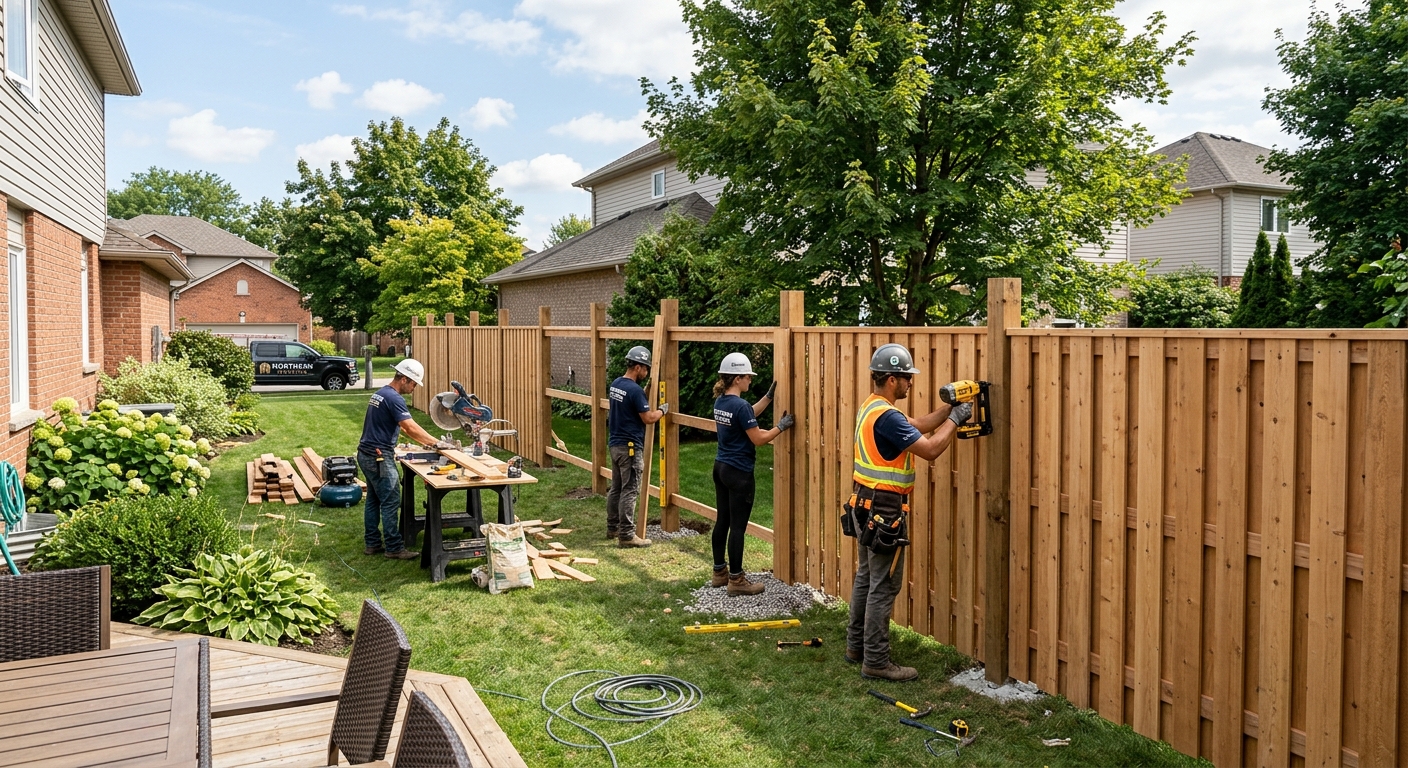
Fencing options and costs in Idlewood
Idlewood homeowners often start with one big question: which fence option fits their yard and their budget. With a population of 5,560 (Statistics Canada, 2021 Census), the neighbourhood is smaller than core Toronto areas, so contractor availability can be tight during peak spring demand—especially for privacy fences that need proper concrete-set posts. That demand is strongest where detached homes are common, because those lots typically have more continuous perimeter fencing to replace or upgrade; in a mature residential market, new builds and renovations also keep crews busy along busy access streets and driveway approaches.
In the Toronto economic region, fencing costs are shaped by Southern Ontario’s freeze conditions. The frost line is commonly taken at about 42"–48", so posts are usually set a minimum of 3.5–4 ft deep to reduce frost heave risk, particularly for 6–8 ft privacy fences. Add Toronto-area mixed soils (often clay-heavy) and you’ll see most reputable crews using concrete setting rather than simple driven posts for long-term stability. For taller, solid styles, wind loading still matters enough that post size and spacing are adjusted, which increases labour and hardware. If your yard is near higher-wind pockets around local corners or any more exposed edges of the community, plan on stiffer framing and closer spacing.
Below is a practical cost comparison you can use as a starting point before you request a site measurement and grade check.
| Material |
Lifespan |
Maintenance |
Privacy Rating |
Price per Linear Foot |
Price per Linear Foot |
| Pressure-treated pine (standard wood) |
10–15 years |
Stain/seal every 2–3 years |
High (solid boards) |
$65 – $120 |
$65 – $120 |
| Cedar (natural rot resistance) |
15–20 years |
Stain optional; typically every 3–4 years |
High (solid boards) |
$75 – $130 |
$75 – $130 |
| Vinyl / PVC (no-maintenance) |
20–30 years |
Wash-rinse only; inspect brackets |
High (solid panels) |
$75 – $130 |
$75 – $130 |
| Chain-link (galvanized steel) |
20–30 years |
Occasional tightening and coating checks |
Low (open mesh) |
$45 – $85 |
$45 – $85 |
| Aluminum ornamental |
25–35 years |
Wash and inspect annually |
Medium (with pickets) |
$90 – $160 |
$90 – $160 |
| Composite / recycled material |
20–30 years |
Wash-rinse; limited staining |
High (solid options) |
$80 – $140 |
$80 – $140 |
Prices are estimates only and vary by project scope, site access and material selection.
What affects the price of fencing in Idlewood
In Idlewood and the wider Toronto area, even “the same fence” can come back 30–50% different depending on how posts are built, how the crew handles your grade, and what’s included in the quote. Two properties can have the same linear footage but differ on access for skid loaders, how many gates you need, whether old fencing must be demolished and hauled, and whether the contractor is setting posts with concrete-set methods that resist frost heave. Toronto’s demand also drives scheduling and minimum crew sizes—so small jobs can price higher per foot than larger continuous runs.
Climate is the most predictable driver. Southern Ontario’s frost depth is commonly estimated at 42"–48", and best practice typically places posts about 4–6" below the design frost depth—meaning you’re often looking at roughly 1.5–2.0 m of hole depth. That translates into longer posts, more excavation, and more concrete, which pushes costs toward the higher end of the wood and vinyl bands. In contrast, chain-link can stay closer to the lower range because posts and mesh panels are lighter and typically easier to install.
Concrete examples that commonly change costs in Idlewood: (1) Clay-mixed soil that holds water can make deeper holes harder to excavate and more time-consuming, raising labour; (2) a backyard with a pronounced slope often requires stepped or raked panels, which increases cutting, framing time, and sometimes adds extra posts; (3) a site with tight driveway clearance may force hand-digging and careful material staging, which can add labour beyond the baseline. If your project is a taller privacy fence (6–8 ft), budget accordingly—solid panels often land nearer the upper end of wood at about $65–$120 per foot, and vinyl privacy frequently competes with the $75–$130 band when you factor the stronger post framing.
| Price Factor |
Why It Matters |
Cost Impact |
| Fence length in linear feet |
The primary driver—materials, posts, and labour scale with total run |
High: longer runs often lower average cost per foot |
| Post depth required |
Frost line determines hole depth and post length to prevent heaving |
Medium to High: deeper holes and extra concrete increase cost |
| Post setting method |
Concrete vs. gravel pack vs. driven posts changes stability and labour time |
High: concrete setting typically adds labour and ready-mix expense |
| Material choice |
Vinyl/cedar/chain-link have different panel weights, hardware, and install time |
Medium: often shifts you between $45–$85 chain-link and $75–$130 privacy |
| Gate count and type |
Double drive-through gates require heavier frames and better hardware |
High: gates commonly add premium cost and longer install time |
| Grade and terrain |
Sloped yards require stepped or raked panels and more layout time |
Medium: extra posts, rails, and labour for fit-up |
| Old fence removal and disposal |
Dismantling, haul-away, and dealing with embedded posts is time-consuming |
Medium to High: disposal and labour can materially change the total |
| Permit fees and survey / property line locate |
Some heights and locations trigger permit needs; accurate locating prevents rework |
Low to Medium: commonly a smaller portion, but can add quickly if surveying is needed |
Permits & regulations in Ontario
In Ontario, fences above a height threshold often require a building permit. As a practical rule of thumb, fences higher than about 2.0 m (6.5 ft) at the rear and about 1.0–1.2 m (3–4 ft) at the front or corner commonly trigger permit requirements. Local setback rules also apply, so your fence may need to sit a specific distance from property lines, driveways, or corners—this is where municipal bylaws matter. Before digging any post holes, call for utility locates (Ontario One Call). Ontario guidelines protect you from accidental damage to buried services.
Step-by-step for Idlewood homeowners: (1) Verify your property line using a survey or locate your pins, ideally before you order materials. (2) Confirm the fence location and height with your contractor—ask them to document the planned line and grade. (3) Check whether your proposed height triggers a permit and, if so, have the contractor specify who pulls it; some firms handle permits while others require you to do it. (4) Ensure the contractor respects shared fence ownership rules under Ontario’s line-fences framework; disputes are easier to prevent when you have written agreements and a clear layout.
To verify an Ontario contractor: check their Ontario business registration/licensing details online (as applicable), request proof of general liability insurance and WSIB/WCB coverage, and review their certificate of insurance for valid coverage dates and limits. If your contractor can’t clearly provide these documents, treat it as a red flag and get another quote.
Choosing the right fence material for Idlewood
Choosing a fence material in Idlewood is really matching your priorities—privacy, low maintenance, budget, and lifespan—to local conditions. Southern Ontario’s freeze-thaw cycles mean posts need proper footing depth, typically set deeper to sit below frost heave risk. That’s why the material decision can’t be separated from the post and concrete-set method. For a wood fence, pressure-treated pine is the budget-friendly choice, but it usually needs staining or sealing every 2–3 years to reduce greying and surface checking. Cedar looks better and resists rot naturally, yet it still benefits from periodic staining for best longevity and colour stability.
Vinyl/PVC is popular because it’s low-maintenance—no staining and easy wash-down—but it has to be installed with correct spacing and hardware for cold conditions; extreme winter contraction can lead to cracking if the system isn’t installed properly. Chain-link is usually the lowest upfront cost and can last a long time, but it offers little privacy unless you add slats or planting. Aluminum ornamental gives a clean, no-rust look and holds up well in Ontario winters, but it’s more about curb appeal than full privacy.
For Toronto’s frost line, plan on concrete-set posts for privacy fences where you want 6–8 ft height and solid boards. Wind can increase racking risk for taller solid panels, so stronger rails and closer spacing are often required. As an example, if a pressure-treated pine privacy fence lands around the lower wood band (about $65–$120 per linear foot), moving to cedar can be worth it when you’re paying for aesthetics plus a better rot-resistant body—often justifying an upgrade only if you value appearance and intend to maintain it.
| Material |
Cold Tolerance |
Lifespan |
Annual Maintenance |
Best For |
Price Band |
| Pressure-treated pine |
Good (with proper post depth and ventilation) |
10–15 years |
1–2 inspections; stain/seal every 2–3 years |
Budget privacy where you’re willing to maintain |
$65 – $120 |
| Cedar |
Good (rot resistance helps through freeze-thaw) |
15–20 years |
1 inspection; stain every 3–4 years (typical) |
Privacy with better natural appearance |
$75 – $130 |
| Vinyl / PVC |
Very good when installed with correct fasteners |
20–30 years |
Wash-rinse; inspect brackets and posts |
Low-maintenance privacy |
$75 – $130 |
| Chain-link |
Excellent (steel with galvanizing) |
20–30 years |
Occasional tightening; check gates and posts |
Security and pet containment (limited privacy) |
$45 – $85 |
| Aluminum ornamental |
Excellent (coated metal) |
25–35 years |
Wash; quick annual inspection |
Curb appeal with light barrier |
$90 – $160 |
| Composite / recycled |
Good (freeze-thaw rated systems) |
20–30 years |
Wash-rinse; check for hardware wear |
Privacy with reduced staining |
$80 – $140 |
How to choose a fencing contractor in Idlewood
When you’re hiring a fencing contractor in Ontario around Idlewood, start by confirming the three essentials: Ontario coverage and compliance, liability protection, and worker protection. Ask for proof of general liability insurance (certificate of insurance, with coverage dates and limits), and proof of WSIB/WCB coverage for their workers—then verify it’s current and matches the legal entity doing the work. You can also cross-check their legitimacy through Ontario business records online and look for a clear, consistent project history. If they can’t provide documentation quickly, you’re taking a risk that’s expensive to fix mid-project.
Next, get 2–3 itemised written quotes instead of a lump-sum number. The quote should separate labour and materials, show how posts will be set (concrete-set depth), list gate hardware, and specify the fence height and panel spacing. Confirm what’s excluded: permit pulling, utility locate fees, disposal/haul-away, survey costs, and any rock removal. A professional quote should state whether they include demolition of the old fence and proper disposal.
Warranty matters too. Ask for the workmanship warranty length and whether it’s transferable if you sell your home. Also confirm product/manufacturer warranties for vinyl/metal coatings or composite boards. Payment schedule should be conservative—never pay more than 10–15% upfront, and hold back payment until the job is complete and any punch-list items are finished. Finally, request a written start date and completion estimate, especially in spring when scheduling bottlenecks happen.
- Request and review current certificate of insurance (liability) before work starts.
- Confirm WSIB/WCB clearance for the exact contractor entity doing the job.
- Get 2–3 itemised quotes with labour and materials separated.
- Ask how posts are installed and what depth they set to avoid frost heave.
- Confirm fence height, panel type, and post size in writing.
- Verify disposal/haul-away is included for old fencing and debris.
- Check whether a permit is required for your height and who pulls it.
- Ensure utility locate calls are included or scheduled before digging.
- Confirm gate frame reinforcement and hardware grade (especially double gates).
- Ask about warranty: workmanship term and manufacturer/product warranty terms.
- Use a payment schedule with only 10–15% upfront and final holdback.
- Get a written timeline for start and completion, not just “weather permitting”.
In Idlewood, common red flags I’ve seen include: contractors who won’t specify post depth or footing method; quotes that treat gates as “standard” without heavier hardware; missing disposal costs leading to surprise add-ons; no proof of WSIB/WCB or incomplete insurance; and schedules that can’t provide a firm start/completion date in writing.
Frequently asked questions — fencing in Idlewood
Can I install a fence on a slope in Idlewood?
Yes, you can install a fence on a slope in Idlewood, but the method matters for both appearance and structural stability. In practice, most privacy fences on sloped yards are installed with either stepped panels (each section changes height in increments) or raked panels (the top rail follows the slope). The contractor should lay out your grade line before digging so the post spacing stays consistent and the fence doesn’t rack in winter wind. Because Southern Ontario uses deeper frost-susceptible footing, the post holes still need to be excavated to proper depth—slope changes how the fence line sits, not the required stability. A well-laid raked or stepped system often fits better within typical wood and vinyl privacy bands, like about $65–$120 per linear foot for wood or $75–$130 per linear foot for vinyl, depending on height and gate count. (Statistics Canada, 2021 Census)
What is the most weather-resistant fence for Idlewood's climate?
For Idlewood’s freeze-thaw winters and wet shoulder seasons, the most weather-resistant choices are typically vinyl/PVC, composite (where available), and well-built chain-link—provided posts are concrete-set to frost-safe depth. Vinyl and composite resist rot and splintering, while chain-link avoids the wood moisture issues entirely. That said, “weather-resistant” doesn’t mean “no installation standards”: cold contraction needs correct hardware and spacing, and taller solid panels still require sturdier posts and rails to reduce wind racking. If you want true privacy with low maintenance, vinyl privacy often lands in the $75–$130 per linear foot range and can be a strong long-term bet versus pressure-treated pine, which usually needs staining every 2–3 years to prevent greying and surface wear. In short: choose durable materials, but insist on proper post depth and concrete setting in Southern Ontario.
How do I prevent wood fence rot in Idlewood?
Preventing rot in Idlewood comes down to moisture control and correct installation details—especially around posts. The most common rot pattern happens when a wood post or lower rail stays wet or is in contact with soil. Use pressure-treated pine with proper airflow and keep wood components elevated above grade where possible. Ensure the posts are concrete-set deep enough to avoid frost heave, because heaving can break the seal between post and surrounding concrete and create gaps where water collects. For cedar, rot resistance is better naturally, but you still need periodic maintenance so water isn’t trapped at board ends and pickets. Plan for an inspection at least once a year and expect staining/sealing on wood typically every 2–3 years for pine. If rot is already widespread, replacing only boards can fail—sometimes the posts are compromised and a full rebuild is safer. In Toronto-area pricing, that “proper build” approach usually falls within the wood band of about $65–$120 per linear foot, depending on height and access.
What is the cost per linear foot for fencing in Idlewood?
In Idlewood, your installed cost per linear foot depends most on material, fence height, and how posts are set (concrete versus driven/gravel). As a practical range for the Toronto economic region, wood fencing typically comes in around $65–$120 per linear foot, vinyl/PVC commonly around $75–$130 per linear foot, and chain-link around $45–$85 per linear foot. Aluminum ornamental is usually higher, roughly $90–$160 per linear foot, because it’s labour-intensive and uses heavier components. Privacy fences (especially 6–8 ft) often push upward within the wood or vinyl ranges due to deeper concrete-set posts, stronger framing, and additional hardware. Your exact price will also change with gate count (double gates cost more), slope grading, disposal of old fencing, and permit/survey requirements when heights cross common thresholds.
Should I repair or replace my old fence in Idlewood?
Repair can be smart when the posts are sound and the damage is limited to a few boards, panels, or rail sections. In Ontario, fence posts that have shifted from freeze-thaw heave or that have rot at the base usually signal that repairs won’t last. A good contractor should assess: post firmness, the condition of concrete footings (if present), the amount of rail/fastener corrosion, and whether the fence line is still straight. If only the top boards are weathered and hardware is tight, repairs may keep you closer to the lower-end of budget projects. If multiple posts are leaning or boards are pulling loose, replacement is often safer and more cost-effective over time—even if it’s in the typical wood privacy band around $65–$120 per linear foot. If your goal is low maintenance, replacing with vinyl might better justify the $75–$130 range when compared to repeating staining cycles on wood.
How do I handle a fence dispute with a neighbour in Ontario?
Fence disputes in Ontario are best handled calmly and with documentation. First, confirm the fence line with a survey or your property locate pins—many disputes come from “assumed” boundaries. Next, measure the fence height and placement relative to the property line and any applicable setback requirements. If the dispute is about maintenance costs or shared ownership, Ontario’s line-fences framework generally guides how responsibilities are divided, but the exact approach can depend on where the fence sits and how it’s been historically treated. Keep everything in writing: take photos, note dates of issues, and ask your contractor to provide a written assessment if repairs are needed. If there’s a permit or height threshold question, clarify it early so you aren’t arguing while building requirements are unresolved. For resolution, consider mediation or formal dispute channels rather than escalating. The best practical prevention is ensuring your contractor’s layout work is accurate before the first post hole is dug.