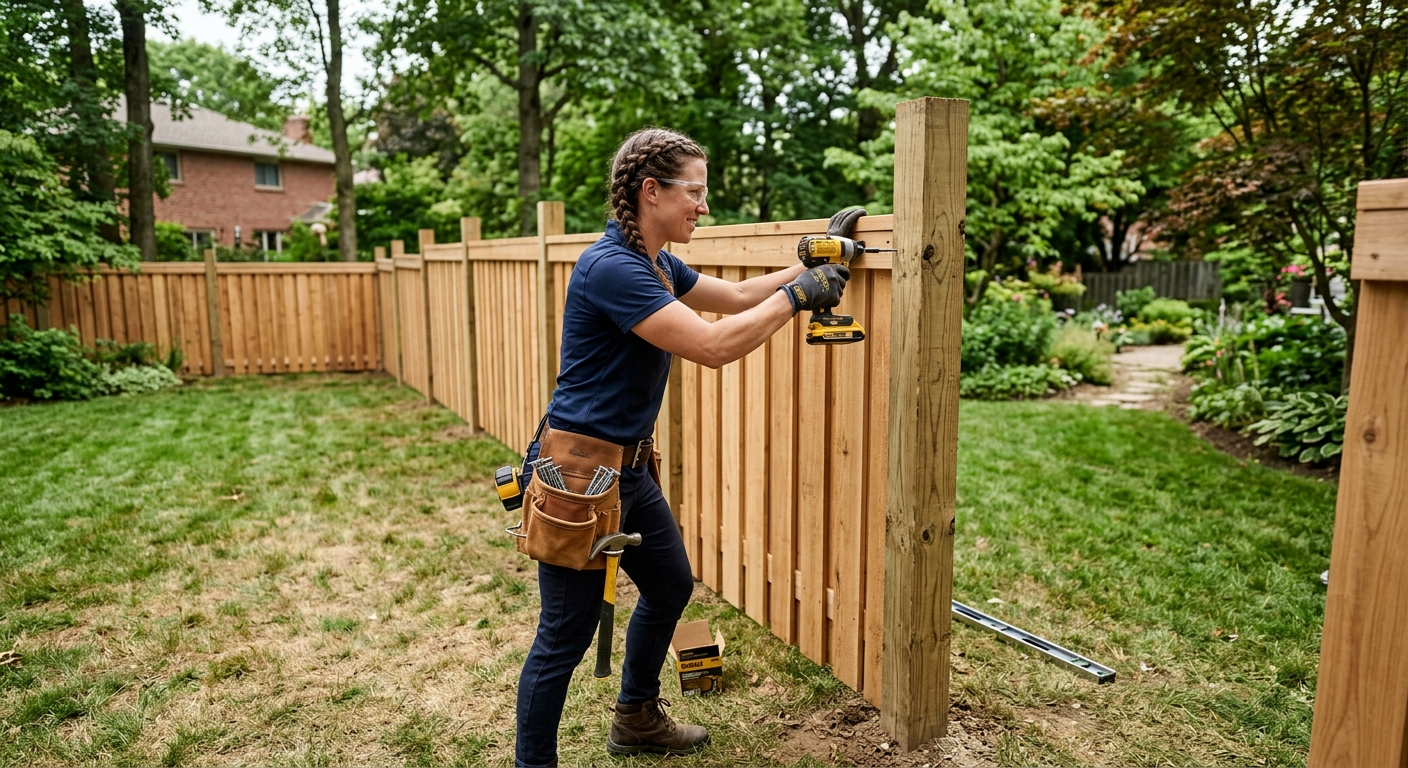
Fencing options and costs in Neebing
Fencing in Neebing comes down to a few practical choices: how much privacy you want, how often you’re willing to maintain materials, and how the Northwest climate tests your posts and panels. Neebing has a high share of single-detached homes—98.9% of dwellings—so most fencing work is aimed at individual property boundaries around homes and yards, not multi-unit lots. With 885 homeowner households (94.1% of households own), demand for replacement and “set-and-forget” upgrades is steady, especially as older fencing wears out.
In Northwest Ontario, frost penetrates deeper than in southern Ontario, so posts typically need to be set close to 4 ft (1.2 m+) below grade, often with concrete, to reduce the risk of frost heave. Wind exposure also matters: open rural stretches and highway corridors can push contractors toward tighter post spacing, stronger rails, and heavier privacy panels. Availability of crews can tighten during peak season, which is why getting an itemised quote early helps you lock in labour costs and preferred material options.
In Neebing, this trade is especially active for boundary and backyard privacy work in and around the more established residential pockets near the core services area—homeowners there frequently upgrade from older board fences to cedar or vinyl for durability and appearance.
Below are realistic cost ranges you can use to compare quotes side-by-side, then we’ll break down exactly why the same fence can land 30–50% apart across the region and province.
| Material |
Lifespan |
Maintenance |
Privacy Rating |
Price per Linear Foot |
Price Range |
| Pressure-treated pine (standard wood) |
10–15 years |
Stain/seal every 2–3 years |
Medium–High (solid board) |
$55–$90 |
$55–$90 |
| Cedar (natural rot resistance) |
15–25 years |
Light stain/cleaning every 2–4 years |
High (solid cedar) |
$70–$110 |
$70–$110 |
| Vinyl / PVC (no-maintenance) |
20–30 years |
Occasional wash; no staining |
Medium–High (slat/solid options) |
$70–$110 |
$70–$110 |
| Chain-link (galvanized steel) |
25–35 years |
Low; rinse and check tension |
Low (privacy requires inserts/closures) |
$35–$65 |
$35–$65 |
| Aluminum ornamental |
25–40 years |
Low; wash and spot-check gates |
Low–Medium |
$80–$140 |
$80–$140 |
| Composite / recycled material |
20–30 years |
Very low; rinse and inspection |
High (board-style systems) |
$75–$125 |
$75–$125 |
Prices are estimates only and vary by project scope, site access and material selection.
What affects the price of fencing in Neebing
Even when homeowners request “the same fence,” quotes in Northwest Ontario can vary by 30–50% once you account for frost-depth excavation, wind-resilient layout, and crew availability. In Neebing specifically, the combination of deeper freeze and the soil conditions common around the Thunder Bay–Kenora area (clay and mixed soils) can push contractors toward deeper or more stable footings. That’s why two projects that look identical on a drawing can still end up priced differently once the contractor calculates post length, concrete volume, and labour hours.
Frost line depth is the big driver. Locally, posts are typically set about 4–6 inches below the design frost depth, which means longer posts and deeper holes; in practical terms, many installs land around 1.5–2.0 m into the ground with concrete setting to reduce frost heave. Wind exposure is another major factor—where properties are more open, contractors tighten post spacing and choose sturdier rails, which adds material and installation time.
Here are a few concrete examples that change costs in Neebing: (1) a straight backyard run on flat ground can be priced closer to the lower end of the wood band ($55–$90), while (2) a fence that crosses a low spot with mixed clay may need extra excavation and a larger footing plan, nudging you toward the higher end. (3) If you’re switching from chain-link ($35–$65) to a solid privacy fence, you’ll typically pay more for panels, hardware, and stronger supports—often the difference you feel right away in the labour line item. (4) Homes built before 1981 (40.4% of dwellings in the area) sometimes have older gates, fence remnants, or irregular lot edges that slow down layout and post spacing.
Use the factors below to compare like-for-like quotes—this is where most “why is your price higher?” conversations get resolved.
| Price Factor |
Why It Matters |
Cost Impact |
| Fence length in linear feet |
Every extra foot adds materials, posts, rails, and labour time |
High (primary driver) |
| Post depth required |
Frost depth determines hole depth and post length to prevent heaving |
High in Northwest Ontario |
| Post setting method |
Concrete vs. gravel pack vs. driven posts affects excavation and stability |
Medium–High |
| Material choice |
Vinyl and cedar typically cost more upfront than chain-link |
Medium–High |
| Gate count and type |
Double drive-through gates and self-closing hardware cost more |
Medium–High |
| Grade and terrain |
Slopes require stepped or raked panels, plus extra labour and cuts |
Medium |
| Old fence removal and disposal |
Debris haul-away, disposal fees, and hazardous materials handling |
Medium |
| Permit fees and survey / property line locate |
Survey verification reduces encroachment risk and rework costs |
Low–Medium (project dependent) |
Permits & regulations in Ontario
In Ontario, fence permits often come into play when a fence is taller than typical thresholds. As a homeowner rule of thumb in many municipalities, fences above about 2.0 m (6.5 ft) at the rear and roughly 1.0–1.2 m (3–4 ft) at the front or corner may require a building permit, depending on the property and local zoning rules. Even when a permit isn’t required, fences must stay within property lines and respect municipal setback bylaws.
Before any post holes are dug, call for utility locates through Ontario One Call. This is non-negotiable—hitting underground services is not just dangerous, it can halt the job. Next, consider obtaining a survey or at least a property pin locate before installation so you don’t end up in a boundary dispute.
If you’re planning a shared boundary fence, Ontario line-fences rules apply and can affect cost sharing and responsibilities for maintenance or replacement.
What usually DOES require a permit: taller fences that exceed local height thresholds and some special situations (notably where the fence configuration affects sight lines or safety near intersections). What typically does NOT: standard-height privacy fences below local thresholds, ordinary replacement of an existing fence in like-for-like height and location, and basic garden fencing (still subject to bylaws).
To verify a contractor in Neebing, ask for: (1) proof of relevant Ontario contractor licensing/registration where applicable for fencing-related work (and confirm it via the appropriate online registry), (2) liability insurance certificate of insurance naming you as additional insured if offered, and (3) WSIB coverage or equivalent clearance—ask for the clearance letter and check that the coverage is active. Get these before work begins and ensure the certificate matches the legal business name on the quote.
Choosing the right fence material for Neebing
Choosing a fence material in Neebing isn’t just about look—it’s about cold performance, wind load, and how quickly you’ll want to maintain it. With Northwest Ontario’s deeper frost, your fence only performs well if the posts are installed correctly and the material can handle freeze–thaw cycles without warping or premature failure.
Pressure-treated pine is the budget-friendly option, but it typically requires staining or sealing every 2–3 years to prevent grey weathering and surface breakdown. Cedar offers better natural rot resistance and a nicer finish, but it still benefits from periodic maintenance to keep colour and reduce checking. Vinyl/PVC is the low-maintenance winner—no staining, just washing—but it can become brittle if panels are forced to fit poorly during installation in extreme cold, so quality installation matters. Chain-link has the lowest upfront cost and the longest practical life, but it provides little privacy unless you add privacy slats or top/side closures. Aluminum ornamental looks sharp, won’t rust, and handles winter well, but it’s usually a mid-range price for mainly decorative boundaries.
Cold tolerance also ties to structure. For Northwest frost, concrete-set posts are common to keep posts below the frost zone and reduce movement. That added embedment is why the difference between chain-link and privacy fences can feel larger than the material difference alone—strong rails and closer spacing are often needed where wind is persistent.
As a practical example: if a privacy install in your yard is priced around the wood band ($55–$90 per linear foot), upgrading to vinyl often moves you toward the $70–$110 range. If you plan to keep the fence for 20+ years and don’t want repeat staining visits, the higher upfront cost is usually justified. If you’re doing a budget boundary or waiting on landscaping, chain-link within the $35–$65 band can make sense while you finalize long-term privacy plans.
| Material |
Cold Tolerance |
Lifespan |
Annual Maintenance |
Best For |
Price Band |
| Pressure-treated pine |
Good (with correct post embedment) |
10–15 years |
Low–Moderate (stain/seal every 2–3 years) |
Budget privacy with a classic look |
$55–$90 |
| Cedar |
Very good (rot-resistant) |
15–25 years |
Low–Moderate (periodic staining/cleaning) |
Attractive privacy, fewer rot issues than pine |
$70–$110 |
| Vinyl / PVC |
Good (avoid poor fit in extreme cold) |
20–30 years |
Very low (wash/inspect) |
Low-maintenance family properties |
$70–$110 |
| Chain-link |
Excellent |
25–35 years |
Very low (check tension, rinse) |
Security with minimal upkeep |
$35–$65 |
| Aluminum ornamental |
Excellent |
25–40 years |
Low (occasional wash) |
Front-yard style boundaries |
$80–$140 |
| Composite / recycled |
Good (system quality matters) |
20–30 years |
Low (rinse and inspection) |
Privacy look with reduced upkeep |
$75–$125 |
How to choose a fencing contractor in Neebing
In Neebing, the right contractor isn’t just the one with the lowest number—it’s the one that builds to Northwest Ontario’s freeze-and-wind realities. Start by verifying Ontario requirements: ask for proof of liability insurance (a current certificate), confirm the company’s coverage is active, and request WSIB coverage or a clearance letter where applicable. Where online registries exist for contractor registration/licensing, check the business name matches the quote and that the coverage details line up with the legal entity doing the work.
Then get 2–3 itemised written quotes—don’t accept a single lump sum. A good quote breaks down labour and materials separately and includes how posts are set (concrete vs. gravel pack), the assumed post spacing, and what’s included for gates and hardware. Read scope language closely: is permit work included or excluded, and is disposal of old fencing part of the price? In Northwest Ontario, excavation and concrete volume can change quickly, so reputable contractors explain the assumptions and how they’ll handle variations.
Ask about warranty. You want a workmanship warranty that’s written and specific (not just “reasonable”), plus the manufacturer warranty on products. Confirm whether the warranty is transferable to you if you sell the home—this matters in long-term neighbourhood value.
For payment, never pay more than about 10–15% upfront. Hold back a portion until the final walkthrough confirms line, level, gate operation, and cleanup. Also request a start date and completion estimate in writing, since early freezes can affect curing schedules for concrete-set posts.
- Provide Ontario-based business info and match the legal name on your quote.
- Show an active certificate of liability insurance and WSIB/clearance documentation.
- Give a post-and-footing plan that references deep embedment for frost conditions.
- Use itemised labour + materials pricing (no “mystery lump sum”).
- Specify post spacing, rail type, and hardware grade for wind resistance.
- Confirm whether concrete supply, rebar/anchoring (if used), and cleanup are included.
- State who does locate calls and what happens if utilities are encountered.
- Detail gate type, swing direction, and whether it’s walk-through or double drive-through.
- Clarify how slopes are handled (stepped vs. raked panels) and who provides adjustments.
- Include removal/disposal scope for old fence and debris haul-away.
- List warranty terms separately for workmanship vs. product/manufacturer.
- Set a payment schedule with a holdback until final acceptance and punch-list items.
Red flags I see in Neebing include: contractors who won’t show insurance/WSIB clearance, quotes that omit post depth and setting method, “we’ll figure it out in the field” language for frost-related excavation, missing warranty details in writing, and requiring a large upfront deposit without a signed contract and schedule.
Frequently asked questions — fencing in Neebing
What is the cost per linear foot for fencing in Neebing?
In Neebing, typical installed fencing costs generally track Northwest Ontario price bands. Chain-link often lands around $35–$65 per linear foot, while standard wood installations usually fall around $55–$90. Cedar, vinyl/PVC, and privacy-oriented composite systems commonly price higher, often in the $70–$110 range depending on panel style and gate hardware. The biggest swing factor is usually post embedment depth for frost protection (often close to 4 ft or more below grade) plus whether concrete setting is included. Wind-heavy layouts can also add labour through tighter post spacing and stronger rails.
Should I repair or replace my old fence in Neebing?
If your Neebing fence has failing posts, leaning sections, or widespread rot at the base, replacement is often the more cost-effective long-term choice. Repairs can work when damage is localized (for example, one or two panels with intact posts), but frost heave can keep moving the line if the original embedment is shallow or posts are cracked at the footing. If you’re seeing multiple broken rails, sagging gates, or hardware pulled loose repeatedly, expect higher labour for patchwork and more frequent follow-up costs. As a practical approach, request a contractor assessment: they should check post depth/condition, rail attachment points, and whether removal and re-setting will be needed. If replacement brings you from a low-privacy material to a solid privacy system, budget accordingly using the $55–$90 (wood) or $70–$110 (vinyl/cedar) bands.
How do I handle a fence dispute with a neighbour in Ontario?
In Ontario, fence disputes typically hinge on property lines and shared fence responsibilities. First, confirm the boundary: review any survey documents you have, and consider a property pin locate to verify where the fence should sit. Keep communication calm and in writing, and don’t build or remove in a way that could be considered encroachment until your location is clear. If you suspect the fence is shared, Ontario line-fences rules can affect how costs and maintenance responsibilities are allocated. For practical resolution, ask both sides to agree on a contractor assessment or a third-party surveyor’s locate. If one party wants height or style changes, clarify who pays the incremental cost and ensure the installation still complies with local bylaws and Ontario permit rules where applicable.
What fence style offers the best wind resistance in Neebing?
For wind resistance in Neebing, a solid-to-semi-solid privacy fence built with robust rails and well-spaced posts generally performs better than lightweight ornamental pickets. That said, fully solid fences can “catch” wind loads, so the design details matter: closer post spacing, heavier rails, and proper tensioning hardware (for chain-link systems with privacy inserts) help keep the fence stable. In Northwest Ontario, deeper post embedment for frost protection is essential—without adequate footing depth, wind can worsen movement and accelerate panel sagging. If you want the most stable feel for high-wind corners or exposed runs, ask contractors about their wind-conscious layouts, especially rail thickness and how they set posts in concrete where needed.
How much does a fence cost in Neebing?
Neebing fence cost depends mostly on linear feet, gate count, and how deep posts must go for frost conditions. For a rough planning range, chain-link is often the budget approach at about $35–$65 per linear foot, while typical wood installations commonly fall around $55–$90 per linear foot installed. Cedar, vinyl/PVC, and many solid privacy upgrades frequently land in the $70–$110 range. Your total project can climb quickly if you add a double drive-through gate, require old fence removal/disposal, or have sloped grade that needs stepped/raked panels. Because Northwest Ontario projects often use deeper embedment (commonly close to 4 ft or more below grade), expect excavation and concrete setting to be a meaningful part of the quote.
How deep should fence posts be for Neebing's frost?
For Neebing and Northwest Ontario conditions, fence posts typically need to be set below the frost line—often close to 4 ft (1.2 m+) below grade, with many installs effectively landing around 1.5–2.0 m into the ground depending on the site and design frost depth. A key rule contractors use is embedding posts about 4–6 inches below the design frost depth to reduce frost heave risk. Because frost penetration is deeper than in southern Ontario, shallow installs can lead to seasonal movement and gate misalignment. In many cases, concrete setting is used to help stabilize the post in freeze–thaw cycles. Your best approach is to ask your contractor to state the assumed frost-depth embedment, post diameter, and whether concrete setting is included in the quote.