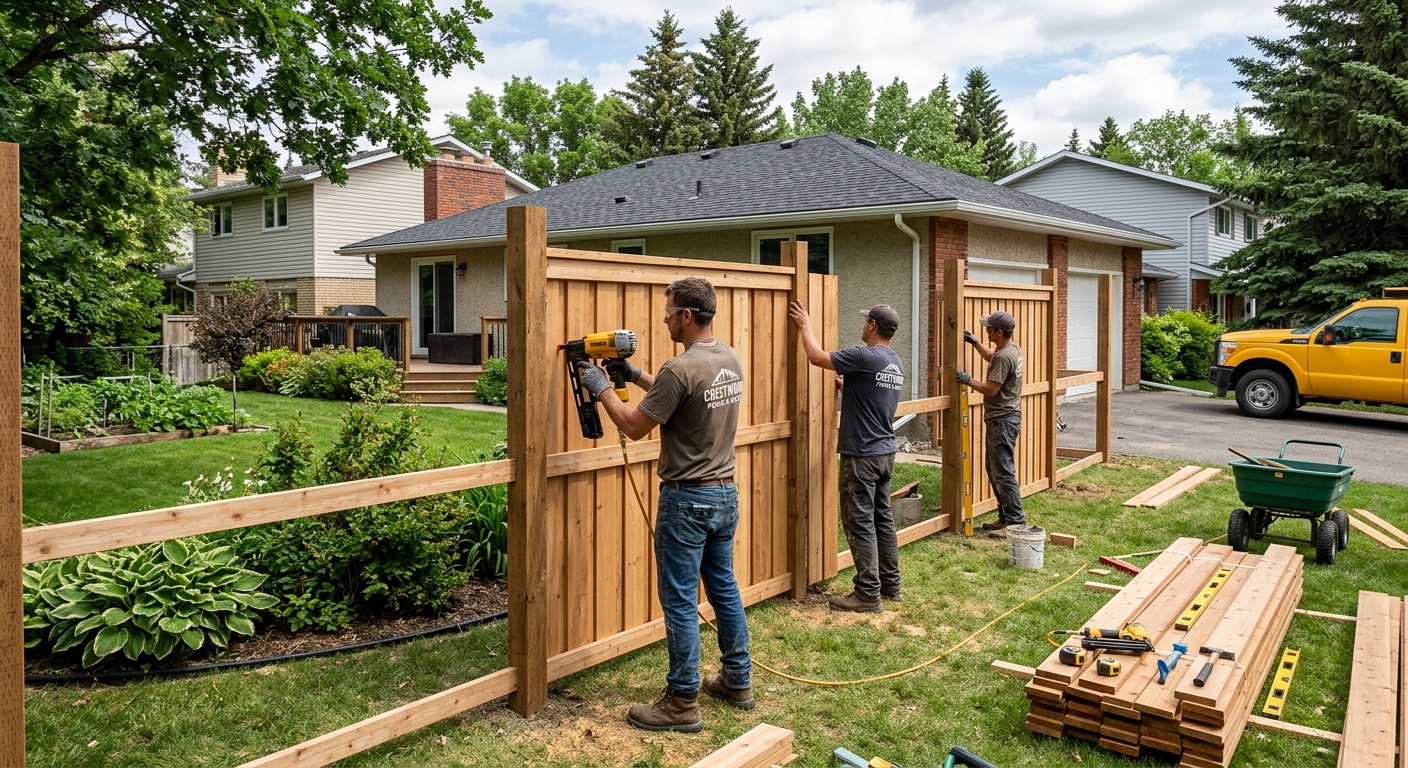
Fencing options and costs in Forest Hill South
Forest Hill South is a well-established, family-heavy area in Toronto, with many households considering perimeter upgrades as neighbourhoods evolve. With a 2021 population of 10,732 (Statistics Canada, 2021 Census), demand is steady—especially around residential pockets where property lines, gates, and landscaping details are common. In practice, detached homes and closely spaced yards tend to generate the most fence work because homeowners often want true privacy, safer walkways, and cleaner sightlines along driveways and back gardens.
In the Toronto economic region, fencing costs are strongly influenced by winter freeze–thaw cycles and local soil conditions. The frost line in Southern Ontario is commonly planned around 42"–48", which means posts are typically set about 3.5–4 feet deep (or deeper depending on design and soil) to reduce frost heave. That drives both labour time and concrete/ready-mix use, particularly for taller 6–8 ft privacy fences. It also increases the importance of good post sizing and spacing to resist racking from local winds and occasional snow loading.
We also see consistent contractor availability and repeat projects in nearby forested/residential corridors such as the Eglinton Avenue West area, where yards tend to be mature and require careful removal of existing fencing and landscaping protection.
Below is a homeowner-friendly comparison of material types you’ll see quoted across Forest Hill South, along with typical lifespan, maintenance expectations, and price bands that match Toronto market reality.
| Material |
Lifespan |
Maintenance |
Privacy Rating |
Price per Linear Foot |
Price Range |
| Pressure-treated pine (standard wood) |
10–15 years |
Stain/seal every 2–3 years; periodic hardware checks |
High (solid boards) |
$12–$28/ft |
$65 – $120 |
| Cedar (natural rot resistance) |
15–25 years |
Stain or oil as needed (often every 3 years) |
High (solid boards) |
$16–$34/ft |
$85 – $130 |
| Vinyl / PVC (no-maintenance) |
25–35 years |
Rinse/wash as needed; check posts after extreme cold events |
High (solid and lattice options) |
$18–$36/ft |
$75 – $130 |
| Chain-link (galvanized steel) |
20–30 years |
Occasional tightening; rust-free with proper coating |
Low–Medium (add privacy slats if needed) |
$10–$20/ft |
$45 – $85 |
| Aluminum ornamental |
30–40 years |
Occasional wash; inspect brackets |
Low–Medium (ornamental pickets) |
$14–$32/ft |
$90 – $160 |
| Composite / recycled material |
20–30 years |
Low; occasional cleaning; avoid heavy-impact damage |
High (solid panel styles) |
$16–$35/ft |
$90 – $150 |
Prices are estimates only and vary by project scope, site access and material selection.
What affects the price of fencing in Forest Hill South
In Forest Hill South and across the Toronto economic region, the same basic fence can land in quotes that differ by about 30–50%. The variability usually comes down to how contractors plan for Toronto’s freeze–thaw conditions, how they set posts in clay/mixed soils, and how much on-site work is required (trees, slopes, tight access, and old fence removal). Labour availability also matters: if a crew has to schedule multiple mobilizations to protect landscaping, you’ll feel it in the labour line.
One of the biggest drivers is the required post depth. In cold Ontario, post holes are often dug about 1.5–2.0 m into the ground (roughly 4–6 ft) so the post base sits below the design frost depth and helps prevent heaving. That commonly translates to concrete-set posts instead of simple driven posts, which increases ready-mix and labour time. When you’re installing a taller privacy fence, the need for heavier posts and closer spacing (often 6–8 ft centres) can also increase both material quantity and installation duration.
Local “real world” examples I see often in Forest Hill South: (1) a 60 ft rear yard privacy run on clay soil usually costs more than the same length on sandy soil because footing sizing and excavation takes longer; (2) sloped yards near established residential lots can require stepped rails or raked panels, which adds fabrication time; and (3) jobs with old fence demolition can swing cost noticeably—disposal and haul time add up, even when the new fence materials are mid-range.
These factors can push a project from the lower end of the wood band (for straightforward runs) toward higher pricing where vinyl/PVC or heavier privacy systems are chosen. Likewise, chain-link might start near the lower band, but upgraded gates or taller privacy add cost quickly.
| Price Factor |
Why It Matters |
Cost Impact |
| Fence length in linear feet |
Every extra foot adds posts, rails, fasteners and labour |
High (+majority of total cost) |
| Post depth required |
Frost line drives hole depth and how deep posts must sit |
Medium–High |
| Post setting method |
Concrete-set posts typically outperform gravel packs or driven posts in frost-prone soils |
Medium (can increase materially for tall fences) |
| Material choice |
Vinyl/PVC and cedar cost more per linear foot than standard pressure-treated wood |
Medium–High (material-driven) |
| Gate count and type |
Gates require heavier framing, hinges, latches and often different hardware |
Medium (can be a top-3 cost line) |
| Grade and terrain |
Slopes need stepped or raked panels; irregular grading increases labour |
Low–Medium (higher on uneven lots) |
| Old fence removal and disposal |
Demolition, hauling, and dump fees can’t be skipped safely |
Low–Medium to High (job-dependent) |
| Permit fees and survey / property line locate |
Locates prevent boundary disputes; some height configurations trigger permits |
Low–Medium |
Permits & regulations in Ontario
In Ontario, fence requirements typically depend on location on the property, fence height, and whether the installation affects setbacks or visibility areas. As a practical rule of thumb used by many Toronto-area homeowners, fences above a rear height threshold of about 2.0 m (6.5 ft) and fences above roughly 1.0–1.2 m (3–4 ft) in the front or corner may require a building permit, subject to municipal rules and lot specifics. Regardless of permit needs, your fence must respect property lines and follow municipal setback bylaws.
Before you dig any post holes in Forest Hill South, call Ontario One Call to have utilities located. This is essential for hydro, cable, and buried services—damaging a line can create major delays and cost. Next, get a survey or at least a professional property-line locate so your posts aren’t encroaching. Shared fence responsibilities are generally guided by provincial line-fences principles; in disputes, documented boundaries matter.
What requires a permit: taller fence configurations (commonly above 2.0 m at the rear, and around 1.0–1.2 m at the front/corner) and any situation where municipal review is triggered by height/placement. What typically does NOT require a permit: small repairs or like-for-like replacements that keep the same height and position, assuming they still meet bylaw and boundary requirements.
To verify your contractor, ask for (1) their Ontario licence number, (2) a current certificate of liability insurance naming you as additional insured when possible, and (3) proof of WSIB/WCB coverage. Many contractors can provide clearance/confirmation documents directly, and you can cross-check legitimacy through online registries and the certificate expiry dates on their COI.
Choosing the right fence material for Forest Hill South
Choosing a fence in Forest Hill South is about matching material to your priorities: privacy level, low maintenance, upfront budget and expected lifespan in Toronto’s freeze–thaw winters. Pressure-treated pine is often the most budget-friendly starting point, but it needs staining or sealing roughly every 2–3 years to prevent grey weathering and to slow surface cracking. Cedar offers better natural rot resistance and tends to age more attractively, but it still benefits from periodic oil or stain to maintain colour and limit dry splitting. Vinyl/PVC is popular for “set it and forget it” ownership because it’s largely no-maintenance, though very cold snaps can make some cheaper products more brittle—so proper post support and correct installation spacing matter.
Chain-link is usually the lowest initial cost and can last a long time with correct galvanization, but it won’t provide true privacy unless you add slats or mesh upgrades. Aluminum ornamental offers a long service life and no rust, but it’s not designed for privacy. For winter conditions, where wind and snow can place side loads on tall panels, taller solid fences should be built with appropriate post sizing, concrete-set posts at frost depth, and solid framing to reduce racking.
In the Toronto frost zone, concrete-set posts are typically recommended for 6–8 ft privacy fences because posts must be set below the frost line (commonly about 42"–48" planning depth, which often leads to roughly 3.5–4 ft hole depth or deeper). If you’re comparing materials, it’s common for a wood privacy fence to start closer to the lower band (around $65–$120 per linear-foot equivalent installed pricing), while a vinyl privacy upgrade may sit higher (often around $75–$130). That higher cost is usually justified when you want fewer annual touch-ups and a longer “appearance warranty” period through multiple winters.
| Material |
Cold Tolerance |
Lifespan |
Annual Maintenance |
Best For |
Price Band |
| Pressure-treated pine |
Good (with proper sealing and hardware) |
10–15 years |
Light prep/spot staining; often 2–3 year full stain cycle |
Budget privacy with periodic upkeep |
$65 – $120 |
| Cedar |
Good (better resistance to rot) |
15–25 years |
Low–moderate; typically every 2–3 years depending on sun/wind |
Premium look for privacy without the same heavy rot concerns |
$85 – $130 |
| Vinyl / PVC |
Very good (avoid poor-grade products; correct installation spacing) |
25–35 years |
Minimal—wash/rinse as needed |
Low-maintenance privacy |
$75 – $130 |
| Chain-link |
Good (galvanization resists corrosion) |
20–30 years |
Minimal tightening; rinse if needed |
Security/containment with minimal visual barrier |
$45 – $85 |
| Aluminum ornamental |
Very good (powder-coated) |
30–40 years |
Minimal—occasional wash and hardware check |
Curbs appeal, long life, light security |
$90 – $160 |
| Composite / recycled |
Good (performance depends on product quality) |
20–30 years |
Low; occasional cleaning |
Privacy with reduced upkeep |
$90 – $150 |
How to choose a fencing contractor in Forest Hill South
When you’re selecting a fencing contractor in Forest Hill South, verify three things up front: (1) Ontario licensing/registration where applicable, (2) liability insurance, and (3) WSIB/WCB coverage for worker protection. Ask them to send their certificate of insurance showing coverage dates and limits, plus a clearance letter or confirmation that workers are covered. You should be able to view documents before work starts and confirm that they’re current (not expired on the day of mobilization).
Next, request 2–3 itemised written quotes—specifically with a labour + materials breakdown rather than a single lump sum. Look for details like: post spacing, post depth plan for frost-prone soil, whether posts are concrete-set, rail configuration, gate hardware grade, and what’s included in demolition/disposal. A strong quote clearly states what’s excluded (for example: stump grinding, tree removal, drainage work, replacing rotted fence boards beyond the estimated scope, or site repairs beyond setting the posts).
Warranty is not one-size-fits-all. You want a workmanship warranty length for installation, plus any manufacturer product warranty for rails, slats, or panels. Ask whether the warranty is transferable to a new owner (important if you sell).
Payment schedule matters in Ontario trades. Avoid paying more than about 10–15% upfront. Hold back the remainder until key milestones are completed (posts set, gates operating smoothly, final grade alignment, and cleanup finished). Also insist on a start date and a completion estimate in writing so scheduling stays predictable during winter wind and spring freeze–thaw timing.
- Confirm Ontario licence/registration details and ask for the number in writing.
- Request COI and verify expiry dates and that your address is covered for the work.
- Ask for WSIB/WCB clearance or confirmation (not just a verbal statement).
- Get 2–3 itemised quotes with labour and material lines separated.
- Require a clear post-depth plan consistent with frost protection (not “driven posts only” for privacy fences).
- Confirm post setting method (concrete-set vs gravel pack vs driven) in the scope.
- Ensure gate hardware is specified (hinge type, latch/lock, reinforcement).
- Check whether permit/locate steps are included or explicitly excluded.
- Verify old fence removal, stump cutting (if needed), and disposal/haul fees are listed.
- Ask how they handle slopes: stepped vs raked panels should be stated.
- Review warranty terms for both workmanship and materials; ask if it transfers.
- Agree on payment milestones and keep holdback until final inspection and cleanup are complete.
Concrete red flags we see in Forest Hill South include: contractors quoting only “per foot” without specifying post depth or setting method; vague scopes that don’t mention gate reinforcement or disposal; asking for large upfront deposits (beyond 15%) before work begins; COIs or WSIB/WCB paperwork that’s missing, expired, or not matching the company name; and no written start/finish window, leaving you exposed to weather-driven delays.
Frequently asked questions — fencing in Forest Hill South
What fence style offers the best wind resistance in Forest Hill South?
For Forest Hill South and much of Toronto, the best wind resistance usually comes from solid privacy panel designs built with proper framing and heavier post support. Wind-driven racking is more noticeable on taller fences, especially when snow and ice load add side pressure during winter storms. In practice, solid wood (with correctly sized posts) and vinyl/PVC privacy systems with solid rails typically perform better than light ornamental styles. The key is not just the material—spacing and installation matter: concrete-set posts at frost depth, solid bracing at corners and gate locations, and panel reinforcement reduce flexing. If your yard sits near exposed corridors or has an open back line, ask your contractor to increase post sizing or reduce post spacing, even if it pushes you toward the mid-range bands (commonly around the $75–$130 installed range depending on material and gate count). (Statistics Canada, 2021 Census)
How much does a fence cost in Forest Hill South?
Forest Hill South fence pricing typically depends on length, height, and site conditions, but most homeowners see installed ranges aligned with Toronto’s market bands. As a baseline, chain-link often lands around $45–$85, while wood and cedar privacy fences commonly fall into the $65–$120 range (wood) with cedar leaning higher depending on board thickness and finish. Vinyl/PVC is frequently quoted around $75–$130 installed, because it carries higher material costs but can reduce maintenance labour over time. Aluminum ornamental is often the priciest per appearance level, commonly $90–$160. Your final number can shift with concrete-set post depth planning for frost protection, how many gates you add, and whether old fencing demolition and disposal are included. Always compare quotes item-by-item (posts, gates, removal, and hardware) so you’re not comparing “like” with “not like.”
How deep should fence posts be for Forest Hill South's frost?
In Forest Hill South, you should plan for Southern Ontario frost protection when installing fence posts. The commonly used planning frost line depth in this region is about 42"–48", and best practice is to set posts below that frost zone to reduce heaving risk. Practically, many contractors dig roughly 3.5–4 feet deep for typical privacy runs, and taller fences or heavier soil conditions may push deeper. That’s why concrete-set posts are often recommended for 6–8 ft privacy fences in Toronto—driving posts only can lead to movement over cycles. The “exact” depth should be confirmed during your site visit using soil conditions, fence height, and panel design. A good quote should clearly state post depth and setting method (concrete vs gravel pack vs driven), not just the fence height.
Wood vs vinyl vs aluminum fence — which is best?
The “best” choice in Forest Hill South depends on whether you want privacy, minimal upkeep, or curb appeal. Wood (pressure-treated or cedar) generally provides the strongest privacy look for the money and fits well with traditional Toronto neighbourhood aesthetics, but it requires ongoing staining/sealing to keep it looking clean through freeze–thaw cycles. Vinyl/PVC is a strong low-maintenance option and is often worth it if you don’t want yearly attention—many homeowners choose it to avoid recurring staining. Aluminum ornamental is best if you want a durable, rust-resistant boundary that looks polished; however, it offers limited privacy because picket styles are more open. If you’re comparing cost justification, a wood privacy fence may start near the $65–$120 band, while vinyl often sits higher (commonly $75–$130) but can reduce recurring maintenance over the long run. If wind-driven racking is a concern for a tall privacy run, all options perform best when posts are installed to frost depth with correct spacing and gate bracing.
Do I need a permit to build a fence in Ontario?
In Ontario, permit requirements can apply based on fence height and placement. A common practical guideline used for Toronto-area projects is that fences above about 2.0 m (6.5 ft) at the rear and above roughly 1.0–1.2 m (3–4 ft) in the front or corner may trigger a building permit, depending on municipal rules and lot specifics. Even when a permit isn’t required, your fence must still respect property lines and municipal setback bylaws. Before digging, you must call Ontario One Call to locate utilities. For accurate placement, consider getting a survey or property line locate—this helps avoid encroachment disputes with neighbours. When you receive a quote, ensure the contractor states whether permit pulling is included or excluded so you’re not surprised by an extra step later.
How long does a wood fence last in Forest Hill South?
A wood fence in Forest Hill South typically lasts around 10–15 years for standard pressure-treated pine when properly installed with frost-protected posts and maintained finishes, and roughly 15–25 years for cedar depending on exposure (sun, wind, and moisture). The Toronto freeze–thaw cycle and damp seasons increase the need for good installation details—especially correct post setting depth and secure hardware. If your boards are stained/sealed regularly (often every 2–3 years for pressure-treated wood), you can slow down weathering and cracking. If the fence is built with concrete-set posts at frost depth and is adequately braced at corners and gates, performance improves and you reduce the chance of leaning. If you’re budgeting, remember that extending life usually costs less than replacing early—maintenance done on time can help you stay within the expected lifespan rather than paying for a premature rebuild.