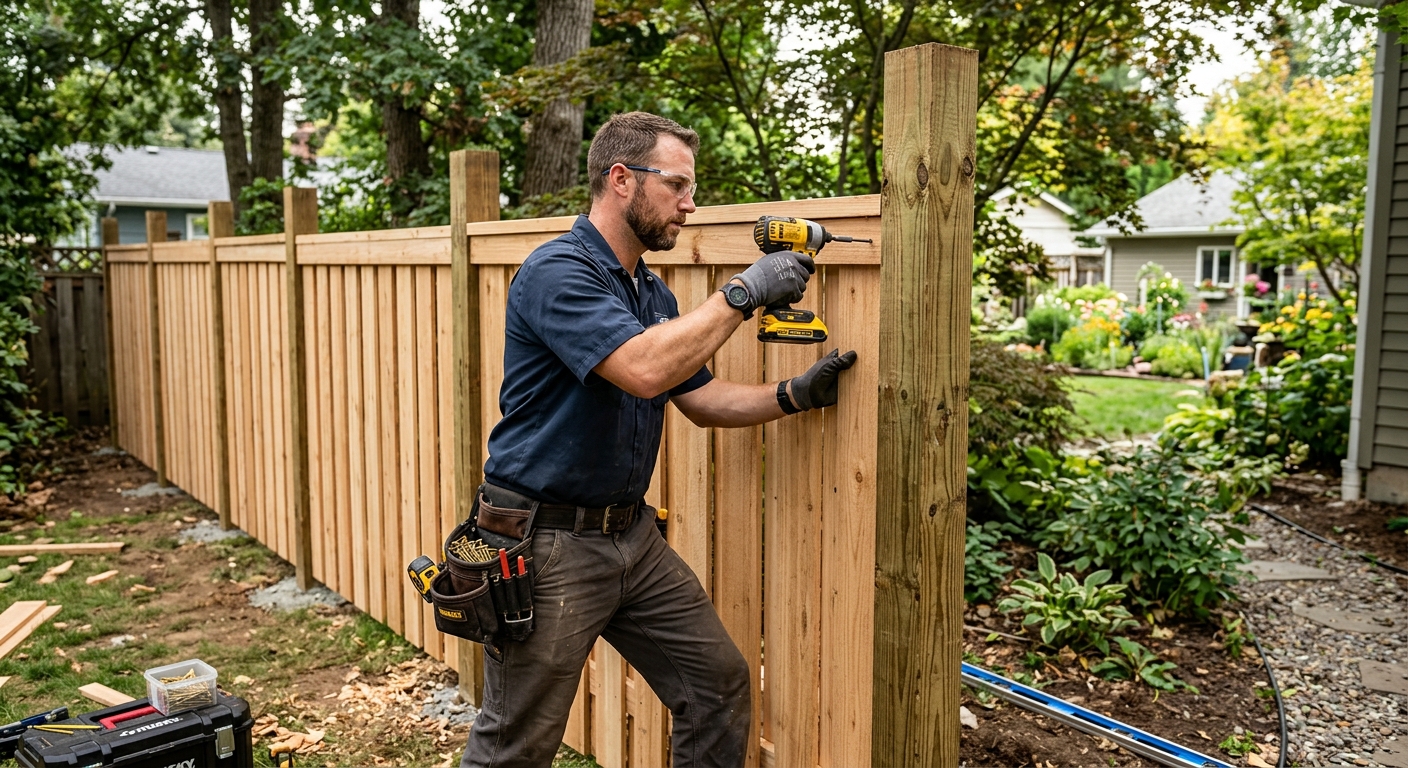
Fencing options and costs in Tavistock
Tavistock homeowners have a few reliable fencing routes, and the “right” choice mostly comes down to privacy, maintenance tolerance, and how long you want the fence to look sharp. Tavistock’s population is 2,955 (Statistics Canada, 2021 Census), which is small enough that local crews know the common yard layouts, but large enough to keep contractors busy during the spring install window. Demand also clusters where detached homes dominate the streetscape, since each property line is a daily decision point—especially near driveways and rear yards. In the Toronto economic region, fencing costs are strongly shaped by freeze depth, soil type, and typical post-and-panel spacing used by local builders.
In Southern Ontario, the frost line is commonly planned at about 42"–48", so posts are usually set a minimum of 3.5–4 feet deep to reduce the risk of heaving. For 6–8 ft privacy fences, that depth often pushes projects into concrete-set posts and heavier hardware to resist racking. The practical result is that even when fence length is similar, labour and installed material can differ more than many homeowners expect. If you’re planning around the area near downtown Tavistock and the older established blocks where yards often back onto mature trees, you’ll also find more time spent on grading, removing obstacles, and matching fence lines.
Below is a realistic comparison to help you baseline your budget before you request an itemised quote.
| Material |
Lifespan |
Maintenance |
Privacy Rating |
Price per Linear Foot |
| Pressure-treated pine (standard wood) |
10–15 years |
Stain/seal every 2–3 years to reduce grey weathering |
High (solid boards) |
$18 – $28 |
| Cedar (natural rot resistance) |
15–20 years |
Light stain/finish as needed (often every 3–4 years) |
High (solid boards) |
$22 – $34 |
| Vinyl / PVC (no-maintenance) |
25–35 years |
Occasional rinse; rare repairs if installed with correct spacing |
High (solid/closed pickets) |
$24 – $38 |
| Chain-link (galvanized steel) |
25–40 years |
Minimal; occasional tension/repair |
Low (unless privacy slats added) |
$14 – $22 |
| Aluminum ornamental |
20–30 years |
Occasional wash; no rust with proper coatings |
Medium (open rail design) |
$26 – $42 |
| Composite / recycled material |
20–30 years |
Minimal; protect from impact damage during installs |
High (solid styles) |
$25 – $40 |
Prices are estimates only and vary by project scope, site access and material selection.
What affects the price of fencing in Tavistock
In Tavistock and across the wider Toronto economic region, quotes for what looks like the “same” fence can swing by 30–50% because contractors price the hidden work: excavation depth, post setting, disposal, gate hardware, and how much panel rework is needed for uneven grade. Two crews can see the same linear footage and still price very differently if one plans for concrete-set posts in clay/mixed soils while the other assumes simpler driven posts. In Southern Ontario, best practice usually favours concrete-set posts—particularly for 6–8 ft runs—because frost heave and soil movement are real problems where temperatures cycle through freeze/thaw.
As a baseline, the design frost depth is commonly planned around 42"–48". That translates to post holes typically needing 4–6 inches below the calculated frost depth, so you’re often looking at roughly 1.5–2.0 m into the ground. That depth means longer posts, more ready-mix and labour time, and more material waste if the trenching/excavation hits stones or compacted clay. In cold conditions, wind and uplift matter less than on the Prairies, but tall solid panels still need heavier posts and closer spacing (often 6–8 ft centres) to prevent racking.
Concrete examples: (1) A straight 80 ft wood privacy run on level ground might land near the wood fence installation band of $65 – $120 per linear foot-equivalent project scope, while the same length with concrete-set posts can push the labour component up noticeably. (2) Switching to vinyl / PVC can cost more upfront (often near $75 – $130 in the regional band) but can reduce future annual touch-ups and repainting budgets for homeowners who want “set it and forget it.” (3) Areas with mature roots or harder access near older lots often add excavation time and disposal—so the quote increases even before you reach materials.
Local neighbourhoods with older housing stock also tend to have older fence lines that aren’t perfectly straight, so expect more layout time and re-stringing to keep the finished line aligned with property pins.
| Price Factor |
Why It Matters |
Cost Impact |
| Fence length in linear feet |
Most components—posts, rails, panels and labour—scale directly with length |
High (typically the largest driver) |
| Post depth required |
Frost line determines hole depth and post length to prevent heaving |
High (can add significant excavation and material cost) |
| Post setting method |
Concrete vs. gravel pack vs. driven posts affects stability and labour time |
Medium to High (concrete-set usually costs more but lasts) |
| Material choice |
Vinyl/cedar/chain-link have different component costs, connectors and longevity |
Medium to High (material markup varies by season and supply) |
| Gate count and type |
Gates need stronger posts, hinges/latches and more precise alignment |
Medium (often a noticeable jump per gate) |
| Grade and terrain |
Sloped yards require stepped or raked panels and extra layout time |
Medium (labour increases even if length stays the same) |
| Old fence removal and disposal |
Demolition, hauling and landfill fees add time and cost |
Medium (can be close to 10–25% of the project) |
| Permit fees and survey / property line locate |
Some fence heights and locations trigger permit/survey work |
Low to Medium (depends on your exact height and location) |
Permits & regulations in Ontario
In Ontario, fence approvals can come down to height and location. While rules vary by municipality, a common threshold is that fences above about 2.0 m (6.5 ft) at the rear and 1.0–1.2 m (3–4 ft) at the front or corner often require a building permit. Separate from permits, your fence still needs to respect property lines and any municipal setback bylaws that apply to your lot. For Tavistock homeowners, the most frequent problem I see isn’t the fence style—it’s when the fence is built too close to the lot line because pins weren’t verified before digging.
Before you start any post-hole digging, call Ontario One Call for utility locates so you don’t hit buried services. Then, confirm your property line using a survey or by locating your property pins (or hiring a locate if pins aren’t visible). This is especially important for corner lots and older properties where boundary markers may be displaced over time.
Shared fence ownership is governed by provincial line-fences legislation, so if you’re rebuilding a shared boundary, clarify who owns the fence and how costs are handled before demolition.
Verify your contractor: request their Ontario business/contractor licence details (where applicable in the trade), obtain a current certificate of insurance that includes general liability, and confirm they carry the required worker coverage (WSIB coverage in Ontario). Ask for the certificate dates and company name on the COI to match the contractor you’re hiring, and keep clearance letters/certificates on file as proof. Step-by-step, you should be able to produce: (1) licence/registration info, (2) COI for liability, and (3) proof of WSIB coverage before work begins.
Choosing the right fence material for Tavistock
Tavistock winters punish the wrong fence choice—especially when posts aren’t set deeply enough for freeze/thaw cycles. For privacy and longevity, pressure-treated pine is often the budget starting point, but it needs staining or sealing every 2–3 years to avoid fast grey weathering and splitting at joints. Cedar looks great and resists rot better than many standard woods, yet it still benefits from periodic finishing to keep it looking uniform.
If low maintenance is your priority, vinyl / PVC is the usual “set-and-forget” option. The catch in Ontario is installation quality: vinyl expands/contracts, so correct spacing, proper post embedment and appropriate hardware matter. Chain-link has the longest “do-nothing” lifespan and is the easiest on your wallet upfront, but it’s not private unless you add privacy slats or choose a privacy-screen add-on. Aluminum ornamental offers clean, rust-resistant performance and curb appeal, though it’s open design—privacy is naturally limited.
Given the local frost line planning of roughly 42"–48", tall privacy fences often require concrete-set posts rather than simply driven posts. For 6–8 ft styles, I typically advise concrete-set for stability in clay and mixed soils, especially where the fence will see more freeze/thaw movement. Wind and snow loads in the Toronto region aren’t as punishing as the Prairies, but tall solid panels still need good post size and spacing to prevent racking.
A realistic dollar example: if your wood privacy run is coming in near the wood installation band of $65 – $120, moving to vinyl may land closer to $75 – $130 in the regional band—often worth it when you’d otherwise budget $300–$800 every couple of years for staining/stewardship and time to maintain consistent colour.
| Material |
Cold Tolerance |
Lifespan |
Annual Maintenance |
Best For |
Price Band |
| Pressure-treated pine |
Good (with proper post depth and sealing) |
10–15 years |
Minor inspections; stain/finish every 2–3 years |
Best budget privacy with willingness to maintain |
$65 – $120 |
| Cedar |
Good (rot resistance holds up through cycles) |
15–20 years |
Light finish as needed, typically every 3–4 years |
Appearance-focused privacy with moderate maintenance |
$75 – $130 |
| Vinyl / PVC |
Very good (if installed with correct tolerances) |
25–35 years |
Rinse/clean as needed; rare repairs |
Low maintenance and consistent look |
$75 – $130 |
| Chain-link |
Excellent |
25–40 years |
Minimal (inspect tension/repairs) |
Security with minimal cost |
$45 – $85 |
| Aluminum ornamental |
Excellent (coatings protect in salt/ice cycles) |
20–30 years |
Occasional wash |
Front-lot appeal with visibility |
$90 – $160 |
| Composite / recycled |
Good (impact-friendly installation practices still matter) |
20–30 years |
Minimal; clean and inspect annually |
Privacy with “wood-like” look and less upkeep |
$75 – $130 |
How to choose a fencing contractor in Tavistock
Choosing a fencing contractor in Tavistock is mostly about verifying the basics and then matching their scope to your site conditions. Start with licensing/registration and insurance. Ask for: (1) proof of Ontario coverage for workers (WSIB coverage in Ontario) and (2) a certificate of insurance showing general liability. If the contractor can’t provide these documents promptly, treat it as a red flag. For liability, the certificate should list the correct business name and include the work address or at least confirm coverage for the type of work being done. Don’t accept verbal assurances—request documents and keep copies.
Next, get 2–3 itemised written quotes rather than lump sums. A proper fence quote lists labour and materials separately: posts (including depth and setting method), rails, pickets/panels, concrete/aggregate, hardware, gate framing, and any grading or privacy slats. Ensure the scope states what’s included and what’s excluded (for example, permit pulling, utility locating fees, and debris hauling/disposal). If old fencing removal is needed, require a line item for demolition and hauling.
Warranty also matters. Ask for the workmanship warranty length (how long they stand behind installation), the manufacturer’s product warranty (materials), and whether either warranty transfers if you sell your home. Payment schedules should protect you: never pay more than 10–15% upfront, and hold a portion until the job is complete and gates/line-posts are properly adjusted.
Finally, insist on a written start date and a realistic completion estimate. In Southern Ontario, spring and early summer schedules fill quickly, but good contractors still commit to a timeline in writing.
- Request WSIB coverage proof (Ontario) and confirm the certificate is current.
- Collect a certificate of insurance showing general liability.
- Verify the contractor’s business name matches the insurance documents.
- Ask for an itemised quote: posts, concrete, rails, panels/pickets, hardware, gates.
- Confirm post depth and setting method (concrete-set recommended for frost protection in this region).
- Make sure the quote includes utility locate coordination costs (or that it states it’s included).
- Check whether permit fees are included or excluded.
- Confirm old fence removal, stump/obstacle handling, and disposal/hauling are specified.
- Require scope language for grading/stepping on sloped yards (raked vs stepped panels).
- Review warranty terms: workmanship duration, manufacturer warranty, and transferability.
- Set payment terms: 10–15% maximum upfront; holdback until walkthrough completion.
- Get start date, weather contingencies, and completion estimate in the contract.
Red flags I commonly see in Tavistock: (1) quotes that assume “driven posts” for tall privacy fencing without frost-depth planning; (2) no itemisation for gates and hardware; (3) missing or expired insurance/WSIB paperwork; (4) large upfront payments beyond 10–15%; and (5) vague scope language like “disposal included” without defining it.
Frequently asked questions — fencing in Tavistock
How do I find my property line before fencing?
In Tavistock (and throughout Ontario), don’t rely on guesswork or neighbour marks—confirm your boundary before any post holes get dug. Start by locating your property pins (survey markers) or arranging a property line locate/survey if pins aren’t visible. Then call for utility locates through Ontario One Call before digging, even if you think the area is clear. If your lot is older, pins can shift over decades, and that’s where disputes start. For shared fences, provincial line-fences rules can affect how costs are handled, so clarify ownership and boundaries before demolition. Once your line is confirmed, measure from pins using consistent string lines so the installed fence stays aligned.
What's the most low-maintenance fence?
For low maintenance in Ontario’s freeze/thaw climate, vinyl / PVC and aluminum are typically the easiest long-term. Vinyl usually needs only occasional rinsing and a visual check after heavy storms. Aluminum ornamental similarly doesn’t rust like steel can, and it avoids the periodic staining cycle that wood requires. Chain-link is also low maintenance, but it won’t provide privacy unless you add slats. As a budgeting reference for Tavistock, vinyl / PVC often falls in the regional band of $75 – $130, while chain-link is commonly lower at $45 – $85. The “least work” option is also the one installed with correct post depth and spacing—so ask how posts will be set for frost stability.
How tall can my fence be in Tavistock?
Fence height limits depend on the fence location (rear vs front/corner) and local municipal bylaws. In Ontario, a common threshold is that fences above about 2.0 m (6.5 ft) at the rear and around 1.0–1.2 m (3–4 ft) at the front or corner often require a building permit. In practice, that means many privacy fences that are 6–8 ft tall may trigger permit checks depending on your exact spot on the lot. Before you buy materials, confirm with your municipality and ask your contractor whether permit pulling is included in the quote. Also remember: even if height is permitted, you still must respect your property line and any setbacks.
Should fence posts be set in concrete here?
For Tavistock and the broader Toronto region, concrete-set posts are usually the safer choice for privacy fences, especially in clay and mixed soils with freeze/thaw movement. The design frost line is commonly planned at about 42"–48", so posts typically need to be set about 4–6 inches below the design frost depth to help prevent heaving—often meaning 1.5–2.0 m into the ground. That depth increases labour and ready-mix costs, but it significantly improves long-term stability compared with simple gravel pack or driven posts in many conditions. If you’re quoted a tall wood privacy fence with driven posts only, ask for their reasoning and ask how they’re addressing frost heave risk. In most Southern Ontario installs, concrete-set wins on performance.
What's the best fence for privacy?
Best privacy in Tavistock usually means a solid, closed-board or closed-picket design with tight spacing, strong posts, and adequate depth. Wood (pressure-treated pine or cedar) offers high privacy, but you must maintain it—pressure-treated typically needs staining every 2–3 years, while cedar often needs finish work less often, yet still benefits from maintenance. Vinyl / PVC also provides strong privacy with less upkeep, though it depends on correct installation tolerances in cold weather. Price-wise, wood installations commonly land around $65 – $120 in the regional band, while vinyl / PVC often ranges around $75 – $130. Privacy also depends on correct panel bracing to resist racking, not only the material.
How do I compare fencing quotes?
To compare quotes fairly in Ontario, ignore the total price until you’ve confirmed the scope is truly equivalent. Ask each contractor for an itemised breakdown: posts (including depth), post setting method (concrete vs other), panel/picket type, rails, hardware, gate construction, and whether disposal/hauling is included. Confirm whether permit fees and any property line locate/survey work are included or excluded. Also check warranties: workmanship coverage length, manufacturer warranty, and whether either transfers. Finally, compare payment terms—never accept more than 10–15% upfront. If one quote assumes different post depth or a different grade/terrain approach, totals aren’t comparable even if the fence length matches.