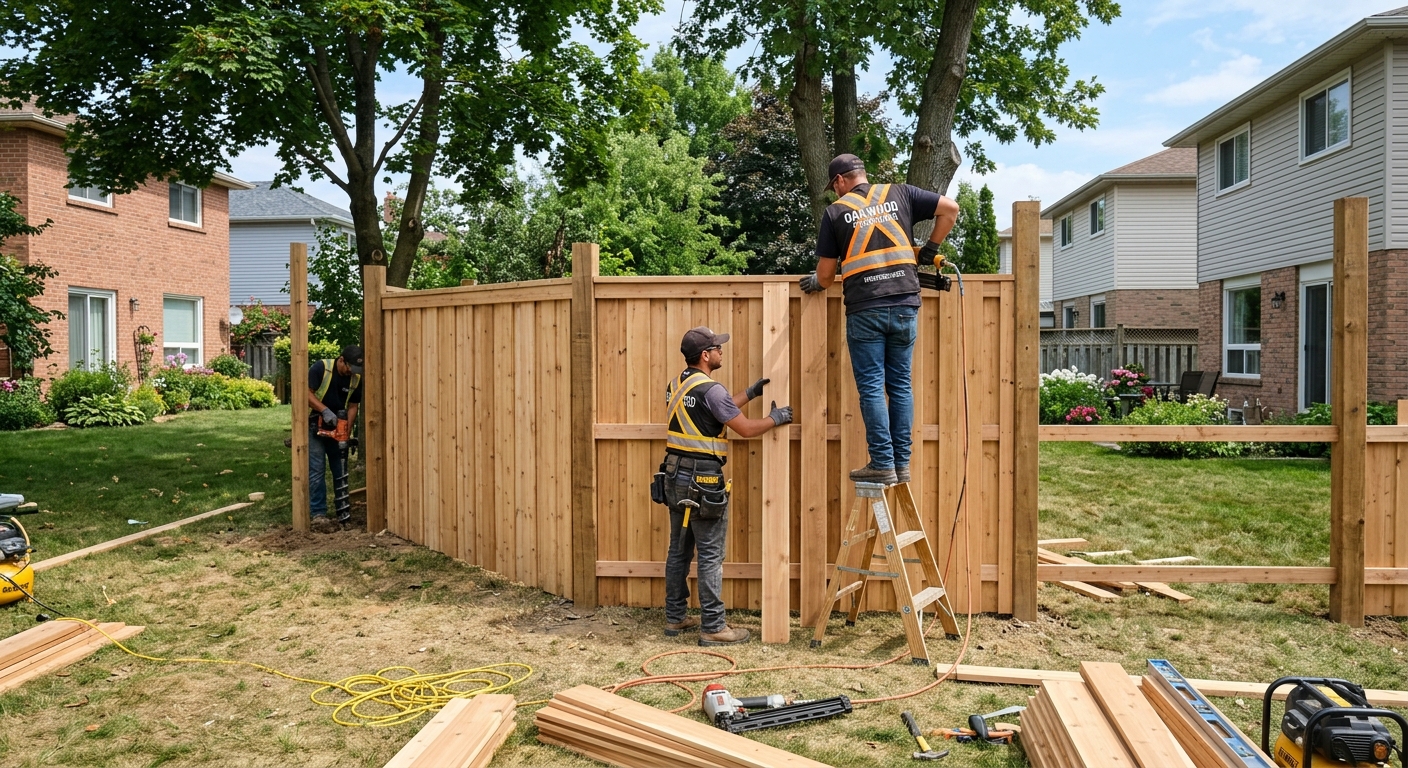
Fencing options and costs in Eastbridge
Fencing in Eastbridge is shaped by a simple reality: you’re protecting what you own, and Eastbridge’s housing stock creates steady demand for both privacy fences and boundary fencing. With a 2021 population of 6,840 (Statistics Canada, 2021 Census), neighbourhoods stay tight-knit—so homeowners often upgrade fencing for privacy and curb appeal after new landscaping, pool installations, or front-yard changes. In a market like the Toronto economic region, where detached homes are common, each property is effectively a potential fencing customer, and that drives consistent contractor workload and pricing stability (Statistics Canada, 2021 Census).
Costs here aren’t just “material x labour.” Toronto-area freeze/thaw cycles require posts set deeper than many people expect. The frost line in Southern Ontario is commonly taken at about 42"–48", so most privacy fences are planned with concrete-set posts set roughly 3.5–4 feet deep. That increases labour time and ready-mix costs, but it’s one of the biggest drivers of long-term stability in clay and mixed soils.
In Eastbridge, you’ll notice fencing work is especially busy around the older established residential pockets where yards are mature and gates are more likely to be added for side access. If you’re getting ready to compare options, the table below gives a practical range for common materials installed in this area.
| Material |
Lifespan |
Maintenance |
Privacy Rating |
Price per Linear Foot |
Price Range |
| Pressure-treated pine (standard wood) |
10–15 years |
Stain/seal every 2–3 years; check posts |
High (solid) |
$17–$28 |
$65–$120 |
| Cedar (natural rot resistance) |
15–25 years |
Light stain/seal every 3–4 years |
High (solid) |
$20–$34 |
$75–$130 |
| Vinyl / PVC (no-maintenance) |
20–30 years |
Wash annually; inspect posts/hardware |
High (solid) |
$23–$38 |
$75–$130 |
| Chain-link (galvanized steel) |
20–40 years |
Occasional rinse; tighten hardware |
Low–Medium (open) |
$12–$19 |
$45–$85 |
| Aluminum ornamental |
25–40 years |
Wash as needed; check gate alignment |
Low–Medium (decorative) |
$18–$34 |
$90–$160 |
| Composite / recycled material |
20–30 years |
Minimal—wash and periodic hardware checks |
High (solid) |
$24–$40 |
$85–$145 |
Prices are estimates only and vary by project scope, site access and material selection.
What affects the price of fencing in Eastbridge
In Eastbridge and across the Toronto region, the same “typical” fence can land 30–50% apart between quotes because the hidden variables are usually site conditions and construction details, not just the board or rail. In practice, two crews can quote different totals because one includes proper footing depth, gate hardware, and disposal—while the other optimizes around assumptions. That difference is amplified by Ontario’s seasonal freeze regime and the way local contractors build for frost stability.
Post depth is the biggest variable. With Southern Ontario frost lines commonly referenced at about 42"–48", we typically plan for concrete-set posts with hole depths around 3.5–4 feet for privacy fences. In cold weather, posts effectively need to sit 4–6 inches below the design frost depth to reduce heaving. That means longer posts, more excavation, and concrete—so even when the fence material looks similar, labour and material costs rise. Wind also plays a role: while the GTA isn’t prairie-level exposure, taller solid privacy fences still need adequate post size and spacing to resist racking.
Concrete examples from the Eastbridge market: (1) a straight backyard run on level ground might fit in the standard wood or vinyl band (for example, wood installation often lands in the $65–$120 range), but (2) the same linear footage with gates on a sloped side yard may require stepped rails and heavier bracing, pushing you closer to the higher end. (3) If you’re replacing an older fence, removal and hauling can add significant labour hours; disposing of multiple loads tends to raise the job cost even if the new material selection stays budget-friendly.
| Price Factor |
Why It Matters |
Cost Impact |
| Fence length in linear feet |
Labour, posts, rails, panels and hardware scale directly with length |
Highest driver; longer runs dominate total price |
| Post depth required |
Frost line determines hole depth and post length to prevent heaving |
Concrete-set work increases material and labour |
| Post setting method |
Concrete vs gravel pack vs driven posts affects stability and longevity |
Concrete-set is typically more expensive but more reliable |
| Material choice |
Vinyl, cedar, pressure-treated wood and chain-link have different costs and brackets |
Switching materials can shift budgets by tens of percent |
| Gate count and type |
Drive-through gates need heavier frames and stronger latching hardware |
Often adds notable cost per gate, especially double-drive |
| Grade and terrain |
Sloped yards require stepped or raked construction, more labour and waste |
Commonly increases labour and may require extra hardware |
| Old fence removal and disposal |
Demolition, load-out, and hauling time vary by old structure condition |
Can add a meaningful line-item even if new fence is simple |
| Permit fees and survey / property line locate |
Higher fences or corner situations may trigger approvals and line verification costs |
May add fixed costs; prevents costly rework |
Permits & regulations in Ontario
In Ontario, fence rules are a mix of municipal bylaws and provincial line-fencing concepts, so it’s important to verify the local threshold that triggers a permit. As a practical guideline used in many Ontario municipalities, fences above a height threshold—often around 2.0 m (6.5 ft) at the rear and roughly 1.0–1.2 m (3–4 ft) at the front or corner—may require a building permit. Even when a permit isn’t required, all fencing must respect property lines and municipal setback bylaws.
Before you dig any post holes in Eastbridge, arrange utility locates through Ontario One Call. This helps prevent damage to buried services and protects you from downtime and repair costs. Next, obtain a survey or at minimum verify your property pins and line locations before installing—encroachment disputes are avoidable, but they’re also expensive to unwind.
Shared fence ownership and maintenance are typically handled under Ontario’s line-fencing framework, but agreements and practical realities (like who built first and when) matter for the division of costs and responsibility. If you’re replacing a shared fence, ask how the boundary is currently treated.
Licence and coverage checks are part of homeowner protection: verify the contractor’s Ontario business licence where applicable, request certificate of insurance (general liability) and proof of workers’ compensation coverage. Look for WSIB/WCB clearance evidence on request, and confirm coverage dates and job-site location match your project. If they won’t provide paperwork promptly, that’s a red flag before a single post is set.
Choosing the right fence material for Eastbridge
Choosing the right material in Eastbridge means balancing privacy, maintenance, budget, and how the fence handles Toronto-area winter swings. With frost action and damp seasons, all fence systems need posts set correctly, especially for taller solid fences. Pressure-treated pine can be the most budget-friendly upfront, but it typically needs staining or sealing every 2–3 years to slow grey weathering and keep the wood from checking. Cedar offers better natural rot resistance and a more attractive finish, yet it still benefits from periodic sealing for consistent colour and longevity. Vinyl/PVC is popular for low maintenance—typically wash-and-go—but in extreme cold the panels and fittings must be installed with the right tolerances to avoid brittleness or warping at stress points.
Chain-link is the long-life, lowest-cost route and works well for perimeter security, but it won’t deliver privacy unless you add screens or slats. Aluminum ornamental fencing gives a clean look and won’t rust like steel (it’s usually powder-coated), but privacy is limited by design. Composite/recycled materials can mimic a solid privacy fence with minimal upkeep, though upfront cost is usually higher.
For Toronto’s frost conditions, concrete-set posts are generally the safest choice for 6–8 ft privacy fences because they reduce heaving risk from freeze/thaw. That foundation approach often makes the material difference easier to justify. For example, if you’re comparing a pressure-treated privacy fence budget band versus vinyl, investing toward vinyl in the $75–$130 installed range can pay off in fewer maintenance visits—particularly for homeowners who want a set-and-forget fence.
| Material |
Cold Tolerance |
Lifespan |
Annual Maintenance |
Best For |
Price Band |
| Pressure-treated pine |
Good with proper sealing and correct post depth |
10–15 years |
2–3 year stain/seal cycle; seasonal hardware checks |
Budget privacy where you’re okay maintaining |
$65–$120 |
| Cedar |
Excellent; handles wet seasons well when sealed |
15–25 years |
Every 3–4 years for best colour and weather resistance |
Premium look with rot resistance |
$75–$130 |
| Vinyl / PVC |
Very good; install for expansion in cold |
20–30 years |
Wash annually; inspect brackets |
Low-maintenance privacy |
$75–$130 |
| Chain-link |
Good; galvanized coating resists winter corrosion |
20–40 years |
Occasional rinse and tension checks |
Security and boundary marking |
$45–$85 |
| Aluminum ornamental |
Excellent; coating resists Ontario moisture |
25–40 years |
Wash as needed; tighten gate hardware |
Decorative fencing with durable hardware |
$90–$160 |
| Composite / recycled |
Good; stable boards when installed correctly |
20–30 years |
Minimal—wash and periodic hardware checks |
Solid privacy with reduced upkeep |
$85–$145 |
How to choose a fencing contractor in Eastbridge
To choose a fencing contractor in Eastbridge, start with verification—because fencing failures often come down to workmanship, not just material. First, confirm the contractor’s Ontario business registration/licence status where required, then request proof of general liability insurance with coverage amounts listed for your project. Next, ask for workers’ compensation coverage (WSIB/WCB). You can check coverage status using the clearance documentation they provide (or confirm the certificate details match your dates and address). If a contractor can’t produce current documents, pause the process until you can.
Next, get 2–3 itemised written quotes. You want a breakdown that separates labour, materials, post footing/setting method, gate hardware, and removal/disposal. Avoid “lump sum with no detail,” especially for privacy fences where concrete-set posts and brace requirements materially change the cost. Ask whether permits are pulled by the contractor and whether disposal is included in the price.
Warranty matters in Ontario’s freeze/thaw environment. Look for a workmanship warranty length for posts, rails and panel alignment, and confirm the product/manufacturer warranty on materials. Ask if the warranty is transferable to you and what conditions void it (for example, improper staining for wood).
Payment schedule should be cautious: never pay more than 10–15% upfront. Hold back the remainder until the job is complete and passes final walkthrough. Also insist on a start date and completion estimate in writing so you can plan around weather and material lead times.
- Request proof of insurance and WSIB/WCB coverage before signing anything.
- Ask for an itemised scope: posts, concrete/footings, rails, panels, fasteners and gates.
- Confirm post-depth approach for Toronto frost conditions (concrete-set for tall privacy fences).
- Verify how they handle sloped yards (stepped vs raked panels) and show an example.
- Ensure gate hardware is included (hinges, latches, brackets, reinforcement).
- Ask whether permit/approval work is included where required for height thresholds.
- Confirm demolition and hauling/disposal is priced or excluded clearly.
- Check what colour/finish is included for metal or wood staining expectations.
- Get the warranty terms in writing for both workmanship and product materials.
- Review the schedule: start date, weather contingency plan, and completion target.
- Use a payment plan with a small deposit and holdback until final inspection.
- Make sure the quote includes utility locate confirmation before digging.
In Eastbridge, concrete red flags include contractors who won’t provide WSIB/WCB or insurance paperwork on request; quotes that omit post depth/footing details (especially for 6–8 ft privacy fences); “same day” promises without a material lead plan; and vague warranty language that only covers products but not workmanship.
Frequently asked questions — fencing in Eastbridge
How long does a wood fence last in Eastbridge?
In Eastbridge, a well-built pressure-treated wood fence commonly lasts about 10–15 years, while cedar can reach roughly 15–25 years depending on exposure and maintenance. The deciding factors are post setting and how the wood is protected through Ontario’s freeze/thaw and wet seasons. For privacy-height fences, posts should be concrete-set and set deep enough to reduce frost heave risk; that’s why many quotes land in the wood installation bands (for example, roughly $65–$120 installed for many standard pressure-treated jobs). If you stain pressure-treated wood every 2–3 years, you slow down grey weathering and extend service life. Neglecting maintenance typically shortens the lifespan, especially at the bottom edges near grade where moisture lingers.
Who owns and maintains a shared fence?
In Ontario, shared fence ownership and maintenance are guided by line-fencing principles, but the practical answer depends on how the fence was built and how the boundary is treated. If a fence sits on or at the boundary, neighbours may share responsibility for costs and upkeep. Before replacing anything, confirm the fence location relative to property pins or an up-to-date locate/survey, because building past the line can create disputes. If you’re changing the fence type (for example, replacing chain-link with a solid privacy fence), discuss what neighbours expect regarding height, materials and aesthetics. A clear written agreement prevents “scope drift” later, especially where gates, corner posts, and bracing are involved.
How do I find my property line before fencing?
For fencing in Eastbridge, don’t guess from old stakes or appearance—start with your property documents. Locate your survey (if you have one), then verify property pins/markers on-site so you can measure from known points. If you’re unsure, hire a surveyor to locate the legal boundary or request a property line locate that uses the pins. This step is especially important for corner yards and older neighbourhoods where fences may have been installed informally. Before you dig any post holes, complete utility locates through Ontario One Call so you don’t hit buried services. Contractors should also include boundary verification in the workflow to avoid costly relocation if a line issue is discovered mid-installation.
What's the most low-maintenance fence?
For low-maintenance performance in Eastbridge, vinyl/PVC and aluminum are usually the best choices. Vinyl typically needs only periodic washing and occasional hardware checks, and aluminum ornamental fences resist rust and can be wiped down as needed. Compared to wood, you avoid recurring staining cycles. Chain-link is also low maintenance, but it won’t provide privacy without additional screening. Cost-wise, vinyl/PVC often aligns with the vinyl band (commonly around $75–$130 installed depending on height, gates and post system). The best “low maintenance” result still depends on correct post depth and proper installation tolerances for Ontario winter conditions.
How tall can my fence be in Eastbridge?
Fence height rules in Ontario are typically handled through municipal bylaws, and permits are more likely as height increases. As a practical guideline used widely, fences over about 2.0 m (6.5 ft) at the rear and around 1.0–1.2 m (3–4 ft) near the front or corners may require a permit. Even if a permit isn’t required, you still need to stay within setback requirements and property line limits. Because Eastbridge projects often involve backyard privacy fences around 6–8 ft, it’s smart to confirm the exact threshold with your municipality before ordering materials. A contractor who can’t discuss the permit/height planning process usually isn’t managing the risk properly.
Should fence posts be set in concrete here?
For most privacy fences in Eastbridge (especially 6–8 ft solid styles), concrete-set posts are the recommended approach because it helps prevent frost heave. Southern Ontario frost depth is commonly referenced around 42"–48", and many installers set posts roughly 3.5–4 feet deep to stay below the frost action zone. That translates into deeper holes, longer posts and added labour and ready-mix—so you’ll often see higher pricing than “driven post” methods. In cold Ontario winters and mixed soils, concrete footings significantly improve long-term stability and reduce wobble or tilting over multiple freeze/thaw cycles. If a quote is unusually low and doesn’t explain post-setting depth and method, ask directly—this is usually where quality and longevity differ.