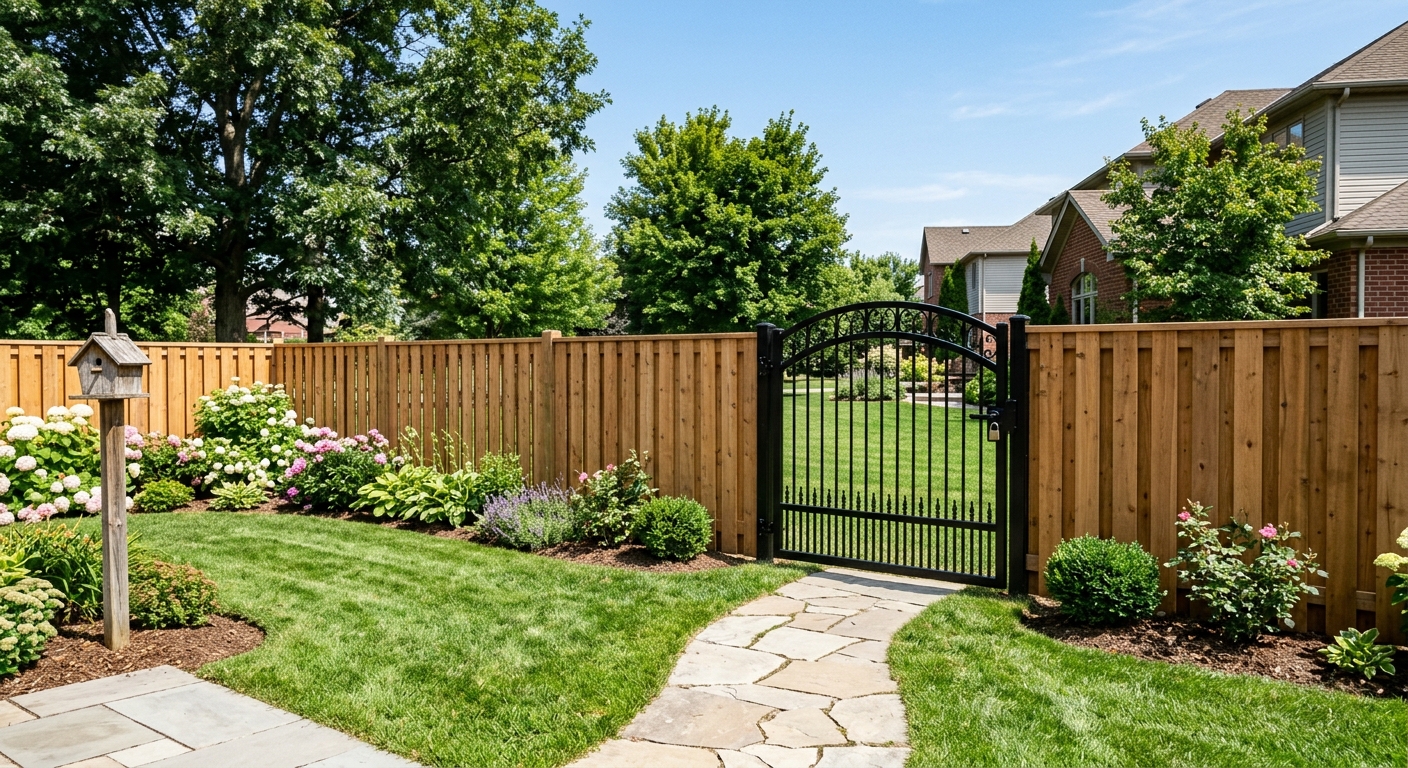
Fencing options and costs in Newtonbrook West
Newtonbrook West homeowners typically start by comparing fence materials, then quickly notice the real-world differences in cost, build method, and longevity. With a population of 23,831 people in the area (Statistics Canada, 2021 Census), there’s steady demand from detached and family neighbourhoods where backyards are used year-round. In Toronto’s housing mix, that creates predictable pressure on trades during spring and early summer—the same period most people schedule fencing after snowmelt and spring landscaping.
In this part of Ontario, climate drives the foundation cost as much as the fence itself. Frost is commonly planned at about 42"–48", so for 6–8 ft privacy fences we typically recommend concrete-set posts set roughly 3.5–4 feet deep to reduce frost heave risk. That means longer posts, deeper holes, and more ready-mix, which pushes pricing above simple “drive-in post” assumptions. Wind also plays a role, not like the Prairies, but enough that solid panel fences (wood or vinyl) are built with heavier posts and appropriate spacing to prevent racking and uplift.
We see particularly strong trade demand around the older residential pockets near Finch Avenue East and Yonge Street corridors, where many lots are narrow and require careful layout, utility-safe digging, and tidy line-fence finishes. Once you know your goal—privacy, curb appeal, or budget—comparing material options becomes easier. Use the table below as a quick Newtonbrook West cost baseline, then we can refine it to your lot length, gates, and access.
| Material |
Lifespan |
Maintenance |
Privacy Rating |
Price per Linear Foot |
| Pressure-treated pine (standard wood) |
10–15 years |
Stain/seal every 2–3 years |
High (solid pickets/panels) |
$65 – $120 |
| Cedar (natural rot resistance) |
15–20 years |
Light staining typically every 2–3 years |
High (solid boards/panels) |
$75 – $130 |
| Vinyl / PVC (no-maintenance) |
20–30 years |
Wash as needed; no staining |
High (solid privacy styles) |
$75 – $130 |
| Chain-link (galvanized steel) |
20–30 years |
Occasional repair of tension/bottom rails |
Low (visibility through mesh) |
$45 – $85 |
| Aluminum ornamental |
25–40 years |
Rinse/spot-clean; no rust coating care |
Medium–Low (decorative spacing) |
$90 – $160 |
| Composite / recycled material |
20–30 years |
Wash periodically; minor repairs if damaged |
High (board-style privacy) |
$90 – $160 |
Prices are estimates only and vary by project scope, site access and material selection.
What affects the price of fencing in Newtonbrook West
In Newtonbrook West (and across the Toronto economic region), it’s common to see fence quotes swing by 30–50% even when homeowners believe they’re comparing “the same fence.” The gap usually comes down to how each contractor handles the foundation (post depth and setting), how they deal with gates, and whether they include demolition and disposal. Two crews may quote the same fence style, but one includes concrete-set posts sized for frost depth and wind bracing, while the other assumes lighter hardware or less digging.
Frost line depth is a major driver in Southern Ontario. Best practice is often to set posts roughly 4–6 inches below the design frost depth, which for Toronto planning typically lands around 1.5–2.0 m into the ground. That requires longer posts and deeper post holes, plus concrete-set labour and ready-mix costs. For privacy fences that are 6–8 ft tall, we also see heavier posts (and closer spacing) to resist racking and uplift. Chain-link can be cheaper because it’s lighter and often tolerates less aggressive post bracing, which is why chain-link pricing commonly sits in the $45–$85 per linear foot band in this tier.
Concrete examples from Toronto jobs: (1) If your yard is sloped and needs stepped panels, the contractor may price extra labour and custom trimming; (2) if you’re adding a double-drive gate, the hardware and reinforcement can add substantial cost compared with a walk gate; (3) if access is tight—think narrow driveways and mature landscaping—labour time increases for hauling materials and setting posts safely. On the flip side, a straightforward run with good access often brings solid privacy wood closer to the lower end of the $65–$120 range.
So when you’re budgeting in Newtonbrook West, treat “fence length plus foundation method” as the real starting point—not the material name alone.
| Price Factor |
Why It Matters |
Cost Impact |
| Fence length in linear feet |
Most costs scale directly with total lineal footage plus footings and hardware |
Highest impact driver |
| Post depth required |
Frost line determines hole depth and how long posts must be |
Can add significant labour and materials |
| Post setting method |
Concrete-set posts improve long-term stability versus gravel pack or driven-only methods |
Concrete typically increases cost |
| Material choice |
Vinyl/PVC has higher upfront cost; cedar balances cost and appearance; chain-link is budget-friendly |
Changes both materials and hardware needs |
| Gate count and type |
Double drive-through gates require heavier reinforcement and stronger latches/hinges |
Often a large swing factor |
| Grade and terrain |
Sloped yards need stepped or raked systems to keep the top rail level |
Extra labour and layout time |
| Old fence removal and disposal |
Hauling debris, disposal fees, and repair to surrounding ground |
Can materially increase total price |
| Permit fees and survey / property line locate |
Verifying property lines prevents encroachment and avoids costly rework |
Variable depending on lot specifics |
Permits & regulations in Ontario
In Ontario, whether you need a permit can depend on fence height and location on your lot. As a practical rule of thumb for many residential builds, fences above roughly 2.0 m (about 6.5 ft) at the rear may require a building permit, while front or corner yard fences often fall under lower thresholds (commonly around 1.0–1.2 m or 3–4 ft). Municipal setback and property-line rules still apply even when a permit isn’t required. In Newtonbrook West, the most common reason projects get delayed is not the permit itself—it’s starting excavation without confirming property lines or without having utilities located.
Before digging any post holes, you must call for utility locates through Ontario One Call. Also consider getting a survey or at least a professional property line locate, especially if your current fence is older, shifted, or built on what later turned out to be incorrect pins. This helps prevent encroachment disputes with neighbours and avoids “remove and rebuild” scenarios.
Licensing and coverage verification is also part of responsible contracting. For a homeowner, confirm that the contractor is licensed for the work they’re doing (where applicable), carries liability insurance, and has WSIB coverage where required by law. Practically, you should: (1) request the certificate of insurance and verify it shows current dates and your project as appropriate, (2) ask for proof of WSIB clearance and confirm it matches the company on the quote, and (3) confirm the company name used in the written quote matches the insurance/coverage paperwork.
Choosing the right fence material for Newtonbrook West
Choosing the right fence material in Newtonbrook West is really about matching your priorities—privacy, low maintenance, and budget—to our local winter and mixed-soil conditions. Pressure-treated pine is the lowest upfront option, but it’s also the one that will most likely require staining or sealing every 2–3 years to slow grey weathering and keep boards looking good. Cedar offers better natural rot resistance and a cleaner, warmer appearance, but it still benefits from periodic maintenance to protect its surface and colour. Vinyl/PVC is the low-maintenance favourite for many homeowners; however, in extreme cold it can become more brittle, so proper post setting and panel support matters more than people expect.
Chain-link is the “budget and durability” choice, with the longest life per dollar and minimal maintenance, but it won’t give privacy unless you add slats or screening. Aluminum ornamental fencing is great for curb appeal and resists rust, but it’s typically a privacy-light option because of the open picket spacing.
On foundations: because Toronto area planning commonly treats frost around 42"–48", concrete-set posts are strongly recommended for 6–8 ft fences. That adds cost, but it’s what helps keep rails aligned for many years—especially in clay and mixed soils where frost heave can lift poorly set posts. Wind and snow loads don’t hit us like the Prairies, but solid panels still need adequate post size and spacing to limit racking.
Example: if a vinyl privacy fence comes in around the $75–$130 per linear foot range while cedar or pressure-treated wood starts in the $65–$120 band, the price difference is often justified when you want “set it and forget it” appearance and fewer maintenance days in your calendar.
| Material |
Cold Tolerance |
Lifespan |
Annual Maintenance |
Best For |
Price Band |
| Pressure-treated pine |
Good with proper post depth and sealing |
10–15 years |
Light inspection; stain/seal every 2–3 years |
Budget privacy with regular upkeep |
$65 – $120 |
| Cedar |
Good; handles moisture better than pine |
15–20 years |
Stain/coat typically every 2–3 years |
Better appearance and rot resistance |
$75 – $130 |
| Vinyl / PVC |
Good if panels and posts are properly supported |
20–30 years |
Wash as needed; no staining |
Low maintenance privacy |
$75 – $130 |
| Chain-link |
Very good; resilient in freeze-thaw cycles |
20–30 years |
Occasional tension and bottom-rail checks |
Security with minimal cost |
$45 – $85 |
| Aluminum ornamental |
Excellent |
25–40 years |
Rinse/spot-clean |
Curb appeal and long service life |
$90 – $160 |
| Composite / recycled |
Good; stable in mixed weather |
20–30 years |
Wash periodically; minor repairs if damaged |
Privacy with reduced upkeep |
$90 – $160 |
How to choose a fencing contractor in Newtonbrook West
Choosing the right fencing contractor in Newtonbrook West starts with proof, not promises. In Ontario, you should verify liability insurance and WSIB coverage (where required) before work begins. Ask for a certificate of insurance (request the PDF or a current certificate) and make sure it’s issued to the same legal business name as the quote and that it includes appropriate coverage for fencing/construction activities. For WSIB, request clearance or proof of coverage as applicable; a contractor should be able to provide documentation without hesitation.
Next, get 2–3 itemised written quotes. A good quote separates labour and materials and explains exactly what’s included: post depth and setting method, rail style, gate hardware, and lineal footage measurements. Avoid quotes that only provide a lump sum without specifying whether old fence removal and disposal are included, whether permits and property line locating costs are included or added separately, and what happens if they find buried obstructions during excavation.
Warranty matters too. Confirm the workmanship warranty length (how long they stand behind installation) and distinguish it from the manufacturer’s product warranty. Also ask whether the warranty is transferable if you sell your home.
On payment schedule, protect yourself: never pay more than 10–15% upfront. Use a holdback until the fence is fully complete and aligned, gates operate smoothly, and cleanup is done. Finally, request a written start date and a realistic completion estimate—fencing projects often hinge on weather windows for digging and concrete curing.
- Ask for WSIB clearance/proof of coverage (where applicable) before signing.
- Confirm liability insurance is current and issued to the same company name as the quote.
- Require an itemised breakdown: posts/rails/panels, concrete/footings, and hardware.
- Have them specify post depth and whether posts are concrete-set (typical frost approach in Toronto).
- Confirm what’s included for gate reinforcement, hinges, latches, and alignment.
- Clarify whether old fence removal and disposal are included or billed separately.
- Ask who pulls permits (if required) and whether permit fees are included.
- Request utility locate confirmation and excavation safety process.
- Verify the property line approach: survey or locate vs. “best guess” measurements.
- Get the warranty in writing: workmanship duration and what it covers.
- Set a payment schedule with no more than 10–15% upfront and hold back until completion.
- Get a written start/completion timeline and confirm protection for landscaping during work.
Red flags I see in Newtonbrook West: (1) contractors who will not provide insurance/WSIB documentation upfront, (2) vague quotes that don’t state post depth or setting method, (3) pricing that assumes driven posts for tall privacy fences on frost-prone ground, (4) no written scope for gate hardware and alignment, and (5) demanding a large upfront deposit (well beyond 10–15%).
Frequently asked questions — fencing in Newtonbrook West
Wood vs vinyl vs aluminum fence — which is best?
In Newtonbrook West, the “best” choice depends on whether you want privacy, curb appeal, or minimal upkeep. For privacy, wood (often in the $65–$120 per linear foot band) and vinyl/PVC (commonly $75–$130) are the practical choices; both typically benefit from concrete-set posts due to Toronto-area frost planning around 42"–48". If you want the lowest maintenance, vinyl usually wins because it doesn’t require staining. Cedar is a strong wood upgrade if you also care about appearance. Aluminum is ideal for style and durability—often $90–$160—but it’s usually open picket, so privacy is limited. If you have narrow lots or more exposure near corners, ask about post size and closer spacing to prevent racking and keep panels straight through winter freeze-thaw cycles.
Do I need a permit to build a fence in Ontario?
Often, yes—depending on the fence height and where it sits on your property. In Ontario, fences above roughly 2.0 m (about 6.5 ft) in the rear may require a building permit, while front/corner yard fences commonly fall under lower thresholds (around 1.0–1.2 m or 3–4 ft). Even when a permit isn’t required, your fence must respect property lines and municipal setback rules. In Newtonbrook West, the most common “gotcha” is starting excavation before confirming the property pins and ensuring you’ve completed utility locates through Ontario One Call. A reputable contractor will ask for your lot details, clarify permit responsibility in the quote, and build to the required heights for your yard orientation.
How long does a wood fence last in Newtonbrook West?
A properly built wood fence in Newtonbrook West can last around 10–15 years for pressure-treated pine and about 15–20 years for cedar, assuming correct post depth and periodic maintenance. The lifespan isn’t just about the boards; frost heave protection is critical. With Toronto-area planning (commonly 42"–48" frost), posts generally need to be set about 3.5–4 feet deep with concrete to reduce uplift in freeze-thaw conditions, especially on clay/mixed soils. If you skip staining or sealing, grey weathering and moisture damage will accelerate deterioration. If you’re budgeting, expect maintenance cycles every 2–3 years for best appearance and performance. A contractor who specifies concrete-set posts and provides a maintenance recommendation is usually protecting your investment.
Who owns and maintains a shared fence?
Shared fences in Ontario are typically governed by provincial line-fences legislation, and the “who pays and who maintains” depends on whether the fence is truly shared by both properties and how costs were originally agreed or established. In practice, many neighbours contribute to upkeep if they both benefit from the barrier and the fence sits on (or is treated as) the boundary. However, if the fence is entirely on one side or built on private land, responsibility is generally aligned with ownership. In Newtonbrook West, older fences sometimes drift from the original line—so it’s worth confirming the property pins or getting a locate before making cost-sharing decisions. If disputes arise, keep everything in writing and use a survey/locate to reduce assumptions.
How do I find my property line before fencing?
Before you install posts, confirm the property line rather than relying on old fence positioning. The most reliable approach is a survey or a professional property-pin locate so your contractor can lay out true corners and boundary lines. If you already have a survey report from when you purchased your home, use it—but have a contractor cross-check pins/markers because fences can shift over time. In Ontario, fences must respect property lines and municipal rules, and guessing is how neighbour disputes start. For Newtonbrook West lots, I also recommend planning your layout to avoid conflicts with easements and buried utilities. Finally, call Ontario One Call for utility locates before digging; that’s separate from the property line issue, but both reduce the chance of rework and delays.
What's the most low-maintenance fence?
For most Newtonbrook West homeowners, vinyl/PVC is the most low-maintenance option. It typically won’t require staining and only needs occasional washing, making it a good match for busy families and for those who don’t want yearly/seasonal upkeep. Budget-wise, vinyl is often priced in the $75–$130 per linear foot band, which can be higher than pressure-treated wood at roughly $65–$120, but you pay for fewer maintenance tasks over time. Aluminum ornamental is also low maintenance (no rust worries), but it usually provides less privacy due to open spacing. Chain-link is low maintenance too, though it won’t offer visual privacy unless you add screening. Whatever you choose, the foundation still matters: proper concrete-set posts help avoid future misalignment after freeze-thaw cycles.