Fencing options and costs in Thorold
Thorold homeowners often start shopping for fencing with a simple question: what will it cost to upgrade privacy, pets, or curb appeal? In Thorold, the demand is steady because a large share of households own their homes (69.3% of households own) and single-detached houses make up 69.1% of dwellings (Statistics Canada, 2021 Census). That mix matters: detached properties typically need longer fence runs, more gate work, and more regular panel repairs than townhomes.
In the Hamilton–Niagara Peninsula, pricing is strongly shaped by how posts are installed in winter. Frost penetration in southern Ontario is about 1.2 m (4 ft), so professional installs set posts deeper—commonly 36–42 inches—for typical 6 ft residential fences. On local clay-heavy soils, deeper holes and concrete-set posts are often used to reduce frost heave and leaning over time, which increases labour and materials compared with lighter, shallow installs.
Wind exposure also plays a role around hilltop lots and near the lakeshore, influencing post spacing and sometimes pushing contractors toward heavier framework to reduce panel racking and gate sag. Availability can vary by season, especially when crews are stretched across older neighbourhoods where access is tighter and where utility locates take extra time. For example, in areas like West Side neighbourhoods and along well-established residential corridors off Geneva Street, we often see fence replacements bundled with gate upgrades and privacy screens.
With these variables in mind, here are realistic cost bands for common fence types, followed by how each option typically performs in Ontario’s freeze–thaw conditions.
| Material |
Lifespan |
Maintenance |
Privacy Rating |
Price per Linear Foot |
Price Range |
| Pressure-treated pine (standard wood) |
10–15 years |
Stain/seal every 2–3 years; inspect rails and posts annually |
High (solid board or close-spaced) |
$15–$28 |
$1,200–$3,000 |
| Cedar (natural rot resistance) |
15–25 years |
Light stain or seal every 2–4 years to maintain appearance |
High (board-on-board or spaced solid) |
$20–$40 |
$1,800–$4,500 |
| Vinyl / PVC (no-maintenance) |
25–35 years |
Occasional wash; check for impact damage |
High (solid panels) |
$22–$45 |
$2,200–$5,500 |
| Chain-link (galvanized steel) |
20–30 years |
Rinse as needed; tighten hardware periodically |
Low–Medium (privacy slats optional) |
$14–$22 |
$900–$2,200 |
| Aluminum ornamental |
20–35 years |
Minimal; rinse and touch up hardware if needed |
Low–Medium (ornamental pickets) |
$18–$35 |
$1,600–$4,200 |
| Composite / recycled material |
25–35 years |
Occasional cleaning; check fasteners |
High (solid privacy designs) |
$24–$48 |
$2,400–$6,000 |
Prices are estimates only and vary by project scope, site access and material selection.
What affects the price of fencing in Thorold
It’s normal to see fencing quotes for the same yard that differ by 30–50% across the Hamilton–Niagara Peninsula and Ontario. The biggest driver isn’t just the material—it’s how the contractor accounts for post depth, soil conditions, access, and site prep before a single rail is installed. Thorold’s housing stock also contributes: with many homes built before 1981 (55.1%) (Statistics Canada, 2021 Census), you often run into mature landscaping, older fence lines, and more frequent tie-ins to existing gates or drive access.
In this region, frost line depth sets your post requirements. While many people picture “post length” as the only factor, the real cost comes from how deep holes must be. A common rule of thumb is setting posts about 4–6 inches below the design frost depth; with southern Ontario’s frost penetration around 1.2 m (4 ft), that typically means posts need roughly 1.5–2.0 m of burial depth and, in many cases, concrete-set posts. Concrete setting increases material and labour versus gravel-backfill, and longer posts raise both purchase and cutting waste.
Wind exposure influences engineering too. Even though Hamilton–Niagara is less exposed than the Prairies, hilltop and lakeshore properties can experience racking that demands closer post spacing and heavier framework. Meanwhile, in milder but wetter coastal climates like BC, untreated wood fails faster from rot—so pricing logic differs there; in Thorold, freeze–thaw is the primary penalty for poor anchoring.
Here are a few real Thorold examples that move the budget:
- A straight 6 ft run on level grade may come in near $1,200–$3,000 for standard wood, while a similar-length run with deeper clay-set holes and upgraded gate hardware often lands closer to the upper end.
- Adding vinyl/PVC privacy panels can be justified when you want long-term stability with less upkeep, but the higher material price often puts projects in the $2,200–$5,500 band.
- Removing an old fence and disposing of it, plus re-locating around sunk areas, can add several days of labour and dump costs—especially where wood and concrete are mixed.
All of these factors are captured in the price factors below.
| Price Factor |
Why It Matters |
Cost Impact |
| Fence length in linear feet |
Most costs scale directly with total run length (posts, rails, labour) |
High (often the largest single variable) |
| Post depth required |
Frost line determines burial depth, which drives hole depth and post length |
Medium–High (can add materials + rig time) |
| Post setting method |
Concrete-set posts resist heave and leaning better than simple backfill |
Medium (typically increases labour and mix costs) |
| Material choice |
Vinyl/PVC, cedar, and chain-link have different material and build costs |
High (can change the quote by 30%+) |
| Gate count and type |
Drive-through gates require heavier frames and more hardware |
Medium–High (hardware + alignment time) |
| Grade and terrain |
Sloped yards require stepped or raked panels and extra layout labour |
Medium (more cutting and fitting) |
| Old fence removal and disposal |
Disposal fees and labour time increase with damaged or mixed materials |
Low–Medium (varies a lot by site) |
| Permit fees and survey / property line locate |
Accurate layout reduces redesign and disputes |
Low–Medium (can prevent costly rework) |
Permits & regulations in Ontario
In Ontario, fences may require a building permit once the fence exceeds typical height thresholds—often around 2.0 m (6.5 ft) for rear yards and about 1.0–1.2 m (3–4 ft) for front yards or corner properties, but local municipal rules can affect the exact trigger. Even when a permit is not required, all fences must respect your property line and any municipal setback requirements. Because Thorold is in the Hamilton–Niagara Peninsula, the practical impact is similar to nearby communities: contractors still need clear site layout to avoid encroachment disputes when lots are older and property lines aren’t visually obvious.
Before any post hole is dug, utility locates are mandatory. Homeowners (or the contractor on your behalf) should call Ontario One Call to mark buried services. Also, get a survey or a formal property pin locate before installation—this is how you confirm you’re building on your land, not on a neighbouring side.
Shared fence ownership and maintenance are guided by provincial line-fences legislation. If a fence sits on or near a shared boundary, the right approach usually involves confirming boundary placement and agreeing in writing on costs for repairs or replacements.
What typically DOES require a permit: fences that exceed the height triggers noted above, plus certain special structures or configurations that exceed common accessory criteria. What typically does NOT: smaller, standard-height replacement fences that stay within the local bylaw limits and do not involve significant changes to location or structure.
To verify a contractor is properly licensed and covered in Ontario, ask for: (1) their Ontario business/contractor registration details (where applicable), (2) proof of liability insurance (certificate of insurance), and (3) proof of WSIB coverage where they have workers on site. You should also request a certificate/letter confirming clearance. Then, review the certificate effective dates and ensure the named insured matches the company quoting your fence.
Choosing the right fence material for Thorold
Choosing the right fence material in Thorold is about matching your priorities—privacy, low maintenance, and lifespan—to the reality of our freeze–thaw winters and occasional wind-driven stress on panels. For most homeowners, pressure-treated pine is the budget starting point. It can last roughly 10–15 years when properly installed, but it typically needs staining or sealing every 2–3 years to limit greying and cracking. Cedar costs more upfront but offers better natural rot resistance and a warmer look; it commonly lasts 15–25 years with maintenance focused on appearance and surface protection.
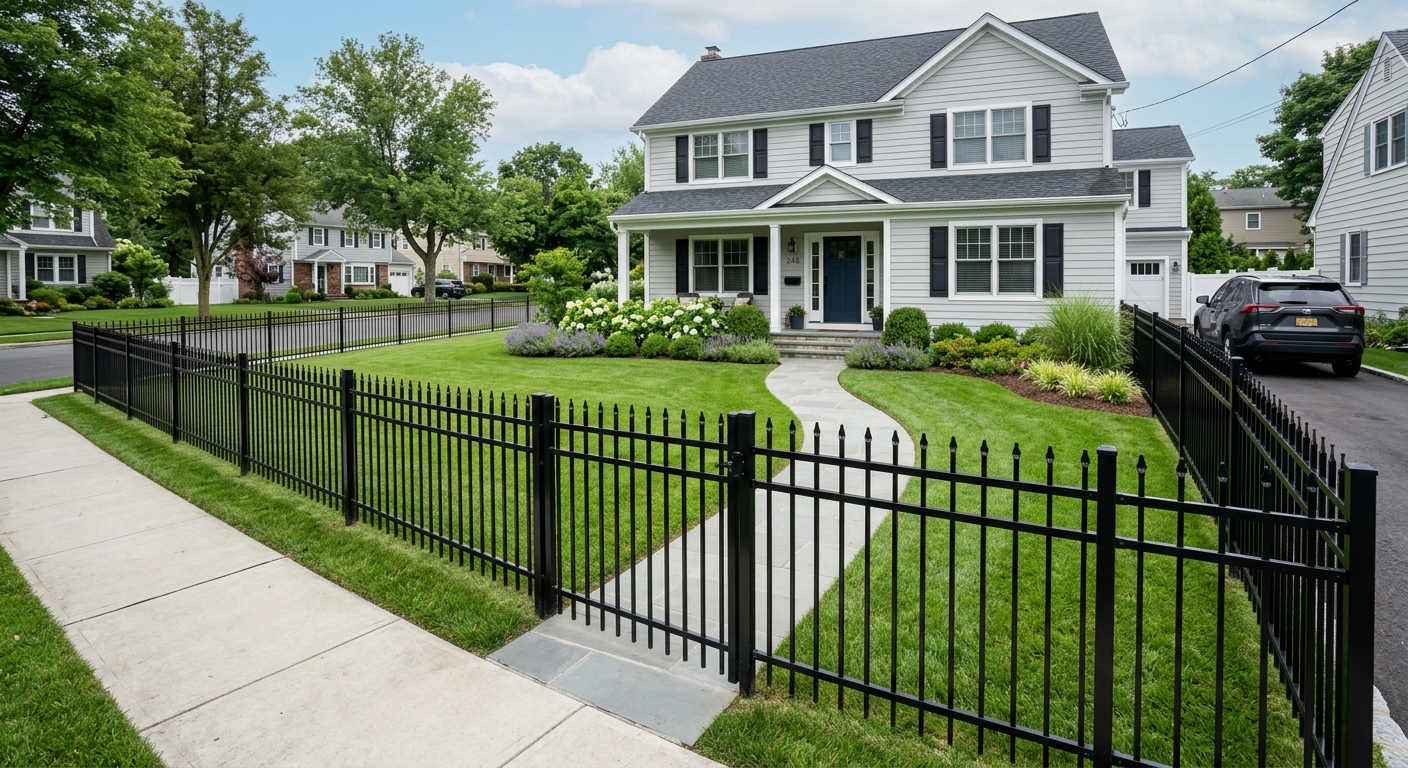
Vinyl/PVC is the low-maintenance favourite for many busy households. It won’t rot, and it generally won’t require staining, but extreme cold snaps can cause brittleness if the fence wasn’t designed and assembled for Ontario temperatures. Chain-link is the lowest first-cost option and tends to be the longest-lived when installed correctly; however, it provides limited privacy unless you add slats or switch to another style. Aluminum ornamental fencing gives a clean, rust-resistant look and handles weather well, but it’s not a privacy solution by default.
On post stability: because the Hamilton–Niagara Peninsula frost penetration is about 1.2 m (4 ft), post depth matters more than most people expect. In practice, that usually means deeper-than-minimum holes and, for long-term stability, concrete-set posts in many yards—particularly on clay soils or where the ground heaves. For wind and snow load, heavier framework and sound post bracing can prevent panel distortion, especially around corner lots or areas that see strong seasonal gusts.
To illustrate the trade-off: if you’re deciding between pressure-treated pine and vinyl privacy, a wood job might land in the $1,200–$3,000 band, while vinyl privacy often sits closer to $2,200–$5,500. The difference is usually justified when you want fewer maintenance tasks and a longer service life—so the higher upfront material cost balances out over time.
| Material |
Cold Tolerance |
Lifespan |
Annual Maintenance |
Best For |
Price Band |
| Pressure-treated pine |
Good (if properly sealed and supported) |
10–15 years |
Low–Moderate: inspect yearly; stain/seal every 2–3 years |
Budget privacy with regular upkeep |
$45–$80 per linear foot installed (typical wood band) |
| Cedar |
Good (rot-resistant with proper fasteners) |
15–25 years |
Low–Moderate: light sealing every 2–4 years |
Appearance-focused privacy |
$60–$95 per linear foot installed (typical wood band) |
| Vinyl / PVC |
Very good (with correct spacing and quality components) |
25–35 years |
Low: wash and check for impact damage |
Low-maintenance privacy |
$70–$120 per linear foot installed (typical vinyl band) |
| Chain-link |
Very good (weathering resilient) |
20–30 years |
Low: tighten hardware and rinse |
Perimeter security on a budget |
$35–$60 per linear foot installed (typical chain-link band) |
| Aluminum ornamental |
Very good (non-rusting, stable) |
20–35 years |
Very low: occasional wash |
Looks + durability without heavy privacy needs |
$80–$150 per linear foot installed (typical metal band) |
| Composite / recycled |
Good (designed for freeze–thaw with proper installation) |
25–35 years |
Low: cleaning and fastener checks |
Privacy with minimal painting/staining |
$75–$140 per linear foot installed (project-dependent) |
How to choose a fencing contractor in Thorold
Choosing the right fencing contractor in Thorold starts with verification, not promises. In Ontario, you should request proof of liability insurance and coverage for workers. If the company has employees, they should carry WSIB coverage, and they should be able to provide a WSIB clearance letter or an equivalent clearance confirmation. Ask for the certificate of insurance and check the effective dates, the insured name, and that the coverage is appropriate for property damage and bodily injury. If they subcontract, ask who carries insurance and coverage for that crew.
Next, get 2–3 itemised written quotes. A good quote breaks labour and materials apart (posts, rails, panels, concrete, hardware, gate frames), and it spells out what’s included: fence removal, utility locate coordination, and disposal. Avoid “lump sum” quotes with vague language like “everything included,” because fencing scope details often change drilling time and material take-offs.
Warranty matters in southern Ontario. Ask for a workmanship warranty length (typical targets are measured in years), and ask whether it’s transferable if you sell your home. Also confirm the manufacturer’s product warranty for the fence panels, fasteners, and hardware—vinyl and metal systems often have different coverage than wood components.
Payment should be controlled. Never pay more than 10–15% upfront. Hold back the remainder until the job is complete, cleaned up, and aligned to your layout. Finally, request the start date and completion timeline in writing so you can plan around winter freeze–thaw scheduling and any permit/locate lead times.
- Verify WSIB clearance (if they use workers) and ask for proof of active standing.
- Check liability insurance certificate: correct business name and current dates.
- Confirm who pulls utility locates and whether marks are documented before digging.
- Require an itemised quote listing posts, concrete, rails, and gate hardware separately.
- Ask if old fence removal and disposal are included (and where they dispose of materials).
- Confirm post depth approach (typical 36–42 inches burial for 6 ft fences, adjusted for soil and frost considerations).
- Clarify post setting method (concrete set vs gravel pack) and why it’s recommended.
- Get written scope for gates: hardware type, latch style, swing direction, and alignment.
- Ask how they handle sloped yards (stepped vs raked panels) and who provides layout.
- Request a workmanship warranty and understand what counts as “defect” vs normal wear.
- Confirm permits: whether permit pull is included, excluded, or handled by homeowner.
- Set a payment schedule in writing with a final holdback until walkthrough acceptance.
Red flags I see in Thorold include: quotes that won’t state post depth or setting method, missing insurance/WSIB clearance details when asked, vague scope language about disposal and utility locates, refusing to provide itemised breakdowns, and demanding large upfront payments without a written schedule.
Frequently asked questions — fencing in Thorold
How long does a wood fence last in Thorold?
In Thorold, a well-built wood fence typically lasts 10–15 years for pressure-treated pine and around 15–25 years for cedar, assuming proper post setting and regular inspection. The reason lifespan matters here is Ontario’s freeze–thaw cycle: frost penetration around 1.2 m (4 ft) means posts must be set below the frost level to prevent heaving and panel leaning. If a fence is installed with shallow holes or without concrete-set posts in clay-heavy areas, you can see early rail loosening and sag after just a few winters. Maintenance also changes the timeline—wood usually needs staining or sealing every 2–3 years (pine) or about every 2–4 years (cedar) to slow weathering and cracking. If your budget is in the wood band (for example, $1,200–$3,000 typical scope), ask your contractor to explain the post depth and setting plan before you commit.
Who owns and maintains a shared fence?
For shared fences in Ontario, the starting point is the location relative to the boundary line and the province’s line-fences framework. Practically, if a fence sits on the boundary or is treated as a shared divider, neighbours commonly share responsibility for maintenance and repair—especially for safety or structural issues. However, “shared” doesn’t always mean 50/50 in every situation; costs can differ based on who benefits from the fence (privacy vs shared security) and what the original agreement was when it was built or replaced. In older Thorold neighbourhoods, existing fences sometimes drift off the original alignment, so it’s important to confirm the property line with pins or a survey. If you’re planning a replacement, ask your contractor to include layout documentation and to quote the fence as a boundary condition, not just “near the fence line.”
How do I find my property line before fencing?
The safest way in Thorold is to locate your property pins or order a survey so you’re confident the fence sits on your land (not on a neighbour’s parcel). Start by checking your purchase documents, then contact a surveyor if pins can’t be found. If you don’t have clear evidence, don’t rely on a neighbour’s fence or “what’s always been there”—older homes can have fences that don’t track the current boundary. Once you know the property pins, a contractor can build the layout from measurable references. If you’re near a corner lot or sidewalk, also confirm local setback rules that affect permitted heights and placement. This reduces disputes and protects your investment, particularly in areas with long-established housing where lot lines and easements aren’t obvious from the street.
What's the most low-maintenance fence?
For most Thorold homeowners, vinyl/PVC is the most low-maintenance option because it doesn’t need staining and typically won’t rot. Aluminum ornamental is also very low upkeep, but it usually offers less privacy unless you use a privacy design. Chain-link is low maintenance too, but privacy is limited unless you add slats or pair it with a privacy screen. Wood can be made to last, but it requires more attention: in Ontario’s weather, pressure-treated pine commonly needs re-staining every 2–3 years to avoid rapid grey weathering and surface cracking. If you want the least ongoing effort and your priority is privacy, vinyl privacy panels are often worth the higher upfront cost; many typical projects fall in the $2,200–$5,500 range depending on linear footage, gates, and post setting.
How tall can my fence be in Thorold?
Fence height rules in Ontario depend on where the fence is located (front yard, corner lot, rear yard) and the applicable local bylaws. As a general reference, fences above commonly enforced thresholds—often around 2.0 m (6.5 ft) in rear yards and 1.0–1.2 m (3–4 ft) in front or corner areas—may trigger a building permit requirement. Even when you stay under those triggers, you must still respect property lines, any municipal setbacks, and safety considerations around visibility near intersections. The easiest way to avoid problems is to tell your contractor the fence location and the exact height you want, then confirm whether your project likely needs a permit before digging. In Thorold, we typically plan layout and post placement early to prevent rework if height or setbacks need adjustment.
Should fence posts be set in concrete here?
In many Thorold installations, yes—concrete-set posts are often the best choice for long-term stability because Ontario freeze–thaw cycles can heave poorly anchored posts. With frost penetration around 1.2 m (4 ft), posts usually need to be set below the frost level (commonly resulting in roughly 36–42 inches of burial for many 6 ft residential fences, adjusted based on soil). Concrete setting increases resistance to leaning and helps keep the fence plumb during winter cycles, especially in clay soils common in the region. That said, the “right” method depends on soil type and drainage, and some contractors use alternative methods in specific conditions (like gravel packs), but they must still address frost heave. If you’re comparing quotes in the wood band (for example, $1,200–$3,000) versus vinyl or metal, ask each contractor to state exactly how they set posts and what depth they’re using, not just the material.