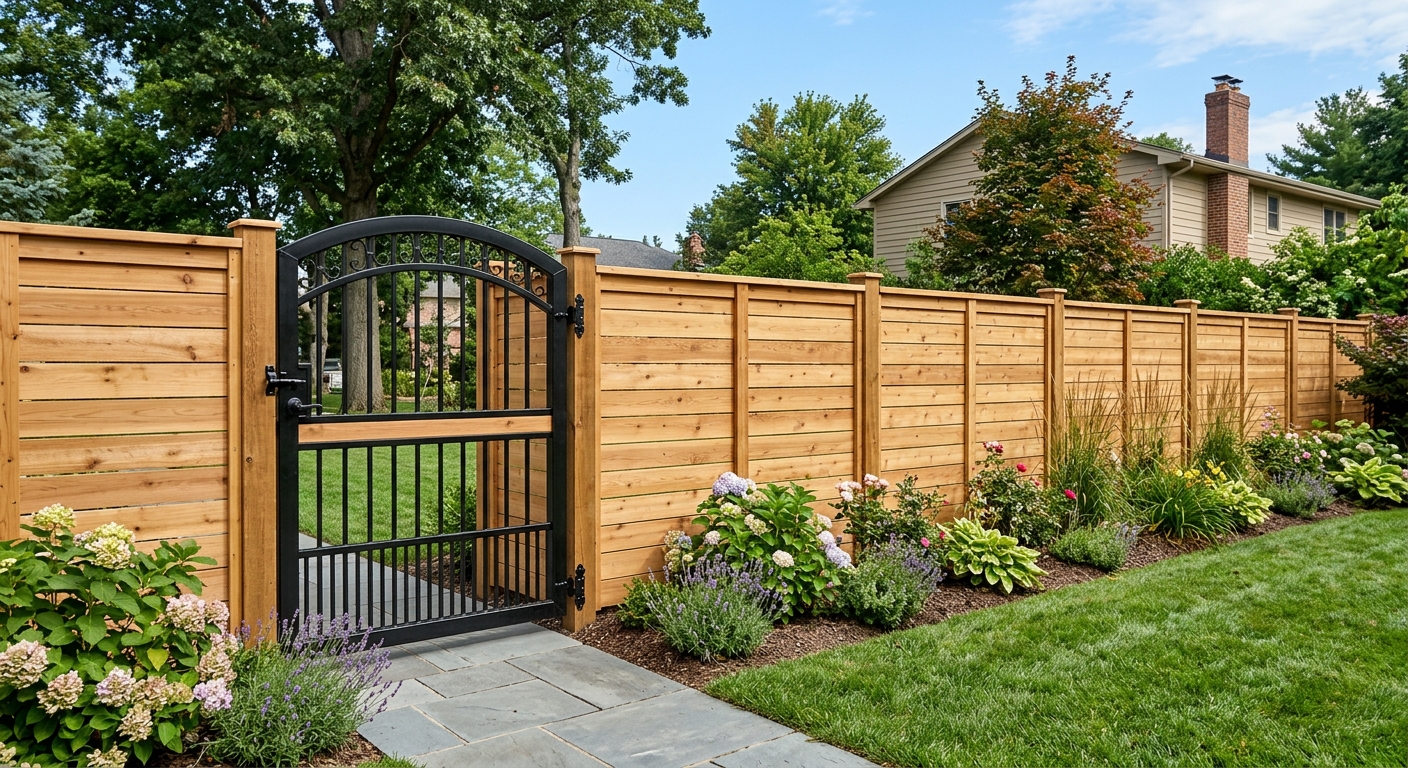
Fencing options and costs in Guelph
Guelph homeowners typically have a straightforward goal when planning a fence: add privacy, define boundaries, and reduce noise—while staying within the realities of our local weather and soil. With Guelph sitting in a Kitchener–Waterloo–Barrie housing market where detached homes make up 48.6% of dwellings (Statistics Canada, 2021 Census), there are plenty of front- and backyard lots that need new fencing or replacements. Demand is also strong because many residents are owners: homeowner households are 65.7% (Statistics Canada, 2021 Census), which usually means more long-term upgrades versus quick rental fixes.
In this region, frost and freeze–thaw cycles drive fence pricing more than many people expect. The frost line typically requires deeper post holes, and most installers use concrete-set posts for wood, vinyl, and aluminum fences—especially for common 6 ft privacy runs. Wind isn’t as punishing as open Prairie sites, but contractors still plan for gusts in and around newer subdivisions with limited tree cover, which often means sturdier rails and tighter post spacing (often 6–8 ft centres for privacy).
Trade demand is especially noticeable in established areas like West Guelph/Eramosa and around the older stock near Hanlon Creek—where many fences were built decades ago and need replacement rather than minor repairs. If you’re comparing options before requesting quotes, the table below summarizes typical material choices, upkeep expectations, and realistic price bands for Guelph projects.
| Material |
Lifespan |
Maintenance |
Privacy Rating |
Price per Linear Foot |
| Pressure-treated pine (standard wood) |
12–18 years |
Stain/seal every 2–3 years |
High (solid pickets) |
$45–$70 |
| Cedar (natural rot resistance) |
18–25 years |
Seal/stain every 2–4 years (optional to let fade) |
High (solid privacy panels) |
$55–$85 |
| Vinyl / PVC (no-maintenance) |
20–30 years |
Rinse as needed; no painting |
High (solid vinyl) |
$55–$90 |
| Chain-link (galvanized steel) |
25–35 years |
Occasional rinse; tension checks |
Low (visual screening only) |
$35–$60 |
| Aluminum ornamental |
25–40 years |
Minimal; wash 1–2 times/year |
Medium (decorative spacing) |
$60–$110 |
| Composite / recycled material |
20–30 years |
Wash annually; no staining |
High (solid boards) |
$75–$105 |
Prices are estimates only and vary by project scope, site access and material selection.
What affects the price of fencing in Guelph
Even when two contractors quote “the same fence,” prices in the Kitchener–Waterloo–Barrie region can differ by 30–50% once you account for post depth, concrete usage, grading, and what’s included in the install. The reason is practical: in colder Ontario regions like Guelph, posts must be set deep enough to resist frost heave, and that usually means concrete-set installation rather than dry-set gravel. Labour rates and trucking also matter—materials aren’t the only cost; the time spent augering, setting posts, and aligning panels is often the main driver.
Frost depth is a key variable. In cold Ontario and Alberta, posts are commonly installed about 4–6 inches below the design frost depth, which typically pushes post setting into the roughly 1.5–2.0 m range. That increases both material cost (more concrete and longer posts) and labour cost (deeper holes, longer set time). In Guelph, that’s why many 6 ft privacy fences land in the mid-range of the wood pricing band of $45,000–$70,000 for typical project budgets, while vinyl often sits a bit higher in the $55,000–$90,000 band due to higher material cost and heavier-duty rails.
Concrete-set posts are also more critical in yards with poor drainage or clay-heavy soil—common in parts of the city—because waterlogged ground can shift if posts are installed too shallow. A second example: sloped or uneven lots near creek-adjacent areas can require stepped panels or raked sections, adding labour and sometimes extra materials. Finally, older fence removal can increase cost: hauling and disposal is labour-intensive, and if you uncover buried posts or roots, augering time goes up.
| Price Factor |
Why It Matters |
Cost Impact |
| Fence length in linear feet |
Every extra foot adds posts, rails, and panels. |
High |
| Post depth required |
Frost line depth determines how deep holes must be. |
High |
| Post setting method |
Concrete-set posts require more material and labour. |
Medium–High |
| Material choice |
Vinyl/cedar cost more upfront than chain-link. |
Medium–High |
| Gate count and type |
Drive-through double gates need heavier frames. |
Medium–High |
| Grade and terrain |
Slopes require stepping or racking panels. |
Medium |
| Old fence removal and disposal |
Demolition, loading, and dump fees add time and cost. |
Medium |
| Permit fees and survey / property line locate |
Locates and documentation avoid boundary disputes. |
Low–Medium |
Permits & regulations in Ontario
In Ontario, permit requirements for fencing generally hinge on height and location. As a rule of thumb, fences above about 2.0 m (6.5 ft) at the rear and around 1.0–1.2 m (3–4 ft) at the front or corner often trigger the need for a building permit. Regardless of permit, all fences must follow property line boundaries and respect municipal setback requirements. Because fencing is built “at the line,” it’s common for issues to arise when a previous fence was installed incorrectly or when the lot line isn’t clearly marked.
Before digging any post holes, call for utility locates through Ontario One Call. That step is non-negotiable for homeowner safety and to protect your service lines. If you don’t already know where your property pins sit, obtain a survey or request a property line locate so you’re not encroaching. For shared fence ownership, line-fences rules are governed by Ontario’s line fencing legislation, so keep documentation if you’re working along a shared boundary.
What typically requires a permit: higher fences (around the 2.0 m rear / 1.0–1.2 m front-or-corner threshold) and any situation where the fence is closer to sensitive areas that the municipality reviews.
What typically does NOT require a permit: smaller, standard-height fences within common allowances (your contractor should confirm the exact height and location for your lot).
To verify a contractor before they dig in Guelph: check the Ontario business registry for proper licencing (where applicable), request a certificate of insurance for liability coverage, and ask for proof of WSIB/WCB coverage. For safety, also ask if they can provide a clearance letter or proof of account status, then match the insured name to the company on the quote.
Choosing the right fence material for Guelph
The best fence material for Guelph depends on your priorities—privacy, low maintenance, budget, and lifespan. In our climate, you also have to plan for deeper post setting due to frost and repeated freeze–thaw cycles. Pressure-treated pine is often the budget-friendly route, but it needs staining or sealing every 2–3 years to prevent grey weathering and early deterioration. Cedar looks excellent and naturally resists rot better than most pressure-treated lumber, yet it still benefits from periodic sealing if you want long-term colour stability.
Vinyl/PVC is attractive for homeowners who want “set it and forget it.” It generally doesn’t require staining, and it’s positioned as a durable option for Ontario winters. That said, extreme cold snaps and impacts can cause cracking if the design and bracing aren’t appropriate; a quality installation with correct post depth and proper rail support matters. Chain-link is usually the most affordable and long-lived, but it won’t provide privacy—unless you add shrubs or privacy slats (which reduce airflow and can increase sail resistance in wind). Aluminum ornamental gives a tidy, rust-resistant look, but it’s typically decorative, not fully private.
Because frost often requires post holes set about 4–6 inches below the design frost depth (commonly meaning deeper, roughly 1.5–2.0 m in ground for cold Ontario), most privacy fences in this region use concrete-set posts for stability. This supports straight alignment through spring thaw and reduces leaning over time. Snow load and wind gusts are additional reasons to avoid undersized rails and overly wide post spacing.
A simple budget example: a basic pressure-treated privacy run commonly fits the wood installation band of $45,000–$70,000 for typical project scopes, while vinyl privacy often moves into $55,000–$90,000. The extra cost is usually justified if you want lower maintenance for 15–25+ years and you don’t want to restain—especially if your yard is time-consuming to maintain in wet shoulder seasons.
| Material |
Cold Tolerance |
Lifespan |
Annual Maintenance |
Best For |
Price Band |
| Pressure-treated pine |
Good (with proper sealing) |
12–18 years |
Low–Moderate (stain/seal 2–3 years) |
Budget privacy with traditional look |
$45,000–$70,000 |
| Cedar |
Very good |
18–25 years |
Low–Moderate (seal/stain every 2–4 years) |
Attractive privacy that resists rot |
$55,000–$85,000 |
| Vinyl / PVC |
Very good (impact-resilient when braced well) |
20–30 years |
Very low (wash/rinse) |
Low-maintenance privacy |
$55,000–$90,000 |
| Chain-link |
Excellent |
25–35 years |
Very low (tension checks) |
Security and boundary definition |
$35,000–$60,000 |
| Aluminum ornamental |
Excellent (won’t rust) |
25–40 years |
Very low (wash 1–2 times/year) |
Front yard curb appeal |
$60,000–$110,000 |
| Composite / recycled |
Good (designed for freeze conditions) |
20–30 years |
Low (wash annually) |
Privacy with stable look |
$75,000–$105,000 |
How to choose a fencing contractor in Guelph
Choosing a fencing contractor in Guelph is mostly about verification and clarity. First, confirm Ontario compliance and coverage. Ask for their business details and verify licencing where applicable, then request a certificate of liability insurance (make sure the policy is active and in the contractor’s legal name). For worker protection, ask for proof of WSIB/WCB coverage; you can typically verify via the agency’s online lookup and by matching the clearance/proof document to the company on the quote.
Next, get 2–3 itemised written quotes. You want a breakdown showing labour and materials separately—posts (including length and depth), concrete quantity/set method, rails, pickets/panels, hardware, gates, and any allowances for grading. Avoid “lump sum” quotes that don’t explain post setting depth or whether they include disposal. Check the scope: is permit pulling included if required, and who pays for any locate/survey add-ons? If you’re removing an old fence, ensure demolition, loading, and dump disposal are specified.
For warranty, ask for both workmanship and product warranties. Confirm the workmanship warranty length, whether it covers post movement or panel re-alignment, and if the manufacturer warranty is transferable to future owners. On payment, a common best practice is to never pay more than 10–15% upfront; hold back a portion until the job is complete and you’ve accepted the final alignment and gate operation. Finally, insist on a written start date and completion estimate.
- Request proof of liability insurance and confirm it matches the company name on the contract.
- Confirm WSIB/WCB clearance/proof for workers—don’t accept “we’ll add it later.”
- Ask for an itemised quote: labour, materials, and post setting method must be explicit.
- Verify post depth and concrete-set method in writing (freeze–thaw handling in Ontario is crucial).
- Confirm gate hardware type and whether it’s designed for winter freeze-up.
- Check if they include old fence removal and disposal (dump fees vary).
- Ask who locates utilities and whether Ontario One Call is completed before digging.
- Ensure they address slope: stepped vs. raked panels and how gaps at the bottom will be handled.
- Confirm who is responsible for permits if your fence height/location needs one.
- Get warranty terms in writing for both workmanship and materials.
- Keep payment staged: small deposit only, then progress payments tied to milestones.
- Require a written timeline and a contact person for changes or delays.
In Guelph, common red flags include: quotes that don’t specify post depth or concrete-set vs. gravel set; refusal to provide insurance/WSIB documentation; vague scope language like “fencing work included” without removal/disposal details; starting without confirming property line locations; and demanding a large upfront payment before measuring or scheduling the work.
Frequently asked questions — fencing in Guelph
How tall can my fence be in Guelph?
In Ontario (and for Guelph lots specifically), fence height limits depend on where the fence sits on your property. A common guideline is that rear fences are often treated differently than front or corner yard fences, with permits commonly triggered around 2.0 m (6.5 ft) at the rear and about 1.0–1.2 m (3–4 ft) at the front or corner. Your exact allowance can also be affected by setback rules and lot characteristics. Because heights are easy to get wrong, measure carefully and confirm the fence height at the highest point, especially on sloped yards. A reputable local installer will ask for your fence location plan and should tell you whether a permit is likely before they order materials.
Should fence posts be set in concrete here?
For most privacy fences in Guelph and the broader Kitchener–Waterloo–Barrie region, concrete-set posts are standard practice because of freeze–thaw cycles. Ontario’s frost line typically requires deeper hole depths—often about 4–6 inches below the design frost depth—so concrete helps stabilize posts in cold soils and reduces leaning over time. If a contractor suggests shallow dry-set posts for a 6 ft fence, that’s a concern. That said, the right method still depends on soil drainage and your fence design. When you compare quotes, look for explicit wording about post depth and whether concrete is included; these details can change pricing meaningfully, not just by a little, but by major dollar amounts across the $45,000–$70,000 (wood) vs. $55,000–$90,000 (vinyl) style project bands.
What's the best fence for privacy?
If privacy is your priority in Guelph, you’ll typically want a solid privacy style: pressure-treated pine or cedar with solid pickets/panels, or vinyl/PVC privacy sections. These choices block sightlines effectively and work well with the tighter post spacing used for tall installations in freeze–thaw conditions. Wood privacy fences are often the most common approach because they fit many homeowners’ budgets; vinyl provides similar privacy with lower maintenance, which can be attractive given how often homeowners don’t want to stain every few seasons. Chain-link is usually not privacy-focused, and aluminum ornamental tends to be decorative. For a realistic expectation, a properly built 6 ft privacy fence is usually in the mid-range of Ontario pricing and commonly aligns with the wood or vinyl bands you’ll see in quotes (for example, wood often aligns with $45,000–$70,000 and vinyl with $55,000–$90,000 for typical project scopes).
How do I compare fencing quotes?
Start by making sure the quotes are truly comparable. Ask each contractor for an itemised breakdown: post depth, post setting method (concrete vs. gravel pack), panel/picket type and spacing, rail construction, gate type and swing/hinge hardware, and whether old fence removal and disposal are included. Next, check what’s excluded: permits, locates (Ontario One Call), surveys/locates for property pins, and any work needed for sloped grade. It’s also worth asking about alignment and wind resistance—privacy fences in this region are built with sturdier rails and appropriate post spacing to handle gusts and seasonal ground movement. Finally, compare warranty terms separately: workmanship length and manufacturer coverage can differ, and the “cheaper” quote can be expensive later. If one quote ignores post depth or concrete-set details, it’s often not apples-to-apples even if the final number looks lower.
How long does fence installation take in Guelph?
Install time in Guelph depends mostly on fence length, number of gates, terrain, and whether you’re removing an old fence. A straightforward, level run with few gates can go faster, while deeper auger work, concrete-setting, and sloped yards add time. Typical residential installs are often completed within a few working days, but the schedule can stretch if concrete curing or post alignment requires additional labour time. Weather also plays a role: contractors usually plan around frozen ground and heavy rain, since excavation and leveling are affected. If you’re comparing quotes, ask for a written start date and estimated completion window, and confirm whether the contractor includes site protection, clean-up, and debris removal. A realistic timeline prevents surprises—especially during the freeze–thaw shoulder seasons when ground conditions can change quickly.
Can I install a fence on a slope in Guelph?
Yes—you can install a fence on a slope in Guelph, and good contractors plan for it rather than forcing a “straight” line that leaves large gaps. Most privacy fences are handled with stepped panels (where each section changes height) or raked panels (where rails follow the slope). Which approach is best depends on your fence material and the amount of grade change. Pine and cedar privacy fences can be adapted with stepped construction, while vinyl systems can also be raked but must be designed for how rails are braced. Chain-link is often easier to tension around a slope, but it won’t give privacy on its own. Ask the contractor how they’ll handle bottom clearance, alignment at corners, and snow accumulation. Also confirm the quote includes the extra labour and materials needed for stepped/raked sections—this is one of the most common reasons quotes differ across the common Ontario price bands like $35,000–$60,000 (chain-link) versus higher privacy options.