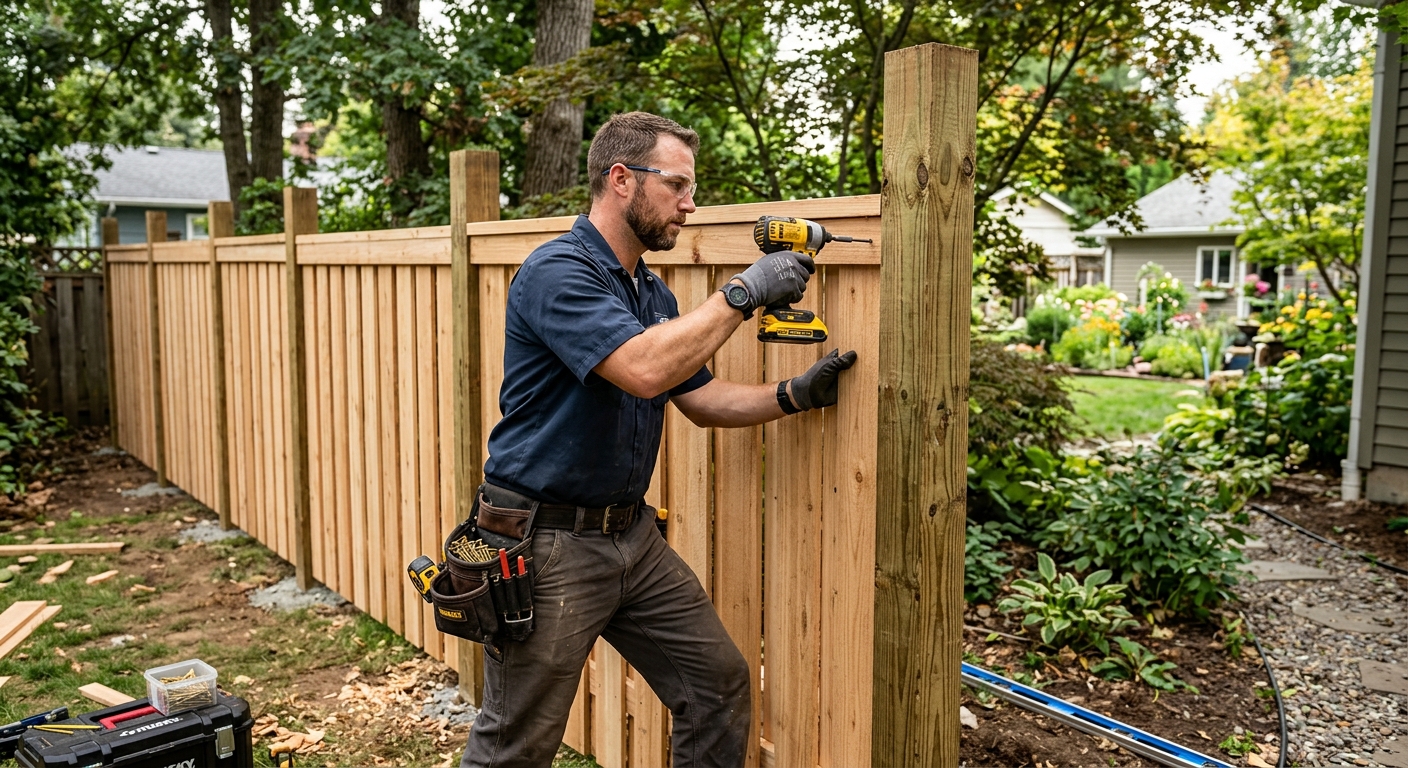
Fencing options and costs in Keelesdale-Eglinton West
Keelesdale-Eglinton West is a busy, established pocket of Toronto (population 11,058 in the 2021 Census) where many homeowners are balancing curb appeal with backyard privacy. Demand is especially strong on streets with older single-family homes and rental turnovers, because a fence upgrade is one of the quickest ways to make a property feel more secure and usable year-round. In this part of the city, the typical yard work you’ll see—new privacy fences, gate replacements, and straightening or replacing older wood—tends to correlate with how long families stay in the neighbourhood and how often property maintenance is refreshed.
Pricing here is shaped by Southern Ontario’s freeze cycle. A frost line around 42"–48" means fence posts generally need to be set deeper to avoid frost heave—often minimum 3.5–4 ft deep for 6–8 ft privacy fences. That depth, plus mixed soils (often clay-heavy in Toronto), is why many contractors in Keelesdale-Eglinton West recommend concrete-set posts rather than simple driven posts. The labour time and ready-mix costs add up, but it improves fence stability and reduces the chance of lean in spring.
Trade demand is particularly noticeable around the Eglinton corridor and nearby local arterials where yards are more visible and properties change hands more frequently. You’ll also see more gate installs on corner lots that need better access for maintenance and snow clearing. Use the comparison below to estimate material-based budget direction before you factor in length, gates, and whether you’re removing an existing fence.
| Material |
Lifespan |
Maintenance |
Privacy Rating |
Price per Linear Foot |
| Pressure-treated pine (standard wood) |
10–15 years |
Stain/seal every 2–3 years |
High (solid boards) |
$65–$120 |
| Cedar (natural rot resistance) |
15–25 years |
Light staining/finishing as needed |
High (solid boards) |
$85–$135 |
| Vinyl / PVC (no-maintenance) |
20–30 years |
Rinse only; inspect fittings |
High (solid or board-style) |
$75–$130 |
| Chain-link (galvanized steel) |
20–40 years |
Occasional tension/repairs |
Low to Medium (fewer slats) |
$45–$85 |
| Aluminum ornamental |
25–40 years |
Wash; repaint only if required |
Low to Medium (open pickets) |
$90–$160 |
| Composite / recycled material |
20–30 years |
Minimal; clean as needed |
High (board-style) |
$95–$165 |
Prices are estimates only and vary by project scope, site access and material selection.
What affects the price of fencing in Keelesdale-Eglinton West
Even when you request the “same fence” across Toronto, you can still see quotes that vary by 30–50%. The reasons are usually practical: one contractor sizes posts for Toronto’s freeze-thaw conditions (deeper holes, heavier hardware), while another offers a faster approach that may use driven posts or lighter framing. Labour availability also plays a role—busy seasons and access constraints (narrow driveways, detached homes with long rear runs, or locations near the Eglinton corridor) can change crew time and equipment costs quickly. Add in different disposal practices and the final numbers diverge fast.
In Southern Ontario, frost line depth sets how deep posts must be set. Best practice is typically to set posts about 4–6 inches below the design frost depth, which aligns with roughly 3.5–4 ft for many 6–8 ft fences. In cold Ontario winters, that works out to about 1.5–2.0 m into the ground, and it usually means longer posts plus concrete setting and larger post holes—raising both material and labour. Wind loads aren’t as punishing as the Prairies, but Toronto can still see enough gusting to rack taller solid panels, so you’ll often pay more for heavier posts (or closer spacing) and better bracing. Conversely, if you choose a chain-link system and your grade is relatively flat, you may land closer to the lower band of $45–$85.
Concrete examples from Keelesdale-Eglinton West: (1) a 40 ft backyard run with two gates can cost materially more than a single 40 ft section because gate hardware and extra posts add labour; (2) a fence across clay-mixed soil frequently requires a proper concrete-set footing approach, often pushing the project closer to the $65–$120 wood band versus a cheaper driven-post method; (3) if the yard is sloped, stepped panels and extra framing time increase costs.
| Price Factor |
Why It Matters |
Cost Impact |
| Fence length in linear feet |
Most materials and labour scale directly with length. |
Highest driver; can swing total price by hundreds to thousands. |
| Post depth required |
Frost line determines hole depth and post length. |
Deeper holes increase concrete, labour time, and post cost. |
| Post setting method |
Concrete vs gravel pack vs driven posts changes longevity. |
Concrete-set typically costs more but reduces lean and heave. |
| Material choice |
Vinyl, cedar, and chain-link have different costs and durability. |
May move you between $45–$85 and $75–$130+ bands. |
| Gate count and type |
Gates require stronger framing, latches, and alignment. |
Each additional gate can add a significant fixed labour/material amount. |
| Grade and terrain |
Slopes require stepped/raked panels and extra hardware. |
Extra framing time and offcuts raise the per-foot price. |
| Old fence removal and disposal |
Demolition and hauling aren’t “free” and vary by condition. |
Can add labour hours and disposal fees; swings total budget. |
| Permit fees and survey / property line locate |
Required where height/setbacks trigger a permit or boundary disputes arise. |
Often a smaller line item, but missing locates can create expensive rework. |
Permits & regulations in Ontario
In Ontario, fences above a height threshold often require a building permit. A common rule of thumb used across many communities is that fences around the rear yard at roughly 2.0 m (6.5 ft) and above may be more likely to trigger a permit, while front yard or corner visibility areas are often limited to around 1.0–1.2 m (3–4 ft). Setbacks and exact thresholds can vary by municipality and by lot type, so treat this as guidance—not a guarantee.
Regardless of whether a permit is required, fences must respect property lines and local setback bylaws. Before you dig any post holes, arrange utility locates (for Ontario, use Ontario One Call) so you don’t hit power, gas, or telecom lines. If you don’t know your boundary with confidence, obtain a survey or at minimum request a property line locate using your pins. This is one of the most practical steps homeowners in Keelesdale-Eglinton West can take to avoid encroachment disputes.
Shared fence ownership in Ontario is also governed by provincial line-fences legislation, which affects responsibilities for maintenance and cost sharing when a fence is on or between properties.
To verify a contractor: (1) confirm the Ontario business and trade credentials on the appropriate public registry for their licence type, (2) ask for a Certificate of Insurance (general liability) naming you as the certificate holder where applicable, and (3) request WSIB coverage documentation (or the appropriate coverage letter, if they’re exempt). A reliable contractor will provide these before you sign and will match the company name on the quote to the insurance certificate.
Choosing the right fence material for Keelesdale-Eglinton West
Choosing the right fence material in Keelesdale-Eglinton West is mostly about matching your priorities—privacy, low maintenance, lifespan, and upfront budget—to the reality of Toronto’s freeze-thaw weather. With Southern Ontario frost conditions and mixed soils, post stability matters as much as the “skin” material. Most homeowners end up investing in concrete-set posts for privacy fences because it reduces leaning and heave after winter.
Pressure-treated pine is the budget-friendly starting point, but it needs staining or sealing every 2–3 years to prevent grey weathering and surface cracking. Cedar is a step up: it naturally resists rot and looks better as it ages, but it still benefits from finishing and periodic inspections around post bottoms and rails. Vinyl/PVC is the low-maintenance choice—no routine painting—but in extreme cold it can become brittle at stress points, so hardware, panel design, and straight installation matter. Chain-link is usually the longest-lasting and least expensive for hardware-heavy security, but it doesn’t deliver privacy unless you add privacy slats or a secondary screen. Aluminum ornamental gives a clean, rust-resistant look and good longevity, yet it’s not the best privacy option. Composite or recycled board products can offer long life with minimal upkeep, though they’re often priced above standard wood.
On cost: if you’re comparing wood versus vinyl for a similar privacy layout, you might see vinyl land nearer the $75–$130 band while cedar/wood could fall closer to $65–$120. The extra cost can be justified when you expect to keep the home long-term and want less maintenance time, especially if your yard is difficult to access for sanding and staining.
| Material |
Cold Tolerance |
Lifespan |
Annual Maintenance |
Best For |
Price Band |
| Pressure-treated pine |
Good (needs proper sealing) |
10–15 years |
Light inspection; plan stain/finish every 2–3 years |
Budget privacy with a willingness to maintain |
$65–$120 |
| Cedar |
Good (stable when correctly built) |
15–25 years |
Inspect annually; stain/finish as needed |
Appearance + rot resistance |
$85–$135 |
| Vinyl / PVC |
Very good (avoid poor-fitting hardware) |
20–30 years |
Minimal—rinse and check fittings |
Low-maintenance privacy |
$75–$130 |
| Chain-link |
Excellent |
20–40 years |
Minimal—check tension and posts |
Security with best value |
$45–$85 |
| Aluminum ornamental |
Excellent |
25–40 years |
Occasional wash; touch-ups if required |
Front-yard curb appeal and durability |
$90–$160 |
| Composite / recycled |
Good (good detailing prevents stress) |
20–30 years |
Low—clean as needed |
Long-life privacy with less upkeep |
$95–$165 |
How to choose a fencing contractor in Keelesdale-Eglinton West
Choosing the right contractor in Keelesdale-Eglinton West starts with proof you can validate. In Ontario, ask for their business licence or registration details (as applicable to their trade), a Certificate of Insurance showing general liability coverage, and WSIB documentation (or a coverage clearance letter where relevant). How to check each: (1) verify the company name and address match the quote and insurance certificate, (2) ensure the Certificate of Insurance isn’t expired, (3) confirm WSIB coverage is active for the time of the project, and (4) request the exact certificate number or confirmation letter so you can reference it if there’s ever a question.
Next, request 2–3 itemised written quotes. You want a breakdown that separates labour, materials, post installation (depth and setting method), gate hardware, and demolition/disposal if included. Avoid “lump sum only” pricing because it hides scope differences; one contractor might include permit pull and locate costs while another excludes them, which can change your final bill. Confirm warranty terms in writing: a workmanship warranty (commonly 1–5 years depending on the contractor), plus any product/manufacturer warranty for materials (vinyl panels, pickets, rails, gate parts). Also ask if warranties are transferable to future homeowners.
For payments, never pay more than 10–15% upfront. Use a holdback until completion, and only release it after you’ve inspected line, height, gates, and post alignment. Get a start date and a completion estimate in writing, including what happens if materials are delayed.
- Ask for concrete specifications: post depth, post size, and whether posts are concrete-set.
- Require a materials list with thickness, rail sizes, and gate hardware brand/model if available.
- Confirm who provides utility locates and who coordinates them on-site.
- Make sure disposal and hauling of old fencing is explicitly included or excluded.
- Check if the quote includes property line locate or survey verification.
- Confirm permit pull responsibility in the written scope (if required).
- Request photos of recent similar projects in Toronto or the GTA, not just brochures.
- Verify insurance: general liability certificate, active coverage, correct company name.
- Verify WSIB coverage/clearance documentation before work starts.
- Agree on a detailed schedule: start date, milestones, and when gates will be installed.
- Inspect warranty wording: workmanship length, exclusions, and how to file a claim.
- Ensure payment schedule aligns to work completion, with a holdback at end.
Red flags I see too often: contractors who won’t state post depth or setting method; quotes that “estimate” without measuring fence length and gate openings; missing insurance/WSIB documentation or unwillingness to provide certificates; refusing itemised scopes (no line for disposal or permits); and asking for large upfront payments beyond 10–15% or demanding cash-only without receipts.
Frequently asked questions — fencing in Keelesdale-Eglinton West
Who owns and maintains a shared fence?
In Ontario, shared fences are governed by provincial line-fences legislation. Practically in Keelesdale-Eglinton West, that usually means if the fence is truly shared—located on or between property boundaries—ownership and maintenance responsibilities may be shared or allocated depending on the fence’s location and how it was originally constructed or agreed to. If there’s any doubt about boundaries, get a property line locate or a survey before arguing maintenance. A good contractor can help document what they’re installing and where posts will sit, which supports a clear maintenance arrangement. If you need estimates for repairs, ask for separate line items for post replacement, rail work, and panel sections so you can split costs accurately. For budgeting, privacy upgrades using concrete-set posts often land in the $65–$120 wood range or higher depending on material.
How do I find my property line before fencing?
Your best first step in Keelesdale-Eglinton West is to locate your property pins (or get a survey if you don’t have reliable pin information). If you’re unsure where the boundary sits, request a property line locate rather than “eyeballing” the line based on existing fences—especially since older fences can drift over time. Before any digging, call Ontario One Call for utility locates so you don’t hit services. For homeowners, verifying pins and keeping a copy of any locate/survey paperwork is the simplest way to prevent encroachment disputes. When contractors quote, ask what they’re relying on to set the fence line. A professional crew will align layouts with pins and provide a site measurement plan, not just start digging along an assumed line.
What's the most low-maintenance fence?
For low maintenance in Ontario’s freeze-thaw climate, vinyl/PVC is typically the easiest day-to-day choice because it doesn’t require staining or regular paint. In Keelesdale-Eglinton West, many homeowners pick vinyl for privacy runs where they’d rather not handle yearly inspections and re-finishing. Chain-link is also low-maintenance mechanically, but it doesn’t provide privacy unless you add slats or a screen system. If you’re comparing budgets, vinyl commonly fits around the $75–$130 band depending on height, gates, and post sizing. The key is installation quality: correct post setting and hardware alignment matters more than material brand when cold snaps and ground movement occur. If your yard has slopes, ensure the framing is designed for stepped panels so the fence doesn’t strain during freeze cycles.
How tall can my fence be in Keelesdale-Eglinton West?
In Ontario, the permit question usually starts once fences exceed common visibility-height thresholds—often around 2.0 m (6.5 ft) at the rear and roughly 1.0–1.2 m (3–4 ft) toward the front or corners. For Keelesdale-Eglinton West, your lot type and visibility from the street matter, so treat these as guidance and confirm the exact local rules for your address. The easiest homeowner approach is: measure the proposed height, then ask your contractor whether a permit pull is likely and what setbacks apply. Also remember that even if your fence is within the height guidance, you still must respect your property line and follow setback requirements. If you expect a 6–8 ft privacy fence, be prepared for deeper post work (often concrete-set) due to frost movement, which can move the project toward the $65–$120 wood or $75–$130 vinyl ranges depending on material.
Should fence posts be set in concrete here?
For many Keelesdale-Eglinton West privacy fences, yes—concrete-set posts are the stability play. Southern Ontario frost conditions are commonly addressed by setting posts about 4–6 inches below the design frost depth, which often means posts roughly 3.5–4 ft deep for taller 6–8 ft fences. In cold winters with mixed soils, driven posts or shallow gravel packs can shift as the ground freezes and thaws, leading to leaning panels and misaligned gates. Concrete-set posts typically increase labour and ready-mix costs, but they reduce long-term rework. If you’re budgeting, this is one reason fences aren’t priced solely by “material”: a well-built concrete-set framework for wood privacy often aligns with the $65–$120 band, while vinyl privacy with heavier framing can fall in the $75–$130 range. Always ask the contractor to specify post depth and setting method in writing.
What's the best fence for privacy?
The best privacy fence is usually a solid-panel style—wood (cedar or pressure-treated), vinyl/PVC, or composite—installed with stable posts and appropriate spacing for Toronto’s winter ground movement and wind loads. For Keelesdale-Eglinton West yards, a 6–8 ft solid privacy fence is the most common because it blocks sightlines and improves usability in backyards. Your best choice depends on maintenance tolerance: cedar offers better natural rot resistance than basic pine, while vinyl/PVC is the lowest-maintenance option. If budget is the primary concern, pressure-treated wood often lands around the $65–$120 band, but you’ll likely need staining/sealing every 2–3 years. If you want long-term “install and forget,” vinyl frequently fits the $75–$130 band and reduces routine upkeep. For any privacy fence, ensure gate hardware and bracing are sized for the height—gates are where misalignment becomes most noticeable over time.