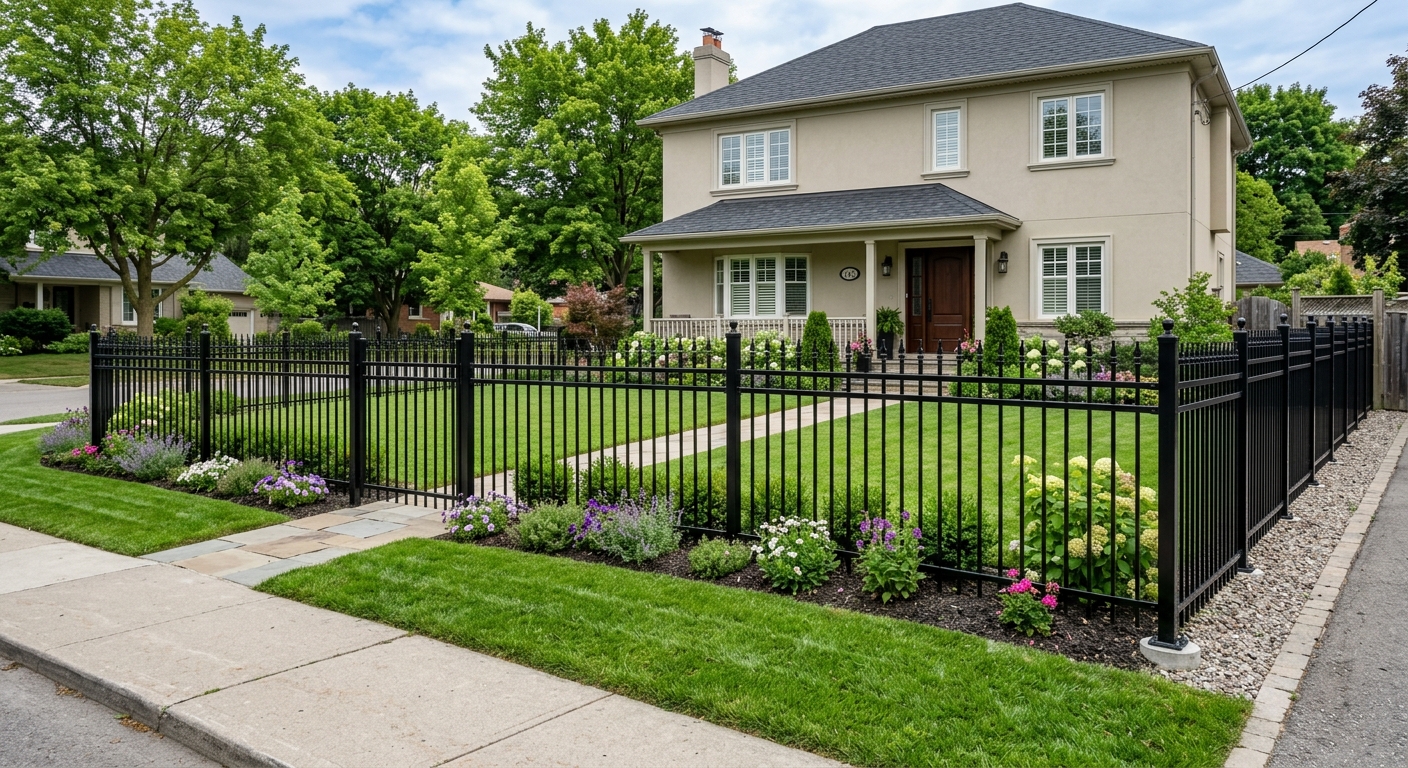
Fencing options and costs in Moss Park
Moss Park is a busy Toronto community where homeowners often want fencing that looks sharp, stands up to freeze-thaw weather, and doesn’t demand constant attention. With a population of 20,506 people (Statistics Canada, 2021 Census), there’s steady local demand for boundary upgrades—especially in residential pockets like the park-adjacent streets where backyards tend to back onto busy corridors and shared access. The Toronto market also means you’ll find many established properties; when you live next to older stock, it’s common to see more fence replacements than brand-new builds.
In Southern Ontario, fencing costs are shaped by climate and by how contractors build for long-term stability. Frost in the region is commonly planned around about 42"–48", which typically means post holes need to be set roughly 4–6 inches below the design frost line. For a 6–8 ft privacy fence, that usually translates to concrete-set posts set about 1.5–2.0 m into the ground—more labour, more ready-mix, and longer posts. That’s why two quotes for the same fence length can diverge noticeably: the “hidden” costs are in excavation depth, setting method, and panel/post sizing for wind resistance.
To make comparisons easier, use the table below for typical installed ranges in Moss Park. Then, match the material to your priorities—privacy, maintenance level, and how long you want the fence to last.
| Material |
Lifespan |
Maintenance |
Privacy Rating |
Price per Linear Foot |
| Pressure-treated pine (standard wood) |
10–15 years |
Stain/seal every 2–3 years |
High (solid boards/panels) |
$65 – $120 |
| Cedar (natural rot resistance) |
15–25 years |
Light staining/oiling every 2–4 years |
High (solid boards/panels) |
$75 – $130 |
| Vinyl / PVC (no-maintenance) |
20–30 years |
Occasional wash only |
High (solid styles) |
$75 – $130 |
| Chain-link (galvanized steel) |
20–35 years |
Minimal; rinse/repair localized areas |
Low (use slats/privacy inserts if needed) |
$45 – $85 |
| Aluminum ornamental |
25–40 years |
Minimal; rinse and inspect hardware |
Low to Medium (depends on picket spacing) |
$90 – $160 |
| Composite / recycled material |
20–30 years |
Occasional wash; no staining |
High (solid panels) |
$95 – $160 |
Prices are estimates only and vary by project scope, site access and material selection.
What affects the price of fencing in Moss Park
In Moss Park (Toronto economic region), it’s common to see fencing quotes for the “same” fence shape vary by 30–50%. The difference usually isn’t in marketing—it’s in how contractors handle Toronto’s freeze-thaw cycles, soil conditions, and wind-driven racking forces. Even within the wider Ontario market, some crews use faster, less stable base methods (like gravel pack or driven-only posts), while others install to best practice with deeper concrete set lines. That labour time and ready-mix cost can add up quickly, especially on 6–8 ft privacy fences where heavier rails and closer post spacing are needed.
Frost line depth is a major driver: in Southern Ontario, the frost line is commonly planned around 42"–48". To prevent heaving, posts are typically set roughly 4–6 inches below that design depth, meaning hole depth and post length often put you around 1.5–2.0 m into the ground. Concrete setting usually increases material costs and labour (excavation, rebar/anchors where required, and curing time).
Toronto wind isn’t prairie-level, but wind still matters. Taller solid panels can rack, so contractors may upsize posts (4x4 to 6x6 wood equivalents) and tighten spacing (often 6–8 ft centres). By comparison, chain-link is cheaper mainly because it uses lighter posts and less deck-style bracing. Also, while BC’s mild-but-wet climate can accelerate wood rot without proper treatment, Moss Park’s freeze-thaw punishes weak connections and shallow footings—so the base build is where savings usually disappear.
Concrete examples: (1) If your fence requires 30–40% longer posts to reach below frost depth, you can easily see a material and labour jump that moves a wood privacy fence toward the upper end of $65 – $120 per linear foot. (2) If your yard has heavier clay that won’t drain well, contractors often recommend concrete-set posts for stability, pushing some jobs from a lower $45 – $85 chain-link baseline up to a privacy-focused wood or vinyl range. (3) If a section runs alongside a narrow laneway, access can add truck trips and increase excavation time, again shifting the total into the high band.
| Price Factor |
Why It Matters |
Cost Impact |
| Fence length in linear feet |
Labour, posts, rails, and materials scale directly with length |
High (primary driver) |
| Post depth required |
Frost line determines hole depth and required post length |
High (especially for privacy fences) |
| Post setting method |
Concrete vs. gravel pack vs. driven posts affects stability and labour time |
Medium to High |
| Material choice |
Vinyl, cedar, and chain-link have different material costs and install details |
Medium to High |
| Gate count and type |
Walk-through gates are simpler; drive-through/double gates require heavier frames and hinges |
Medium to High |
| Grade and terrain |
Sloped yards require stepped or raked panels and more layout time |
Medium |
| Old fence removal and disposal |
Demolition, hauling, and surface restoration can be time-consuming |
Medium |
| Permit fees and survey / property line locate |
Documentation reduces boundary disputes and protects the project schedule |
Low to Medium |
Permits & regulations in Ontario
In Ontario, fences above a certain height—commonly around 2.0 m (6.5 ft) at the rear and 1.0–1.2 m (3–4 ft) at the front or corner—often require a building permit. Exact thresholds and setback expectations depend on your property’s location and local bylaws, but the key rule is the same: your fence must respect property lines and municipal setback requirements. Before you dig any post holes, call for utility locates through Ontario One Call (and follow the locate marks carefully). For Toronto properties like those in Moss Park, it’s also smart to obtain a survey or have your property pins located so the new fence doesn’t creep onto a neighbour’s land—boundary disputes are a common source of delays.
Shared fence ownership along a lot line is governed by provincial line-fences legislation, which means responsibilities can be negotiated where two owners benefit from the same boundary barrier; however, permits and compliance still apply to the fence you’re building or altering.
Steps to verify a contractor in Ontario (before work starts): (1) confirm their licence/registration and status via the appropriate online registry for their business category; (2) request a current certificate of insurance showing liability coverage with your address listed; (3) confirm workplace coverage (WSIB/WCB clearance letter or proof, as applicable) if workers will be on site. Ask for the documents in writing, not just by verbal assurance.
What typically DOES require a permit: most new fences (or fence height upgrades) that exceed common height thresholds, plus certain situations where changes occur near corners or across visibility areas. What typically does NOT: small, below-threshold repairs or like-for-like replacements that don’t change height or location—still, confirm with your contractor and the local permitting office for your specific site.
Choosing the right fence material for Moss Park
Choosing fencing material in Moss Park is mostly about how you want the fence to behave through Toronto’s winters and how much work you’ll accept each year. Pressure-treated pine is the budget-friendly route, but to keep it looking good you’ll generally need staining or sealing about every 2–3 years to reduce grey weathering and surface cracking. Cedar looks better longer because of its natural rot resistance, yet it still benefits from regular maintenance to protect the top boards and exposed edges.
Vinyl/PVC is often the low-maintenance favourite for homeowners who want “set it and forget it,” but it can crack if the fence is installed poorly or if panels aren’t designed for Ontario cold snaps. Chain-link is the longest-lasting, lowest-cost option for security and boundary marking, but it won’t deliver privacy unless you add slats or fabric inserts. Aluminum ornamental fencing is rust-resistant and works well for curb-facing boundaries, though it offers limited privacy due to picket spacing.
For Toronto frost performance, the install method matters as much as the product. Because the design frost line is commonly planned around 42"–48", posts for taller privacy fences usually need to be concrete-set about 1.5–2.0 m into the ground. That foundation approach is what prevents lift and misalignment over repeated freeze-thaw cycles. With wind exposure, installers may tighten post spacing (often 6–8 ft centres on solid styles) and use heavier rails to resist racking and uplift.
A practical dollar example: if you’re choosing between pressure-treated pine and cedar for a solid privacy run, the upfront difference can be noticeable. In Moss Park you might see pine land closer to $65 – $120 per linear foot while cedar climbs toward $75 – $130—but cedar’s longer look and rot resistance can justify the added cost if you plan to keep the fence for 15+ years and want fewer “refresh” cycles.
| Material |
Cold Tolerance |
Lifespan |
Annual Maintenance |
Best For |
Price Band |
| Pressure-treated pine |
Good when properly sealed and installed on deep, concrete-set posts |
10–15 years |
Check boards/fasteners; plan staining every 2–3 years |
Budget privacy with manageable upkeep |
$65 – $120 |
| Cedar |
Excellent; handles moisture better with correct installation details |
15–25 years |
Light staining/oiling every 2–4 years |
Longer-lasting natural look |
$75 – $130 |
| Vinyl / PVC |
Very good if installed with correct spacing and hardware |
20–30 years |
Occasional rinse/cleaning |
Low-maintenance privacy |
$75 – $130 |
| Chain-link |
Very good; galvanized steel tolerates freeze-thaw well |
20–35 years |
Minimal; inspect tension and posts annually |
Security, pets, and budget-friendly boundaries |
$45 – $85 |
| Aluminum ornamental |
Excellent; powder coating resists winter impacts |
25–40 years |
Minimal; rinse and inspect hardware |
Attractive front-yard fencing with low rust risk |
$90 – $160 |
| Composite / recycled |
Good; stable material when posts and alignment are done right |
20–30 years |
Occasional wash; check for fastener issues |
Privacy with reduced maintenance |
$95 – $160 |
How to choose a fencing contractor in Moss Park
When you hire a fencing contractor in Moss Park, start with proof—licensing, insurance, and workplace coverage—because fencing is hard on schedules and safety when trenching for deep posts. In Ontario, confirm the contractor’s licence/registration for their business category and ask for a current certificate of insurance showing general liability (and any additional insured language if offered). For jobsite protection, request WSIB/WCB clearance documentation (or proof of coverage as applicable) so you know workers are covered if something happens during excavation.
Next, get 2–3 itemised written quotes rather than one lump-sum number. A proper fencing estimate breaks out labour and material: excavation depth, number of posts, concrete volume/setting method, rails/hardware, gate framing, and debris disposal. Read the scope closely for what’s excluded—common exclusions include permit pull assistance, surveying/property line locate, concrete overages, fence style changes, and unexpected subsoil conditions.
Warranty matters too. Ask for both workmanship warranty (how long they stand behind installation—posts, alignment, rails, and fastening) and product/manufacturer warranty (what the fence material covers). Also confirm whether warranties are transferable if you sell your home.
Payment schedule: avoid large upfront payments. As a rule of thumb, don’t pay more than 10–15% at the start; use progress payments and hold back until the final walkthrough confirms compliance and finish quality. Finally, lock in timeline details: request a start date and a completion estimate in writing, including weather contingencies for excavation and concrete curing.
- Ask for licence/registration details and verify status in writing.
- Request an up-to-date certificate of insurance with your address included.
- Confirm WSIB/WCB clearance/proof before work begins.
- Get 2–3 itemised quotes (labour + materials breakdown, not a single total).
- Verify post setting method: concrete-set depth for frost performance.
- Confirm hardware type (hinges, latch, fasteners) and gate frame build.
- Ensure disposal/haul-away of old fence is included or clearly excluded.
- Ask whether permits are pulled by the contractor or by the homeowner.
- Review warranty terms in writing for both workmanship and materials.
- Use a deposit limit of 10–15% and hold back until final acceptance.
- Get a written schedule with weather stoppage/return plan.
- Request references or photos of similar Toronto privacy fences installed on deep footings.
Red flags to watch for in Moss Park: vague quotes that don’t specify post depth or setting method; “driven posts only” claims for tall privacy fencing without frost-focused footing work; missing or expired insurance/coverage documents; pressure for a large upfront payment; and no written warranty terms (or warranties that exclude labour on alignment, posts, or hardware).
Frequently asked questions — fencing in Moss Park
How long does fence installation take in Moss Park?
Most fence installations in Moss Park take anywhere from 2 to 5 days for a typical backyard run, depending on length, gate count, and how much excavation is needed. Because Toronto’s freeze-thaw season demands deeper footings, crews often spend extra time on layout and concrete-set post installation (commonly set below the local frost depth plan, roughly 1.5–2.0 m into the ground for privacy fences). If you’re adding gates or doing grade adjustments on a sloped section, expect longer. Access also matters—narrow laneways and vehicle access can slow delivery and debris removal. Always ask for a written start date and a completion estimate that accounts for concrete curing and weather interruptions.
Can I install a fence on a slope in Moss Park?
Yes, you can install a fence on a slope in Moss Park, but it needs to be designed correctly so the fence stays plumb and doesn’t “rack” over time. Contractors typically use either a stepped fence (stair-step sections following the slope) or a raked layout (following the grade with consistent panel angle). Stepped designs are common for privacy fences when you want each board to stay properly aligned. Expect more layout time—and possibly additional material—because you may need extra posts at grade breaks. If your fence is near a permitted height threshold, the measured height at the lot line still matters, so confirm the layout before finalizing.
What is the most weather-resistant fence for Moss Park's climate?
For Moss Park’s Ontario winters, the most weather-resistant results usually come from a solid privacy fence built on correct, frost-conscious footings. Material-wise, vinyl/PVC and cedar both perform well when installed properly; vinyl is popular for its low maintenance and cedar is strong against moisture-related rot. Chain-link is also very durable—galvanized steel holds up through freeze-thaw—but it doesn’t provide privacy unless you add inserts or slats. The “weather resistance” difference you feel day-to-day is often driven by installation: deep concrete-set posts, correct spacing for wind/racking resistance, and solid hardware. Budget-wise, many homeowners compare pressure-treated wood around $65 – $120 per linear foot versus vinyl/PVC or cedar trending toward $75 – $130, depending on style and height.
How do I prevent wood fence rot in Moss Park?
Preventing wood rot in Moss Park starts with foundation and airflow. The biggest avoidable cause is water trapped at the base—so posts should be installed with concrete-set methods that keep wood components from staying damp against soil. Use quality pressure-treated lumber or cedar, and ensure the design includes good drainage and clear ground clearance where appropriate. Regular maintenance helps: stain/seal pressure-treated pine about every 2–3 years and keep an eye on fasteners at board ends and fence corners. If a board is cracked or a rail connection loosens, water can infiltrate quickly during freeze-thaw cycles. Plan inspections after heavy winters and during spring thaw so repairs happen before soft spots form.
What is the cost per linear foot for fencing in Moss Park?
In Moss Park, typical installed pricing generally follows the Toronto regional bands contractors use for estimating. Chain-link often lands around $45 – $85 per linear foot. Wood privacy installations commonly fall around $65 – $120 per linear foot depending on height, post depth, rails, and whether concrete is used for stability. Vinyl/PVC and cedar are frequently closer to $75 – $130, while aluminum ornamental can trend higher at $90 – $160. Your exact number depends on length, gate count, slope grading, and how deep posts must be set for frost protection, so ask for an itemised estimate that explains each component.
Should I repair or replace my old fence in Moss Park?
Repair vs. replace depends on how far the damage has progressed. If only a few boards or rails are loose, replacing those components—plus re-securing hardware—can be cost-effective. But if you’re seeing posts that are leaning, missing concrete-set stability, or widespread rot at the bottom, replacement is usually the better long-term value. In Moss Park and the wider Toronto area, shallow or failing foundations can cause alignment issues after freeze-thaw cycles; once posts have lifted, spot repairs often don’t last. A quick contractor assessment should include checking post firmness, base condition, and gate operation. If you’re already budgeting toward a privacy upgrade, replacing with correct post depth and a material that matches your maintenance preference can cost similar to a “repeat repair” path over a few years.