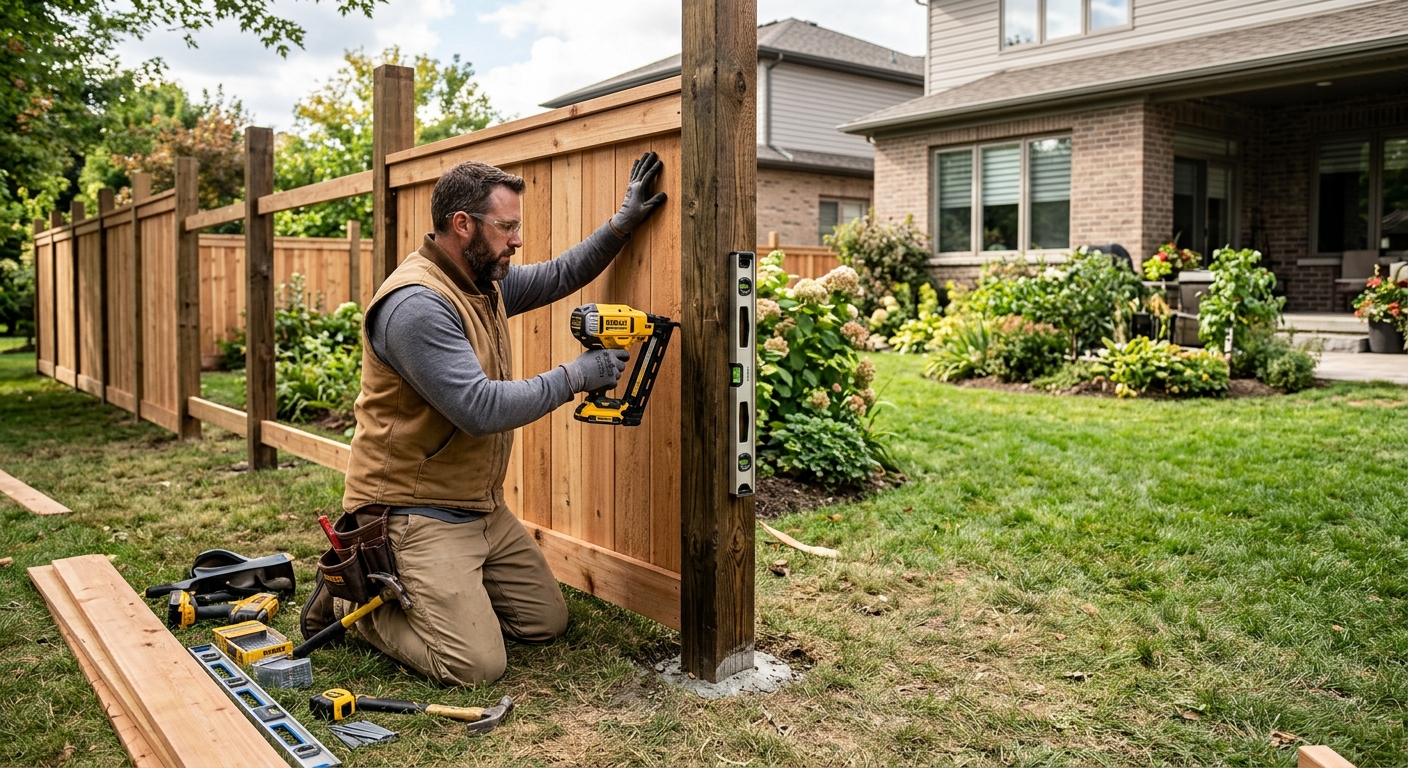
Fencing options and costs in Espanola
Espanola is a small, established community where fencing demand tracks closely with how many detached homes are out there—single-detached houses make up 80.7% of dwellings, and homeowner households account for 75.9% of households (Statistics Canada, 2021 Census). When you own a typical detached lot, you’re more likely to add backyard privacy, keep pets secure, or define a driveway and side yard, and that means more fence projects at comparable times of year.
In the Northeast economic region, winter conditions can be demanding. Even though Espanola’s climate differs from the Peace region of B.C., local pricing still reflects Ontario frost behaviour: contractors plan for proper post depth and concrete setting to limit frost heave and seasonal movement. Wind and drifting snow also matter for taller panels and gated openings, so crews often adjust post spacing and frame stiffness—especially near open lots and wind-exposed corners.
In practice, projects tend to be especially active in older residential pockets such as central Espanola and the surrounding established neighbourhood blocks where many homes were built before 1981 (79.0%). That housing age often means older fences are being replaced rather than new installs only, adding removal, disposal, and sometimes property-line re-establishment work. From there, the material choice drives both the initial quote and what you’ll spend to keep the fence looking good over the next decade.
Use the table below to compare common options and realistic installed price bands for Espanola, then we’ll break down what pushes quotes higher or lower.
| Material |
Lifespan |
Maintenance |
Privacy Rating |
Price per Linear Foot |
| Pressure-treated pine (standard wood) |
10–18 years |
Stain or seal every 2–3 years; quick repairs for loose boards |
High (solid boards) |
$80–$130 |
| Cedar (natural rot resistance) |
15–25 years |
Seal/stain periodically; monitor for warped rails |
High (solid boards) |
$95–$140 |
| Vinyl / PVC (no-maintenance) |
20–30 years |
Occasional wash; check hardware after freeze-thaw cycles |
High (solid systems) |
$85–$140 |
| Chain-link (galvanized steel) |
20–35 years |
Minimal; straighten sections and replace worn ties if needed |
Low–Medium (add privacy slats if desired) |
$55–$90 |
| Aluminum ornamental |
25–40 years |
Wash as needed; occasional tightening |
Low–Medium (ornamental pickets) |
$95–$150 |
| Composite / recycled material |
20–30 years |
Low; clean and inspect joints/hardware |
High (solid composite boards) |
$90–$150 |
Prices are estimates only and vary by project scope, site access and material selection.
What affects the price of fencing in Espanola
In Espanola and across Northeast Ontario, two homeowners can receive quotes for the “same” fence that differ by 30–50% because the job isn’t actually the same in the places that create labour and material waste. Quote swings typically come from linear footage, how deep the posts must be set for frost protection, whether concrete is required, how many gates are needed, and whether old fence removal is included. Even if your style selection is identical, crews may need different hardware, extra bracing, or closer post spacing when the yard is uneven or exposed to winter wind gusts.
Frost line depth is one of the biggest drivers. As a practical planning guideline, posts are often set about 4–6 inches below the design frost depth to help prevent heaving—meaning deeper holes, longer posts, and more concrete. In cold Ontario conditions, that can translate into higher material cost and longer install time compared with “light” post setting methods. When frost-protected installs require concrete-set posts, your project usually shifts into the higher side of the wood band (for example, $80–$130/linear foot) because of both post length and crew time.
Wind and panel exposure are the other common reason prices climb. In exposed locations, contractors tighten post spacing and may recommend sturdier frames; that’s why some homeowners opt for chain-link where appropriate ($55–$90/linear foot) to reduce sail-like panel area, while others pay more for privacy styles that need extra support.
In Espanola specifically, these real-world examples often raise cost: (1) replacing a leaning older fence where the existing line posts are rotten means more excavation and disposal; (2) a sloped side yard often requires stepped or raked panels so you can’t “just run straight rails”; and (3) lots with limited side access can slow down auger/excavator progress, increasing labour hours. On the flip side, a straight, level run with clear access and no gate can keep you closer to the low end of vinyl ($85–$140) or wood pricing.
| Price Factor |
Why It Matters |
Cost Impact |
| Fence length in linear feet |
Every run requires posts, rails, and labour; waste increases with turns |
Highest driver; affects almost every line item |
| Post depth required |
Frost protection dictates how deep holes must be dug and how long posts need to be |
More depth = more time, concrete and longer lumber/steel |
| Post setting method |
Concrete set vs gravel pack vs driven posts changes durability and stability |
Concrete typically increases cost and improves long-term performance |
| Material choice |
Vinyl, cedar, and chain-link have different hardware, installation complexity and longevity |
Can shift you across wood/vinyl/chain-link price bands |
| Gate count and type |
Double drive gates are heavier and require stronger frames and bracing |
Often adds major cost due to extra posts and hardware |
| Grade and terrain |
Sloped yards need stepped or raked layouts to keep spacing consistent |
More fabrication time and more fasteners |
| Old fence removal and disposal |
Rotten posts, nails, and debris add time and landfill/disposal fees |
Frequently adds 10–25% depending on condition |
| Permit fees and survey / property line locate |
Locates and line confirmation reduce encroachment risk |
Can add cost if a permit or survey is required for your height/layout |
Permits & regulations in Ontario
In Ontario, fence rules depend on height, location on your lot, and municipal bylaws. A permit is often required for fences above a height threshold—commonly around 2.0 m (6.5 ft) at the rear and about 1.0–1.2 m (3–4 ft) at the front or corners, though your municipality’s zoning bylaw ultimately governs the numbers. Regardless of height, all fences must stay within your property lines and comply with municipal setbacks.
Before you dig post holes, you must arrange utility locates. In Ontario, homeowners and contractors typically use Ontario One Call (www.on1call.com) to mark buried services so you don’t hit power, gas, or telecom lines. If you’re unsure where your pins or boundary are, get a survey or locate your property pins before installing—fencing disputes are one of the most common reasons replacement projects drag on.
Shared fence ownership is handled under provincial line-fences legislation concepts. Practically, this means you should clarify responsibility for maintenance, repairs, and replacement—especially if the fence straddles a boundary or affects neighbouring properties.
How to verify your contractor in Espanola: confirm they carry general liability insurance (ask for a certificate of insurance showing your project address or property), and ensure they have clearance/coverage for workplace safety (WSIB). Many reputable firms list WSIB information on their paperwork and can provide a certificate. For licensing, confirm the appropriate Ontario registration/business credentials for their work scope (and ask for their policy details in writing) before any excavation begins.
Choosing the right fence material for Espanola
Choosing a fence for Espanola is mostly about matching the material to your priorities: privacy, low maintenance, upfront budget, and lifespan—then validating that choice for winter performance. Pressure-treated pine is usually the lowest upfront option, but it needs staining or sealing every 2–3 years to prevent premature greying and surface weathering. Cedar looks great and naturally resists rot, yet it still needs periodic finishing to keep colour and reduce warping at rails. Vinyl/PVC is popular for low maintenance because you mostly wash it, but extreme cold can make hardware and panel alignment more sensitive, so good installation practices matter.
Chain-link is typically the best value if you can live with limited privacy (or if you add slats for visual screening). Aluminum ornamental is mid-range in cost and provides long service life without rust, but it’s not a privacy fence unless you combine it with planting or specialty infill.
For frost performance, posts in Northeast-style winter conditions often need to be set below frost influence—commonly planning for depth roughly 4–6 inches under the design frost depth—so concrete-set posts are frequently recommended for solid fence panels and taller gate openings. That added stability can be worth it when you want a privacy fence that stays square through freeze-thaw cycles and snow loads.
Where price differences are justified: if a basic pressure-treated privacy fence lands around the middle of the $80–$130/linear foot range, but cedar comes in closer to the higher end (often about $95–$140 depending on height and post spacing), cedar can make sense when you plan to keep the look for many years. If you want the lowest maintenance and durability, vinyl often sits in the $85–$140 band and can be a smarter long-term value versus repainting and re-staining wood.
| Material |
Cold Tolerance |
Lifespan |
Annual Maintenance |
Best For |
Price Band |
| Pressure-treated pine |
Good when posts are frost-set and rails are well fastened |
10–18 years |
Low effort but needs staining/sealing every 2–3 years |
Budget privacy with planned upkeep |
$80–$130 |
| Cedar |
Good; performs well with proper sealing and fastener care |
15–25 years |
Periodic sealing/staining, spot repairs as needed |
Premium appearance and natural rot resistance |
$95–$140 |
| Vinyl / PVC |
Very good; depends on correct hardware and expansion gaps |
20–30 years |
Wash as needed; inspect hardware after freeze-thaw |
Low maintenance privacy |
$85–$140 |
| Chain-link |
Excellent; flexible mesh handles freeze-thaw well |
20–35 years |
Minimal; tighten ties and replace small sections if damaged |
Secure perimeter and pets |
$55–$90 |
| Aluminum ornamental |
Excellent; non-rusting performance |
25–40 years |
Occasional wash and hardware checks |
Front yard curb appeal |
$95–$150 |
| Composite / recycled |
Good; needs correct fastening to avoid joint stress |
20–30 years |
Low; occasional cleaning and joint/hardware inspection |
Solid look with reduced upkeep |
$90–$150 |
How to choose a fencing contractor in Espanola
Choosing a contractor in Espanola starts with proof, not promises. Verify Ontario licensing/registration for their business (and ask which trades/permits they handle, if applicable), then check liability insurance and WSIB/WCB coverage. What to look for: a current certificate of insurance (COI) showing general liability, the insured party name matching the company quoting your work, and coverage details that align with fencing/excavation risk. For workplace coverage, ask for WSIB clearance/coverage information—reputable contractors can provide it on request before they start digging.
Get 2–3 itemised written quotes that break out labour, materials (posts/rails/panels), concrete/hardware, gates, and any removal/disposal. Avoid lump sums without detail; they hide assumptions about how much post depth excavation will take or whether disposal is included. Read the scope carefully: is permit pull included (if required), is locates/survey your responsibility, and will they replace damaged landscaping or restore grade?
Warranty matters. A good workmanship warranty covers installation defects and post/gate alignment issues for a stated period, while product/manufacturer warranty covers material defects. Ask if warranties are transferable if you sell the home, and keep the paperwork.
Payment schedule: never pay more than 10–15% upfront. Hold back a portion until the fence is complete and cleaned up. Finally, demand a start date and an estimated completion timeline in writing—weather can affect install dates, but the contractor should still provide a clear plan.
- COI and insurance details provided before signing
- WSIB/WCB coverage confirmed in writing (ask for clearance)
- Itemised estimate: posts, rails, concrete, gates, and fasteners listed separately
- Explicit allowance for post depth/frost-set requirements
- Permit responsibility stated clearly (if height triggers a permit)
- Property line approach explained (pins locate/survey if needed)
- Old fence removal and disposal included or clearly excluded
- Gate hardware rated for winter use (self-latching, hinges/bracing details)
- Photos of similar completed fences in Ontario provided
- Workmanship warranty length written into the contract
- Payment schedule with small deposit and holdback until completion
- Site protection plan: how they prevent damage to grass/driveways/sidewalks
If a fencing contractor in Espanola won’t put these items in writing, it’s a problem. Red flags: they request a large deposit up front, their quote is not itemised, they refuse to provide insurance/WSIB information, they won’t discuss post depth or how they handle frost, or they dismiss permit/property-line questions without checking your layout.
Frequently asked questions — fencing in Espanola
Wood vs vinyl vs aluminum fence — which is best?
For many Espanola homeowners, “best” depends on how much upkeep you want and where the fence sits on the lot. Wood (pressure-treated pine or cedar) can look traditional and usually lands around the $80–$130/linear foot band for standard installs, but it typically needs finishing every 2–3 years to keep it looking sharp in Ontario freeze-thaw. Vinyl/PVC is a strong low-maintenance option and commonly sits around $85–$140/linear foot, with fewer upkeep tasks besides occasional washing. Aluminum ornamental usually provides long life and doesn’t rust, but it’s not typically a privacy fence; pricing often falls in the $95–$150 range. If you need privacy, wood or vinyl tends to fit best; for front curb appeal and longevity, aluminum is often the easiest win.
Do I need a permit to build a fence in Ontario?
Possibly, depending on your height and location on the property. In Ontario, many municipalities require a building permit for fences above common thresholds (often around 2.0 m at the rear and about 1.0–1.2 m at the front/corners), plus any fence must still respect property lines and local setback bylaws. Because rules can vary by municipality, the best approach in Espanola is to confirm the planned height and placement with the municipal bylaw office (or ask your contractor to confirm which permits are triggered). If you’re digging post holes, arrange utility locates through Ontario One Call before any excavation. A reliable contractor won’t “guess”—they’ll explain whether they pull the permit or whether it’s on you.
How long does a wood fence last in Espanola?
With correct installation and maintenance, a wood fence in Espanola commonly lasts about 10–18 years for pressure-treated pine and 15–25 years for cedar. The biggest lifespan limiter is often the interface where boards meet fasteners and where posts sit in the ground during freeze-thaw cycles. That’s why proper post depth and good concrete setting (when required) matter. If you stay on top of staining or sealing every 2–3 years, you slow down surface weathering and reduce the rate of warping. If the fence is in a wet, shaded section or you get frequent snow contact, expect more wear on lower rails. In short: the material matters, but installation quality and upkeep are what actually control longevity.
Who owns and maintains a shared fence?
In Ontario, shared fence ownership and responsibility are governed by line-fences legislation concepts, but the practical answer is that you and your neighbour may both have rights and obligations depending on the boundary location and any prior agreements. For Espanola homeowners, the important step is to clarify in writing who maintains the shared sections and how replacement decisions are handled. If the fence is on (or near) the property line, you should confirm the boundary with pins/survey before assuming ownership. If the fence is damaged, ask for a joint inspection and keep communications documented. A good contractor can help document existing conditions with photos so both parties have a shared view—this reduces conflict when replacement is needed.
How do I find my property line before fencing?
Start by locating your property pins or markers—your property survey documents are usually the most direct guide. If you don’t have a current survey, consider arranging a survey or a property-line locate before installing. This matters in Espanola because mistakes become expensive quickly: posts are set in concrete, and correcting an encroachment can mean partial rebuilds. If you’re unsure where the fence should go, don’t rely on older neighbour estimates or visible remnants alone. Also coordinate utility locates with Ontario One Call before digging. When you hire a contractor, ask how they verify line placement (pins/survey review, layout measurements, and how they mark the line on-site). A careful scope reduces disputes and protects your investment.
What's the most low-maintenance fence?
For many homeowners in Espanola, vinyl/PVC is the top “low maintenance” pick because it typically needs little beyond washing and occasional hardware checks. Chain-link can also be low maintenance, with the advantage of long life and minimal upkeep, but it won’t provide privacy unless you add slats or a screening solution. Aluminum ornamental is similarly low maintenance (non-rusting) but, like chain-link, it usually doesn’t deliver full privacy. In terms of pricing, vinyl often sits around $85–$140 per linear foot depending on height and components, while chain-link commonly runs about $55–$90. If you want privacy without periodic staining and repairs, vinyl is often the best balance—just make sure the installer accounts for winter hardware alignment and proper frost-suitable post installation.