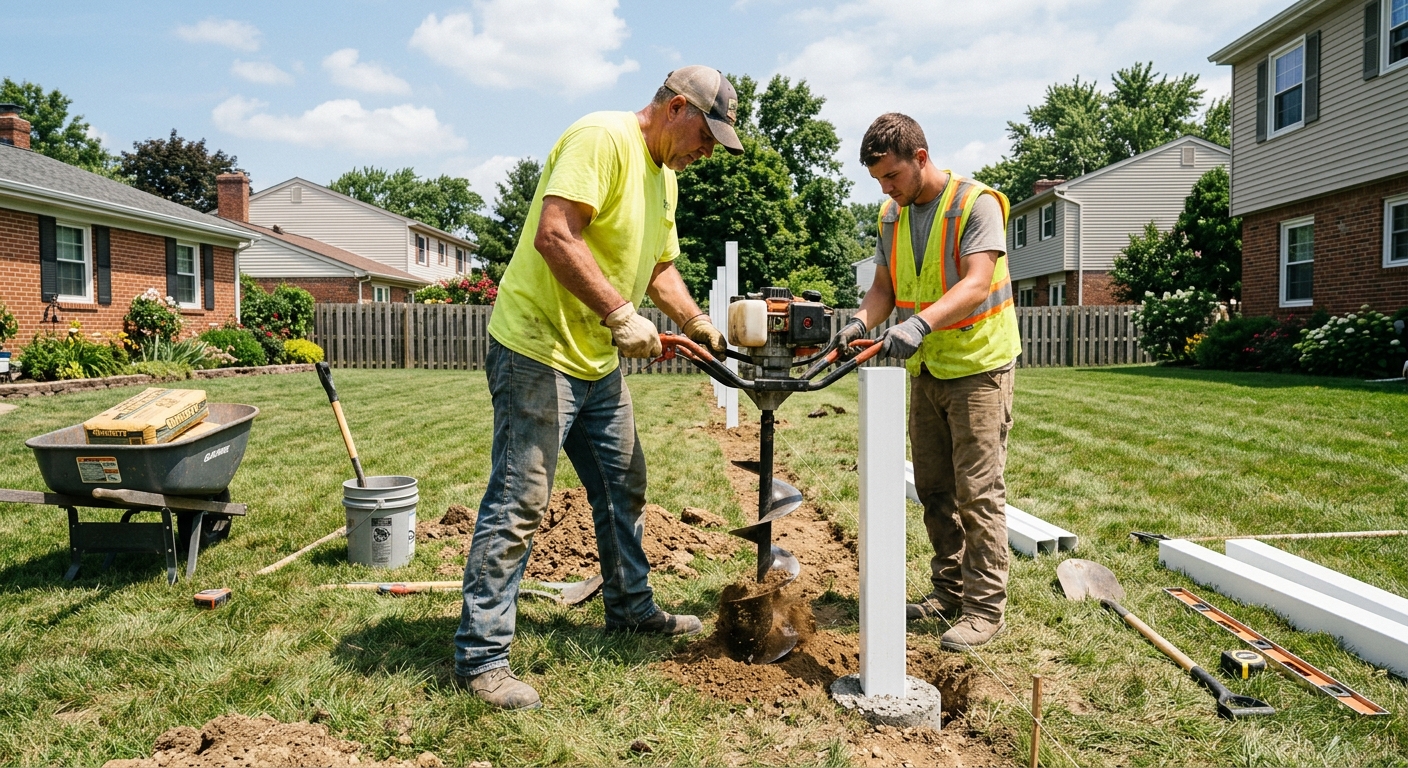
Fencing options and costs in Hillcrest Village
Fencing in Hillcrest Village is largely shaped by what homeowners can realistically afford and what will still look good after Ontario winters. With a population of 16,934 (Statistics Canada, 2021 Census), and a neighbourhood dominated by established residential lots, demand stays steady every year—especially for backyard privacy and front boundary upkeep. In practice, the Toronto economic region has a lot of detached and semi-detached properties, and each additional yard upgrade is a direct opportunity for fencing contractors.
Local climate drives the biggest cost difference: the frost line in Southern Ontario is commonly estimated around 42"–48", so posts for taller privacy fences typically need concrete-set footing depths to reduce heaving. For 6–8 ft fences, that usually means setting posts roughly 3.5–4 ft down, using longer posts and more labour. In Hillcrest Village, clay and mixed soils also encourage concrete setting as the default—so even when two fences use the same material, one site can come in meaningfully higher due to footing requirements, access, and how many posts are needed.
In my experience, the trade is especially busy around the Yonge Street corridor and the surrounding residential pockets where older properties often need re-fencing and line repairs. If you’re comparing fence types before contacting installers, the table below gives a realistic snapshot of typical lifespan, maintenance, privacy performance and per-foot pricing for Hillcrest Village.
| Material |
Lifespan |
Maintenance |
Privacy Rating |
Price per Linear Foot |
| Pressure-treated pine (standard wood) |
10–15 years |
Stain/seal every 2–3 years |
High (solid/board-on-board) |
$65–$120 |
| Cedar (natural rot resistance) |
15–25 years |
Stain/oil every 2–4 years |
High (solid/board-on-board) |
$85–$130 |
| Vinyl / PVC (no-maintenance) |
20–30 years |
Rinse as needed |
High (solid privacy panels) |
$75–$130 |
| Chain-link (galvanized steel) |
25–40 years |
Occasional rinse and tension checks |
Low–Medium (privacy slats optional) |
$45–$85 |
| Aluminum ornamental |
25–40 years |
Rinse; rarely paint |
Low–Medium (open pickets) |
$90–$160 |
| Composite / recycled material |
20–30 years |
Low; periodic wash |
High (solid boards) |
$95–$155 |
Prices are estimates only and vary by project scope, site access and material selection.
What affects the price of fencing in Hillcrest Village
In Hillcrest Village and the broader Toronto region, it’s common to see fencing quotes for what sounds like the “same fence” come back 30–50% apart. The difference is usually not the board colour—it’s the frost-footing reality, the soil conditions, and how each contractor builds for long-term stability. Labour availability also matters in peak season: contractors who can mobilize quickly and stock materials may price more tightly, while others add logistics and scheduling buffers.
Toronto’s frost line depth is the main driver of post cost. Best practice in Southern Ontario is to set posts about 4–6 inches below the design frost depth; practically, that often means posts need to be set roughly 1.5–2.0 m into the ground. That pushes you toward concrete-set posts for 6–8 ft privacy fences, because driven posts alone can shift with freeze-thaw cycles. In colder winters around the GTA, longer posts and more ready-mix translate directly into higher material handling and labour time.
Here are a few concrete examples that change the final numbers in Hillcrest Village: (1) A 40 ft run of solid privacy can cost more when the yard is clay-heavy—extra effort goes into clean hole excavation and consistent concrete placement; (2) if your fence line includes gate posts, the builder often increases post size and uses heavier hardware, which raises the per-foot effective price even if total footage is the same; (3) if you replace a chain-link that’s already on an engineered footing, demolition and re-setting can be faster than starting from scratch.
That’s why a wood privacy run may land closer to the $65–$120 band when footings are straightforward, while cedar or vinyl privacy frequently pushes into the higher end of the $75–$130 ranges once concrete-set posts, gate hardware, and longer installation time are included. Next, let’s break down the cost factors that show up in every itemized quote.
| Price Factor |
Why It Matters |
Cost Impact |
| Fence length in linear feet |
The primary cost driver for materials, posts and labour |
Directly proportional—every extra foot adds posts, rails and fasteners |
| Post depth required |
Frost line determines hole depth and required post length |
Deeper concrete footings increase labour, concrete volume and post cost |
| Post setting method |
Concrete vs. gravel pack vs. driven posts changes build time and stability |
Concrete-set posts typically raise cost versus gravel/driven options |
| Material choice |
Vinyl, cedar and chain-link have different hardware and build rates |
Switching materials can shift the project by tens of dollars per foot |
| Gate count and type |
Gates require stronger posts, hinges and latching hardware |
Each gate can add a meaningful lump of labour and materials |
| Grade and terrain |
Slopes require stepped panels or raked framework |
Extra layout time and cut labour can increase total cost |
| Old fence removal and disposal |
Demolition, haul-away and recycling vary by condition |
Broken concrete footings or tangled mesh add cost |
| Permit fees and survey / property line locate |
Some fence heights and corner conditions trigger approvals or locating work |
May add administrative and site verification time |
Permits & regulations in Ontario
In Ontario, fences are generally regulated around height thresholds and property-line rules. A rear yard fence is often treated differently than a front or corner fence: commonly, a permit may be required for fences above about 2.0 m (6.5 ft) at the rear and above 1.0–1.2 m (3–4 ft) at the front or corners. The exact trigger can vary by local bylaw, but the practical takeaway for Hillcrest Village homeowners is to assume a higher fence may require review before you dig post holes.
Before installation, you must respect property lines and any municipal setback bylaws. Also, before digging, you should call for utility locates so you don’t hit buried services. In Ontario, that’s done through Ontario One Call. If you’re unsure of boundaries, get a survey or property pin locate first—encroachment disputes are one of the most expensive “surprises” to fix after fencing is built.
Shared fence ownership typically follows Ontario line-fences principles, but day-to-day maintenance responsibilities can depend on which side erected and paid for the structure and what’s actually on your property. Finally, to verify your contractor, ask for proof of: (1) an active Ontario business/contractor licence where applicable, (2) liability insurance, and (3) WSIB coverage or equivalent clearance. Where to check: look for the company’s licence status online, request a certificate of insurance showing your jobsite and dates, and ask for WSIB clearance letters (or the documented equivalent). A reputable fencing crew will provide these without hesitation.
Choosing the right fence material for Hillcrest Village
Choosing the right fence material in Hillcrest Village comes down to what you want most: privacy, low maintenance, a specific look, or the lowest upfront cost. Toronto winters can be tough on surfaces due to freeze-thaw cycles and salt spray, so the material’s long-term performance—and how posts are set—matters as much as the board itself.
Pressure-treated pine is the budget-friendly route, but it usually needs staining or sealing every 2–3 years to prevent grey weathering and premature splitting. Cedar offers better natural rot resistance and often looks better longer, yet it still benefits from periodic staining/oiling in our climate. Vinyl/PVC is genuinely low maintenance—no staining, and it resists rot—but in extreme cold it can become brittle if it’s not installed correctly, with proper expansion allowances and stable, concrete-set posts. Chain-link is the lowest cost and lasts a long time, though it won’t provide privacy unless you add slats or plan for greenery. Aluminum ornamental is durable and rust-resistant, with a mid-range price point and great curb appeal, but it’s open by design.
For privacy fences in Toronto’s freeze conditions, concrete-set posts are typically the safer plan because frost heave can move lighter, shallow-set structures over time. A real-world example: if a pressure-treated wood privacy fence lands in the $65–$120 range but requires regular staining, while vinyl privacy sits closer to $75–$130, the vinyl difference is often justified when you value “install-and-forget” maintenance and plan to stay put for decades. Wind and snow loads here aren’t as severe as the Prairies, but taller solid panels still need solid post sizing and spacing to reduce racking.
| Material |
Cold Tolerance |
Lifespan |
Annual Maintenance |
Best For |
Price Band |
| Pressure-treated pine |
Good (needs protected finish) |
10–15 years |
1–2 hours seasonally + staining every 2–3 years |
Budget privacy with willingness to maintain |
$65–$120 |
| Cedar |
Good (stable with proper sealing) |
15–25 years |
Light wash; stain/oil every 2–4 years |
Premium look, rot resistance, natural grain |
$85–$130 |
| Vinyl / PVC |
Very good if installed correctly with proper posts |
20–30 years |
Minimal—rinse as needed |
Low-maintenance privacy |
$75–$130 |
| Chain-link |
Excellent |
25–40 years |
Occasional rinse and tension check |
Perimeter security on a budget |
$45–$85 |
| Aluminum ornamental |
Excellent (coated finish) |
25–40 years |
Minimal—rinse and spot touch-ups if required |
Curb appeal, durable boundary definition |
$90–$160 |
| Composite / recycled material |
Good (varies by brand; supports stable posts) |
20–30 years |
Low—periodic wash |
Privacy panels with low maintenance |
$95–$155 |
How to choose a fencing contractor in Hillcrest Village
When you’re hiring a fencing contractor in Hillcrest Village, verify the basics first—licensing/registration where required, liability insurance, and proper coverage for workers. For Ontario jobs, you should ask for: (1) a current certificate of liability insurance (request it before work begins, and confirm the coverage dates); (2) proof of WSIB coverage or a clearance letter if the contractor is required to carry it; and (3) licence/registration details for the business through the appropriate provincial or business registry channels. If they won’t provide documents or try to push you into “verbal confirmation,” treat that as a risk.
Then get 2–3 itemised written quotes. The most useful quote breaks down labour and materials separately (posts, rails, boards/panels, gates, hardware, concrete, demolition, and disposal). Avoid lump-sum-only pricing unless it’s very clear what’s included. Make sure the scope addresses: permit pull (if required), utility locate responsibility, disposal of removed fence materials, how they handle uneven grade, and whether they replace damaged landscaping or only restore to “workmanlike” condition.
Also review warranties. You typically want a workmanship warranty (how long they’ll stand behind installation) and the manufacturer’s warranty for materials. Ask whether warranties are transferable to future owners and whether it’s valid for the exact product used.
For payments, a safe schedule is keeping upfront deposits around 10–15% and holding a portion until final inspection and cleanup. Finally, require a written start date and completion estimate.
- Ask for proof of liability insurance with jobsite details.
- Confirm WSIB coverage or WSIB clearance letter before signing.
- Get at least two itemised quotes with labour/material breakdowns.
- Ensure concrete-set post depth is specified (not “typical” language).
- Verify gate hardware quality and whether posts are upgraded for gates.
- Ask how they handle slopes: raked panels vs. stepped sections.
- Confirm top rail/bracing style for privacy panels (reduces racking).
- Check whether demolition and disposal are included in price.
- Ask who pulls any required permit and who pays permit fees.
- Require utility locate confirmation before digging.
- Request a clear schedule for cleanup and final site restoration.
- Clarify warranty length for workmanship and product, and transferability.
Common red flags I see around Hillcrest Village include: (1) no proof of insurance/coverage provided up front, (2) quotes that don’t specify post depth or setting method, (3) vague scope language like “materials as needed” with no allowance, (4) taking large upfront payments beyond 10–15% without a contract schedule, and (5) refusing to provide an itemized quote or a written start/completion window.
Frequently asked questions — fencing in Hillcrest Village
Do I need a permit to build a fence in Ontario?
In Ontario, whether you need a permit depends mainly on fence height, location (rear yard vs. front/corner), and local setback rules. A common practical threshold is that fences taller than about 2.0 m (6.5 ft) in the rear, or above roughly 1.0–1.2 m (3–4 ft) near the front or at corners, may trigger a permit requirement in many municipalities. In Hillcrest Village, the safest approach is to ask your contractor to confirm the specific rule for your lot before you order materials or dig holes. Also remember: utility locates are required before digging, and many homeowners should consider a survey/property pin locate if there’s any boundary uncertainty to avoid encroachment issues. Your contractor should clearly state whether the permit pull is included in the quote and provide proof of compliance.
How long does a wood fence last in Hillcrest Village?
Wood longevity in the Toronto area depends on the type of wood, how it’s finished, and—critically—how the posts are set below the frost line. With properly concrete-set posts and regular staining, pressure-treated pine commonly lasts about 10–15 years, while cedar often reaches 15–25 years. If posts are only driven or set shallow, freeze-thaw cycles can create movement and loosen rails sooner, especially on clay or mixed soils common in the GTA. You’ll also see earlier wear on areas that get lots of snow storage or salt spray. Budget-wise, pressure-treated pine is often in the $65–$120 range, but the “true” cost includes re-staining every 2–3 years. If you want to reduce upkeep, vinyl privacy in the $75–$130 band may be more cost-effective over time for many homeowners.
Who owns and maintains a shared fence?
Shared fence rules in Ontario generally fall under provincial line-fences principles, but day-to-day responsibility often depends on what’s agreed locally and what each owner paid for or installed. In many neighbourhoods near Hillcrest Village, you’ll find older fences that were erected by one property owner with an understanding of shared use later. Maintenance can become a dispute when one side wants to replace a deteriorated section while the other side prefers repairs. The best way to handle this is to discuss scope in writing, document the condition (photos), and decide on how costs will be shared before work begins. A contractor can help by providing a clear replacement breakdown and confirming the fence line. If you’re unsure whether a fence is on your property or straddles a boundary, a property pin locate or survey can prevent incorrect assumptions.
How do I find my property line before fencing?
The most reliable method is to use your property pins and/or obtain a survey. Before any post hole is dug, homeowners in Hillcrest Village should confirm boundaries rather than relying on old measurements, fence remnants, or neighbour estimates. Start by locating the property pins and matching them to the lot layout; if you don’t have clear documentation, book a survey or property line locate through a qualified professional. This matters because fence placement mistakes can lead to removal requests and rework—costly after the concrete is poured. Your contractor should also be willing to use the locate information to plan string lines for posts and rails. If a permit is required, boundary clarity becomes even more important, because inspections and documentation may rely on accurate placement.
What's the most low-maintenance fence?
For most Hillcrest Village homeowners, vinyl/PVC privacy fences are typically the lowest-maintenance option because they don’t need staining and resist rot. Aluminum ornamental fences are also low maintenance since they’re coated and won’t rust like exposed steel. Chain-link is usually maintenance-light as well—mainly occasional cleaning and tension checks—but it doesn’t provide privacy unless you add slats or another privacy layer. The “low maintenance” story only holds up if the posts are stable for Ontario winters: that’s why concrete-set posts are commonly recommended for tall fences where frost heave could shift lighter installations. If you’re comparing costs, vinyl privacy often sits in the $75–$130 per-foot band, while pressure-treated pine is often $65–$120, but wood requires re-staining every 2–3 years to keep it looking good and reduce early weathering.
How tall can my fence be in Hillcrest Village?
Fence height limits are usually determined by local bylaw and the fence’s location on your lot (rear yard versus front/corner). A commonly referenced Ontario guideline is that rear fences are often treated differently from front/corner fences—for example, permits may be triggered around 2.0 m (6.5 ft) at the rear and around 1.0–1.2 m (3–4 ft) near the front or corners. In Hillcrest Village, you should confirm the maximum allowable height and whether a permit is required based on your exact location, because “corner lot” or boundary conditions can change what’s permitted. Before ordering a privacy fence, ask your contractor to help verify the bylaw and to include the permit step in the project scope if it applies. Also consider practical wind and snow impacts: taller solid fences can require stronger post sizing and closer spacing to prevent racking in the Toronto climate.