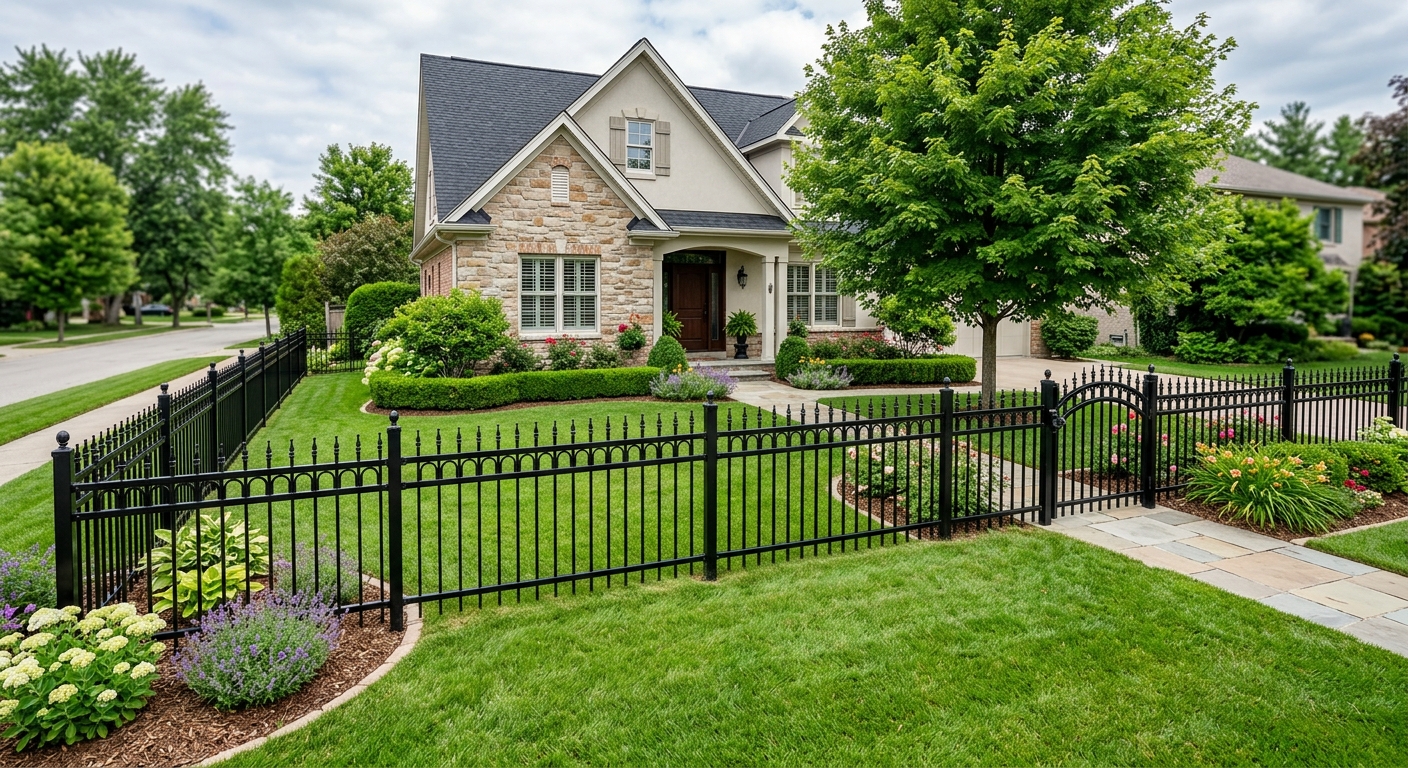
Fencing options and costs in Russell
Russell is a great place to put up a fence—whether you’re defining yards on larger lots or adding privacy for kids and pets. With 79.0% of local dwellings being single-detached homes, fencing demand is steady because most homeowners control their own exterior boundary planning, gates, and landscaping-style upgrades (Statistics Canada, 2021 Census). And because Russell sits in the Ottawa economic region, pricing is shaped less by “style” and more by how deeply posts must be set for winter frost, how windy snow can be, and how much labour it takes to dig and dispose of soil.
In our market, quality installations typically bury posts close to 4 ft to manage Ontario’s frost depth (about 3.5–4 ft) and reduce winter heave and leaning. That deeper digging means more machine time and sometimes more concrete, especially in clay soils that shift during freeze–thaw cycles. When snow drifts press against privacy panels, contractors often tighten post spacing and use stronger rails, which can affect the final quote even when your fence height stays the same.
Fence work is especially in demand around higher-turnover residential pockets like the Russell Village area, where homeowners frequently upgrade older boundary fences rather than rebuild from scratch. Below is a practical comparison of common material options and what homeowners usually pay per linear foot in Russell, to help you anchor your budgeting before we talk layout and site conditions.
| Material |
Lifespan |
Maintenance |
Privacy Rating |
Price per Linear Foot |
| Pressure-treated pine (standard wood) |
10–15 years |
Stain/seal every 2–3 years |
High (solid picket/board) |
$40–$75 |
| Cedar (natural rot resistance) |
15–25 years |
Light staining every 2–4 years |
High (solid board) |
$55–$95 |
| Vinyl / PVC (no-maintenance) |
20–30 years |
Wash as needed; no staining |
High (solid panels) |
$45–$80 |
| Chain-link (galvanized steel) |
20–35 years |
Occasional rinse; patching as needed |
Low (typically not private) |
$25–$50 |
| Aluminum ornamental |
25–40 years |
Wash; rare repairs |
Medium (open look) |
$70–$120 |
| Composite / recycled material |
25–30 years |
Wash; minimal spot repairs |
High (solid design) |
$65–$105 |
Prices are estimates only and vary by project scope, site access and material selection.
What affects the price of fencing in Russell
In Russell and the wider Ottawa area, two homeowners can receive quotes that differ by 30–50% for “the same” fence because the total installed job includes more than boards and posts. Your cost depends on how much ground must be excavated, how many gates you need, whether old fencing is removed and hauled away, and how the design resists wind and winter loads. Ottawa-region frost depth is the big driver: posts are typically set about 4–6 inches below the design frost line, meaning installers often need 1.5–2.0 m (roughly 5–6.5 ft) into the ground depending on soil and conditions. In practical terms, that increases post length, hole diameter, concrete footing amounts, and labour hours.
In more exposed lots, contractors may also use closer post spacing and heavier rails to handle wind loading and drifting snow. By comparison, chain-link often stays near the lower band, while privacy options like pressure-treated pine or vinyl usually sit in the mid bands because they require more structure and larger panel components.
Here are a few local examples that routinely move price up or down in Russell. First, clay soils can require extra excavation and careful backfill to keep alignment straight during freeze–thaw seasons—this adds time and sometimes disposal. Second, if your fence route crosses uneven ground or wet spots near swales, stepped panels and additional hardware are common. Third, if you’re replacing a fence built before 1981 (21.6% of homes were built before 1981), you often inherit older post locations, rotted footings, and more unknowns during removal. That can add concrete breaking time and disposal costs, especially when excavation reaches deeper footing levels.
| Price Factor |
Why It Matters |
Cost Impact |
| Fence length in linear feet |
Most materials and labour scale directly with length. |
High—often the biggest multiplier of total cost. |
| Post depth required |
Frost line dictates hole depth to prevent heave. |
High—in Russell this often pushes to ~4 ft burial and concrete set. |
| Post setting method |
Concrete footings resist shifting; gravel pack may be used in certain soils. |
Medium to high—concrete increases materials and labour. |
| Material choice |
Vinyl, cedar and metals have different hardware and durability profiles. |
Medium—can swing the project by multiple price bands. |
| Gate count and type |
Gates require heavier posts, braces, and more custom hinges/latches. |
Medium to high—especially drive-through (double) gates. |
| Grade and terrain |
Slopes require stepped/raked systems and extra rails. |
Medium—more labour and more cut components. |
| Old fence removal and disposal |
Demolition, concrete breaking, and hauling can add time. |
Medium—can add days depending on footing condition. |
| Permit fees and survey / property line locate |
Some installations need approvals; boundary accuracy prevents rework. |
Low to medium—usually small vs. materials, but can be essential. |
Permits & regulations in Ontario
In Ontario, fence rules are typically tied to both height thresholds and where the fence sits (front yard vs. rear). As a homeowner in Russell, plan for the fact that fences above a common threshold—often around 2.0 m (6.5 ft) in the rear and roughly 1.0–1.2 m (3–4 ft) in the front or corner—may require a building permit, plus compliance with municipal setback bylaws. Regardless of height, fences must not cross property lines, and any required setbacks still apply.
Before digging any post holes, always arrange utility locates (Ontario One Call). Hitting buried services is an expensive mistake and a serious safety risk. Also, obtain a survey or locate your property pins before installation. This is the best way to avoid encroachment disputes with neighbours—especially if you’re replacing an older fence that may not have been built on the current boundary line.
Shared fence ownership and maintenance responsibilities are governed by Ontario’s line-fences principles, but the practical takeaway is: confirm who owns which side and how repairs are handled before work starts.
What does and doesn’t usually require a permit: In practice, adding a small, low-height fence that stays within typical front/rear height limits often does not trigger a permit, while increasing height beyond those thresholds (or adding a taller privacy fence) frequently does. To verify your exact case, confirm with the municipal permitting office and your contractor’s documentation.
When hiring, verify the contractor’s Ontario licence (when applicable to their work category), liability insurance, and WSIB coverage. Ask for: (1) a certificate of insurance showing your name/address as applicable, (2) WSIB clearance or proof of enrollment/coverage, and (3) the appropriate licensing/registration details. Where possible, cross-check through online registries and ensure certificates match the company that will be onsite.
Choosing the right fence material for Russell
Choosing the right fence material in Russell is mostly about matching your priorities—privacy, low maintenance, budget and lifespan—to Ottawa’s freeze–thaw winters and snow-driven exposure. Pressure-treated pine is the classic budget choice, but it typically needs staining or sealing about every 2–3 years to reduce grey weathering and protect the wood from moisture swings. Cedar looks better and resists rot naturally, yet it still needs periodic maintenance (often every 2–4 years) to keep colours even and prevent surface checking. Vinyl/PVC offers the “wash-and-forget” style, but in extreme cold it can become brittle, so quality installation details and correct post/rail hardware matter. Chain-link is the lowest cost and longest-life option, though it won’t give meaningful privacy unless you add slats or plant screening. Aluminum ornamental is rust-resistant and low-maintenance, but it’s open by design and usually used when visibility and style matter more than privacy.
In Ottawa’s climate, post depth requirements are the same regardless of material: bury posts near 4 ft to account for the local frost depth. Concrete-set posts are commonly used in clay or anywhere you need maximum stability. And since privacy fences act like sails during snow-heavy wind events, stronger rails and proper post spacing help reduce racking and panel flex over time.
To make the pricing decision concrete: if you’re comparing wood and vinyl for a privacy line, a vinyl install often lands in the mid-to-upper portion of the $45–$80 style bands, while pressure-treated wood typically competes closer to $40–$75. The difference can be justified when you want fewer weekend maintenance tasks and a more uniform look through winter, especially if your household is busy and you’d otherwise be paying for periodic staining.
| Material |
Cold Tolerance |
Lifespan |
Annual Maintenance |
Best For |
Price Band |
| Pressure-treated pine |
Good with proper sealing; can grey and check over time |
10–15 years |
1–2 light coats or inspection; stain every 2–3 years |
Budget privacy where maintenance is acceptable |
$40–$75 |
| Cedar |
Excellent rot resistance in wet-freeze cycles |
15–25 years |
Inspect and stain as needed (about every 2–4 years) |
Attractive privacy with moderate upkeep |
$55–$95 |
| Vinyl / PVC |
Good; needs solid installation in extreme cold |
20–30 years |
Rinse/wash as needed; no staining |
Low-maintenance privacy |
$45–$80 |
| Chain-link |
Excellent; steel and coating hold up in winter |
20–35 years |
Minimal—rinsing and occasional tension adjustments |
Security with minimal visual bulk |
$25–$50 |
| Aluminum ornamental |
Excellent; no rust in Ontario winters |
25–40 years |
Wash/inspect 1x per year |
Style and curb appeal over privacy |
$70–$120 |
| Composite / recycled |
Good; stable boards when installed correctly |
25–30 years |
Wash as needed; occasional hardware checks |
Durable privacy with low upkeep |
$65–$105 |
How to choose a fencing contractor in Russell
Choosing the right fencing contractor in Russell comes down to proof—proof that they’re insured, properly covered for workers, and that their quote reflects how an Ontario installation should be built. Start with licensing and coverage. Ask for their Ontario business/contractor information where applicable, but more importantly request: (1) liability insurance (certificate of insurance) naming the worksite/address as appropriate, and (2) WSIB clearance or evidence of WSIB coverage. You can verify WSIB status through WSIB’s clearance tools if your contractor provides the necessary details. For higher-risk situations—like deep concrete footings in clay—coverage matters because the job has more excavation and more potential for damage.
Next, get 2–3 itemised written quotes, not lump sums. A strong quote breaks down labour and materials separately and shows how posts are installed (typically concrete-set), what panel system is used, gate hardware, and any colour/stain or installation tolerances. Read the scope carefully: confirm what’s included for permits (if applicable), utility locating, property line locating/survey responsibility, disposal of old fencing, and site restoration (grading, topsoil or reseeding). Make sure the quote clearly lists exclusions such as buried obstacles, rock removal, landscaping reinstatement, or unmarked drains.
Warranty matters too. Ask for the workmanship warranty period (labour) and the product/manufacturer warranty, and whether either warranty is transferable if you sell the home. Payment schedules should be conservative: don’t pay more than 10–15% upfront, and use a holdback until the job is complete and verified. Finally, insist on a start date and completion estimate in writing so winter conditions don’t slip the timeline.
- Ask for liability insurance certificate and confirm it covers fence construction work.
- Request WSIB clearance/proof of coverage and confirm it applies to the work crew.
- Get 2–3 itemised quotes with labour and materials separated.
- Confirm post depth plan (typically near 4 ft in this region) and whether concrete footings are included.
- Verify gate construction: hinges/bracing and whether the gate uses heavier posts.
- Check if old fence removal and disposal are included or billed separately.
- Clarify permit responsibility and whether the contractor pulls the permit when required.
- Confirm utility locate is included (Ontario One Call) and when it will be done.
- Ask how property line locations will be handled (pins/survey responsibility in scope).
- Request a workmanship warranty length in writing.
- Confirm who is responsible for site restoration (grading, topsoil, clean-up).
- Keep to a payment schedule: small deposit, then staged payments, with holdback until completion.
Red flags I’ve seen in Russell include: refusing to provide proof of insurance/WSIB coverage, quoting a full job without post-depth/concrete details, giving only a lump-sum price with no itemisation, starting work without a clear agreement on disposal and reinstatement, and pressuring for large upfront payments beyond 10–15%.
Frequently asked questions — fencing in Russell
How much does a fence cost in Russell?
In Russell, your fence cost typically depends on linear feet, how deep posts must be set, and whether you’re installing privacy panels or just a boundary security fence. As a budgeting anchor, many Ontario residential projects land around $40,XXX – $75,XXX for wood installs and $45,XXX – $80,XXX for vinyl/PVC when comparing per-linear-foot style ranges in the market (prices vary by height, gates and site access). Because Ottawa’s frost depth is about 3.5–4 ft, installers commonly bury posts close to 4 ft and use concrete footings in clay, which raises labour and machine time. If you also need fence removal and proper line locating, the total can increase—yet a good scope will prevent surprises.
How deep should fence posts be for Russell's frost?
For Russell (Ottawa region), posts should be set below the local design frost depth to prevent heaving and leaning. In practice, that usually means burying posts close to 4 ft, with hole depth often about 4–6 inches below the design frost line. The exact depth can vary a bit based on soil type, fence height and local ground conditions, but a consistent rule of thumb is that many installations effectively require posts around 1.5–2.0 m into the ground. Deeper digging increases labour time and sometimes concrete quantity. This is why a quote should spell out post depth and footing method, not just the fence material.
Wood vs vinyl vs aluminum fence — which is best?
“Best” depends on what you value most. Pressure-treated wood is often the lowest upfront option, typically competing around the $40,XXX – $75,XXX style market range per linear foot, but it needs staining or sealing every 2–3 years to prevent grey weathering. Vinyl/PVC tends to sit around $45,XXX – $80,XXX and is usually lower-maintenance, though quality installation details matter in Ontario cold. Aluminum ornamental generally costs more, often in the $70,XXX – $120,XXX range, but it’s rust-resistant and offers long service life with minimal upkeep. If privacy is the priority, wood/vinyl/composite typically outperform ornamental aluminum.
Do I need a permit to build a fence in Ontario?
In Ontario, permits can be required depending on fence height and location (front vs. rear/corner). A common planning benchmark is that fences above about 2.0 m (rear) and roughly 1.0–1.2 m (front or corner) may require a building permit, and municipal setback bylaws must be followed. Even when a permit isn’t expected for a low fence, you still need to respect property lines and complete utility locates before digging. For Russell homeowners, the safest approach is to have your contractor confirm permit need based on your proposed height and placement, and to ensure the scope includes responsibility for any permit pulls if required.
How long does a wood fence last in Russell?
A well-built pressure-treated pine fence in Russell commonly lasts about 10–15 years, while cedar can last roughly 15–25 years. Longevity depends heavily on post depth (near 4 ft burial in this region), whether footings are set correctly, and how maintenance is handled. In an Ottawa-area freeze–thaw climate, moisture cycling and winter stress can speed up wear if the wood is not sealed/stained. Since Russell homes are largely single-detached (Statistics Canada, 2021 Census), wood fencing is common around yards, but the biggest predictor of lifespan is whether the installation was engineered for frost heave and wind loading, not just the board type. Proper maintenance (every 2–3 years for pine) helps keep the life closer to the upper end.
Who owns and maintains a shared fence?
Shared fence ownership in Ontario is governed by line-fences principles, but the details still depend on how the boundary is defined and how the fence was agreed to by neighbours. In practice, you should confirm: (1) which side the fence is on relative to the property line, (2) whether neighbours share maintenance costs, and (3) who is responsible for repairs when sections fail. For Russell homeowners, disputes usually happen when an older fence was installed off the intended boundary or when only one side had planned upgrades. Before you start digging, get your property pins located or obtain a survey, and keep communication clear in writing. If the fence is shared, agree on replacement scope (materials, height, and timing) before any demolition begins.