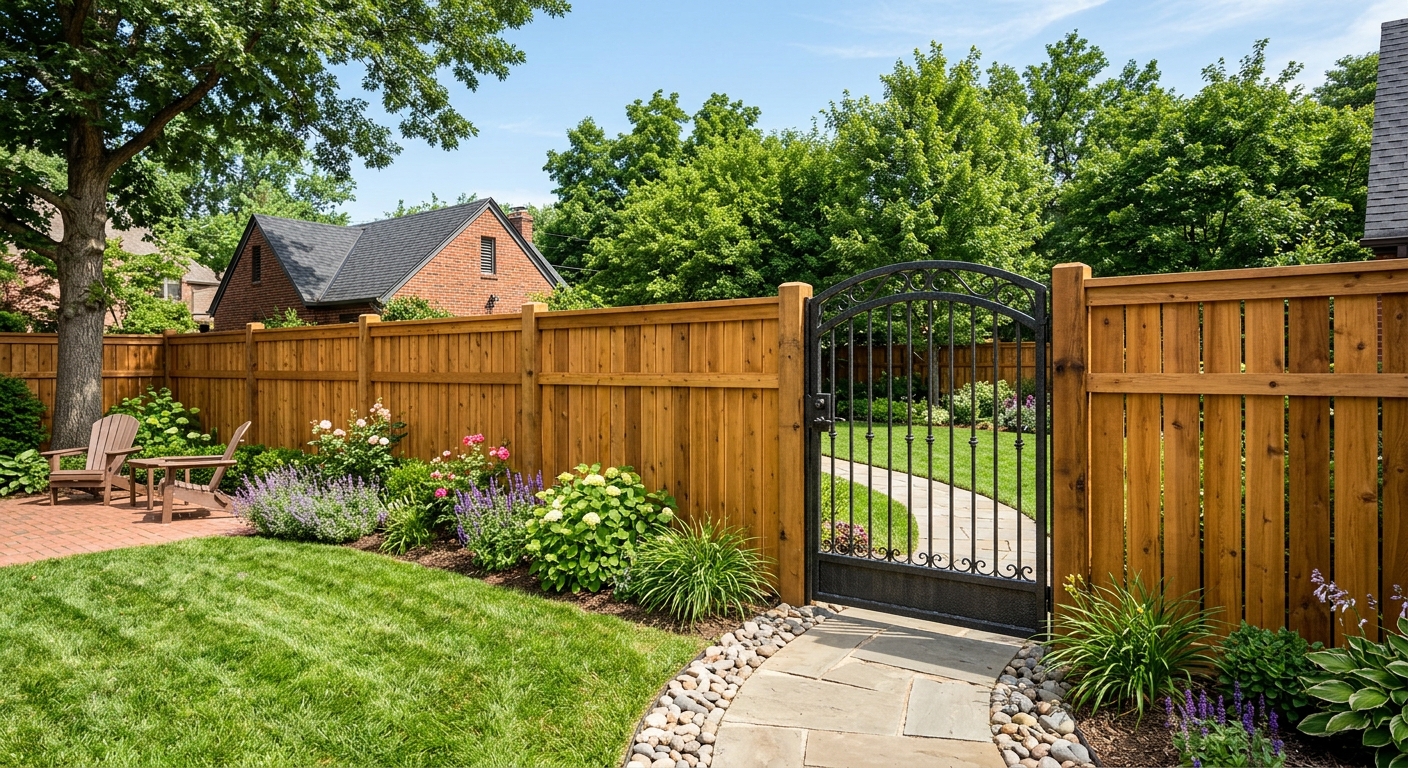
Fencing options and costs in Shuniah
Fencing in Shuniah is all about practical choices that hold up to Northwest Ontario’s winters and wind. With 97.2% of dwellings in the area being single-detached homes, many homeowners end up upgrading or replacing fence lines as yards get landscaped, privacy needs change, or older boards start to warp. In Shuniah specifically, homeowner households make up 94.7% of households, which means a steady local demand for installed fencing and gate repairs. (Statistics Canada, 2021 Census.)
Costs here can feel higher than quotes you may see in milder parts of the province because frost penetrates deeper in the North. That typically means posts need to be set roughly 4 ft (1.2 m+) below grade (often deeper depending on soil and design frost depth), usually with concrete to reduce frost heave and movement. Excavation takes longer, concrete volume increases, and longer posts cost more. Wind exposure also shapes design choices: more exposed lots often need tighter post spacing and sturdier panels, especially for solid-board privacy fences near open stretches and highway corridors where gusts carry.
Contractor availability can also affect pricing in busy seasons. When excavation and cement-setting crews are handling multiple projects, you’ll often see scheduling premiums for last-minute starts. For many properties, upgrades are especially common around the Shuniah waterfront and the more open rural edges where privacy and wind-blocking matter most. With that context, here’s how the main fence types typically stack up in cost and performance, moving into the comparison table.
| Material |
Lifespan |
Maintenance |
Privacy Rating |
Price per Linear Foot |
| Pressure-treated pine (standard wood) |
10–15 years |
Stain/seal every 2–3 years |
Good (solid pickets/boards) |
$28–$40 |
| Cedar (natural rot resistance) |
15–20 years |
Light staining or oiling every 2–4 years |
Good (solid pickets/boards) |
$32–$48 |
| Vinyl / PVC (no-maintenance) |
20–30 years |
Rinse only; inspect hardware |
Good–Very good (solid styles) |
$35–$55 |
| Chain-link (galvanized steel) |
25–40 years |
Occasional re-tension and coating touch-ups |
Low (visibility mostly open) |
$20–$32 |
| Aluminum ornamental |
20–35 years |
Wash annually; check latches |
Low–Medium (open pickets) |
$38–$60 |
| Composite / recycled material |
20–30 years |
Low; occasional cleaning |
Good (solid panel styles) |
$42–$70 |
Prices are estimates only and vary by project scope, site access and material selection.
What affects the price of fencing in Shuniah
In Shuniah and across Northwest Ontario, fencing quotes for the “same” project can vary by 30–50% because the expensive part is rarely the fence material alone—it’s the ground conditions and installation method. Two properties 100 ft apart can price differently depending on how deep we must set posts below grade, whether we can excavate efficiently, how rocky or clay-heavy the soil is, and how exposed the yard is to wind. In practice, labor and concrete dominate in cold, frost-prone sites, while material selection drives the rest.
Post depth is the biggest installer cost driver. Northwest’s frost conditions typically mean posts are set around 4–6 in (to be safely below the design frost depth) beyond typical shallow embedment—often resulting in about 1.5–2.0 m into the ground once you account for local frost depth, grade, and finished height. That changes everything: longer posts, deeper holes, more concrete, and more time on-site. If you choose a privacy fence, wind exposure also affects layout—contractors often go with tighter post spacing and heavier rails or more robust panel systems. For homeowners comparing options, that’s why wood installation prices (commonly in the $55–$90 range per linear foot for local installed work, depending on design) can climb quickly when the job includes deep-set posts and solid panels. Vinyl/PVC (often $70–$110 per linear foot installed) stays higher mainly because of material cost, even though maintenance is lower.
Concrete examples from typical Shuniah work include: (1) a solid-board fence on an exposed lot where we add bracing and heavier rails to reduce racking; (2) a yard with clay or mixed soils where we may require deeper, more stable footings to limit movement; and (3) sloped grades where we step panels rather than attempt a straight run, increasing layout and labour. Also note housing age: since 52.6% of homes were built before 1981, you’ll often see older fence remnants, buried footings, or compromised edges that add removal, disposal, and re-staking time—costing real dollars even before you buy new material.
| Price Factor |
Why It Matters |
Cost Impact |
| Fence length in linear feet |
Most costs scale directly with total run length. |
High (primary driver) |
| Post depth required |
Frost conditions dictate hole depth and post length. |
High (labour + materials) |
| Post setting method |
Concrete set usually costs more than gravel pack or driven posts. |
Medium–High |
| Material choice |
Vinyl/cedar/metal have different material and hardware costs. |
Medium |
| Gate count and type |
Gates require heavier hardware, posts, and alignment. |
Medium–High |
| Grade and terrain |
Slopes require stepped frames, extra posts, and layout time. |
Medium |
| Old fence removal and disposal |
Hauling and dismantling add labour and fees. |
Medium |
| Permit fees and survey / property line locate |
Some projects need permits or a locate to avoid encroachment. |
Low–Medium |
Permits & regulations in Ontario
In Ontario, whether you need a permit for a fence often depends on height and location. As a practical rule in many municipalities, fences exceeding roughly 2.0 m (6.5 ft) along rear yards and those above about 1.0–1.2 m (3–4 ft) at the front or corner commonly trigger a permit requirement. Even when permits aren’t required, you must follow property-line rules and any municipal setback by-laws that govern where a fence can sit. For Shuniah homeowners, the safest approach is to confirm the local fence height/setback requirements before ordering materials.
Before any digging, call for utility locates through Ontario One Call so your post holes don’t hit buried services. If you’re replacing an older fence or building close to a boundary, get a survey or at least a property pin locate so you can verify the exact line—especially important where older stakes may have shifted over decades.
Shared fence boundaries are typically handled under Ontario’s line-fences framework, but the practical takeaway is to clarify responsibility for costs and maintenance in writing with your neighbour before work begins.
Licence and coverage checks: verify your contractor is properly licensed where applicable, carries liability insurance, and has WSIB coverage (or the right equivalent clearance/coverage documentation for your situation). Ask for a current clearance letter, and request a certificate of insurance that lists the correct insured business name; then confirm expiry dates and scope. If a contractor can’t provide these documents promptly, that’s a red flag and often correlates with cost surprises.
Choosing the right fence material for Shuniah
Choosing a fence in Shuniah is mostly matching material to your priorities—privacy, low maintenance, budget, and expected lifespan—while accounting for Northwest Ontario’s cold and wind. With frost requiring deep, below-grade post settings (often about 1.2 m+ depending on design and grade), your structure has to stay stable in winter. That means concrete-set posts are frequently the right choice for durability, particularly for privacy fences where wind pressure can stress rails and fasteners. If the post system moves, boards and slats fail faster, so foundation quality matters as much as the fence surface.
Pressure-treated pine is the budget-friendly route, but it typically needs staining or sealing every 2–3 years to limit greying, checking, and moisture damage. Cedar has better natural rot resistance and looks great longer, but it still benefits from periodic oiling or staining. Vinyl/PVC is popular for “set it and forget it” convenience; it won’t rot, but extreme cold can make it less forgiving if hardware is incorrectly installed, and you’ll still want quality post spacing and proper expansion considerations. Chain-link is the lowest cost with the longest functional life, but it doesn’t provide privacy on its own. Aluminum ornamental looks sharp and won’t rust, yet it’s more decorative than private. Composite/recycled boards are a strong option for solid looks with low upkeep, though the upfront material cost is higher.
Here’s where the price difference is justified: if wood installation starts around the $55–$90 per linear foot band, but you need a solid privacy fence that must resist wind-driven racking, spending more on a vinyl/PVC or cedar system can reduce maintenance time and future replacement. In an exposed Shuniah yard, that can outweigh the higher upfront cost because the fence stays straighter and hardware lasts longer. For any option, we’ll also consider snow load and wind—especially for open stretches—by choosing panel stiffness, rail size, and post spacing that match your site.
| Material |
Cold Tolerance |
Lifespan |
Annual Maintenance |
Best For |
Price Band |
| Pressure-treated pine |
Good (with proper sealing) |
10–15 years |
Inspect hardware; stain as needed (typically every 2–3 years) |
Lowest upfront cost privacy |
$55–$90 |
| Cedar |
Very good (rot resistance) |
15–20 years |
Light oil/stain or cleaning as needed (often every 2–4 years) |
Appearance + natural durability |
$65–$100 |
| Vinyl / PVC |
Good (install correctly for cold) |
20–30 years |
Rinse and check posts/hardware |
Low maintenance privacy |
$70–$110 |
| Chain-link |
Excellent (galvanized) |
25–40 years |
Occasional re-tension and spot touch-ups |
Security + budget |
$35–$65 |
| Aluminum ornamental |
Excellent (won’t rust) |
20–35 years |
Wash/inspect latches annually |
Curb appeal with moderate visibility control |
$80–$140 |
| Composite / recycled |
Good (stable boards if properly framed) |
20–30 years |
Low; clean periodically |
Solid look with low upkeep |
$90–$150 |
How to choose a fencing contractor in Shuniah
When choosing a fencing contractor in Shuniah, start with proof, not promises. In Ontario, ask whether the company is properly set up to do the work and can show liability insurance—then request the certificate of insurance and confirm it’s current. For workers, check WSIB/WCB coverage documentation: reputable fence builders can provide a current clearance letter or coverage proof upon request. If they won’t share it, or if the paperwork is expired, it’s a major risk for you and your property.
Next, get 2–3 itemised written quotes. You want labour and materials broken out so you can compare like-for-like: post depth assumptions, whether concrete is included, gate framing, rail sizes, and how they handle slope transitions. Confirm what’s excluded: does the quote include permits, utility locates, property line survey/latches, and disposal of the old fence? Also ask about soil conditions—if they assume easy digging but your yard is clay or rocky, the price can change during construction.
Look for clear warranty terms. A workmanship warranty should cover post-setting, alignment, and fastener failure due to installation issues for a defined period. Product/manufacturer warranties should be separate, and you should ask whether the coverage is transferable to you as the homeowner. For payment, avoid large deposits—never pay more than 10–15% upfront—and use a holdback tied to completion and punch-list sign-off. Finally, insist on a written timeline with a start date and estimated completion, especially during spring ground-thaw when excavation is busiest.
- Ask for WSIB/WCB coverage proof and confirm it’s current (or a valid clearance letter).
- Request liability insurance certificate and verify the named insured matches the contractor.
- Get itemised quotes: labour, posts/footings, rails, panels, gate hardware.
- Confirm post depth and setting method (concrete set vs gravel pack) in writing.
- Clarify how they’ll handle slope—stepped vs raked panels—and who measures grade.
- Check whether old fence removal, hauling, and disposal are included.
- Ask if permit filing is included if required for fence height/location.
- Verify utility locates are included or confirmed before digging.
- Ensure gate pricing includes proper hinges, latches, and heavy-duty posts.
- Confirm materials are the stated type (e.g., cedar grade, vinyl thickness, galvanized finish).
- Review warranty separately: workmanship vs product warranty, and whether it’s transferable.
- Agree on payment schedule: small deposit (10–15%) and holdback until completion.
Red flags to watch for in Shuniah: a contractor who quotes without discussing frost-depth post setting; no written scope (just a lump-sum number); refusal or inability to provide WSIB coverage and liability insurance documents; vague warranty language with no written terms; and asking for large upfront payments or no defined completion date.
Frequently asked questions — fencing in Shuniah
How much does a fence cost in Shuniah?
In Shuniah, fencing typically lands in established installed ranges depending on material and how difficult the ground is to excavate. For example, wood installation often comes in around $55–$90 per linear foot, while vinyl/PVC usually sits closer to $70–$110 per linear foot because of higher material costs and gate hardware. Chain-link is generally lower at about $35–$65 per linear foot, while aluminum ornamental can be higher at roughly $80–$140. The biggest cost swings locally are deep, below-frost post holes and concrete setting in winter-prone soil, especially on exposed rural edges where wind loading requires stronger layouts. (Statistics Canada, 2021 Census.)
How deep should fence posts be for Shuniah's frost?
For Shuniah and Northwest Ontario, posts usually need to be set deep enough to sit below frost heave risk. In practical terms, that’s often around 4 ft (1.2 m+) below grade, and it can run deeper depending on design frost depth, soil, and the final fence height. Many installs also use concrete setting for stability because deeper embedment increases both concrete and excavation time, and that cost is part of why “standard” post assumptions don’t always hold in the North. When you get quotes, ask exactly what embedment depth they’re using and whether it’s concrete-set. If a contractor suggests shallow holes in winter, you should treat it as a serious concern for future leaning or panel movement.
Wood vs vinyl vs aluminum fence — which is best?
“Best” depends on whether you prioritise privacy, appearance, or maintenance. Wood (pressure-treated pine) is usually the most budget-friendly—often around $55–$90 per linear foot installed—but it typically needs staining or sealing every 2–3 years in this climate to keep it looking good. Vinyl/PVC is usually higher—commonly $70–$110—but it’s genuinely low maintenance once installed correctly, which matters when you’re dealing with deep-set posts and winter freeze-thaw cycles. Aluminum ornamental is often the most maintenance-simple visually and won’t rust, but privacy is limited because it’s decorative; costs commonly fall into the $80–$140 band. For wind-exposed runs near highway corridors, a solid privacy design (wood/cedar or vinyl) often performs better than ornamental pickets.
Do I need a permit to build a fence in Ontario?
Often, yes—depending on height and where the fence sits. In Ontario, fences above roughly 2.0 m (6.5 ft) in rear yards and around 1.0–1.2 m (3–4 ft) at the front or corner can require a building permit in many settings. Your exact requirement depends on municipal by-laws and the fence location, so confirm with your local office before you dig. Regardless of permits, you must stay within property lines and setbacks, and you should have utility locates done before post holes (Ontario One Call). If you’re replacing an older boundary fence, a survey or locate of property pins can prevent costly encroachment disputes.
How long does a wood fence last in Shuniah?
With proper installation and maintenance, wood fences in Shuniah commonly last around 10–15 years for pressure-treated pine, with better longevity possible for cedar. The key is what happens below grade and at the fasteners: deep, properly set posts reduce movement from frost heave, which otherwise loosens rails and causes rot to start higher up. Above grade, wood still needs periodic care; staining or sealing every 2–3 years helps limit greying, checking, and moisture intrusion in our freeze-thaw cycles. If your property is exposed to strong winter winds, panel racking can accelerate wear, so wind-conscious bracing and correct rail sizing matter. For many homeowners, the maintenance schedule becomes the deciding factor between wood and vinyl.
Who owns and maintains a shared fence?
In Ontario, shared fence boundaries are commonly governed by the province’s line-fences rules. Practically, this means both neighbours may share responsibility depending on the boundary arrangement and how the fence is considered to benefit the properties. For Shuniah homeowners, the safest approach is to clarify expectations before work begins—especially if you’re replacing an old fence line that may have been installed decades earlier. Ask your contractor to identify which sections are on the shared boundary, then talk with your neighbour about cost sharing, maintenance responsibilities, and whether there are any existing agreements. A written understanding helps prevent disputes when the new fence includes deeper below-frost posts and more durable hardware.