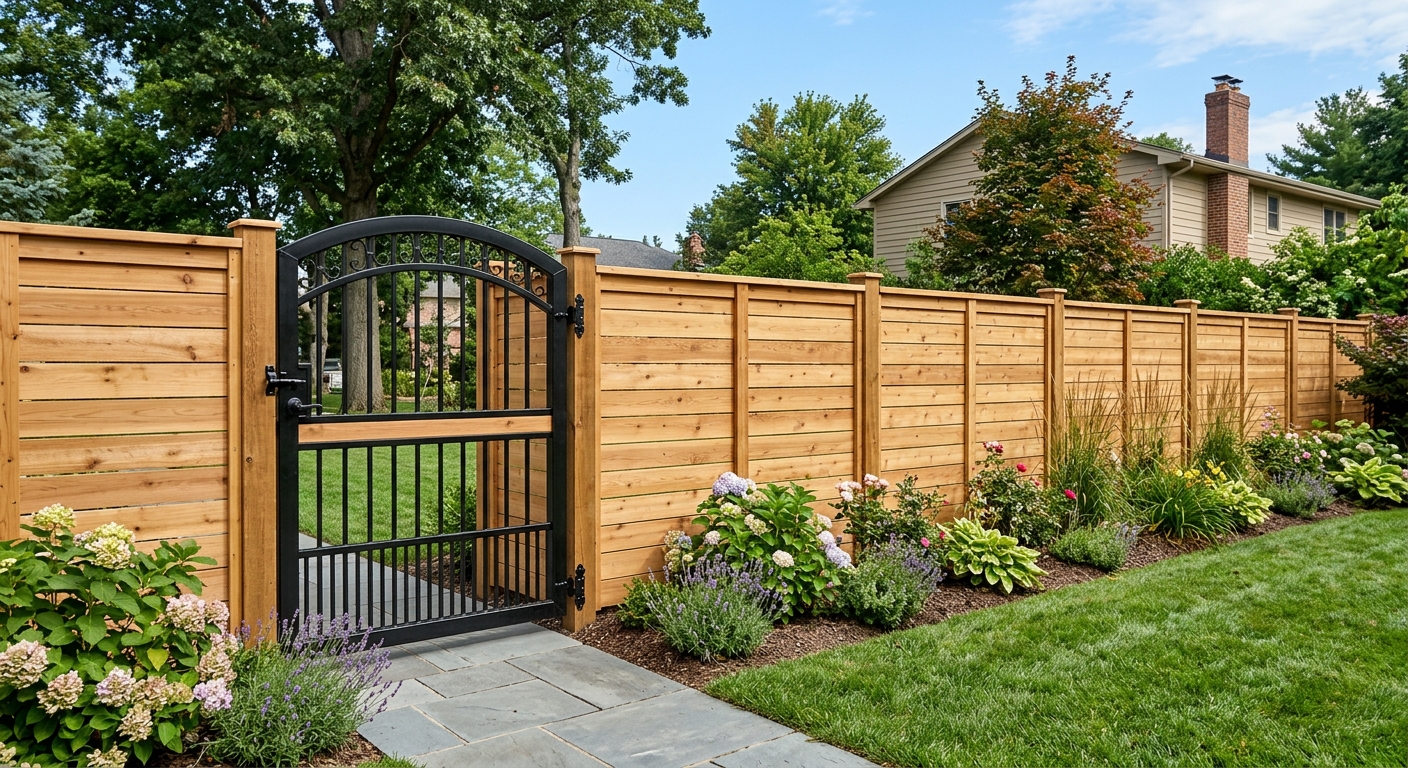
Fencing options and costs in Roncesvalles
In Roncesvalles, fencing comes down to balancing privacy, curb appeal, and long-term stability on a lot that’s often already shaped by existing landscaping and mature trees. With a population of 14,974 (Statistics Canada, 2021 Census), the neighbourhood draws steady demand for property upgrades—especially among homeowners with established yards where a new fence becomes a practical “boundary refresh” as much as it is a security upgrade. Toronto’s housing mix also matters: many fenced properties are on typical urban lots, so access (driveway width, sidewalk gate space, and whether a crew can stage materials) can shift the final price meaningfully.
In the Toronto economic region, fencing costs are driven heavily by freeze–thaw conditions. The commonly used frost-line estimate for Southern Ontario is about 42"–48", which means posts usually need to be set roughly 3.5–4 feet deep to reduce frost heave risk—particularly for taller 6–8 ft privacy fences. This translates into more excavation, more concrete, and longer posts (with heavier hardware) compared to simple shallow set-ups. Labour availability also plays a role: when crews are busy with winter-proximity installs and spring replacements, scheduling and site-prep time can move.
In Roncesvalles, trade demand is especially noticeable around areas like the main commercial strip on Roncesvalles Avenue and adjacent residential blocks where front yards tend to have tighter setbacks and more neighbours to coordinate with. With those realities in mind, here’s a clear comparison of common materials and what they typically cost to install in this part of Toronto.
| Material |
Lifespan |
Maintenance |
Privacy Rating |
Price per Linear Foot |
| Pressure-treated pine (standard wood) |
10–15 years |
Stain/seal every 2–3 years |
High (solid pickets/boards) |
$15 – $30 |
| Cedar (natural rot resistance) |
15–25 years |
Light staining every 2–4 years |
High (board-on-board styles) |
$20 – $38 |
| Vinyl / PVC (no-maintenance) |
20–30 years |
Rinse only; check fittings after extreme cold |
High (solid panels) |
$20 – $40 |
| Chain-link (galvanized steel) |
25–35 years |
Occasional coating touch-ups if needed |
Low–Medium (screening optional) |
$10 – $22 |
| Aluminum ornamental |
25–40 years |
Wash as needed; occasional hardware check |
Low (decorative pickets) |
$18 – $42 |
| Composite / recycled material |
20–30 years |
Minimal; periodic cleaning |
High (solid composite boards) |
$22 – $45 |
Prices are estimates only and vary by project scope, site access and material selection.
What affects the price of fencing in Roncesvalles
Even when two homeowners ask for the “same” fence, quotes in Toronto can land 30–50% apart because the hidden variables aren’t visible from the street. Differences in post depth, the type of post setting, the exact rail/picket layout, gate hardware, and how crews handle obstructions (roots, old footings, driveway crossings, uneven grades) all change both labour time and materials. In practice, the cost swings most when installers must dig deeper for frost stability and when tall privacy fences need heavier framing to resist racking.
Frost-line depth is the big driver in Roncesvalles. The commonly used Southern Ontario frost estimate is about 42"–48", so posts are typically set roughly 4–6 inches below the design depth. That commonly translates to 1.5–2.0 m into the ground depending on local soil and the fence height. Taller fences (often 6–8 ft) also require concrete-set posts for long-term stability on clay and mixed soils—meaning higher ready-mix and longer post lengths. You’ll often see wood privacy come in near the wood band (for example, $65 – $120 for wood installations), while vinyl can land in a higher bracket like $75 – $130 when heavier posts and solid privacy panels are used.
Here are concrete, local examples of what changes costs in Roncesvalles: (1) If your yard has settled or soft soil near the fence line, we usually specify deeper concrete footing holes to prevent posts from shifting after spring thaw; (2) If there’s an existing fence with concrete remnants, demolition and jack-out time increases, and disposal fees add to the bill; (3) If you have a sloped yard near the rear lot line, crews may need stepped rails/panels, more measuring time, and extra hardware for a clean, straight look.
| Price Factor |
Why It Matters |
Cost Impact |
| Fence length in linear feet |
More sections means more posts, rails, hardware, and time. |
Highest overall impact; drives most of the total cost. |
| Post depth required |
Frost conditions dictate hole depth and post length. |
Can add labour and concrete; typically raises cost for taller fences. |
| Post setting method |
Concrete set-ups cost more than simple gravel or driven posts. |
Concrete-set posts are usually more reliable; higher material and labour time. |
| Material choice |
Vinyl and composite cost more upfront; chain-link is lower material cost. |
Switching material often moves you into a different price band. |
| Gate count and type |
Gates need reinforced frames, hinges, and latching hardware. |
Each gate typically adds significant labour and hardware cost. |
| Grade and terrain |
Slopes need stepped panels or raked sections; more measuring and cuts. |
Usually increases labour and waste. |
| Old fence removal and disposal |
Demolition time, hauling, and concrete breakup can add hours. |
Can materially raise the quote, especially with old concrete posts. |
| Permit fees and survey / property line locate |
Locates and documentation reduce risk of encroachment issues. |
Varies by project; may add a few hundred dollars. |
Permits & regulations in Ontario
In Ontario, whether you need a permit often depends on the fence height and where the fence sits on your property. As a common rule of thumb used across many Ontario municipalities, fences above about 2.0 m (6.5 ft) in the rear typically require a building permit, while front or corner areas are often capped lower—around 1.0–1.2 m (3–4 ft). Your local bylaw and property location matter, especially in neighbourhoods like Roncesvalles where front yard lines and sightline areas can be more sensitive.
Before you dig any post holes, call for utility locates (Ontario One Call). You should also verify your property line using a survey or property pin locate so you don’t build over the line and trigger disputes. Shared fence ownership rules are governed by Ontario line-fences legislation, which affects how neighbours should share responsibilities for repairs or boundary disputes.
For verification and contractor checks: confirm the company is eligible to work in Ontario for fencing/contracting services (look for a business profile/licence where applicable for the contracting category in Ontario), request a certificate of insurance naming you as additional insured if possible, and make sure they have WSIB coverage (for workers under the contractor’s operations) or the correct WCB status. Ask them to provide a clearance letter or coverage proof and keep copies of the insurance certificate and coverage documents for your records. When a contractor can’t show paperwork up front, that’s a major red flag.
Choosing the right fence material for Roncesvalles
Choosing a fencing material in Roncesvalles is mostly about matching your priorities—privacy, low maintenance, and lifespan—to the reality of Toronto’s freeze–thaw cycle. With posts commonly set around 42"–48" frost-line depth (often translating to roughly 3.5–4 feet in the ground for stability), the framing must stay rigid through winter. That’s why most Toronto installers favour properly sized posts (and concrete-set installation) for taller privacy fences.
Pressure-treated pine is the budget-friendly option, but plan for maintenance: staining or sealing every 2–3 years helps prevent grey weathering and early surface checking. Cedar looks great and resists rot better in wet seasons, yet it still needs periodic staining or treatment to maintain its colour and reduce splitting. Vinyl/PVC is popular for low maintenance—no sanding or staining—but in extreme cold it can become brittle if the system is underspecified; it also relies heavily on correct post spacing and hardware. Chain-link is typically the lowest upfront material cost and can last a long time, but privacy requires add-on screening or slats, and winds can pass through. Aluminum ornamental is attractive and rust-resistant, but it’s best when you want delineation rather than full privacy. Composite/recycled materials offer a middle ground of durability and clean look with minimal maintenance, though initial cost is usually higher.
As a dollar example: if a wood privacy install is quoted closer to the wood band of $65 – $120, and vinyl privacy comes in nearer $75 – $130, the extra cost can be justified if you want fewer seasonal chores and consistent appearance year after year—especially when you’re already investing in concrete-set stability for frost-proof posts.
| Material |
Cold Tolerance |
Lifespan |
Annual Maintenance |
Best For |
Price Band |
| Pressure-treated pine |
Good when properly sealed; may check in deep freeze |
10–15 years |
Inspection; stain/seal every 2–3 years |
Budget privacy with planned upkeep |
$65 – $120 |
| Cedar |
Very good; holds up well to wet-cold cycles |
15–25 years |
Light cleaning; stain every 2–4 years |
Premium look and strong rot resistance |
$65 – $120 |
| Vinyl / PVC |
Good; panels need proper spacing and hardware for cold |
20–30 years |
Rinse as needed |
Low maintenance privacy |
$75 – $130 |
| Chain-link |
Excellent; metal resists cold |
25–35 years |
Occasional check of tension and coating |
Security with minimal visual blockage |
$45 – $85 |
| Aluminum ornamental |
Excellent; no rust risk like steel |
25–40 years |
Wash and hardware checks |
Decorative boundaries and airflow |
$90 – $160 |
| Composite / recycled |
Good; resists rot and warping when installed correctly |
20–30 years |
Minimal cleaning |
Stable look with reduced maintenance |
$75 – $130 |
How to choose a fencing contractor in Roncesvalles
For homeowners in Roncesvalles, contractor quality shows up in the details: how posts are set for frost stability, how gates are reinforced, and how the crew documents insurance and coverage. Start by confirming the contractor is properly set up for work in Ontario. Ask for a certificate of insurance (liability) and verify it includes fencing-related work and adequate limits; request the certificate naming you as the certificate holder/additional insured if offered. For worker coverage, request proof of WSIB clearance/coverage status (or the correct documentation for their workers) and make sure the clearance is current for the period when work will occur.
Next, get 2–3 itemised written quotes. Look for a breakdown that separates labour and materials, lists post spacing, post size, post-setting method (concrete set vs gravel pack), gate count, hardware type, and whether installation includes removal of the old fence and disposal. A good quote also clarifies what’s excluded—common exclusions are repairs to buried services, tree/rock removal, concrete removal beyond what’s specified, and permit/survey costs if they’re needed. If permit pull is required, confirm whether it’s included or billed separately.
Warranty matters, too. Ask for the workmanship warranty length (not just product warranty) and whether it’s transferable to you if you sell the home. Payment should be staged: avoid paying more than 10–15% upfront. Hold back a portion until the job is complete and cleaned up. Finally, get a start date and a completion estimate in writing so you can plan around weather and material lead times.
- Confirm current WSIB coverage or clearance letter before work starts.
- Request a liability insurance certificate and verify dates/coverage details.
- Ask for proof of experience with tall privacy fences on concrete-set posts.
- Get itemised quotes (labour + materials), not one lump sum number.
- Verify post setting method (concrete-set) and post depth plan for frost stability.
- Confirm fence height, panel layout, and post spacing in writing.
- Ensure gate hardware is specified (hinges, latch type, reinforcement plates).
- Check whether old fence removal and disposal are included.
- Confirm disposal location/handling method and whether debris removal includes the yard/sidewalk edge.
- Ask how they handle sloped ground (stepped vs raked panels) and who designs the layout.
- Ask about permit pull and property line locate/survey requirements in the quote.
- Use a payment schedule with a small deposit (10–15%) and a holdback until completion.
Concrete red flags I see around Roncesvalles: quotes that don’t specify post depth or post-setting method; refusal to provide WSIB/insurance documentation; skipping itemised breakdown (no labour/material separation); promises of “driven posts” for 6–8 ft privacy fences without concrete set on clay/mixed soils; and vague warranty terms like “work guaranteed” with no duration, scope, or transferability.
Frequently asked questions — fencing in Roncesvalles
How do I handle a fence dispute with a neighbour in Ontario?
In Roncesvalles (and across Ontario), start by keeping it neighbour-friendly and factual. Confirm your property line using a survey or locate your pins so you know whether the fence is truly on the boundary. If it’s a shared boundary fence, Ontario’s line-fences rules guide responsibilities for maintenance and repair; if it’s not shared, encroachment becomes your bigger issue. Document everything—photos, dates, and any communications. If you can’t resolve it informally, you may need to consult a property professional or legal advice rather than relying on verbal agreements. A contractor can also help by providing as-built measurements and showing how posts were set (especially important in frost-prone conditions).
What fence style offers the best wind resistance in Roncesvalles?
For Roncesvalles, wind resistance is less about violent coastal storms and more about Toronto’s winter gusts plus the way taller fences rack when posts aren’t set correctly. The best balance typically comes from solid privacy styles that are well-framed: heavier posts, adequate rail bracing, and closer panel spacing. In practical terms, a properly built 6–8 ft privacy fence with concrete-set posts and rated hardware is usually stronger than an overly light panel design. Chain-link is very breathable, so it can “feel” wind-friendly, but it won’t stop wind-driven debris and offers minimal privacy. If you’re in a more exposed spot (open corners or long fence runs), discuss heavier post size and stronger fasteners—this is where quotes can vary even within the same material band like wood or vinyl.
How much does a fence cost in Roncesvalles?
In Roncesvalles, most homeowner installs come down to total linear feet, gate count, and whether you need concrete-set posts for frost stability. As a planning reference, wood installations often land around $65 – $120, while vinyl/PVC frequently falls around $75 – $130 for privacy-style fences. Chain-link is usually the lower-cost option at about $45 – $85, and aluminum ornamental tends to be higher at roughly $90 – $160. Your final number can shift 30–50% depending on excavation depth, soil conditions, removal of an old fence, and site access. If you’re comparing quotes, insist they specify post depth, spacing, and setting method—those items explain most differences.
How deep should fence posts be for Roncesvalles's frost?
Southern Ontario frost depth is commonly estimated around 42"–48", and best practice generally sets posts about 4–6 inches below the design frost depth to reduce frost heave. For Roncesvalles projects, that commonly works out to roughly 3.5–4 feet deep (about 1.5–2.0 m), especially for 6–8 ft privacy fences where wind load and panel weight push harder on the posts. Because Toronto soils can include clay and mixed ground, most contractors recommend concrete-set posts rather than driven posts for long-term stability. If you’re seeing previous post movement or gaps after winters, that’s often a sign the original installation didn’t account for frost and movement.
Wood vs vinyl vs aluminum fence — which is best?
The “best” choice depends on whether you want privacy, low maintenance, or appearance. Wood (pressure-treated) is a solid value in the $65 – $120 band, but it requires staining or sealing about every 2–3 years to keep it looking good through Toronto’s wet-to-freeze swings. Vinyl/PVC usually costs more, around $75 – $130, but it’s low maintenance and holds colour better with less seasonal work—provided the system is designed correctly for cold and the framing is stout. Aluminum ornamental is typically the priciest at about $90 – $160, but it doesn’t rust and looks sharp; it’s best for delineation rather than full privacy. In Roncesvalles, many homeowners choose wood or vinyl for rear privacy and aluminum for front curb appeal.
Do I need a permit to build a fence in Ontario?
Often, yes—depending on height and location. In Ontario, fences above about 2.0 m (6.5 ft) in the rear commonly require a building permit, while front/corner fencing is often limited to around 1.0–1.2 m (3–4 ft). Municipal setback rules and property-line requirements also apply. Before digging, you must call for utility locates through Ontario One Call. And for safety against encroachment disputes, consider obtaining a survey or property pin locate before you set posts. On contractor paperwork, ensure the installer understands whether a permit is required for your specific height and location and can explain who pulls it (or whether you will).