Fencing options and costs in Lambton Shores
Lambton Shores homeowners are buying fences for practical reasons—privacy by the yard, keeping pets in, and marking property boundaries—and in a community where 83.7% of dwellings are single-detached homes, every detached property is a potential fencing customer. With 4,295 homeowner households (81.0% of households own) (Statistics Canada, 2021 Census), demand stays steady across the peninsula as properties expand gardens, add pools, and replace older split-rail or wire fencing.
In the Windsor–Sarnia corridor, our pricing is shaped by southern Ontario freeze conditions and the way soil moves in winter. We design around a frost line of about 1.2 m (roughly 4 ft), so posts typically need to be set below the heaving zone—often with concrete footings and deeper embedment in exposed or clay-heavy areas. That added digging, concrete volume, and longer posts are a major local cost driver, especially where access is limited near drives and utility corridors.
Wind also matters near larger farm lots and the lake-influenced areas of Lambton Shores, where gusts can rack solid privacy panels. For those sites (common around areas like Lakeshore and the county road corridors connecting toward towns and rural properties), we may tighten post spacing, upsize posts, or select more wind-relieving styles.
Below is a practical cost-and-performance comparison to help you match material to budget before you request an itemised quote.
| Material |
Lifespan |
Maintenance |
Privacy Rating |
Price per Linear Foot |
| Pressure-treated pine (standard wood) |
10–15 years |
Stain/seal every 2–3 years |
7/10 (solid boards) |
$19 – $32 |
| Cedar (natural rot resistance) |
15–25 years |
Light staining as needed (every 3–5 years) |
8/10 (solid boards) |
$22 – $40 |
| Vinyl / PVC (no-maintenance) |
20–30 years |
Wash only; no staining |
8/10 (solid or board-on-board) |
$25 – $45 |
| Chain-link (galvanized steel) |
20–30 years |
Occasional rinse; check tension |
2/10 (minimal privacy) |
$17 – $26 |
| Aluminum ornamental |
25–40 years |
Occasional cleaning |
3/10 (open pickets) |
$23 – $48 |
| Composite / recycled material |
20–30 years |
Wash; follow manufacturer cleaning |
7/10 (solid panels) |
$28 – $52 |
Prices are estimates only and vary by project scope, site access and material selection.
What affects the price of fencing in Lambton Shores
In Lambton Shores (and across the Windsor–Sarnia area), two neighbours can receive bids for “the same fence” that differ by 30–50% because the hidden drivers are almost always job-site conditions: post depth, concrete use, soil hardness, gate count, and whether an existing fence needs removal. Even when the material cost looks similar, labour can swing sharply depending on digging and hauling distances—especially in older yards where buried lines, tree roots, and compacted clay slow progress.
Frost depth is the biggest technical reason pricing changes. To prevent heaving, posts typically go about 4–6 inches below the design frost depth, which translates to roughly 1.5–2.0 m into the ground in cold Ontario best practice. That deeper embedment means longer posts and more concrete setting time. In many Windsor–Sarnia installs, concrete footings are used (not just gravel packs), which raises both material and labour—particularly for taller privacy fences.
Wind exposure also pushes costs up. While we aren’t the wind-battered Prairies, open farm fields and lake-influenced gusts can act like a sail on solid panels. That can mean tighter post spacing and more robust framing.
Local examples in Lambton Shores: (1) clay-heavy lots often require more excavation effort and additional concrete; (2) sites near driveways and utility corridors can increase labour due to careful digging and access staging; (3) replacing an aging fence built before 1981—when many properties were originally laid out—can add disposal costs if boards and rails are rotted and require full tear-out (Statistics Canada, 2021 Census). If you compare wood at roughly $45 – $80 per linear foot band versus vinyl around $65 – $110, you’re usually not just paying for material—you’re paying for how long and how deep we have to build.
| Price Factor |
Why It Matters |
Cost Impact |
| Fence length in linear feet |
More sections means more posts, rails, and labour time |
Major increase; scales almost linearly |
| Post depth required |
Frost line determines hole depth and post length |
Can add significant labour and material (concrete) |
| Post setting method |
Concrete vs. gravel pack vs. driven posts affects strength and cost |
Concrete typically costs more but improves long-term stability |
| Material choice |
Vinyl/cedar need different rails, fasteners, and detailing |
Moderate to major; drives the quote range |
| Gate count and type |
Gates require heavier hinges, latching hardware, and bracing |
Often adds disproportionately to the perimeter cost |
| Grade and terrain |
Slope requires stepped bases or raked panels |
Adds labour time and sometimes extra materials |
| Old fence removal and disposal |
Tear-out, load-up, and debris handling take time and equipment |
Can raise total cost notably, especially with rot |
| Permit fees and survey / property line locate |
Location work prevents encroachment disputes and supports compliance |
Moderate; sometimes a one-time add-on |
Permits & regulations in Ontario
In Ontario, whether you need a building permit often depends on fence height and location. As a practical rule of thumb for many residential situations, fences above a height threshold—commonly around 2.0 m (6.5 ft) at the rear and about 1.0–1.2 m (3–4 ft) near the front or corner—may require a permit. Municipal setback rules and property-line compliance also apply, so even a permit-approved height can still need to respect location requirements.
Before any digging, you should call utility locates through Ontario One Call to mark buried services. Also, get a survey or at minimum locate your property pins before installing posts. This is critical because fence disputes in Ontario often come down to a few inches of encroachment at multiple post locations.
Shared fence ownership rules are handled under Ontario’s line-fence framework, which generally governs how neighbours split costs for a shared boundary fence. In practice, I recommend documenting agreements in writing before work begins.
What typically requires a permit: taller fences and any project that pushes height limits in front/corner or rear areas, plus any site-specific requirements your municipality flags. What typically does not: replacing a fence in like-for-like condition and height that stays within bylaw limits, provided you don’t change location, materials that affect structural elements, or exceed height thresholds.
To verify your contractor in Lambton Shores, ask for: (1) an Ontario business number/contractor credentials as applicable, (2) a certificate of liability insurance naming you as a certificate holder, and (3) WSIB coverage confirmation where required for workers. Look for these directly on the contractor’s insurance certificate (or clearance letter if provided) and ensure the coverage is current on the date work starts.
Choosing the right fence material for Lambton Shores
Choosing the right fence material in Lambton Shores is about matching your priorities to the realities of freeze–thaw cycles, lake-influenced damp spells, and local wind gusts. Pressure-treated pine is the budget-friendly path, but it needs staining or sealing every 2–3 years to limit grey weathering and keep moisture out of the wood. Cedar looks great and resists rot naturally, yet it’s still not “set and forget”—expect periodic maintenance to preserve colour and reduce checking. Vinyl/PVC is popular because it’s low maintenance, but extreme cold snaps can cause brittleness over time if the system isn’t installed correctly and kept aligned.
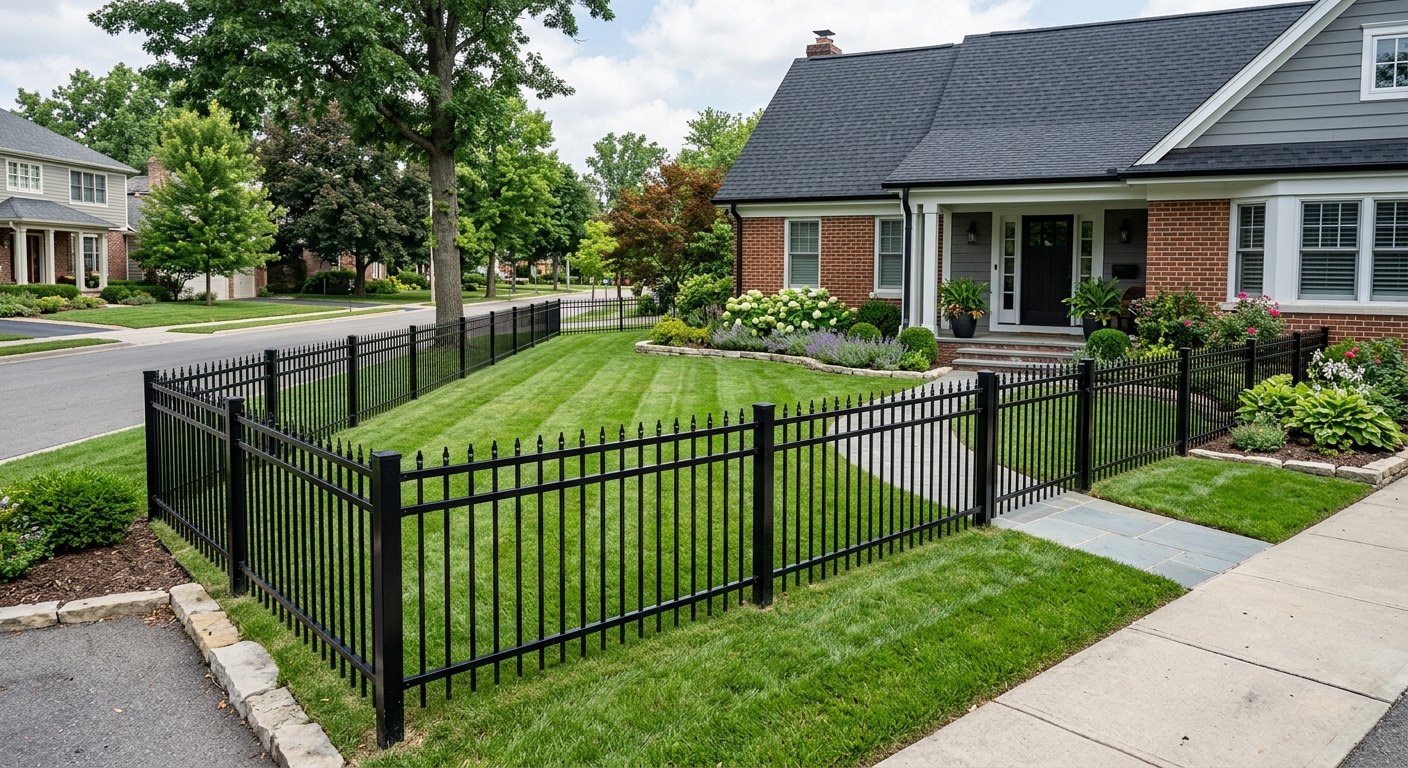
Chain-link is the lowest upfront option and performs well in our climate because it doesn’t rot, doesn’t warp like solid boards, and typically handles wind better due to its open structure. The trade-off is privacy: it’s a low privacy rating, so it’s best where you want boundary definition rather than screening. Aluminum ornamental sits in the mid-range cost tier, doesn’t rust in the Ontario environment, and offers a clean look, but it’s also open—so think of it more as decorative security than privacy.
For frost-line performance in the Windsor–Sarnia corridor, post depth and bracing matter more than people expect. In many yards, concrete-set posts are recommended because the embedment needed to avoid heaving (often around 1.5–2.0 m into the ground depending on site) improves stability. That said, the final decision depends on soil and whether your fence is loaded (taller privacy, gate openings, heavier panel styles). If your site is clay-heavy or exposed, we typically recommend concrete footings and appropriate post sizing.
A real budget comparison: if pressure-treated wood is coming in near the wood band (around $45 – $80 per linear foot), but cedar is closer to $65 – $110 when labour and bracing are similar, the extra cost is justified when you want longer service life and better appearance without repainting every season. If your main goal is wind-friendly boundary fencing, chain-link often gives the best value because it installs quickly and lasts through Canadian winters without the finish-care of wood.
| Material |
Cold Tolerance |
Lifespan |
Annual Maintenance |
Best For |
Price Band |
| Pressure-treated pine |
Good (with proper sealing and correct fasteners) |
10–15 years |
2–3 year staining cycle (low/medium effort) |
Budget privacy where you can maintain finishes |
$45 – $80 |
| Cedar |
Good (natural rot resistance) |
15–25 years |
Every 3–5 years for best appearance |
Premium look with moderate maintenance |
$55 – $95 |
| Vinyl / PVC |
Very good when installed with correct expansion allowance |
20–30 years |
Wash only (very low) |
Low maintenance privacy |
$65 – $110 |
| Chain-link |
Excellent (won’t rot or split) |
20–30 years |
Occasional rinse and tension checks |
Wind-tolerant boundary security |
$30 – $55 |
| Aluminum ornamental |
Excellent (no rust) |
25–40 years |
Occasional cleaning |
Decorative security and curb appeal |
$70 – $130 |
| Composite / recycled |
Good (follow manufacturer fastener guidance) |
20–30 years |
Wash; inspect hardware |
Privacy with wood-like look and low rotting risk |
$75 – $120 |
How to choose a fencing contractor in Lambton Shores
When you hire a fencing contractor in Ontario, don’t rely on word-of-mouth alone—verify coverage and scope clarity. Ask for proof of liability insurance and confirm whether the company’s workers are covered under WSIB/WCB where applicable. In practice, homeowners can check by requesting a current insurance certificate (certificate of liability, coverage dates, and policy number) and looking for WSIB clearance/coverage documentation. If the contractor can’t provide current documents quickly, that’s your first warning sign.
Next, get 2–3 itemised written quotes. The best bids break labour and materials down: posts, rails, panels, gates, hardware, concrete quantity (if included), and disposal. Avoid lump sums that don’t show how they’ll handle frost-depth embedment, grade changes, and any required concrete setting. Also confirm what’s excluded—common exclusions include permit fees, utility locates, survey costs, and removal/disposal of old fence material.
Warranty matters: request the workmanship warranty length in writing, plus the product/manufacturer warranty terms and whether it’s transferable if you sell the home. Payment should follow a safe schedule—generally no more than 10–15% upfront, with the remainder tied to milestones and a holdback until completion and cleanup. Finally, demand a start date and completion estimate in writing so expectations match the excavation realities of Canadian freeze–thaw scheduling.
- Ask for insurance certificate dates and ensure you’re listed as the certificate holder if offered.
- Confirm WSIB/WCB coverage documentation for workers (or subcontractor coverage).
- Require an itemised quote with posts, rails, concrete, hardware, and gate details separated.
- Make sure post depth and setting method are stated (concrete vs. gravel pack, and how deep).
- Check that yard grade solutions (raked/stepped panels) are included for sloped sections.
- Verify disposal/take-away is included for old fence removal and debris haul.
- Confirm utility locate responsibility (Ontario One Call) is accounted for.
- Ask who pulls permits and whether permit fees are included or billed separately.
- Get warranty terms in writing for both workmanship and materials.
- Clarify the schedule: estimated start date, milestones, and completion target.
- Review payment terms: no more than 10–15% upfront; holdback until final inspection.
- Request a site plan or layout confirmation process before digging (to avoid property-line issues).
Red flags I see in Lambton Shores: contractors who won’t state post depth or concrete setting method, quotes that exclude fence removal/disposal but imply “haul-away is included,” no written scope for gates (hinge hardware/bracing), warranties that are only verbal, and crews that ask for most payment before posts go in. If any of those show up, keep shopping.
Frequently asked questions — fencing in Lambton Shores
What is the cost per linear foot for fencing in Lambton Shores?
In Lambton Shores, most homeowners land within local market bands for installed fencing: wood typically comes in around $45 – $80 per linear foot, vinyl/PVC often around $65 – $110, chain-link around $30 – $55, and aluminum/metal around $70 – $130. The reason you might see a spread within the same material is usually frost-line embedment requirements and whether concrete footings are included—posts often need to be set well below the frost zone to prevent heaving in winter. Gate count, soil type (clay vs. sand), and whether there’s old fence removal also drive the labour portion of the quote.
Should I repair or replace my old fence in Lambton Shores?
Repair is usually the better option when the structure is mostly sound: posts are straight and firmly set, rails aren’t significantly rotted, and damage is limited to a few panels or pickets. Replacement is typically the safer choice if posts are loose, bases are deteriorated, or you’re seeing repeated failure after freeze–thaw cycles. In Lambton Shores, many older fences were installed decades ago—56.9% of homes were built before 1981 (Statistics Canada, 2021 Census)—so corrosion, rot, or weakened post spacing can be widespread. If you’re already digging for new footings or replacing multiple posts, replacing the full run can cost less than piecemeal repairs.
How do I handle a fence dispute with a neighbour in Ontario?
Start by documenting the issue: take photos, measure distances to property pins/survey marks if you have them, and keep copies of any past agreements or correspondence. In Ontario, line-fence rules can affect how neighbours share boundary fencing costs, but encroachment disputes are best handled with accurate locating first. If either side is unsure of the boundary, request a survey or property-line locate before construction. Then talk about a practical resolution: a shared fence agreement, a cost split, or an adjustment to move the fence to the correct line. In many Lambton Shores cases, the fastest path is a contractor layout verification followed by neighbour confirmation in writing.
What fence style offers the best wind resistance in Lambton Shores?
For wind performance in Lambton Shores—especially near open farm lots and lake-influenced areas—an open or semi-open style is usually more wind-stable than a fully solid tall privacy wall. Chain-link is a strong option for wind tolerance because airflow passes through it, reducing uplift and racking. Aluminum ornamental can also be stable, and board-on-board designs can be engineered to relieve wind load. Where privacy is essential, the key is construction: use properly sized posts, keep spacing appropriate, and set footings below the frost zone with correct bracing so the structure resists movement over the seasons. If you want full privacy, we’ll recommend a layout that can withstand gusts rather than treating the panels like a solid sail.
How much does a fence cost in Lambton Shores?
The total price depends on the linear footage, height, gates, and site conditions like soil and access. As a starting point, fencing installed in this market often falls within the regional per-linear-foot ranges: wood about $45 – $80, vinyl/PVC about $65 – $110, chain-link about $30 – $55, and aluminum/metal about $70 – $130. A simple yard run can look inexpensive until you factor in gates and deeper frost-safe post embedment with concrete where required. That’s why the best quotes are itemised—so you can see what portion is base materials versus labour for excavation, concrete, and installation.
How deep should fence posts be for Lambton Shores's frost?
For Lambton Shores, a typical design approach is to set posts below the heaving zone—often around 4–6 inches below the design frost depth. In southern Ontario practice, that commonly results in embedment of roughly 1.5–2.0 m into the ground depending on frost expectations and the exact site conditions. In exposed or clay-heavy soils, deeper concrete-set footings are often recommended to keep posts stable through freeze–thaw cycles. The safest way to confirm the right depth for your specific run is to base it on your soil conditions and the fence height/load (especially with privacy styles and gates), then have the contractor describe post depth and setting method clearly in writing.