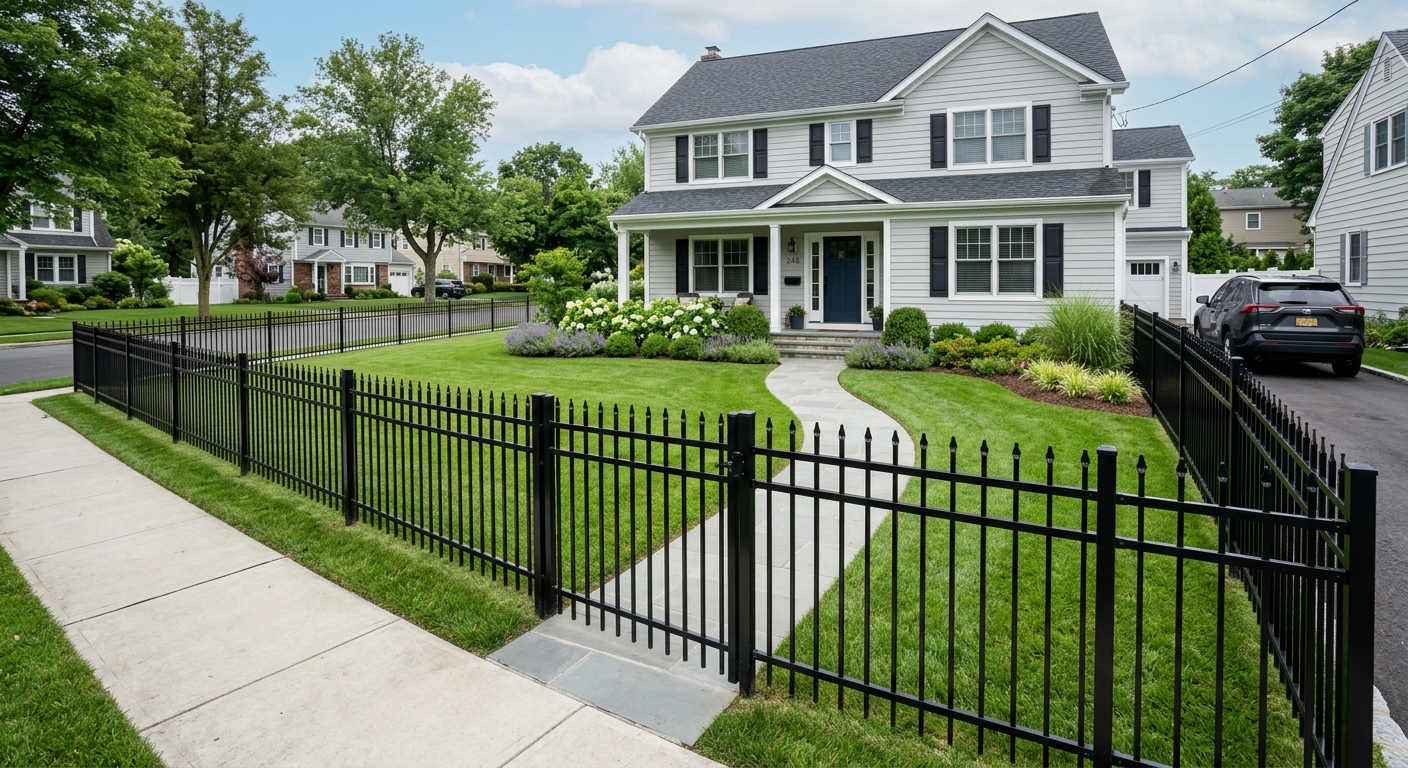
Fencing options and costs in L'Amoreaux
L'Amoreaux is a busy, family-oriented part of Toronto with lots of backyard space—so when you’re planning a fence, you’re not just picking materials, you’re supporting year-round curb appeal for thousands of households. With a total population of 43,993 (Statistics Canada, 2021 Census), the neighbourhood sees consistent demand for privacy and boundary fencing, particularly where residential lots meet busy arterials and school corridors. In practice, fencing is especially in demand around community-heavy pockets and high-traffic edges like the retail-and-residential strips near Progress Avenue and nearby schools, where homeowners commonly want both visual screening and a sense of security.
In the Toronto economic region, the biggest cost driver isn’t style—it’s the ground. Southern Ontario’s frost line is commonly treated around 42"–48", and most contractors set posts at roughly 3.5–4 ft deep (often closer to 3 ft for shorter fences, but deeper for 6–8 ft privacy). That depth, plus mixed soils around the GTA, is why concrete-set posts are the norm for long-term stability. Even if wind loads aren’t as extreme as the Prairies, taller solid panels can rack, so hardware, post size, and spacing matter.
Because of that, two fences that look similar can land far apart in price. Use the comparison table below as a planning baseline, then we’ll fine-tune the quote once we measure your linear feet, gate count, and access.
| Material |
Lifespan |
Maintenance |
Privacy Rating |
Price per Linear Foot |
| Pressure-treated pine (standard wood) |
10–15 years |
Stain/seal every 2–3 years; inspect posts annually |
High (solid board/board-on-board styles) |
$8 – $14 |
| Cedar (natural rot resistance) |
15–20 years |
Light stain/oil every 2–3 years; seal ends |
High (solid board/stockade styles) |
$10 – $18 |
| Vinyl / PVC (no-maintenance) |
20–30 years |
Wash as needed; replace warped sections if extreme impacts |
High (solid picket/vinyl privacy panels) |
$11 – $20 |
| Chain-link (galvanized steel) |
20–35 years |
Occasional rinse; touch up any damage |
Low (screening only) |
$6 – $11 |
| Aluminum ornamental |
25–40 years |
Wash annually; tighten hardware as needed |
Low–Medium (decorative pickets) |
$10 – $22 |
| Composite / recycled material |
20–30 years |
Minimal cleaning; avoid sanding and harsh solvents |
Medium–High (solid slats depending on style) |
$12 – $24 |
Prices are estimates only and vary by project scope, site access and material selection.
What affects the price of fencing in L'Amoreaux
In L'Amoreaux, two contractors can quote the “same fence” and still differ by 30–50%. The gap usually comes from how they build the foundation and frame: post depth, concrete-set versus gravel pack, rail sizing, spacing between posts, and how many hours they’ll spend dealing with tight access or uneven ground. Toronto-area labour and delivery costs also fluctuate based on crew availability and how often a contractor has to reroute materials around neighbourhood traffic and staging constraints.
First, frost control drives real money. In Southern Ontario, the frost line is often treated at about 42"–48", so many jobs require setting posts roughly 4–6 inches below the design frost depth to reduce heaving risk. For taller privacy fences (common in the 6–8 ft range), that frequently means posts need to go about 1.5–2.0 m into the ground. Concrete-set posts then add labour time and ready-mix costs, and they often require longer posts—both raising the installed total. If a yard can be accessed easily and holes can be dug straight down, cost is typically closer to the lower end of the wood band (about $65–$120). If access is tight or the crew needs raking/stepping, you can land closer to the upper end.
Second, panel style matters for wind resistance. While Toronto isn’t the windy Prairie open-field scenario, solid privacy boards can rack in gusts and thermal expansion. That’s why heavier posts and closer centres (often 6–8 ft) can become necessary. Vinyl (often running about $75–$130) can be cost-effective long-term when you value low maintenance, but it may require more robust installation details in freeze-thaw conditions to avoid gaps after cold snaps. Examples of local conditions that shift your price in L'Amoreaux include: (1) clay/mixed soils that hold water, increasing hole prep time; (2) sloped lots near fence lines that need stepped rails; and (3) gate-heavy designs that add framing and hinges.
Finally, demolition and site admin add up quickly. Taking down an old fence, hauling debris, pulling permits, and locating property pins are “hidden” items that can push an estimate higher even when material choices stay similar.
| Price Factor |
Why It Matters |
Cost Impact |
| Fence length in linear feet — the primary cost driver |
All materials, post count, rails, and labour scale directly with length |
Can change the total by hundreds to thousands; drives most of the quote difference |
| Post depth required — frost line determines post length and hole depth |
Deeper setting improves stability and reduces frost heave risk |
Concrete-set and deeper holes add labour + ready-mix; often the single biggest upgrade cost |
| Post setting method — concrete vs. gravel pack vs. driven posts |
Concrete and proper base prep resist movement in clay and freeze-thaw cycles |
Driven/gravel can reduce short-term cost, but concrete usually increases price for longevity |
| Material choice — vinyl vs. cedar vs. chain-link |
Material cost and hardware requirements vary; solid materials need stronger frames |
Often shifts you between wood, vinyl, and chain-link price bands (e.g., $65–$120 vs. $75–$130) |
| Gate count and type — walk-through vs. drive-through (double) |
Gates require heavier framing, hinges, latches, and sometimes reinforced posts |
A couple gates can add a significant labour/material premium versus fixed fence sections |
| Grade and terrain — sloped yards require stepped or raked panels |
Uneven ground changes layout, cutting, and alignment time |
More labour and extra components; can push quotes toward the higher end of the range |
| Old fence removal and disposal |
Debris hauling, time for disassembly, and landfill fees |
Can add substantial hours; disposal fees vary by volume |
| Permit fees and survey / property line locate |
Some fence heights require permits; locating reduces encroachment disputes |
Administrative and professional fees; can add to the project total |
Permits & regulations in Ontario
In Ontario, fence rules can vary by municipal by-law, but there are common thresholds homeowners should know. A permit is often required when you’re building fences over typical height limits—commonly around 2.0 m (6.5 ft) at the rear and about 1.0–1.2 m (3–4 ft) at the front or corner. Even when a permit isn’t required for the height you’re aiming at, you still must respect the property line and any municipal setback requirements.
Before digging any post holes in L'Amoreaux, call for utility locates through Ontario One Call. That means the contractor (or you, depending on how it’s arranged) must request locates so excavators don’t strike buried hydro, gas, or telecom lines. Next, obtain a survey or locate your property pins to confirm the exact fence line; this is one of the most preventable sources of neighbour disputes.
Shared fence ownership is governed by provincial line-fences principles: generally, boundary fences can be maintained/constructed jointly, and responsibilities may be negotiated or handled based on who benefits and local agreements. The practical takeaway: confirm whether you’re building on the true boundary, and document any shared-fence arrangements early.
For contractor verification: ask for their Ontario licence details (where applicable for their trade), a current certificate of insurance (liability) showing coverage limits, and evidence they’re covered under WSIB/WCB for the workers on site. Where to look: request the insurance certificate directly, and if they claim coverage, confirm the policy dates match your work window. Also ask for the contractor’s Ontario business information and clearance/coverage letter documentation so you’re not left holding the risk if anything goes wrong.
Choosing the right fence material for L'Amoreaux
Choosing the right fence material in L'Amoreaux is about matching what you want—privacy, low maintenance, budget, and longevity—to what Toronto’s climate does to materials. Freeze-thaw cycles, winter freeze depth, and spring thaw moisture all impact how posts move and how boards expand and contract. For privacy, you’re usually choosing solid styles that still need strong posts and proper concrete-set footings because Southern Ontario frost commonly falls around 42"–48" and posts often need to be set deeper to prevent heaving.
Pressure-treated pine is the budget-friendly starting point, but it typically needs staining or sealing every 2–3 years to slow grey weathering and protect end-grain. Cedar costs more upfront, yet it offers better natural rot resistance and looks warmer longer—still, it generally benefits from periodic maintenance. Vinyl/PVC is the “hands-off” option: minimal maintenance and good long-term appearance, but it can be more sensitive to impact and requires correct installation spacing to manage cold snaps. Chain-link is usually the cheapest per linear foot and very durable for decades, but it won’t deliver privacy unless you add slats or screening. Aluminum ornamental fences look sharp and resist rust, but they’re best when you’re balancing aesthetics and visibility rather than full privacy. Composite/recycled boards can also deliver strong privacy with lower maintenance, though costs are often closer to mid-to-high premium materials.
Here’s an example of when price differences make sense: if you’re planning a solid privacy run where wood lands around the $65–$120 band, and vinyl is closer to $75–$130, spending toward vinyl can be justified if you want to avoid regular staining and you plan to stay in the home long enough to realize the maintenance savings. For Toronto’s winter realities, the better “value” often comes down to the quality of the post installation—proper depth, concrete-set footings, and solid bracing—regardless of the material you pick.
| Material |
Cold Tolerance |
Lifespan |
Annual Maintenance |
Best For |
Price Band |
| Pressure-treated pine |
Good (with proper concrete-set posts and sealing) |
10–15 years |
Light inspection; stain/seal every 2–3 years |
Budget-focused privacy fencing |
$65 – $120 |
| Cedar |
Good (handles freeze-thaw well when well-installed) |
15–20 years |
Seal/oil every 2–3 years; check post movement |
Longer-looking wood privacy without heavy rot risk |
$75 – $130 |
| Vinyl / PVC |
Very good (correct spacing needed in extreme cold) |
20–30 years |
Wash as needed; no staining |
Low-maintenance privacy |
$75 – $130 |
| Chain-link |
Excellent (galvanization resists winter corrosion) |
20–35 years |
Occasional rinse; repair minor damage |
Security and long-term perimeter durability |
$45 – $85 |
| Aluminum ornamental |
Excellent (powder coating and corrosion resistance) |
25–40 years |
Tighten hardware; wash annually |
Front-yard aesthetics with visible boundaries |
$90 – $160 |
| Composite / recycled |
Good (depends on product system and installation) |
20–30 years |
Minimal cleaning; avoid abrasive damage |
Maintenance-light privacy with solid look |
$75 – $130 |
How to choose a fencing contractor in L'Amoreaux
Choosing a fence contractor in L'Amoreaux starts with verifying coverage and then reading quotes like a contractor would. In Ontario, reputable installers should carry liability insurance and have worker protection coverage (WSIB/WCB) for their team. How to check each: (1) request a certificate of insurance and confirm the policy is current for your project dates and that it names the insured properly; (2) ask for proof of WSIB/WCB coverage or a clearance letter; (3) confirm their business details and ability to legally operate in Ontario for the work they’re proposing. If they’re reluctant to provide documents before you sign anything, that’s a red flag.
Next, get 2–3 itemised written quotes—not one lump number. The best quotes break down labour versus materials, show the number of posts, include footing depth and setting method (concrete-set versus other), and list gates and hardware separately. Scope clarity matters: is old fence removal included? Is disposal included or is it “extra”? Is a permit pull included if your design meets the typical Ontario height threshold? Does the quote include a property line locate/survey, or will you need to arrange that?
Warranty should be spelled out: workmanship warranty length and what “workmanship” covers, plus the manufacturer’s product warranty (and whether it’s transferable if you sell). For payments, never pay more than 10–15% upfront; use a holdback until the job is complete and you’ve inspected alignment, gate operation, and post stability. Finally, require a written start date and completion estimate so you’re not waiting on seasonal scheduling surprises.
- Ask for proof of liability insurance (certificate with active dates).
- Ask for WSIB/WCB coverage or clearance letter for workers on site.
- Confirm their fence builds use concrete-set posts for privacy heights in frost-prone ground.
- Require footing depth listed in the quote (not just “posts set”).
- Get an itemised breakdown: materials, labour, gates, hardware, rails.
- Confirm access plan for your yard (driveway gates, narrow side yard staging).
- Clarify what’s excluded (permits, survey, locating pins, disposal).
- Verify disposal/hauling details if removing an old fence.
- Check for a workmanship warranty in writing, with duration and exclusions.
- Ensure manufacturer warranty terms and transferability are stated.
- Use a payment schedule: small deposit, progress payments, holdback until completion.
- Get start date and completion timeline in writing, including weather contingencies.
In L'Amoreaux, my experience says these are common red flags: (1) quotes that don’t specify post depth or setting method; (2) contractors who won’t show insurance and WSIB/WCB paperwork; (3) “lump-sum” pricing with no line-item gates/hardware and no disposal explanation; (4) promises of “no concrete needed” for tall privacy fences in frost-prone ground; and (5) asking for large upfront payments without a written schedule or warranty terms.
Frequently asked questions — fencing in L'Amoreaux
How deep should fence posts be for L'Amoreaux's frost?
In L'Amoreaux and across Toronto’s Southern Ontario frost-prone conditions, most stable fences use posts set below the freeze zone. A common approach is to set posts about 3.5–4 ft deep (roughly 1.1–1.3 m) for many privacy fence layouts, and deeper—often around 1.5–2.0 m—when you’re building taller 6–8 ft privacy fences or when soil conditions require extra stability. The key isn’t the “exact number” on paper; it’s that the quote should state a depth and a setting method that accounts for frost heave and freeze-thaw movement. For long-term performance, concrete-set posts are the usual best practice in the GTA. If a quote mentions only driven posts for tall privacy panels, ask why.
Wood vs vinyl vs aluminum fence — which is best?
“Best” depends on your priority. If you want privacy and can handle periodic upkeep, wood (pressure-treated pine or cedar) is a strong value—often aligning with the wood installation band of about $65–$120 depending on materials and height. If you want low maintenance and don’t mind paying a bit more upfront, vinyl/PVC often lands in the $75–$130 band and is popular because you can typically wash rather than stain. Aluminum is great for curb appeal and corrosion resistance, but it’s usually not a privacy solution; it’s more of a decorative/visibility fence and typically prices higher, often around $90–$160. In L'Amoreaux, even the “best material” can perform poorly if posts aren’t set correctly for frost, so verify depth and concrete-set footings either way.
Do I need a permit to build a fence in Ontario?
In Ontario, a building permit is commonly required when fences exceed typical height thresholds—often around 2.0 m (6.5 ft) at the rear and about 1.0–1.2 m (3–4 ft) at the front or corner—though municipal by-laws can fine-tune the details. Even if a permit isn’t needed for your specific height, you still must follow property line rules, municipal setbacks, and any local restrictions. Before digging, you must also request utility locates via Ontario One Call. For contractors: ask whether the permit pull is included (some companies include it, others treat it as an add-on) and confirm in writing what they handle. If a contractor won’t discuss permits or setbacks, that’s not a good sign.
How long does a wood fence last in L'Amoreaux?
In the Toronto area, a well-built wood fence commonly lasts about 10–15 years for pressure-treated pine, and roughly 15–20 years for cedar, assuming proper post depth, good ventilation, and correct sealing/staining practices. The reason the build quality matters so much here is frost movement and freeze-thaw cycling; posts that aren’t set deep enough (or aren’t concrete-set where needed) can shift, causing rails to loosen and boards to warp. Maintenance also plays a role: wood fences generally need staining/sealing every 2–3 years to prevent grey weathering and reduce moisture penetration. If you want the best lifespan in L'Amoreaux, ensure your contractor plans for concrete-set footings, especially for taller privacy sections.
Who owns and maintains a shared fence?
Shared fences typically sit on or near the boundary, and ownership/maintenance responsibility is often handled under Ontario’s line-fence principles and any neighbour agreements. In practical terms, if the fence is truly on the boundary and benefits both properties, neighbours may share costs for repairs and replacement. However, how that plays out depends on the situation: who installed it originally, what the agreement (if any) says, and whether the fence is on the shared line versus entirely on one property. For homeowners in L'Amoreaux, I recommend clarifying ownership and responsibilities before work starts—ideally in writing—especially if you’re removing and rebuilding sections or adding gates. Also confirm property pins so you’re not building beyond the boundary.
How do I find my property line before fencing?
The safest approach is to start with your survey and confirm property pins. If you don’t have a recent survey, order or request a property survey or a locate service so the pins are marked accurately before any post holes are dug. This matters because fence disputes are often about a few inches of encroachment—an expensive error once concrete is in the ground. In Ontario, you should also request utility locates through Ontario One Call before digging, even if you’re confident about the location. When you hire a contractor in L'Amoreaux, ask them whether they rely on an existing survey or whether they include property line location as part of the scope. A professional quote will state what they’re doing to verify the fence line before construction.