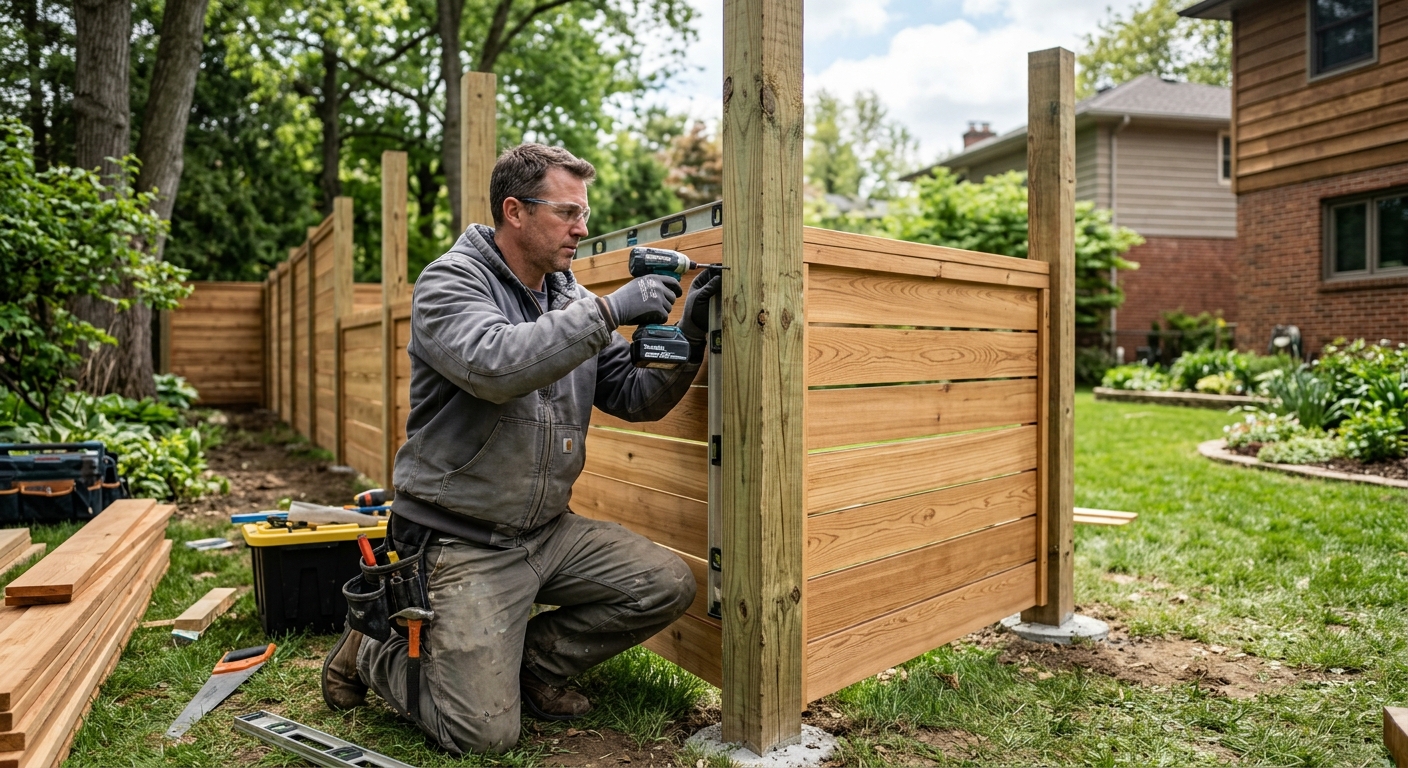
Fencing options and costs in East Gwillimbury
Fencing in East Gwillimbury is shaped by a familiar pattern in the GTA: lots of detached properties, lots of curb appeal, and lots of winter stress on fence posts. With 81.2% of local homes being single-detached houses (Statistics Canada, 2021 Census), there’s steady demand for privacy lines, back-yard gates, and front-yard boundaries—especially in neighbourhoods around Holland Landing and the newer growth pockets closer to 404 corridors, where homeowners typically want a clean, solid look quickly.
In this area, Toronto’s freeze–thaw cycles are a cost driver. The “design frost line” in Southern Ontario is commonly estimated around 42"–48", so fence posts need to be set deep enough (typically about 3.5–4 ft) to help prevent frost heave. That means most contractors recommend concrete-set posts for 6–8 ft privacy fences, which adds labour and ready-mix costs but improves long-term stability. Wind and snow also matter: solid panel privacy fences can experience racking, so post size and spacing need to be planned, not just “standard” hammered-in posts.
Because East Gwillimbury sits inside the broader Toronto market, contractor availability and material pricing are broadly aligned with local bands: wood privacy installations often land between $65,XXX–$120-type ranges, while vinyl/PVC and metal options tend to price higher. The table below compares common materials by lifespan, maintenance, privacy, and typical per-linear-foot budgeting so you can compare quotes apples-to-apples.
| Material |
Lifespan |
Maintenance |
Privacy Rating |
Price per Linear Foot |
| Pressure-treated pine (standard wood) |
8–12 years |
Stain/seal every 2–3 years |
High (solid or close-board) |
$65–$120 |
| Cedar (natural rot resistance) |
12–18 years |
Light staining every 3–4 years |
High (solid or close-board) |
$85–$135 |
| Vinyl / PVC (no-maintenance) |
20–30 years |
Occasional wash (no staining) |
High (solid privacy panels) |
$75–$130 |
| Chain-link (galvanized steel) |
25–35 years |
Minimal (periodic rinse) |
Low–Medium (not privacy by itself) |
$45–$85 |
| Aluminum ornamental |
25–40 years |
Minimal (wash as needed) |
Low–Medium (open pickets) |
$90–$160 |
| Composite / recycled material |
20–30 years |
Minimal (wash; no paint) |
Medium–High (panel style) |
$95–$155 |
Prices are estimates only and vary by project scope, site access and material selection.
What affects the price of fencing in East Gwillimbury
In East Gwillimbury, you’ll often see quotes for the “same” fence vary by 30–50% once you look past the headline material. The biggest reason is that Toronto-area fencing is priced around installation details—how deep posts go, what hardware is used for wind resistance, and whether the contractor uses concrete-set posts or a faster method that’s more vulnerable to frost movement. Another factor is quote structure: one contractor may include demolition, disposal, and permit/survey locating, while another lists those as extras.
Frost depth drives a lot of that spread. In cold Ontario conditions, fence posts typically need to be set about 1.5–2.0 m into the ground to reduce frost heaving risk—especially for 6–8 ft privacy fences. That usually means longer posts, deeper post holes, and concrete setting. The material cost changes too because heavier rails and larger post stock are often recommended when you’re mounting solid panels that act like sails in storms.
Wind exposure is usually less extreme than Prairies open-field sites, but the GTA still benefits from tighter spacing and sturdier framing in neighbourhoods with open corners, thicker snowfall accumulation, or wider lots. For comparison: on the prairies, contractors often tighten spacing even more; in coastal British Columbia, wood rot is the main enemy, so proper treatment dominates cost instead of frost depth. Here in East Gwillimbury, you’re mostly balancing frost movement and freeze–thaw cracking, so concrete-set posts and correct panel hardware tend to be the “worth it” upgrade.
Two practical cost examples: (1) if you switch from gravel-pack posts to concrete-set for privacy height, labour time and ready-mix can add noticeable cost—often pushing a job closer to the higher end of the $65–$120 wood band; (2) if your yard requires stepped/raked panels due to slope, you’ll usually pay more for labour and sometimes extra materials, nudging totals toward vinyl/PVC territory around the $75–$130 band. Housing age also matters: with 27.9% of homes built before 1981 (Statistics Canada, 2021 Census), older properties may have mature trees and more complex grading, which can increase excavation time and access requirements.
| Price Factor |
Why It Matters |
Cost Impact |
| Fence length in linear feet |
Most components scale directly with length (posts, rails, panels, fabric) |
Highest impact—often the majority of the budget |
| Post depth required |
Frost line determines hole depth and post length to prevent heaving |
Can add significant labour and concrete/aggregate |
| Post setting method |
Concrete vs. gravel pack vs. driven posts changes stability in Ontario freezes |
Concrete-set typically costs more but reduces movement risk |
| Material choice |
Vinyl/PVC and composites cost more than basic wood; chain-link costs less |
Shifts the job between wood, vinyl, and metal price bands |
| Gate count and type |
Drive-through double gates require heavier hardware and more structure |
Often adds labour + upgraded hinges/latches |
| Grade and terrain |
Slopes need stepped, raked, or custom panel angles |
Increases fabrication time and waste |
| Old fence removal and disposal |
Demolition, hauling and possible salvage affect total time |
Can materially raise cost, especially for long runs |
| Permit fees and survey / property line locate |
Locates prevent encroachment and delays; permits may be required at certain heights |
Usually a smaller line item, but it can delay the schedule if missed |
Permits & regulations in Ontario
In Ontario, whether you need a building permit depends mainly on fence height and location. As a practical guideline used in many Ontario municipalities, fences above about 2.0 m (6.5 ft) for the rear yard and about 1.0–1.2 m (3–4 ft) for the front yard or corner area often trigger a permit requirement. That said, the exact threshold can vary by local bylaw, and corner lots typically face additional restrictions. For any East Gwillimbury installation, confirm the height and placement requirements before digging so your contractor can plan post depth and inspections correctly.
Two other compliance points matter before you start: (1) property lines and setbacks—your fence can’t encroach on the property line, and municipal setback rules may apply; and (2) utility safety. Before any post-hole digging, you should have utilities located through Ontario One Call (1 Call). Also, get a survey or a property line locate using your pins if you’re not 100% sure where your boundary sits; this reduces neighbor disputes and contractor rework.
To verify contractor compliance in Ontario: ask for proof of licence/registration where applicable, and request a certificate of insurance (liability) plus clearance showing they have the required workplace coverage (WSIB for eligible workers/operations). For fencing, you can typically check the certificate of insurance for active coverage and request the contractor’s WSIB account clearance or proof document. If a contractor can’t provide documentation promptly, it’s usually a sign to pause.
Choosing the right fence material for East Gwillimbury
Choosing a fence in East Gwillimbury is mostly about matching material to your priorities—privacy, low maintenance, budget, and lifespan—while respecting Toronto-area winter reality. Pressure-treated pine is the most budget-friendly starting point, but it typically needs staining or sealing every 2–3 years to reduce grey weathering and keep boards from drying out. Cedar looks better as it weathers and resists rot longer, yet it still benefits from periodic maintenance to maintain a uniform colour and reduce surface cracking.
For true low-maintenance, vinyl/PVC is the common pick: you generally wash it, and you don’t stain it. The trade-off is upfront cost and performance in extreme cold—high-quality profiles handle winters well, but low-grade panels can become brittle if installed incorrectly. Chain-link is usually the lowest installed price and can last decades, but it doesn’t provide privacy unless you add slats or screening, which changes both look and cost. Aluminum ornamental is durable and won’t rust in normal conditions, but it’s more for perimeter definition and curb appeal than for blocking sightlines. Composite/recycled materials are strong on lifespan and low maintenance, though they often cost more than basic wood.
Because of Southern Ontario frost depth (often estimated around 42"–48"), post depth is a deciding factor for performance. For privacy fences, concrete-set posts are commonly recommended because frost heave can shift lighter installations over time. In practice, this means you’re not only paying for the fence material—you’re paying for stable foundations and correct panel framing to handle wind and snow loading. If you want a concrete example: upgrading from pressure-treated wood to vinyl can be justified when you want 20+ year service without recurring staining, even though vinyl often lands closer to the $75–$130 per-foot range rather than wood’s $65–$120.
| Material |
Cold Tolerance |
Lifespan |
Annual Maintenance |
Best For |
Price Band |
| Pressure-treated pine |
Good (with proper sealing and correct post depth) |
8–12 years |
Low to moderate (stain/seal every 2–3 years) |
Budget privacy with periodic upkeep |
$65–$120 |
| Cedar |
Very good (natural rot resistance in freeze–thaw) |
12–18 years |
Low (stain every 3–4 years) |
Better appearance and longer life than pine |
$85–$135 |
| Vinyl / PVC |
Good (best with quality profiles and correct installation) |
20–30 years |
Very low (wash as needed) |
No-stain, long-term privacy |
$75–$130 |
| Chain-link |
Excellent (galvanized coating tolerates winter well) |
25–35 years |
Very low |
Security/perimeter with minimal cost |
$45–$85 |
| Aluminum ornamental |
Excellent (non-rusting in typical conditions) |
25–40 years |
Very low |
Front yard definition and curb appeal |
$90–$160 |
| Composite / recycled material |
Good (stable boards when installed to spec) |
20–30 years |
Very low |
Low maintenance with a solid look |
$95–$155 |
How to choose a fencing contractor in East Gwillimbury
Choosing the right fence contractor in East Gwillimbury is about verification and clarity. First, confirm licensing/registration where applicable in Ontario, and request liability insurance plus workplace coverage. Practically, you should be able to see a certificate of insurance (liability) showing the contractor’s active coverage and coverage limits, and you should also receive proof of WSIB clearance or relevant workplace coverage documents where required. Don’t accept “we’re covered” statements—ask to see paperwork before signing anything.
Next, get 2–3 itemised written quotes instead of lump-sum estimates. The best quotes break down labour (excavation, setting posts, rail/panel install, gate build), materials (posts, rails, fasteners, panels), and extras like demolition, hauling/disposal, and any locating/survey costs. Check the scope line-by-line: what’s excluded? Is permit work included if your fence triggers it? Who handles disposal of removed fencing? If the quote doesn’t state it clearly, assume it’s not included.
Warranty matters in Toronto winters. Ask for the workmanship warranty length (often 1–2 years for install workmanship, but it varies) and the product/manufacturer warranty for the material itself. Also ask whether warranties are transferable to a new homeowner if you sell your property. On payment, never pay more than 10–15% upfront; a holdback until the job is complete is common and protects you if materials or finishes are not delivered/installed as promised. Finally, get a written start date and completion estimate—fencing is weather-dependent, and a good contractor schedules around frost and wet ground.
- Provide a certificate of liability insurance before work starts.
- Show WSIB/workplace coverage proof where applicable.
- Offer an itemised quote (labour + materials + extras), not a single total.
- Specify post depth and setting method (concrete-set vs. gravel pack) in writing.
- Confirm gate hardware quality (hinges, latch type, and alignment approach).
- Include whether demolition and disposal of the old fence are included.
- State how they handle slope (stepped vs. raked panels) and any extra material/waste.
- List what fasteners and rail sizes they use (quality matters for wind/racking).
- Explain how they protect existing landscaping and what restoration is included.
- Provide a workmanship warranty and specify what it covers.
- Clarify start date, completion target, and weather-related rescheduling policy.
- Use a payment schedule with a small deposit and a holdback for completion.
Red flags in East Gwillimbury include: refusing to put post depth and setting method in writing, quoting only the fence material without labour breakdown, asking for a large upfront payment, giving a vague warranty (“covered if there’s no damage”) without details, or missing documentation for insurance/coverage. If any of these show up, ask questions—then consider a different contractor.
Frequently asked questions — fencing in East Gwillimbury
How do I find my property line before fencing?
In East Gwillimbury, don’t rely on an estimate from the road edge or neighbour’s guess. Start by pulling your property information and looking for property pins on-site, typically shown on your survey plan. If you don’t have a recent survey, hire a surveyor or request a property line locate so your fence line matches your legal boundary. Before any post-hole digging, have utilities located through Ontario One Call to avoid service hits. This matters because a fence built on the wrong line can trigger removal demands and change your cost—sometimes forcing you to relocate posts deeper or redo sections after the fact.
What's the most low-maintenance fence?
For low maintenance in Ontario winters, vinyl/PVC and quality composite/recycled materials are usually the easiest to live with. They typically don’t require staining like pressure-treated pine and don’t require the periodic upkeep that cedar often needs to prevent uneven grey weathering. In the Toronto economic region, vinyl privacy fencing often comes in around the $75–$130 per-foot band, so you pay more upfront, but you save on recurring labour for staining and repairs. Chain-link can also be low maintenance, but it won’t provide privacy unless you add slats or a privacy screen, which affects both cost and wind behaviour.
How tall can my fence be in East Gwillimbury?
In East Gwillimbury and across Ontario, fence height restrictions depend on whether it’s front, side/corner, or rear, and local bylaw specifics. A common guideline is that fences above about 2.0 m (6.5 ft) in the rear yard and about 1.0–1.2 m (3–4 ft) near the front or corner may require a building permit. Because corner lots can have additional constraints, confirm your exact location and height before construction. If a permit is required and it’s missed, the timeline can get delayed and you may need to adjust hardware, panels, or even reduce height—adding rework costs.
Should fence posts be set in concrete here?
Often, yes—especially for taller privacy fences (6–8 ft) in East Gwillimbury. Southern Ontario has a design frost line commonly estimated around 42"–48", so contractors typically recommend post holes deep enough to reduce frost heave (often about 3.5–4 ft minimum for privacy heights) and concrete-set posts rather than simple gravel pack or driven posts. Concrete setting increases labour and ready-mix costs, but it improves long-term stability, reducing the chance of leaning panels after freeze–thaw cycles. If your fence is shorter, or on very stable ground with good drainage, some contractors may propose alternatives, but a reputable quote should explain the reasoning in writing.
What's the best fence for privacy?
For privacy, the best options are typically solid-panel styles: vinyl/PVC privacy, cedar or pressure-treated close-board, or composite privacy fencing. These materials block sightlines and can be built with heavier posts and closer spacing to resist racking and wind. In terms of budgeting, wood privacy installations are often found in the $65–$120 range, while vinyl privacy commonly lands closer to the $75–$130 range. Privacy is also affected by installation details—like post depth and panel alignment—so compare quotes based on framing and hardware, not only the material name.
How do I compare fencing quotes?
Start by requesting itemised quotes from at least two contractors. Make sure each quote lists the same fence height, total linear footage, post size/spacing, post-setting method (concrete vs. gravel pack), and gate count/type. Confirm whether old fence demolition and disposal are included, whether permits and utility locating are handled, and what’s excluded (e.g., landscaping restoration, tree trimming, or rock removal). Pay attention to timelines and warranty terms: workmanship warranty, product/manufacturer warranty, and whether warranties transfer if you sell. Finally, remember why quotes vary in the GTA: frost-line conditions in East Gwillimbury push deeper postwork, and that’s where “cheap” quotes often cut corners.