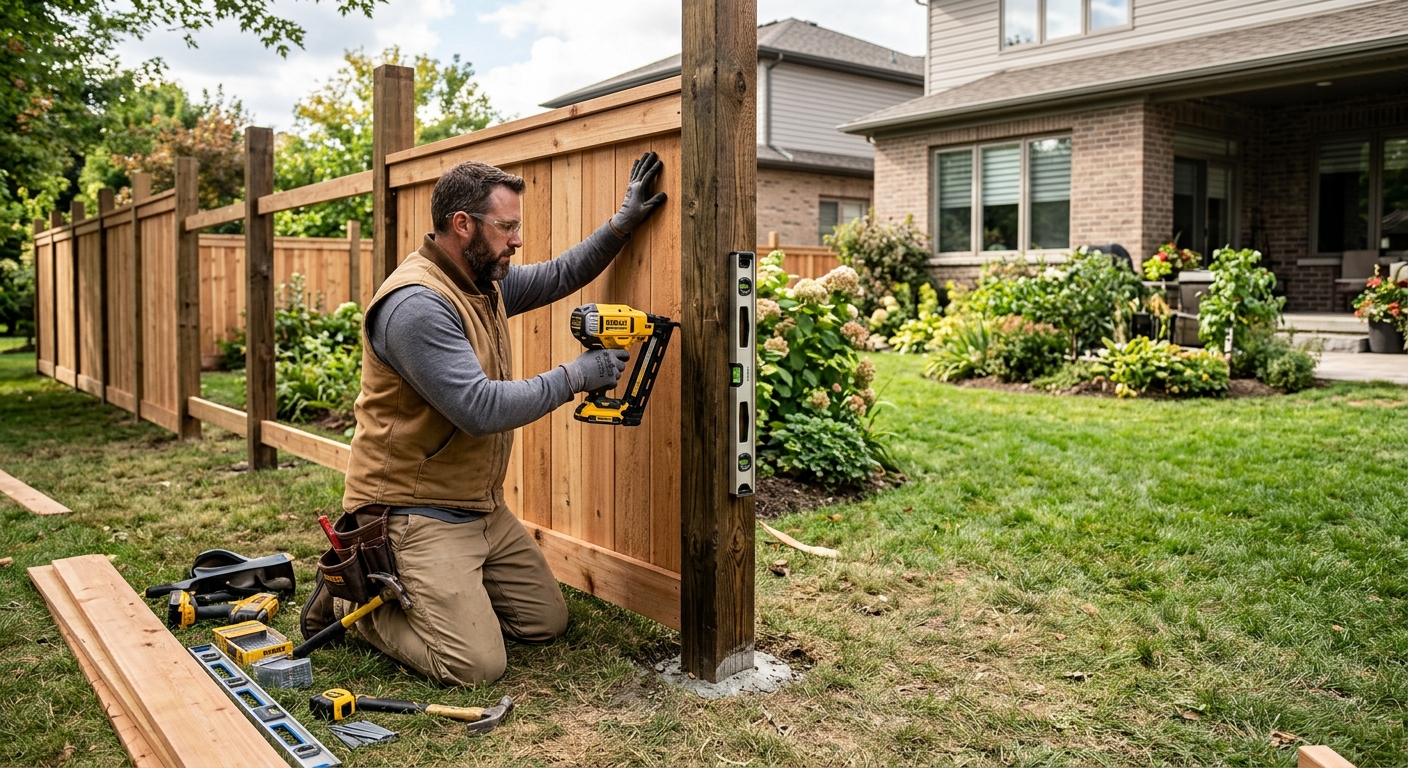
Fencing options and costs in St. Thomas
In St. Thomas, homeowners typically choose between wood, vinyl, chain-link, aluminum, and newer composite styles—mostly based on privacy needs and how much maintenance they’re willing to do. With 12,245 homeowner households (67.8% of households own) and single-detached homes making up 64.8% of dwellings, there’s steady demand for backyard fencing that can handle Ontario weather while matching older property lot layouts. London-area freeze-thaw conditions also shape pricing: fence posts must be installed below the frost line to reduce heaving, and that adds labour for digging, post length, and (often) concrete setting. On top of that, clay-heavy soils around Middlesex County can hold water and expand more when it freezes, increasing the effort for clean holes and accurate alignment.
In neighbourhoods like Westervelt and parts of the east end, contractors often see repeat projects tied to backyard renovations and rear-yard gates—especially where homes built before 1981 (57.7%) have older fence footprints and may need partial removals. Availability of crews can also affect your end price: if the site is easy to access and material is in stock, schedules compress; if there’s heavy equipment access or longer concrete footing time, the labour component rises. Use the table below to compare typical materials and what you’ll likely pay per linear foot in St. Thomas before you request a detailed quote.
| Material |
Lifespan |
Maintenance |
Privacy Rating |
Price per Linear Foot |
| Pressure-treated pine (standard wood) |
10–15 years |
Stain/seal every 2–3 years |
High (solid boards) |
$40 – $65 |
| Cedar (natural rot resistance) |
15–25 years |
Light staining every 2–4 years |
High (solid boards) |
$55 – $80 |
| Vinyl / PVC (no-maintenance) |
20–30 years |
Rinse occasionally |
High (solid panels) |
$45 – $80 |
| Chain-link (galvanized steel) |
20–30 years |
Minimal; occasional tension/repairs |
Low to medium (mesh) |
$25 – $50 |
| Aluminum ornamental |
25–40 years |
Occasional cleaning |
Low to medium (open rails) |
$70 – $120 |
| Composite / recycled material |
25–35 years |
Minimal; periodic cleaning |
High (solid styles) |
$65 – $110 |
Prices are estimates only and vary by project scope, site access and material selection.
What affects the price of fencing in St. Thomas
In the London, Ontario region, it’s common to see quotes for what looks like the “same fence” come in 30–50% apart. The difference is usually not the material alone—it’s the buried work (frost-depth posts), the amount of layout and alignment labour, and how accessible your yard is for post-hole digging, hauling, and gate installation. Two properties can sit a few blocks apart and still differ because St. Thomas lots often have mature trees, older fence lines, and uneven ground that forces re-layout and more careful setting.
Frost line depth is a major driver. Contractors typically set fence posts about 4–6 inches below the design frost depth to reduce heaving during freeze-thaw cycles; in southern Ontario this often translates to posts buried roughly 3 feet deep, with 2.5 to 3 feet as a practical minimum. Where soils are heavier or exposure is higher, we often go deeper and use concrete setting for stability. That means longer posts, deeper holes, more concrete/aggregate, and additional time for alignment. If your yard has wind-exposed corners, the design may require tighter post spacing and stronger rails—costs move closer to the mid-to-upper end of the wood ($40–$75) or vinyl ($45–$80) bands depending on height and panel build.
Concrete examples: (1) Removing an old fence and disposing of posts can add labour and dump fees, pushing a basic wood install upward; (2) a clay-saturated slope can require stepped panels and extra measurement time to keep the top rail level; (3) where a gate needs precise swing clearance, hardware and installation labour add cost even if the fencing footage stays the same. Housing age also matters: many pre-1981 lots have legacy alignments and buried remnants that slow excavation and raise the labour portion by hundreds of dollars on average, even before you compare a chain-link ($25–$50) option to a privacy-focused vinyl or wood build.
| Price Factor |
Why It Matters |
Cost Impact |
| Fence length in linear feet — the primary cost driver |
More footage means more posts, rails, and labour time |
High (majority of total cost) |
| Post depth required — frost line determines post length and hole depth |
Deeper embeds increase digging time and post material |
Medium to High |
| Post setting method — concrete vs. gravel pack vs. driven posts |
Concrete adds materials and labour; gravel pack can reduce weight/haul |
Medium |
| Material choice — vinyl vs. cedar vs. chain-link |
Different material cost and installation speed; maintenance changes over time |
Medium to High |
| Gate count and type — walk-through vs. drive-through (double) |
Gates require heavier frames, hinges, latches, and careful alignment |
High for drive-through |
| Grade and terrain — sloped yards require stepped or raked panels |
Slopes increase layout, cutting, and alignment time |
Medium |
| Old fence removal and disposal |
Hauling and landfill fees plus extra labour |
Low to Medium (can become High if extensive) |
| Permit fees and survey / property line locate |
Required documentation can affect schedule and total administrative cost |
Low to Medium |
Permits & regulations in Ontario
In Ontario, whether you need a building permit often depends on fence height and location. In general practice around southern Ontario, fences above about 2.0 m (6.5 ft) in the rear and 1.0–1.2 m (3–4 ft) at the front or corner may require a permit. Even when a permit isn’t required, your fence still must respect property lines and municipal setback bylaws, and setbacks can vary based on whether you’re near a street allowance or laneway. In St. Thomas, the “paper work” matters because many lots were created decades ago and corner visibility and utility corridors can affect where posts can safely sit.
Before digging any post holes, you must call for utility locates through Ontario One Call (BC and Alberta have their own call centres, but your dig in Ontario uses the Ontario service). Also, obtain a survey or confirm your property pins before installation so you don’t build across a lot line. For shared boundary issues, line-fences rules govern shared fencing responsibilities under provincial legislation.
Typically requires a permit: taller fences near thresholds (especially rear fences over the ~2.0 m range), and some corner/front configurations above typical limits, depending on your exact situation and municipal rules. Typically does not require a permit: short privacy fencing or lower-height yard fences that stay under common height thresholds, though you should still verify with the municipality.
To verify a contractor for St. Thomas: (1) confirm their Ontario business licence/registration details online (where applicable), (2) ask for a certificate of insurance showing liability coverage that names you as additional insured, and (3) request proof of WSIB coverage or a clearance letter (as applicable) before work starts. Don’t rely on a verbal assurance—collect the documents.
Choosing the right fence material for St. Thomas
Choosing the right fence material in St. Thomas is really about matching your priorities—privacy, low maintenance, upfront budget, and lifespan—to local freeze-thaw conditions. Pressure-treated pine is usually the lowest upfront option, but it demands staining or sealing every 2–3 years to prevent grey weathering and premature wear where it traps moisture against the boards. Cedar looks better and resists rot naturally, but it still benefits from maintenance. Vinyl/PVC is popular in Ontario for its no-fuss upkeep: rinse off grime and you’re done for the season, though extreme cold can make planning important—posts still need correct embed depth to prevent panel misalignment over time.
Chain-link is the lowest-cost route and the longest-lasting for its price, but it won’t give true privacy unless you add privacy slats or plant screening. Aluminum ornamental provides a crisp look and won’t rust, but it’s typically a mid-range budget and offers open-rail visibility rather than full privacy. For London-area soils and frost-depth requirements, the bigger decision is post embed and setting: because fence posts must be set below the frost line (commonly around 3 feet in southern Ontario), concrete-set posts are often used for stability, especially on clay-heavy sites or where gates add leverage.
Where the price difference makes sense: if you want full privacy and minimal ongoing work, spending toward vinyl’s band (about $45–$80 per linear foot) can be justified versus pressure-treated pine ($40–$75) when you factor in multiple maintenance cycles over a decade. If your main goal is keeping costs low and you can accept low privacy, chain-link ($25–$50) often fits best. Snow and winter wind can also stress fences, so we ensure proper rails and post spacing regardless of material.
| Material |
Cold Tolerance |
Lifespan |
Annual Maintenance |
Best For |
Price Band |
| Pressure-treated pine |
Good (with correct post embed and sealing) |
10–15 years |
Seasonal check; stain/seal every 2–3 years |
Budget-friendly privacy with acceptable upkeep |
$40 – $75 |
| Cedar |
Very good (resists rot in damp cycles) |
15–25 years |
Seasonal check; light staining every 2–4 years |
Better appearance and longer wood life |
$55 – $80 |
| Vinyl / PVC |
Good (depends on embed depth and hardware) |
20–30 years |
Minimal; rinse as needed |
Low maintenance privacy in freeze-thaw weather |
$45 – $80 |
| Chain-link |
Excellent (galvanized steel) |
20–30 years |
Minimal; occasional tension checks |
Security with minimal cost |
$25 – $50 |
| Aluminum ornamental |
Excellent (doesn’t corrode like steel) |
25–40 years |
Minimal; occasional cleaning |
Attractive, durable boundary fencing |
$70 – $120 |
| Composite / recycled |
Good (engineered boards; still needs solid posts) |
25–35 years |
Minimal; periodic cleaning |
Privacy with reduced maintenance |
$65 – $110 |
How to choose a fencing contractor in St. Thomas
When you hire a fencing contractor in St. Thomas, verification protects you twice: first from workmanship issues, and second from delays that can become expensive in winter schedules. Start with Ontario licensing/registration details where the business is required to be listed, then request liability insurance and WSIB coverage (or a clearance letter, where applicable). How to check: (1) for insurance, ask for a certificate showing liability coverage limits and confirm the named insured matches the company on the contract; (2) for WSIB, ask for proof of coverage status and keep a copy for your records; (3) confirm any subcontractors are covered as well. Don’t accept photos of paperwork—use current documents.
Get 2–3 itemised written quotes, not lump sums. A good fence quote breaks out labour and materials (posts, rails, panels, gate hardware, fasteners, concrete/aggregate if used) and lists footing and embed assumptions, including frost-depth embed depth and post spacing. Read the scope carefully: is fence removal included, is disposal included, and are permit pulls (if required) included or paid separately? Confirm warranty terms: workmanship warranty length, product/manufacturer warranty coverage, and whether warranties are transferable to subsequent owners.
For payment, never pay more than 10–15% upfront. Use a holdback until the job is complete and posts/gates are aligned. Finally, request a start date and a completion estimate in writing—especially important in Ontario when rain and freeze-thaw can affect excavation and concrete curing.
- Verify Ontario business/registration details and match them to the contract.
- Request current certificate of liability insurance (and additional insured if offered).
- Confirm WSIB coverage or a clearance letter before work starts.
- Ask for 2–3 references for similar St. Thomas residential fences.
- Get itemised labour vs. material breakdown (posts, rails, gates, hardware).
- Ensure the quote states post spacing and the frost-depth embed plan.
- Confirm concrete setting method (concrete vs. gravel pack) and where it’s used.
- Clarify what’s excluded: permit fees, survey/locates, and grading/landscaping touch-ups.
- Confirm disposal of old fencing is included (or priced separately).
- Check warranty: workmanship duration and product warranty specifics.
- Use a payment schedule with a holdback (no big upfront deposits).
- Get a written timeline and contact point for schedule changes.
Common red flags in St. Thomas: a quote that doesn’t mention post embed depth or assumes “surface setting” on clay soil; refusal to provide proof of WSIB/clearance and insurance; only offering a single lump-sum number without an itemised breakdown; promising “same price” despite different gate counts or heights; and starting without a written scope that explains disposal, permits (if needed), and grading/leveling approach.
Frequently asked questions — fencing in St. Thomas
What's the most low-maintenance fence?
For most St. Thomas homeowners, vinyl/PVC and composite tend to be the lowest-maintenance options because you don’t need to stain them like wood. In Ontario’s freeze-thaw cycles, the key is still correct installation: posts should be set below the frost line (commonly around 3 feet in the London area) so panels don’t shift and rub. Vinyl typically comes in around the $45–$80 per linear foot band, while wood can look cheaper at first (often $40–$75), but you’ll pay the upkeep time—staining every couple of years—especially on the north/east sides of yards where moisture sits. If you want “set it and forget it,” vinyl or composite is usually the practical answer.
How tall can my fence be in St. Thomas?
In Ontario, fence height rules commonly involve thresholds that can trigger a building permit—often around 2.0 m (6.5 ft) for rear fences, and roughly 1.0–1.2 m (3–4 ft) near the front or corners. St. Thomas follow-on bylaws can affect placement and corner visibility, so you should verify your exact location before ordering materials. The safe approach is to ask your contractor to confirm the intended height, line placement, and whether a permit is required. If your plan is a privacy fence near the rear at the higher end, assume you may need a permit and plan for a little extra time in scheduling.
Should fence posts be set in concrete here?
Often, yes in St. Thomas—especially for privacy fences with solid panels, gate locations, and clay-heavy sites. The reason is not just “strength”; it’s frost heaving prevention. Posts need to be set below the design frost depth, and local guidance in southern Ontario commonly lands around a 3-foot embed (with practical minimums near 2.5–3 feet). Concrete setting improves stability in areas where the soil holds water and expands during freeze-thaw cycles. That said, your contractor should match the method to your conditions and cite what they’re doing. Concrete doesn’t automatically mean “better,” but if your quote is only slightly higher and includes proper embed depth and setting method, it’s usually worth it.
What's the best fence for privacy?
For true privacy in St. Thomas, solid-board wood (pressure-treated pine or cedar), vinyl privacy panels, or composite privacy styles are the best choices. Chain-link and aluminum ornamental typically don’t block sightlines unless you add slats or screening, which changes the look and ongoing care. Vinyl often lands around the $45–$80 per linear foot band, while pressure-treated pine commonly sits about $40–$75 for typical residential installs. Cedar costs more upfront (often $55–$80), but it can provide a warmer finish that holds up well in damp Ontario conditions. If privacy is your priority, focus first on material and panel style, then verify post spacing and frost-depth embed depth so the fence stays straight and tight over multiple winters.
How do I compare fencing quotes?
Start by comparing like-for-like details. Ask each contractor for an itemised quote that includes posts (spacing and embed depth plan), rails, fencing panels, gate hardware, and whether old removal/disposal is included. Ensure the quotes specify the setting method (concrete vs gravel pack), the number and type of gates, and how slopes will be handled (stepped vs raked panels). It’s also important to compare warranties and payment schedules, not just price. If one quote is within the $25–$50 band for chain-link but another is $70–$120 for aluminum, that may be apples-to-oranges. A well-built privacy fence in the $45–$80 range can cost more than chain-link, but it delivers a very different result.
How long does fence installation take in St. Thomas?
For typical residential projects in St. Thomas, installation is often a matter of days once materials arrive, but the timeline depends on length, gate complexity, soil conditions, and whether you need permit steps or utility locates. Post-hole digging below the frost line can slow things if the ground is wet or clay-heavy. If removal is included, it adds time for dismantling and disposal. As a general homeowner planning range, a straightforward run with limited gates may take about 1–3 working days, while a longer perimeter with multiple gates or tricky grade changes can stretch beyond that. Your contractor should give you a written start date and completion estimate and explain how weather could affect excavation and concrete curing.