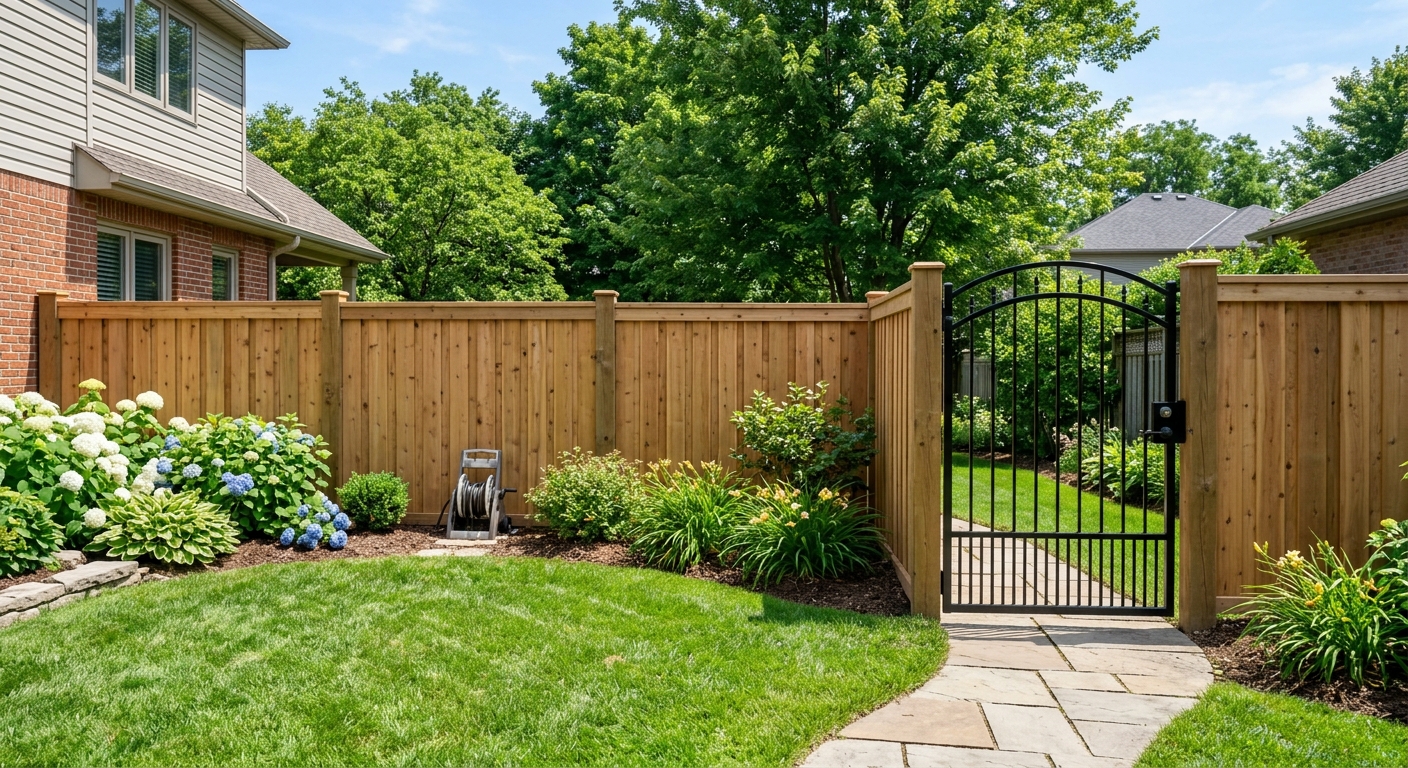
Fencing options and costs in Oshawa
Oshawa homeowners typically start their fence search by deciding how much privacy they want, then matching that goal to material and post depth requirements. With 55.5% of local dwellings being single-detached homes, there’s a steady demand for backyard privacy fences and side-yard dog/maintenance barriers. That matters because each detached property is essentially a separate project footprint—gate placements, access paths, and line-length all affect labour and the amount of concrete needed for stable footings. For context, Oshawa’s population is 175,383 (Statistics Canada, 2021 Census), and the area’s housing stock skews older: 58.6% of homes were built before 1981. Older neighbourhoods often have tighter lot lines and established landscaping, which can increase install time when crews need to work around trees, fences, and irregular property line conditions.
In the Toronto economic region, fencing costs are shaped by freeze–thaw cycles and typical GTA building practice. Frost is commonly planned around about 42"–48", so posts for 6–8 ft privacy runs are usually set a minimum of 3.5–4 ft deep (and crews often recommend concrete-set posts) to reduce the risk of frost heave. Wind isn’t “Prairie-level,” but solid panel systems still need stronger posts and appropriate spacing to resist racking. Areas around north Oshawa and the Highway 407 corridor can be especially active for new builds and backyard upgrades, which keeps installers busy during peak spring and early summer.
Below is a practical comparison of common fence types you’ll see in Oshawa, with the usual lifespan and maintenance expectations that influence long-term cost.
| Material |
Lifespan |
Maintenance |
Privacy Rating |
Price per Linear Foot |
| Pressure-treated pine (standard wood) |
10–15 years |
Stain/seal every 2–3 years; check posts annually |
High (solid panels) |
$12–$20 |
| Cedar (natural rot resistance) |
15–25 years |
Light staining every 2–4 years; periodic hardware checks |
High (solid boards) |
$14–$26 |
| Vinyl / PVC (no-maintenance) |
25–35 years |
Rinse as needed; occasional inspection for cracks/fasteners |
High (solid styles) |
$16–$27 |
| Chain-link (galvanized steel) |
20–30 years |
Occasional cleaning; repair tension/wear points |
Low to medium (open mesh) |
$8–$14 |
| Aluminum ornamental |
25–40 years |
Wash as needed; inspect for coating damage |
Low to medium (less solid) |
$18–$34 |
| Composite / recycled material |
20–30 years |
Minimal cleaning; replace any damaged boards |
Medium to high (solid/composite styles) |
$16–$30 |
Prices are estimates only and vary by project scope, site access and material selection.
What affects the price of fencing in Oshawa
If you’re getting multiple quotes for what looks like the “same fence” in Oshawa, the numbers can still differ by 30–50% across the Toronto region because the job is rarely identical once you factor in footing depth, post-setting method, and the labour needed to protect existing landscaping and grade. In the GTA, many crews plan around a frost depth that’s commonly taken at about 42"–48". To prevent heaving, posts are typically set 4–6 inches below the design frost depth, which often means 1.5–2.0 m into the ground. That pushes you toward longer posts and concrete setting, increasing both material and labour. For privacy fences, taller solid styles (wood or vinyl) also need heavier framing and closer spacing to prevent racking, especially when wind gusts catch the broad panel surface.
Local conditions can push costs up or down in practical ways. For example, a run through damp clay can require more concrete volume and careful post alignment (higher cost). A backyard that’s wide open with easy truck access usually lowers labour time (lower cost). Similarly, an older neighbourhood lot with mature trees may require extra time to avoid roots, or adjustments to step/rake fence sections over uneven grade (higher cost). Because 58.6% of Oshawa homes are older (pre-1981), it’s common to see established fences, mature shrubs, and uneven ground that influence prep time and disposal costs.
Material choice also interacts with these site factors. If your base estimate is in the wood band (for example, wood fence installation at $65–$120 total per linear foot equivalent pricing depends on scope), switching to vinyl can add upfront cost, often aligning more closely with the vinyl band $75–$130. Chain-link tends to stay more budget-friendly in the $45–$85 range, but it won’t give privacy without adding slats or screening.
| Price Factor |
Why It Matters |
Cost Impact |
| Fence length in linear feet |
Directly determines posts, rails, panels, and fasteners |
Highest driver; small length changes swing totals |
| Post depth required |
Frost planning sets hole depth and post length |
Deeper holes + longer posts increase material and labour |
| Post setting method |
Concrete vs gravel pack vs driven posts affects stability |
Concrete-set posts usually raise cost but reduce long-term failure |
| Material choice |
Vinyl, cedar, and chain-link have different framing and system costs |
Can shift estimates by tens of percent |
| Gate count and type |
Gates require heavier hardware and often additional bracing |
Each extra gate adds labour and cost for hinges/latches |
| Grade and terrain |
Slope requires stepped or raked installation and more custom cutting |
More fitting time; possible added posts |
| Old fence removal and disposal |
Demolition, hauling, and disposal add time and equipment |
Can be a major add-on if materials are embedded |
| Permit fees and survey / property line locate |
Verification prevents encroachment and rework |
Administrative and professional costs may apply |
Permits & regulations in Ontario
In Ontario, whether you need a permit usually depends on fence height and where it sits. Many homeowners only run into permit requirements once they plan a taller “privacy” fence: fences above the common threshold of about 2.0 m (6.5 ft) at the rear, and around 1.0–1.2 m (3–4 ft) at the front or corner area, are often more likely to require a building permit. Even when a permit isn’t required, you must still respect property lines and municipal setback/bylaw rules. Because Oshawa lots vary and older neighbourhoods can have established boundary markers, it’s worth confirming setbacks before you schedule excavation.
Before any post hole is dug, call for utility locates through Ontario One Call to identify buried wiring, gas, and other services. Also, obtain a survey or locate your property pins (or have a locate done) so your fence doesn’t creep onto a neighbour’s property. Shared fence ownership and maintenance responsibilities are guided by provincial line-fences legislation, so clarify who maintains which side and how repairs are handled before construction.
What typically does NOT require a permit: like-for-like repairs (replacing a few boards/panels) or matching the existing fence height, provided you’re not altering height/location significantly. What DOES often require a permit: installing a new fence or changing the height/location beyond typical thresholds, particularly for tall privacy systems.
To verify a contractor in Oshawa, check (1) Ontario licence/registration information where applicable through the appropriate online registry they reference, (2) liability insurance—ask for a current certificate of insurance showing the right insured parties and job address, and (3) WSIB coverage (or WCB compliance) as applicable: look for clearance letters or evidence on their documentation packet, and confirm the dates match your project timeline.
Choosing the right fence material for Oshawa
Choosing the right fence material in Oshawa is mainly about matching your priorities—privacy, low maintenance, budget, and lifespan—to how Ontario weather treats materials. Pressure-treated pine is usually the lowest upfront option, but it’s not “set and forget.” To minimize grey weathering and keep boards looking clean, it typically needs staining or sealing about every 2–3 years. Cedar costs more than standard pine but offers better natural resistance to rot and warping; it still benefits from periodic staining, yet it often holds up visually longer. Vinyl/PVC is popular for low maintenance: there’s no annual staining, and it usually performs well against rot, but extreme cold snaps can make some styles more prone to cracking if the system framing and fasteners weren’t designed for winter movement.
Chain-link is the lowest-cost long-life option, but it provides open visibility. Many Oshawa homeowners who want chain-link for security pair it with privacy slats or add-on screening to achieve a more private yard. Aluminum ornamental fencing looks crisp and won’t rust, though it’s typically low to medium privacy because of spacing. Composite/recycled materials can provide a solid look with less maintenance than wood, but pricing is often closer to premium wood/vinyl depending on the system and board profile.
Post depth matters regardless of material. With GTA frost planning commonly around 42"–48", you should expect posts to be set roughly 3.5–4 ft deep for many 6–8 ft privacy fences, and concrete-set posts are typically recommended rather than simple driven posts for stability. Wind and winter snow load affect how much the fence racks: solid privacy panels need stronger posts (and closer spacing) than open mesh styles.
As a practical budget example, if you’re comparing wood versus vinyl: a wood privacy run often lands closer to the wood installation band (for example, $65–$120), while vinyl privacy can align more with the vinyl band (for example, $75–$130). That difference is commonly justified when you want fewer maintenance visits over the next decade—especially valuable in older Oshawa neighbourhoods where yard access can be tight and staining work is more disruptive.
| Material |
Cold Tolerance |
Lifespan |
Annual Maintenance |
Best For |
Price Band |
| Pressure-treated pine |
Good with proper sealing |
10–15 years |
Inspect; stain/seal every 2–3 years |
Best budget privacy |
$65–$120 |
| Cedar |
Very good in freeze–thaw with hardware care |
15–25 years |
Light staining every 2–4 years |
Natural look with longer service life |
$75–$130 |
| Vinyl / PVC |
Good; avoid overly flimsy installs in cold |
25–35 years |
Rinse/inspect; no staining |
Low-maintenance privacy |
$75–$130 |
| Chain-link |
Excellent (mesh resists cold flex) |
20–30 years |
Minimal; tension/hardware checks |
Security and pet containment on a budget |
$45–$85 |
| Aluminum ornamental |
Very good; coating holds in winter |
25–40 years |
Occasional wash/inspection |
Front-yard curb appeal |
$90–$160 |
| Composite / recycled |
Good; relies on correct mounting and spacing |
20–30 years |
Minimal cleaning; replace damaged pieces |
Solid look with lower maintenance |
$85–$145 |
How to choose a fencing contractor in Oshawa
Choosing the right fencing contractor in Oshawa starts with verifying the basics in writing. First, confirm their Ontario business registration details (where applicable) and ask for proof of liability insurance for the current term; the certificate should list the insured contractor and show coverage appropriate for construction work at your address. Second, verify WSIB/WCB coverage evidence: ask for a current clearance letter or equivalent proof (and make sure the document isn’t expired). If a contractor can’t provide either insurance documentation or WSIB/WCB evidence promptly, that’s a major risk for you.
Next, require 2–3 itemised written quotes, not just lump sums. A good estimate breaks down labour and materials separately—posts, rails, panels, concrete/footings, hardware, gates, and any specialized work like stepped sections on sloped yards. Read the scope carefully: confirm whether permit pull is included if needed for your fence height, whether old fence removal and disposal are included, and what happens if they find underground utilities or have to adjust footing locations after locates. A fence quote should also specify the post-setting method (concrete-set vs gravel pack vs driven), because that’s where long-term stability is won or lost in Southern Ontario freeze–thaw cycles.
Ask about warranties: there should be a workmanship warranty (commonly at least 1 year, longer is better if offered) and a separate manufacturer/product warranty. Determine whether warranties are transferable if you sell the home.
On payment, don’t accept a schedule with more than about 10–15% upfront. Use holdback until the fence is complete, straight, properly braced, and cleaned up. Finally, insist on a start date and completion estimate in writing so you can plan around summer scheduling.
- Ask for proof of liability insurance and ensure it covers your job address.
- Confirm WSIB/WCB coverage with an up-to-date clearance letter or equivalent document.
- Get 2–3 itemised quotes (labour + materials), not “one price.”
- Ensure the quote states post depth/setting method, including concrete-set requirements for frost protection.
- Verify gate hardware is included (hinges, latches, closers if requested) and counted.
- Confirm whether permit pull is included if your design crosses typical Ontario height thresholds.
- Ask whether utility locates are handled by the homeowner or the contractor (don’t guess).
- Clarify old fence removal and disposal: hauling included or extra?
- Check how they handle slopes: stepped vs raked panels and how that’s priced.
- Get warranty terms in writing for both workmanship and products.
- Require a written timeline: start date and estimated completion date.
- Use a payment schedule with a small deposit and a holdback until final walk-through.
In Oshawa, watch for red flags like: (1) quoting driven posts for tall privacy fencing without discussing frost depth and concrete-set stability, (2) refusing to provide insurance/WSIB documentation, (3) only offering a lump-sum estimate with no post-setting details, (4) not addressing slope/grade changes (stepping/raking) in the scope, and (5) pushing large upfront payments with no holdback for completion and cleanup.
Frequently asked questions — fencing in Oshawa
How much does a fence cost in Oshawa?
In Oshawa, fencing cost typically depends on length, height, gate count, and how deep the posts must be set for frost protection. For budgeting, wood privacy installations often land in a mid-range band (commonly around $65–$120 per linear-foot equivalent pricing depending on system), while vinyl/PVC privacy is frequently higher at about $75–$130. Chain-link is usually the lowest-cost option, often around $45–$85, because it uses lighter posts and less labour for solid panel construction. If you’re comparing quotes, make sure the scope includes the same post-setting method (concrete vs gravel pack), because that’s a frequent reason for 30–50% differences. (Statistics Canada, 2021 Census)
How deep should fence posts be for Oshawa's frost?
For most privacy fences in Oshawa, posts should be set below the design frost influence. In Southern Ontario, contractors commonly plan around a frost line of roughly 42"–48". Best practice is to set posts about 4–6 inches below that planning depth, which often results in setting posts approximately 3.5–4 ft deep (about 1.5–2.0 m) for 6–8 ft fences. Because Oshawa soils can hold moisture and go through freeze–thaw cycles, many crews recommend concrete-set posts rather than simply driving posts, especially for tall solid panels that can rack in wind. Always ask your contractor to specify post depth and setting method in the written quote before work begins.
Wood vs vinyl vs aluminum fence — which is best?
“Best” depends on what you value most. Wood (pressure-treated pine or cedar) is a strong choice if you want privacy and affordability, but you should budget for maintenance like staining or sealing every few years. Vinyl/PVC is typically best for low maintenance and long-term appearance; it costs more upfront, often aligning with the vinyl band around $75–$130. Aluminum ornamental is great for curb appeal and durability without rust, but it generally provides less privacy because of its open picket style—so it’s often chosen for front yards or decorative boundaries rather than full privacy. For Oshawa backyards, where freeze–thaw is real and solid panels face winter stress, the most important decision is also the footing system: correct post depth and solid bracing matter as much as the material.
Do I need a permit to build a fence in Ontario?
In Ontario, the need for a permit often depends on fence height and location (front/corner vs rear) and your municipal rules. Common guidance is that fences above about 2.0 m (6.5 ft) at the rear and roughly 1.0–1.2 m (3–4 ft) at the front or corner may require a building permit. Even if a permit isn’t required, you must still follow property-line and setback bylaws, and you may need to adjust plans if you’re near side yards with specific municipal requirements. Before digging, Ontario One Call utility locates are essential. For shared fence situations, provincial line-fences legislation impacts ownership and maintenance—so clarify responsibilities before construction. Ask contractors whether permit pull is included in their scope if your fence crosses these typical thresholds.
How long does a wood fence last in Oshawa?
Wood fence lifespan in Oshawa usually varies by wood type, how well posts are installed, and how regularly the finish is maintained. Pressure-treated pine often lasts about 10–15 years with periodic staining/sealing, while cedar can last about 15–25 years when installed with proper hardware and reasonable maintenance. The biggest longevity factor you control is the footing: in freeze–thaw conditions, posts set too shallow can lift or loosen over time, leading to sagging and failure. Because Oshawa’s housing stock includes many older properties (58.6% built before 1981), it’s common to encounter uneven grades and established landscaping that can complicate post alignment—so a careful, concrete-set installation is important. Budgeting for maintenance every 2–4 years is usually the difference between a fence that ages gracefully and one that needs early replacement.
Who owns and maintains a shared fence?
In Ontario, shared fence responsibilities are generally guided by provincial line-fences legislation. Practically, that means the fence can be considered shared between neighbouring properties, but ownership and maintenance duties depend on how the boundary is treated and how the fence was originally erected (and any agreements between neighbours). Before you install or replace a “shared” fence, confirm with your neighbour who will pay for which portion, how repairs are handled, and what happens if one side wants changes. If you’re in Oshawa and your fence is on/near a boundary, also verify property pins or get a locate/survey to avoid encroachment disputes. A well-written contract should spell out which side the panels face, who maintains it over time, and how warranty claims will be handled for workmanship and materials.