Fencing options and costs in Sarnia
Sarnia homeowners usually start comparing fencing options by budget first, but the “right” fence is also about how well it survives our freeze–thaw cycles and spring storms. In Sarnia, 67.4% of dwellings are single-detached homes, and every detached property is a potential fencing customer—so local demand is steady rather than seasonal. It also helps explain why many quotes you’ll see are competitive on labour: most crews are familiar with the typical lot layouts across the city.
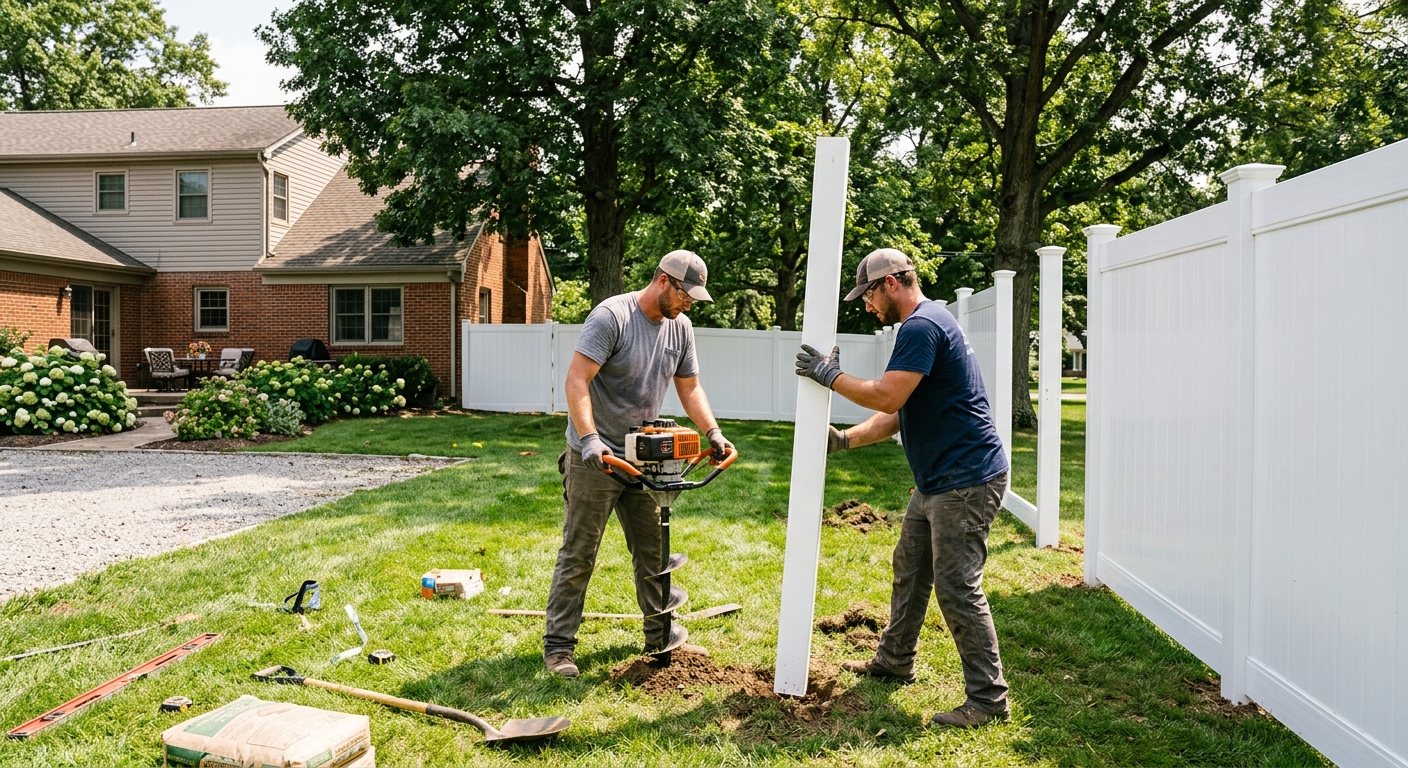
In the Windsor–Sarnia corridor, we design around southern Ontario’s frost line, roughly 1.2 m (about 4 ft). To avoid frost heave, posts typically go at least 3 ft deep, with 4 ft embedment recommended in exposed or clay-heavy soils. That depth requirement increases digging time, concrete volume, and material handling, which can move pricing even when the fence style looks “similar” on paper. Wind near Lake Huron and Lake Erie also plays a role—open farms and shoreline areas can put gust loads on tall, solid privacy fences.
If you’re near areas with lots of backyard upgrades and mature properties—like parts of west Sarnia where homes built before 1981 are common—you’ll often see fencing work scheduled in spring as soon as soil conditions allow deeper footing installation. Next, compare typical costs by material and life-cycle value, then we’ll talk about the factors that make one quote come in higher than another.
| Material |
Lifespan |
Maintenance |
Privacy Rating |
Price per Linear Foot |
| Pressure-treated pine (standard wood) |
10–15 years |
Stain/seal every 2–3 years; inspect for warping |
Good (solid boards) |
$19 – $28 |
| Cedar (natural rot resistance) |
15–20 years |
Light staining every 3–4 years; occasional board replacement |
Good (solid boards) |
$24 – $36 |
| Vinyl / PVC (no-maintenance) |
25–35 years |
Wash only; check posts/fasteners after severe winters |
Very good (with solid panels) |
$28 – $42 |
| Chain-link (galvanized steel) |
20–30 years |
Occasional tighten/straighten; rinse for salt splash |
Low to fair (add privacy slats if needed) |
$16 – $22 |
| Aluminum ornamental |
25–40 years |
Wash annually; touch up hardware as needed |
Low (open pickets) |
$32 – $50 |
| Composite / recycled material |
25–30 years |
Minimal; periodic cleaning |
Good (solid boards) |
$30 – $45 |
Prices are estimates only and vary by project scope, site access and material selection.
What affects the price of fencing in Sarnia
Two fence projects that look nearly identical in Sarnia can still come in 30–50% apart because the real cost isn’t just the material—it’s how deep we must set posts, how many supports are required for wind, how hard the ground is to dig, and how much work the site needs (demolition, gates, and disposal). Windsor–Sarnia homeowners often see variation because lot sizes, soil conditions, and access constraints differ block to block, and crews may price in different overhead depending on how quickly they can mobilize and excavate.
The biggest technical driver is frost depth. In cold Ontario, posts typically need to be set about 1.5–2.0 m into the ground (often around 4 ft in exposed or clay-heavy areas) so footing sits below the frost line and prevents heaving. That usually means longer posts and more concrete if you choose concrete-set installation—raising labour and material costs compared with shallow-set designs. Next comes wind exposure. While we aren’t as wind-stressed as the Prairies, shoreline gusts around Lake Huron/Lake Erie still matter, so we may tighten post spacing and upsize framing for taller privacy fences.
Concrete examples: (1) Replacing a short, 60 ft run of chain-link in sandy soil can fall toward the lower band for chain-link, while (2) installing a 6 ft board-on-board privacy fence on a clay-heavy lot near the shoreline often moves into the mid-to-upper wood pricing because footings take longer and require more concrete. If your yard needs a double drive-through gate, that adds structural posts and hardware and can shift the whole project toward the higher end of the $70–$130 per linear foot metal range when you compare aluminum gates versus lighter options. Finally, if your home is older (71.0% built before 1981, in the region), you may deal with existing fence remnants, mature roots, and older property layouts that slow excavation—adding dollars even with the same total fence length.
| Price Factor |
Why It Matters |
Cost Impact |
| Fence length in linear feet — the primary cost driver |
Every extra foot adds posts, rails, hardware and installation time |
Major; scales directly from a per-foot rate |
| Post depth required — frost line determines post length and hole depth |
Deeper holes require longer posts and more excavation |
Major; can raise costs when concrete is included |
| Post setting method — concrete vs. gravel pack vs. driven posts |
Concrete increases material and labour but improves stability |
Moderate to major; concrete typically costs more |
| Material choice — vinyl vs. cedar vs. chain-link |
Different components and life-cycle costs change installation pricing |
Moderate; material premiums can be significant |
| Gate count and type — walk-through vs. drive-through (double) |
Gates require stronger posts, hinges, latches and precise alignment |
Moderate to major per gate |
| Grade and terrain — sloped yards require stepped or raked panels |
Slopes increase labour and may require custom panel adjustments |
Moderate; often adds hours on installation day |
| Old fence removal and disposal |
Demolition adds labour, dump fees and may reveal hidden anchors |
Moderate; can materially increase the quote |
| Permit fees and survey / property line locate |
Some projects need extra documentation and locate work |
Low to moderate; project-dependent |
Permits & regulations in Ontario
In Ontario, fence rules are usually tied to height limits and location within your property (front/corner vs. rear), and many municipalities require a building permit when a fence exceeds typical thresholds—commonly around 2.0 m (6.5 ft) for rear yards and about 1.0–1.2 m (3–4 ft) for front or corner areas. The key practical point for Sarnia homeowners is this: if you’re planning a tall privacy fence, a solid double-gate system, or anything that may exceed the common height limits at the front/corner, treat it as permit-sensitive and confirm before ordering materials.
Before you dig any post holes, call for utility locates (Ontario One Call). Also, obtain a survey or at least a clear property-line locate using your property pins before you start—fencing on the wrong line can lead to costly removal. Shared fence ownership and responsibility generally follow Ontario line-fences principles, so if your fence is truly a boundary fence, both sides may share maintenance obligations depending on the situation and agreement.
To verify your contractor in Ontario: confirm they carry liability insurance (request a COI with your address listed), check WSIB/WCB coverage where applicable, and ask for their licence/registration details for contracting work. You can also request their WSIB clearance letter or coverage proof and verify the document is current (not expired) before scheduling the excavation.
Choosing the right fence material for Sarnia
Choosing a fence in Sarnia is easiest when you match material to your top priority: privacy, low maintenance, budget, or long lifespan. Our winters demand that posts and framing be installed for frost and that products handle freeze–thaw movement without premature loosening. For pressure-treated pine, you get the lowest upfront cost, but expect staining or sealing every 2–3 years to prevent grey weathering and keep boards looking fresh. Cedar offers better rot resistance and a nicer look from day one; it still benefits from periodic maintenance, especially where snow storage and wetting are frequent. Vinyl/PVC is genuinely low maintenance, but extreme cold can make some components brittle if the system isn’t designed correctly for post spacing and hardware—so proper install matters. Chain-link is typically the lowest cost and longest life, but it won’t provide privacy without slats or an added screen. Aluminum ornamental gives a clean, rust-resistant look with low upkeep, though it’s not a privacy-first material. Composite/recycled boards sit in the low-maintenance camp and usually perform well where you want solid privacy without frequent staining.
On post depth: because the Windsor–Sarnia frost line is roughly 1.2 m, we typically plan on 3–4 ft embedment for stability and heave resistance. In many Sarnia yards, concrete-set posts are recommended in exposed or clay-heavy soils to reduce movement after freeze–thaw. Where snowplough routes and wind gusts are common, sturdier post and rail sizing helps reduce wobble.
A practical dollar example: if you’re deciding between vinyl and pressure-treated pine for a privacy run, vinyl may come in closer to the mid-to-upper band for vinyl/PVC (roughly $65–$110). For many homeowners, that difference is justified because you’re paying for fewer yearly tasks and longer service life—especially valuable when you’re already managing aging (pre-1981) home landscaping and fencing that may have root conflicts.
| Material |
Cold Tolerance |
Lifespan |
Annual Maintenance |
Best For |
Price Band |
| Pressure-treated pine |
Good (with proper sealing and sturdy posts) |
10–15 years |
Inspect twice; clean; stain/seal every 2–3 years |
Budget-friendly privacy |
$45 – $80 |
| Cedar |
Good (natural rot resistance) |
15–20 years |
Inspect and light stain about every 3–4 years |
Longer-life wood look |
$55 – $95 |
| Vinyl / PVC |
Good (best with correct hardware and spacing) |
25–35 years |
Wash as needed; check fasteners after storms |
Low maintenance privacy |
$65 – $110 |
| Chain-link |
Excellent (steel is stable in cold) |
20–30 years |
Rinse; tighten at tension points if needed |
Security and pet containment |
$30 – $55 |
| Aluminum ornamental |
Excellent (no rust) |
25–40 years |
Wash annually |
Curb appeal with boundary definition |
$70 – $130 |
| Composite / recycled |
Good (designed for freeze–thaw) |
25–30 years |
Clean; periodic inspections for hardware |
Solid privacy with minimal upkeep |
$75 – $125 |
How to choose a fencing contractor in Sarnia
Start by verifying the contractor’s Ontario contracting basics. For liability, ask for a current certificate of insurance (COI) showing general liability limits that make sense for fencing work and listing your property as a project location. For worker protection, confirm WSIB coverage or the equivalent clearance proof for the work being performed (you should see documentation that is current and matches the contractor’s legal name). These checks matter locally because fencing installs involve excavation, working near utilities, and heavy materials—so coverage is not optional.
Next, get 2–3 itemised written quotes, not a single lump sum. A good fence quote separates labour (excavation, setting posts, rail assembly, installation) and materials (posts, rails, boards/panels, concrete, hardware, gates). Confirm whether permits are included if your fence exceeds height thresholds and whether disposal/removal of the old fence is included or billed separately.
Warranty is also different between products and workmanship. Ask for the workmanship warranty length (how long they stand behind alignment, post stability, and fastening) and the manufacturer warranty on material components. Also ask if the manufacturer warranty is transferable if you sell your home.
Payment schedule: keep it safe—never pay more than 10–15% upfront. Hold back a portion until the job is fully complete, including punch-list items. Finally, demand a timeline in writing: proposed start date, weather contingencies, and an estimated completion window.
- Ask for COI with your address/project listed and confirm expiry date.
- Confirm WSIB/WCB coverage documentation before excavation begins.
- Ensure quotes include utility locate responsibility and confirm Ontario One Call is handled.
- Get the fence line marked/located plan (survey pin/locate) in writing.
- Verify post depth and embedment method (concrete vs. alternatives) is stated.
- Make sure gate hardware is specified (hinge type, latch style, self-closing if needed).
- Require itemised disposal costs for old fencing and debris removal.
- Confirm concrete mix, footing size assumptions, and number of post holes.
- Ask who supplies and places post caps, rails and fasteners (specific make/grade if possible).
- Check for stated tolerances (panel alignment, level vs. racked on slopes).
- Get warranty terms in writing for both workmanship and materials.
- Set a payment schedule with a holdback until final walkthrough and punch list completion.
In Sarnia, red flags include: (1) quotes that won’t specify post depth/embedment method, (2) refusal to provide COI or WSIB/WCB clearance proof, (3) claiming they “don’t need” utility locates, (4) missing disposal/haul-away details for old fence removal, and (5) asking for most of the payment upfront before any excavation is done.
Frequently asked questions — fencing in Sarnia
Who owns and maintains a shared fence?
In Ontario, shared fence situations are handled under line-fences principles and typically come down to where the fence sits (true boundary), the original arrangement, and who established or maintained the fence over time. In practice in Sarnia neighbourhoods, disputes often happen when a fence is built slightly off the property line or when one homeowner assumes the other will share upkeep automatically. If the fence is a boundary fence, maintenance expectations may be shared, but you should confirm details in writing—especially when repairs, panel replacement, or gate hardware are needed. The safest approach is to talk with your neighbour, document the agreement, and clarify responsibilities (repairs vs. full replacement) before signing contracts. If you’re unsure, a property-line locate and/or survey can help resolve ownership questions before work begins. (Statistics Canada, 2021 Census)
How do I find my property line before fencing?
Before installing fencing in Sarnia, don’t rely on “good guess” measurements from the street or landscaping. Start by locating your property pins or boundary markers—often shown on your survey plan or property documents. If you don’t have a current survey, hire a surveyor for a locate so your contractor can set the fence line correctly. This matters because even small encroachments can trigger disputes and costly rework. Then, call Ontario One Call for utility locates before any post hole digging. When you meet your fencing contractor, ask how they will confirm the layout (pin locate method, measurement approach, and whether they’ll adjust for grade). A properly planned boundary line reduces the risk of delays and change orders once excavation starts.
What's the most low-maintenance fence?
For most Sarnia homeowners, vinyl/PVC is the most low-maintenance option because it doesn’t require staining and generally only needs occasional washing. In southern Ontario conditions—freeze–thaw cycles and wet spring weather—vinyl still performs well when panels and posts are installed with correct spacing and reliable hardware. If you prefer a solid privacy look without yearly work, vinyl/PVC is a common choice. Budget-wise, you’ll often see vinyl/PVC in the $65–$110 per linear foot range, while pressure-treated pine is more budget-friendly (commonly $45–$80). The “right” choice depends on whether you value avoiding maintenance tasks more than minimizing upfront cost. If your yard is busy with snow storage or frequent splashback, a low-maintenance finish can also look better over time because you aren’t constantly re-staining boards.
How tall can my fence be in Sarnia?
Fence height rules in Ontario are tied to where the fence is located on your lot (rear vs. front/corner) and often trigger permit requirements when heights exceed common thresholds—commonly around 2.0 m (6.5 ft) at the rear and about 1.0–1.2 m (3–4 ft) at the front or corner. However, exact thresholds can vary by municipal bylaw, so it’s important to confirm with Sarnia’s permitting requirements before you commit to materials and order panels. When you talk to your contractor, ask them to identify the fence height you’re building, whether it will likely need a permit, and who is pulling that permit. A tall privacy fence also increases wind load, so contractors may recommend tighter post spacing and stronger posts to prevent wobble during gusty Lake Erie/Lake Huron weather patterns.
Should fence posts be set in concrete here?
In Sarnia and the Windsor–Sarnia corridor, concrete-set posts are commonly recommended because frost heave resistance is critical. Southern Ontario’s frost line is roughly 1.2 m, and best practice typically calls for posts going about 3–4 ft deep to sit below the frost zone, especially in exposed or clay-heavy soils. Concrete helps stabilize the post in that deeper hole and reduces movement after freeze–thaw cycles. That said, whether concrete is required depends on soil and your fence type and height—some fence systems can use alternative settings, but they must still meet depth and stability expectations. The cost difference can be meaningful because concrete adds material and labour, but it’s one of the best ways to prevent early lean or post lift. If your quote doesn’t clearly state embedment depth and setting method, ask before you sign.
What's the best fence for privacy?
The best privacy fence for Sarnia usually means a solid panel design—board-on-board wood, solid vinyl/PVC, or composite—because open styles like aluminum ornamental won’t block views. If you want maximum privacy with low maintenance, vinyl/PVC privacy systems are popular and typically fall in the $65–$110 per linear foot range. Pressure-treated pine can be cheaper (often $45–$80) but will need staining/sealing every 2–3 years to keep it from weathering and warping visually. Cedar sits between those in terms of aesthetics and rot resistance, with periodic maintenance still needed. For any privacy fence, ensure the contractor designs for wind load near shoreline areas by using adequate post spacing and sturdy framing—especially for taller runs and gates. If your yard is sloped, choose a design that can be raked/stepped cleanly so privacy isn’t compromised by uneven gaps.