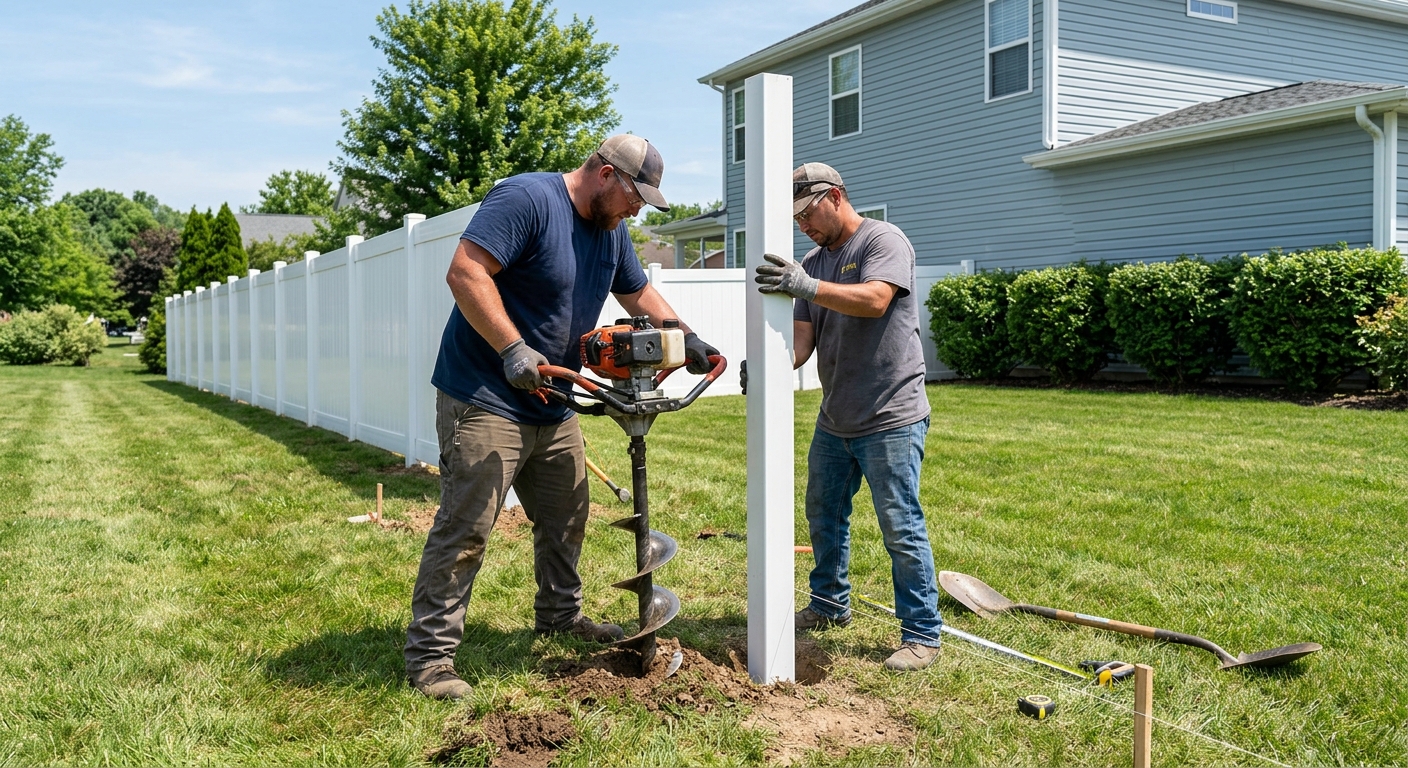
Fencing options and costs in Stittsville
In Stittsville, fencing choices usually start with privacy and curb appeal, then quickly narrow down to what will survive Ottawa-area winters without leaning. With a population of 40,889 in 2021 (Statistics Canada, 2021 Census), Stittsville has plenty of homeowners and growing families who update outdoor spaces as properties mature and landscapes change. The area’s housing stock also creates steady demand for boundary fencing and backyard privacy panels—every new deck, pool, or raised garden bed tends to bring a fence conversation with it. In the Ottawa economic region, frost depth and soil conditions are the biggest cost drivers, so it’s common to see Stittsville quotes that are higher than you’d expect if you only compare “material price” on paper.
Local installations typically bury posts close to the regional frost line (around 3.5 to 4 ft), especially in heavier clay. That means more digging, concrete footings, and longer posts—labour time and machine time add up. Wind exposure and drifting snow also matter for privacy fences: panels act like sails, so contractors often adjust post spacing and panel strength to keep fences straight after spring thaw. You’ll also notice especially strong trade demand in family-oriented areas like the emerging neighborhoods near Abbott’s Village and around Stittsville Main Street, where many lots are built out with similar setbacks and shared-yard layouts.
Below is a practical comparison of common fence types you’ll see in Stittsville, including typical lifespan expectations and installed price ranges that align with Ottawa-area realities, then we’ll break down what makes bids swing from one contractor to the next.
| Material |
Lifespan |
Maintenance |
Privacy Rating |
Price per Linear Foot |
| Pressure-treated pine (standard wood) |
10–15 years |
Stain/seal every 2–3 years to reduce greying and checking |
High (solid board layouts) |
$40 – $75 |
| Cedar (natural rot resistance) |
15–25 years |
Light staining or oiling every 2–4 years (varies by sun exposure) |
High (solid board layouts) |
$55 – $95 |
| Vinyl / PVC (no-maintenance) |
20–30 years |
Wash/rinse annually; check fittings after extreme cold snaps |
High (solid/close picket styles) |
$50 – $100 |
| Chain-link (galvanized steel) |
20–35 years |
Occasional tension checks and rinse; add privacy slats if needed |
Low to Medium (depends on slats) |
$25 – $55 |
| Aluminum ornamental |
25–40 years |
Minimal; wash annually |
Low (decorative—more visibility) |
$70 – $120 |
| Composite / recycled material |
25–35 years |
Minimal; no staining, occasional cleaning |
High (solid panel designs) |
$60 – $110 |
Prices are estimates only and vary by project scope, site access and material selection.
What affects the price of fencing in Stittsville
In Stittsville, quotes for what looks like the same fence can vary by 30–50% because contractors price the “hidden work” differently: post depth and footing type, how many gates you have, whether they include old-fence removal, and whether the layout requires extra labour for corners and setbacks. Even two yards that are “both 100 ft” may not be comparable if one includes a slope, a double driveway gate, or concrete removal near existing hardscape.
The Ottawa-region frost depth is a major reason. Posts generally need to be set about 4–6 inches below the design frost depth to reduce the risk of frost heave. Practically, that often means posts going roughly 1.5–2.0 m into the ground, requiring concrete setting in many Stittsville soils—especially clay—so you’ll see higher labour hours, longer auger time, and more disposal for spoil. Wind exposure isn’t as relentless as open Prairie sites, but privacy fences still experience gusts and drifting snow loads; that can lead to closer post spacing, stronger rails, and larger brackets, which increases material and install time.
Two or three common local scenarios that raise costs in Stittsville are: (1) digging through clay near established landscaping where extra spoil handling and concrete work is needed; (2) installing near driveways or retaining edges where contractors must take more care to avoid utility lines and break-up costs; and (3) replacing a leaning wood fence where existing posts are already pulled up by freeze–thaw cycles. Costs can be lower when the yard is flatter, access is straightforward, and the run is a simple rectangle with fewer corners and no gates—projects like that often land nearer the lower end of the wood and chain-link bands (for example, chain-link commonly sits around $25 – $50 per linear foot, while standard treated-wood installs often start closer to $40 – $75 when footing conditions are routine).
| Price Factor |
Why It Matters |
Cost Impact |
| Fence length in linear feet |
Most material and labour are scaled directly by total linear feet |
High (often the #1 driver) |
| Post depth required |
Frost line determines required post length and hole depth |
Medium to high (can change footing volume significantly) |
| Post setting method |
Concrete vs. gravel pack vs. driven posts affects stability and longevity |
Medium (concrete increases cost and time) |
| Material choice |
Vinyl, cedar, chain-link, and aluminum have different hardware and assembly rates |
High (drives wide price band differences) |
| Gate count and type |
Gates require heavier frames, hinges, and often different rail structures |
Medium to high (double gates add significant labour/material) |
| Grade and terrain |
Sloped yards require stepped or raked panels and more fabrication time |
Medium (adds labour and waste) |
| Old fence removal and disposal |
Hauling and disposal are often separate line items |
Low to medium (can spike if access is tight) |
| Permit fees and survey / property line locate |
Verification reduces encroachment risk and aligns with local requirements |
Low to medium (varies by project type) |
Permits & regulations in Ontario
In Ontario, fence rules commonly hinge on height, location, and whether you’re near a property line or frontage. As a homeowner in Stittsville, plan for the fact that fences above typical thresholds—often about 2.0 m (6.5 ft) in the rear yard and roughly 1.0–1.2 m (3–4 ft) at the front or corner—may require a building permit. Even when a permit is not triggered, your fence still must respect property lines and municipal setback bylaws. Before you dig a single post hole, arrange utility locates through Ontario One Call so contractors can mark buried services.
Because fencing disputes are frequently caused by inaccurate positioning, it’s smart to obtain a survey or at least a property line locate before installation—especially on lots with older boundaries, mature hedges, or recent landscaping that obscures pins. Where fences are shared, boundary ownership and responsibilities are governed by Ontario line-fences principles, so confirm which side is on shared fencing if you’re touching a neighbouring boundary.
What typically DOES require a permit: fences that exceed the common height thresholds (especially taller rear privacy fences), and any project your municipality flags based on placement and height. What typically does NOT: smaller, standard-height fences on the interior side of your lot that remain within typical height limits, provided they stay within setbacks and meet required setbacks.
To verify your contractor in Stittsville, ask for proof of Ontario licensing (where applicable for their trade classification), a valid certificate of insurance (liability, naming you as certificate holder if required), and WSIB/WCB coverage documents. You can also check online business registries and confirm dates/coverage on the certificate of insurance before work starts, and request a clearance letter or coverage verification where available.
Choosing the right fence material for Stittsville
Choosing the right fence material in Stittsville is about matching the product to winter reality: deep frost, freeze–thaw movement in clay, and repeated freeze conditions that punish poorly set posts. Pressure-treated pine is the budget-friendly choice and looks good when new, but it typically needs staining or sealing every 2–3 years to reduce grey weathering, splintering, and surface cracking. Cedar costs more upfront but handles moisture and rot better; it still benefits from maintenance, yet it often ages with fewer structural issues and a nicer look. Vinyl/PVC is popular for low upkeep and cleans easily, but extreme cold can make some components more brittle, so quality systems with proper rail hardware matter—installation quality and post depth still drive longevity.
Chain-link is the long-life, lowest-cost option, but it offers limited privacy unless you add slats or plant screens. Aluminum ornamental is rust-resistant and typically holds its appearance well, but it’s designed for visibility rather than privacy. In Stittsville, most privacy fences (wood/cedar/vinyl/composite) perform best when posts are set at frost-appropriate depths—close to 3.5–4 ft, with concrete footings commonly used in clay—because the fence can look “well-built” and still lean if the foundation shifts.
A concrete cost example: if a basic treated-wood privacy fence is quoted near $40 – $75 per linear foot, swapping to cedar often moves the installed range upward (often roughly $55 – $95). That difference is usually justified when you want better natural appearance and longer service life without fighting early rot, especially on shaded sides of the yard where moisture lingers.
| Material |
Cold Tolerance |
Lifespan |
Annual Maintenance |
Best For |
Price Band |
| Pressure-treated pine |
Good when posts are properly set; wood movement occurs if footing is shallow |
10–15 years |
Inspect and plan stain/seal every 2–3 years |
Budget privacy with manageable upkeep |
$40 – $75 |
| Cedar |
Very good for rot resistance; still sensitive to poor installation/foundation movement |
15–25 years |
Light oil/stain as needed (often every 2–4 years) |
Premium look with better natural longevity |
$55 – $95 |
| Vinyl / PVC |
Good in Ottawa cold when using quality hardware and correct spacing |
20–30 years |
Rinse/wash; check brackets after extreme cold snaps |
Low-maintenance privacy |
$45 – $80 |
| Chain-link |
Excellent; galvanized coatings resist freeze-related issues |
20–35 years |
Minimal; tension and rinse checks |
Security and long service life (privacy with slats if needed) |
$25 – $50 |
| Aluminum ornamental |
Excellent; cold doesn’t compromise structure like untreated wood can |
25–40 years |
Wash annually; inspect hinges only if gates |
Decorative boundaries, visibility, rust resistance |
$70 – $120 |
| Composite / recycled material |
Good; handles cold well when installed with proper clearance and hardware |
25–35 years |
Minimal; periodic cleaning |
Durable privacy without staining |
$60 – $110 |
How to choose a fencing contractor in Stittsville
Choosing the right fencing contractor in Stittsville starts with verification. First, request proof of insurance: general liability coverage (so you’re protected against property damage) and, if subcontractors are used, that they are covered as well. Next, confirm WSIB/WCB coverage for workers (or provide the appropriate clearance documentation). Ask for the clearance letter or coverage verification and check that it’s current—not expired—before any digging begins. For licence verification, use Ontario business registries or the relevant public registry checks available for the contractor’s business details, and cross-check that the certificate name matches the company doing the work.
Then get 2–3 itemised written quotes with labour and materials breakdowns rather than a lump sum. Look for line items for post depth/footings, gate frames/hinges, hardware type, panel style, removal/disposal, and any surface restoration. Scope clarity matters: ask whether the quote includes utility locate coordination, permit pull (if required), and post-hole restoration. A good warranty should cover workmanship and specify duration; also confirm the manufacturer warranty for rails/panels and whether it’s transferable if you sell your home.
For payment, never agree to pay more than 10–15% upfront. Hold back a portion until the job is complete and inspected. Finally, insist on a written start date and completion estimate; Ottawa-area frost schedules can shift timelines, and you want that plan in writing.
- Verify liability insurance and that you are named as certificate holder where required.
- Confirm WSIB/WCB coverage is active and ask for clearance verification if available.
- Ensure the quote includes post depth and whether concrete footings are included.
- Ask for a material specification list (board type, thickness, grade, hardware brand).
- Confirm gate hardware is included (hinge type, latch, posts for gate loads).
- Check if disposal and recycling/haul-away of old fencing is included.
- Verify how the contractor handles sloped yards (stepped vs. raked panels).
- Confirm whether permits are the homeowner’s responsibility or contractor-handled.
- Ask about utility locate coordination and who pays if locate tickets are needed.
- Review warranty terms: workmanship length, exclusions, and how claims are handled.
- Request a project schedule: start date, key milestones, and completion estimate.
- Agree on payment milestones tied to inspections (footings set, panels complete, final).
In Stittsville, common red flags I’ve seen include: quotes that don’t specify post depth or footing method, “allowance pricing” for gates/hardware without listing what you’re actually getting, missing insurance/WSIB documents, schedules that are vague with no written completion date, and payment terms that ask for more than a small deposit before any work begins.
Frequently asked questions — fencing in Stittsville
How do I compare fencing quotes?
Start by comparing like-for-like scope: total linear feet, fence height, gate count, and the exact material grade. Then compare installation details that drive Ottawa-area costs—post depth and whether posts are set with concrete footings (often used around the regional frost depth to prevent winter heave). Quotes should list whether old fence removal and disposal are included, and whether the contractor will coordinate utility locates before digging. Finally, confirm warranty terms for workmanship and materials. If one quote is far cheaper, ask what’s missing—such as less secure post setting, different hardware, or no gate framing. In Stittsville, a “privacy wood” quote that lands near the lower end of the wood band (around $40 – $75 per linear foot) should still include frost-appropriate footings to be a fair comparison.
How long does fence installation take in Stittsville?
For typical backyard runs in Stittsville, many installations land in the range of a few days to about a week, depending on length, gate count, and how complex the layout is. Short straight sections with no gates can be faster, while yards with slopes, multiple corners, and a double driveway gate take more fabrication and alignment time. Ottawa-region digging also affects speed: deeper post holes and concrete setting add time compared with shallow-footing regions. Weather can influence schedules too—contractors aim to avoid work when soils are overly frozen or saturated. A good contractor will provide a written start date and an estimated completion window. If you’re planning a spring install, ask how they handle post-setting timing around thaw cycles to keep fences level through early settling.
Can I install a fence on a slope in Stittsville?
Yes, you can install a fence on a slope in Stittsville, but the method matters. Most contractors use either stepped panels or a raked design that follows the grade while keeping the fence top as straight as possible. On privacy fences, stepped designs can look cleaner on moderate slopes; on steeper yards, a raked approach may be better for aesthetics but requires more measuring and careful rail alignment. The bigger issue is still foundation stability: even when the top is level, post depth must remain consistent with frost depth so individual sections don’t shift at different rates during freeze–thaw cycles. Your contractor should explain how they’ll handle panel transitions near corners and driveways, and should show you an example layout before construction starts.
What is the most weather-resistant fence for Stittsville's climate?
For Stittsville’s Ottawa-area freeze–thaw conditions, the “most weather-resistant” choice depends on whether you mean rot resistance, rust resistance, or resistance to leaning. Chain-link with proper galvanization is very durable in cold weather and typically has minimal structural problems (often in the $25 – $50 range per linear foot). For privacy, cedar and composite are often strong performers because they handle moisture exposure better than basic untreated woods, especially when posts are set at frost-appropriate depths. Vinyl is also durable and low maintenance, but it still relies on good footing and correct hardware so boards don’t loosen after winter movement. No material beats a solid installation—deep posts and correct spacing usually determine whether your fence stays straight more than the paint or colour does.
How do I prevent wood fence rot in Stittsville?
Wood rot prevention starts with preventing water retention and keeping the fence properly founded. Ensure posts are set below the frost line with stable footings; leaning and separated boards trap moisture and accelerate decay. Use pressure-treated or cedar boards that match the intended exposure level. For treated pine, staining/sealing every 2–3 years helps slow grey weathering and checks that allow moisture penetration. Keep bottom rails and pickets off standing water where possible—avoid burying organic materials directly into soil. Also maintain airflow by trimming nearby plants that keep panels constantly damp. If your fence is on the shaded side of your yard (common in established Stittsville lots), consider a cedar or a quality maintenance plan, since moisture lingers longer. Annual inspections in late summer are a practical habit.
What is the cost per linear foot for fencing in Stittsville?
In Stittsville, pricing varies by material, height, gate count, and how much footing work your soil needs. As a planning guide aligned to Ottawa-area residential ranges, pressure-treated wood often lands around $40 – $75 per linear foot, vinyl/PVC typically runs about $45 – $80, chain-link is commonly $25 – $50, and aluminum ornamental often sits around $70 – $120. Privacy-style cedar generally costs more than basic treated pine due to material and hardware, so it often falls above the standard wood range. In Stittsville specifically, clay and frost-depth requirements can push total installed cost up versus milder regions—even if your material choice is the same—so make sure your quote specifies post depth and footing method.