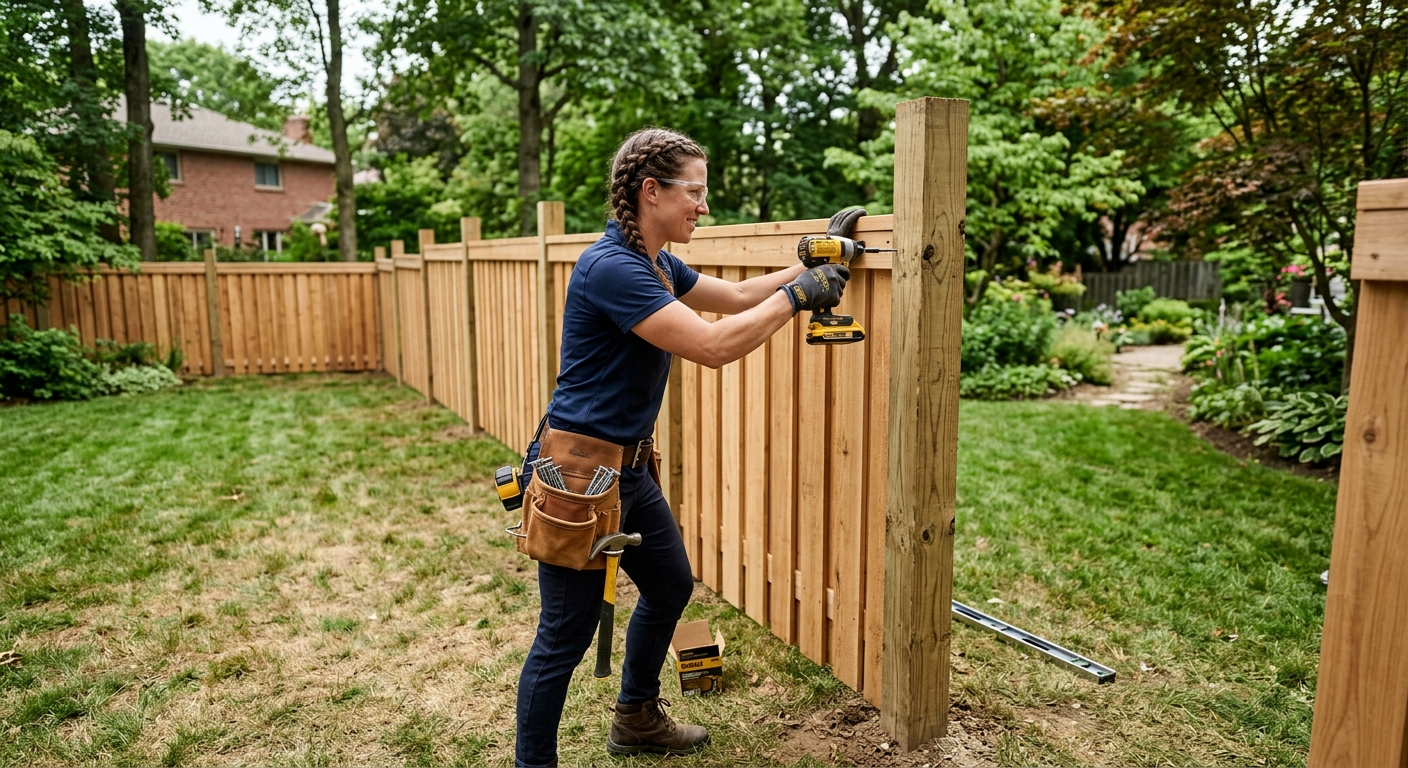
Fencing options and costs in Corso Italia-Davenport
In Corso Italia-Davenport, the right fence choice usually comes down to privacy needs, maintenance tolerance, and how your yard handles Toronto’s freeze–thaw cycles. With a population of 14,133 in the area (Statistics Canada, 2021 Census), there’s steady demand for both boundary work and back-yard privacy upgrades—especially because local neighbourhoods are packed with detached homes, which tend to be where fence lengths and gate counts expand. In practice, the cost picture in Toronto is strongly shaped by the ground conditions and the need to set posts below frost depth. Contractors commonly dig to about 42"–48" of frost depth, then go deeper—often roughly 4–6 inches below that design line—to reduce the risk of post heave, racking, and sag over time.
For many 6–8 ft privacy fences, this means concrete-set posts and longer materials. Access also matters: narrow driveways, mature trees, and side-yard egress around Corso Italia and Davenport roadways can add labour for hauling and careful post placement. The strongest trades demand is typically in the mid-block residential pockets near Davenport Road and the Corso Italia shopping strip, where property upgrades and backyard renovations run year-round.
Below is a homeowner-friendly comparison of common options—using realistic lifespan, maintenance expectations, and typical installed price bands for the Toronto market—so you can match your budget before requesting an itemised quote.
| Material |
Lifespan |
Maintenance |
Privacy Rating |
Price per Linear Foot |
| Pressure-treated pine (standard wood) |
10–15 years |
Stain or seal every 2–3 years; annual hardware check |
High (solid or close-board) |
$18 – $30 |
| Cedar (natural rot resistance) |
15–25 years |
Seal or stain every 3–4 years; boards still benefit from periodic inspection |
High (solid or close-board) |
$22 – $38 |
| Vinyl / PVC (no-maintenance) |
25–35 years |
Occasional wash; check posts for fastener tightness |
High (solid board panels) |
$25 – $44 |
| Chain-link (galvanized steel) |
20–30 years |
Minimal; occasional tightening and coating touch-ups if damaged |
Low to moderate (generally not private) |
$15 – $26 |
| Aluminum ornamental |
30–40 years |
Wash as needed; repaint only if powder-coat is damaged |
Low to moderate (decorative spacing) |
$23 – $55 |
| Composite / recycled material |
25–30 years |
Low maintenance; periodic cleaning and inspection |
High (solid panel styles) |
$26 – $50 |
Prices are estimates only and vary by project scope, site access and material selection.
What affects the price of fencing in Corso Italia-Davenport
In Corso Italia-Davenport, you can see the same basic fence concept quoted 30–50% apart because Toronto contractors price around risk: soil type, frost-depth footing, wind loads, and how complicated your lot is to access. Even when two quotes use the same height and material, the post depth, post spacing, concrete quantity, and hardware quality can differ—especially for taller solid privacy fences that resist racking.
Frost line depth is a major driver. In Southern Ontario, frost is commonly estimated at about 42"–48", and good practice is to set posts roughly 4–6 inches below that design depth. That typically pushes hole depths toward about 1.5–2.0 m into the ground, so you’re buying longer posts, hauling more concrete, and spending more time on excavation. Chain-link may be cheaper because it’s lighter and often uses less mass per post, while wood privacy fences trend toward the higher end of the $65–$120 range for wood and the $75–$130 range for vinyl/PVC when footing work is substantial.
Toronto wind isn’t as punishing as prairie open exposure, but we still plan for uplift and panel movement. In neighbourhood pockets with more exposure—like homes on corners or with open rear yards—the heavier posts and tighter spacing (often 6–8 ft centres on solid panels) can increase material and labour. Coastal BC doesn’t apply here, but the broader point is relevant: mild but wet climates can accelerate wood rot if treatment isn’t right; in Toronto, you’re more focused on freeze–thaw stability rather than constant rot.
Concrete examples from local jobs: (1) a backyard replacement on clay-heavy soil often requires additional excavation and concrete volume, raising costs by several hundred dollars even at the same fence length; (2) removing an old fence that’s already leaning can add time for careful tear-out and disposal; (3) adding a second gate for a drive-through entrance increases hardware and framing complexity.
| Price Factor |
Why It Matters |
Cost Impact |
| Fence length in linear feet — the primary cost driver |
More fence means more posts, rails, panels, and labour time |
Often the largest driver of total cost (commonly 60–75% of the quote) |
| Post depth required — frost line determines post length and hole depth |
Deeper setting increases excavation, concrete, and materials |
Can add 10–25% where frost-footing work is heavy |
| Post setting method — concrete vs. gravel pack vs. driven posts |
Concrete-set posts reduce heaving and increase stability for privacy fences |
Concrete usually increases costs but improves long-term performance (often 5–15%) |
| Material choice — vinyl vs. cedar vs. chain-link |
Material cost and installation speed vary significantly |
Switching wood privacy to vinyl can raise budgets toward the upper end of the $75–$130 band |
| Gate count and type — walk-through vs. drive-through (double) |
Gates require framing, hinges, latches, and alignment |
Each additional gate can add a noticeable premium (often hundreds of dollars per gate) |
| Grade and terrain — sloped yards require stepped or raked panels |
Slopes increase fitting time and can require different panel heights |
Can add 5–20% depending on slope severity |
| Old fence removal and disposal |
Demolition, hauling, and dump fees add labour and materials handling |
Can add 10–30% if the old system is extensive or difficult to remove |
| Permit fees and survey / property line locate |
Locates and documentation reduce the risk of encroachment disputes |
Variable; can add a small fixed amount or more if a survey is required |
Permits & regulations in Ontario
In Ontario, fences may require a building permit depending on height and location. As a practical rule homeowners use in the GTA: fences above about 2.0 m (6.5 ft) near the rear often fall into the “permit likely” zone, while front or corner fences are typically treated more stringently at roughly 1.0–1.2 m (3–4 ft). Even if a permit isn’t required for your exact height, you still must respect property lines and any municipal setback bylaws.
Before you dig any post holes in Corso Italia-Davenport, call for utility locates through Ontario One Call so contractors can mark gas, hydro, telecom, and other buried services. Also confirm your property line: if you’re unsure where pins are, obtain a survey or have a property line locate done. This is how you avoid disputes with neighbours and expensive rework if a fence crosses a boundary.
Shared fence situations are governed by Ontario’s line-fences principles, but the practical takeaway is to confirm who owns which portion and who maintains it before you build or replace anything.
Step-by-step contractor verification: ask for (1) proof of Ontario business registration (as applicable), (2) a certificate of insurance showing general liability coverage and the correct insured party, and (3) workplace coverage documentation (WSIB coverage/clearance letter where required). Then look for WSIB/WCB clearance status and the insurance certificate directly from the contractor—don’t rely on verbal confirmation.
Choosing the right fence material for Corso Italia-Davenport
Choosing a fence material in Corso Italia-Davenport is easiest when you start with your top priority—privacy, low maintenance, or staying closer to budget—then match it to how Toronto’s winters behave. Pressure-treated pine is the budget-friendly route, but it typically needs staining or sealing every 2–3 years to prevent grey weathering and to keep the boards performing. Cedar looks great and naturally resists rot better, so it often holds up longer, but it still benefits from periodic maintenance so it doesn’t dry out and warp. Vinyl/PVC delivers the lowest day-to-day effort—wash and go—though extreme cold can make some components less forgiving, so proper fastening and quality posts matter. Chain-link is the longest-lived low-cost option in many cases, but it won’t give you privacy unless you add slats, lattice, or planting strategies. Aluminum ornamental has a clean, no-rust look and a mid-range cost, while composite/recycled materials aim for similar privacy and longer service life with low maintenance.
For Toronto stability, concrete-set posts are usually the practical standard for privacy fences because posts often need to be set well below the frost line (commonly about 42"–48" design depth, translating to deeper footing in practice). On a solid 6–8 ft fence, that usually means a stronger post system and closer spacing to resist wind-driven racking, even though Toronto doesn’t face prairie-level exposure.
A quick dollar example: if you’re comparing a wood privacy install at roughly $65–$120 per foot against vinyl at roughly $75–$130 per foot, the extra $10–$35 per linear foot can be justified if you want to avoid staining work and you plan to stay in the home for many years.
| Material |
Cold Tolerance |
Lifespan |
Annual Maintenance |
Best For |
Price Band |
| Pressure-treated pine |
Good with proper post depth and sealing |
10–15 years |
Seasonal check + stain/seal every 2–3 years |
Budget privacy with a willingness to maintain |
$65 – $120 |
| Cedar |
Good; benefits from correct top and bottom rail detailing |
15–25 years |
Inspect + stain/seal every 3–4 years |
Attractive privacy that ages well |
$75 – $125 |
| Vinyl / PVC |
Excellent when installed with correct hardware and spacing |
25–35 years |
Occasional wash; visual checks |
Low-maintenance privacy |
$75 – $130 |
| Chain-link |
Excellent for freeze–thaw stability |
20–30 years |
Minimal; tightening and spot repairs as needed |
Security with lowest upfront cost |
$45 – $85 |
| Aluminum ornamental |
Excellent; powder-coat holds up well |
30–40 years |
Occasional wash; repair/coat if damaged |
Front-yard aesthetics and durability |
$90 – $160 |
| Composite / recycled |
Good; performs well in Toronto temperature swings |
25–30 years |
Low; periodic cleaning and inspection |
Privacy with reduced maintenance |
$85 – $140 |
How to choose a fencing contractor in Corso Italia-Davenport
When you hire a fencing contractor in Corso Italia-Davenport, start by verifying coverage and credentials so you’re protected if something goes wrong. In Ontario, ask for proof of general liability insurance and ensure the certificate names the correct business entity. Also request workplace coverage documentation—WSIB clearance/coverage letters where applicable—so you’re not exposed to unpaid worker issues on your property. For licensing, confirm the contractor’s registration status through Ontario’s business information channels and confirm they can legally operate under their business name.
Next, get 2–3 itemised written quotes. Look for a breakdown that separates labour (excavation, post setting, alignment, install) from materials (posts, rails, panels/pickets, gate hardware). A good quote should also identify what’s excluded: permit pulls, property line locate/survey requirements, disposal, site protection, concrete supply and waste handling, and any rock removal or tree root remediation that’s beyond “typical excavation.”
Warranty matters for both workmanship and products. Ask for the workmanship warranty length (for example, post setting and panel alignment) and confirm the manufacturer warranty for materials. If your product warranty is transferable to future owners, it can add resale value comfort.
For payment schedule, don’t pay more than about 10–15% upfront. Hold back the balance until the job is complete and the fence is properly aligned, gates latch correctly, and cleanup is done. Also request a written start date and completion estimate—Toronto projects can shift due to concrete curing times and weather around installation weeks.
- Provide insurance certificate showing general liability and correct legal business name.
- Provide WSIB/WCB clearance letter or coverage documentation (where applicable).
- Submit an itemised quote listing post count, post spacing, and footing depth approach.
- Confirm whether posts are concrete-set and whether the quote includes concrete supply/placement.
- State whether old fence removal and disposal are included (and where debris is hauled).
- List gate count, swing direction, latch type, and whether posts are reinforced.
- Confirm how slopes are handled (stepped vs. racked panels) and how that changes material.
- Include utility locate confirmation (Ontario One Call) before digging.
- Confirm permit responsibility: whether contractor pulls the permit or you do.
- Provide warranty details: workmanship duration and product manufacturer warranty terms.
- Use a payment schedule with a small deposit and holdback until completion.
- Provide a written timeline with concrete cure/finish expectations.
Red flags in Corso Italia-Davenport: a contractor who quotes only a lump sum without post count or footing detail, avoids giving insurance/WSIB documentation, insists on large upfront payments, offers no workmanship warranty in writing, or doesn’t clarify whether the quote includes disposal and permit work.
Frequently asked questions — fencing in Corso Italia-Davenport
Do I need a permit to build a fence in Ontario?
In Ontario, a permit requirement depends mainly on your fence’s height and where it’s located (rear vs. front/corner). As a practical guide used in the GTA, fences above about 2.0 m (6.5 ft) near the rear often trigger permit considerations, while front/corner fences are commonly assessed at roughly 1.0–1.2 m (3–4 ft). Regardless, you must respect property lines and local setback rules. Before posts are dug in Corso Italia-Davenport, ensure utility locates are completed through Ontario One Call. When you request a quote, ask whether the contractor includes permit pulling or if you’ll be responsible—this can affect both cost and timeline.
How long does a wood fence last in Corso Italia-Davenport?
A typical pressure-treated pine wood fence in Toronto’s freeze–thaw conditions often lasts around 10–15 years when posts are set properly and the fence is maintained. If you choose cedar, you can often push the timeline to about 15–25 years because cedar resists rot better. The biggest longevity factor isn’t just the board material—it’s the footing method. For privacy fences, most reputable Toronto contractors recommend concrete-set posts to help prevent frost heave at the 42"–48" frost depth range. Maintenance also matters: plan for staining/sealing on a cycle of roughly every 2–3 years for pine, rather than assuming it will “weather out” evenly. Depending on materials and scope, wood installs typically land around the $65–$120 per foot band.
Who owns and maintains a shared fence?
In Ontario, shared fence ownership and maintenance fall under line-fences principles, but the exact responsibilities depend on your property arrangement and how the shared boundary is treated in your situation. Practically, homeowners in Corso Italia-Davenport should confirm whether the fence is truly shared and which side each property owns. Before replacing a shared section, ask your neighbour for agreement on scope and expected maintenance responsibilities. A common best practice is to document decisions in writing (even a simple agreement) and ensure your contractor places the fence on the correct side of the property line based on locate/survey pins. If you’re budgeting, treat shared projects as more coordination-heavy, which can affect labour time and schedule even when material pricing is similar.
How do I find my property line before fencing?
Start with your property pins and any existing documentation you have from when you bought the home. If you can’t confidently identify pins in your yard, hire a surveyor or request a property line locate so you know where the boundary is before digging in Corso Italia-Davenport. This step is important because crossing a property line can lead to rework, disputes, and delays. Utility locates are also essential: call Ontario One Call before any post hole excavation so buried services are marked. When you get quotes, ask the contractor whether they require a locate/survey and whether they follow up with a marked layout on-site.
What's the most low-maintenance fence?
For low everyday effort in Ontario, vinyl/PVC is usually the easiest option: it doesn’t require staining and typically needs only occasional cleaning plus basic inspections of posts and hardware. In the Toronto market, vinyl/PVC privacy installations commonly sit around the $75–$130 per foot band depending on height, gate count, and footing requirements. Aluminum ornamental is also low-maintenance, especially for front-yard applications, but it usually won’t provide the same level of privacy as solid vinyl panels. Chain-link has minimal maintenance too, but it doesn’t offer privacy unless you add slats or other screening. The key caveat in winter: regardless of material, confirm the contractor’s approach to post depth and setting so freeze–thaw doesn’t compromise the fence’s alignment.
How tall can my fence be in Corso Italia-Davenport?
There isn’t one universal “always allowed” height that fits every yard because Ontario rules combine with municipal bylaws and fence location (rear vs. front/corner). In the GTA, a common planning reference is around 2.0 m (6.5 ft) near the rear for fences that often trigger permit considerations, and roughly 1.0–1.2 m (3–4 ft) for front or corner areas. To avoid surprises, confirm the fence height with your contractor and check whether a permit is needed before ordering materials. When you request your quote, include the exact height, style (solid privacy vs. ornamental), and where it sits on your property so the installer can propose an appropriate post system for Toronto frost depth conditions.