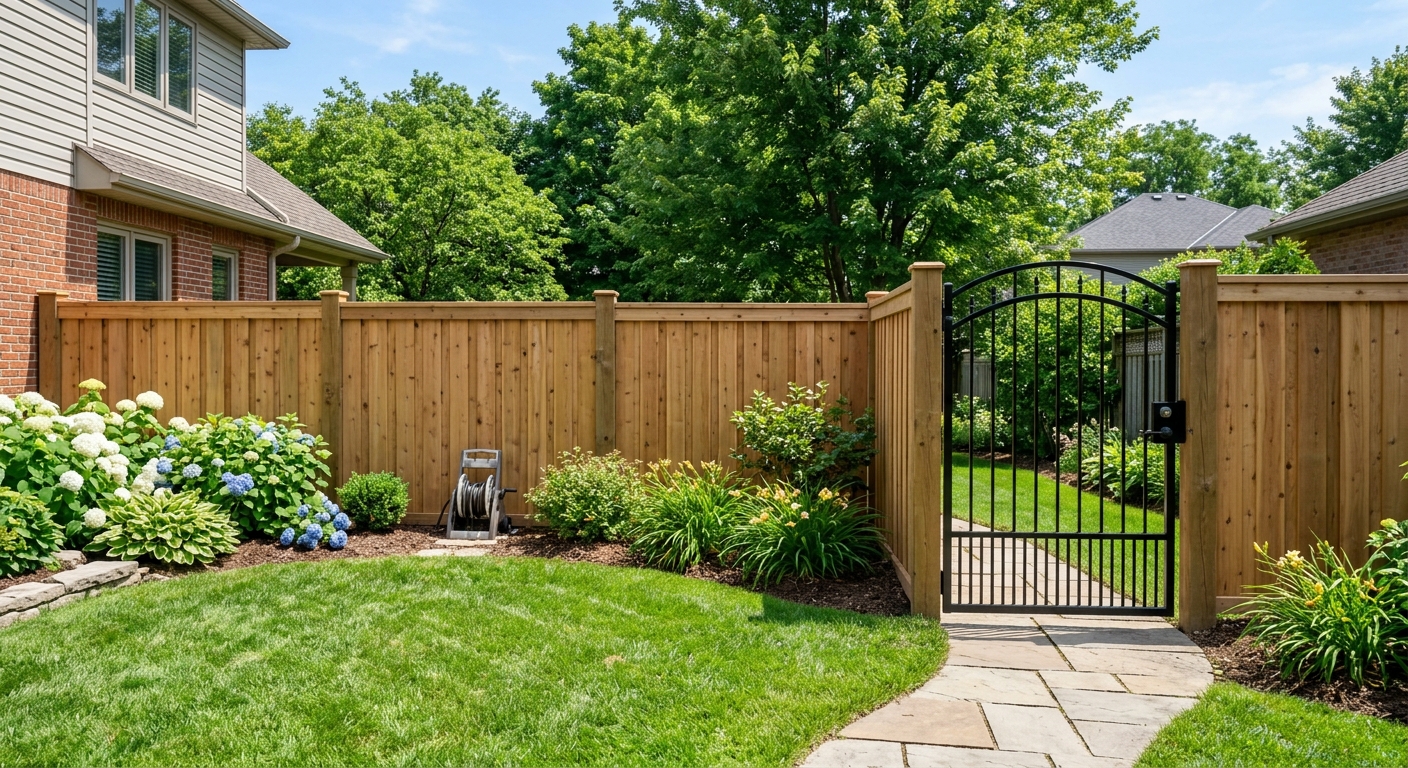
Fencing options and costs in Innisfil
Innisfil is a fast-growing community where fencing demand closely tracks housing ownership and the mix of home types. With 85.7% of local households owning their homes and 90.5% of dwellings being single-detached, many neighbours are looking to add privacy, define yards, or secure properties as families settle in. (Statistics Canada, 2021 Census) That combination—lots of backyard space and long-term ownership—creates steady work for contractors and keeps turnaround times competitive in peak season.
In the Kitchener–Waterloo–Barrie region, pricing is shaped by Ontario’s freeze–thaw cycle and how it affects fence foundations. Here, the frost line typically means post holes must go deeper than in warmer parts of Canada, and concrete-set posts are standard for most wood, vinyl, and aluminum privacy fences—especially 6 ft installs—so panels don’t shift or lean over time. Contractors also price in wind-and-racking resistance for taller sections, with tighter post spacing often used on privacy runs across open lots and newer subdivision backyards.
Innisfil’s demand is especially noticeable around Cookstown Road and the newer development pockets closer to Innisfil Beach Park, where privacy screening and boundary definition are common reasons for homeowners to replace older fencing. Once you know the material paths, comparing typical lifespan and price per linear foot will make your quote easier to evaluate—see the table below.
| Material |
Lifespan |
Maintenance |
Privacy Rating |
Price per Linear Foot |
| Pressure-treated pine (standard wood) |
10–15 years |
Stain/seal every 2–3 years |
High (solid panels) |
$45 – $70 |
| Cedar (natural rot resistance) |
15–25 years |
Light staining/cleaning every 2–4 years |
High (solid boards) |
$55 – $85 |
| Vinyl / PVC (no-maintenance) |
20–30 years |
Wash only; no staining |
High (slat/solid styles) |
$55 – $90 |
| Chain-link (galvanized steel) |
20–35 years |
Minimal; occasional tension checks |
Low (security only) |
$35 – $60 |
| Aluminum ornamental |
25–40 years |
Wash; inspect hardware |
Low–Medium (decorative pickets) |
$60 – $110 |
| Composite / recycled material |
20–30 years |
Low; rinse and spot-clean |
High (privacy panels) |
$70 – $120 |
Prices are estimates only and vary by project scope, site access and material selection.
What affects the price of fencing in Innisfil
Innisfil fence quotes can swing by 30–50% for the same overall “look” because the real drivers are hidden in the foundation work, layout complexity, and what’s included in the scope. In the Kitchener–Waterloo–Barrie region, contractors typically set posts deep and often use concrete-set installations due to Ontario’s frost effects, while labour and material costs remain closely tied to broader Ontario averages. In other words, two homeowners can both choose a 6 ft privacy fence, but one yard may require more posts, deeper holes, racking for slope, or additional prep due to existing fence removal—turning a mid-band wood job into a higher total.
Frost line depth matters because posts must be placed roughly 4–6 inches below the design frost depth to reduce heaving risk. In cold Ontario conditions, that often translates to deeper augering and more concrete per post than in milder climates; longer posts also mean higher material cost. On top of that, freeze–thaw cycling can expose weak post bases, so crews price in proper setting methods rather than shortcuts. Wind exposure isn’t “Prairie-level,” but gusts across open farmland and new subdivision lots still create racking risk, which can lead to tighter post spacing (commonly 6–8 ft centres for privacy) and sturdier rails.
Concrete examples from common Innisfil scenarios: (1) replacing an old fence with rotten posts usually adds disposal fees and extra excavation time; (2) a sloped backyard that needs stepped panels increases labour and sometimes adds materials; (3) upgrading from a budget pressure-treated pine run to cedar or vinyl can be justified when you want better longevity—moving from the wood band of $45 – $70 closer to the cedar or vinyl ranges where appearance and maintenance trade-offs improve.
When homes built before 1981 make up 34.6% of the housing stock, many projects involve older boundaries, settled ground, or previous repairs, which can add time to “make the line straight” and verify pin locations—so quote comparisons should always include the foundation and layout details, not only the material name. (Statistics Canada, 2021 Census)
| Price Factor |
Why It Matters |
Cost Impact |
| Fence length in linear feet — the primary cost driver |
More footage means more posts, rails, and fasteners. |
High; typically the biggest portion of the total |
| Post depth required — frost line determines post length and hole depth |
Deeper holes require longer posts, deeper augering, and more concrete. |
Medium–High, especially for 6 ft privacy fences |
| Post setting method — concrete vs. gravel pack vs. driven posts |
Concrete-set posts resist heaving and leaning in freeze–thaw zones. |
Medium; can noticeably change labour and material totals |
| Material choice — vinyl vs. cedar vs. chain-link |
Durability, rail/panel design, and hardware differ by system. |
Medium; shifts project totals into different price bands |
| Gate count and type — walk-through vs. drive-through (double) |
Gates need reinforced frames, hinges, latches, and more careful alignment. |
Medium–High depending on gate size/number |
| Grade and terrain — sloped yards require stepped or raked panels |
Stepping/raking affects layout time and board cutting. |
Medium; adds labour and sometimes additional material |
| Old fence removal and disposal |
Hauling and disposal add time; hidden post depth can increase excavation. |
Low–Medium; can become Medium on large removals |
| Permit fees and survey / property line locate |
Some installations need verification and documentation. |
Low–Medium; varies by complexity and municipality requirements |
Permits & regulations in Ontario
In Ontario, whether your fence needs a building permit usually depends on the height, location, and placement. As a practical rule of thumb for many residential situations, fences above about 2.0 m (6.5 ft) at the rear and roughly 1.0–1.2 m (3–4 ft) at the front or corner often trigger a permit requirement. Regardless of height, you must respect property lines and any municipal setback requirements that apply to your specific lot. Innisfil homeowners should also remember that digging changes the ground you share with utilities—so utility locates aren’t optional.
Before any post hole is dug, call for utility locates through Ontario One Call. Next, get a survey or at least a property pin locate so your fence line doesn’t drift onto a neighbour’s land. This is especially important when you’re replacing an older fence that may have been installed slightly off over time.
Shared fence ownership is handled under Ontario’s line-fence principles, which focus on shared maintenance responsibilities and the ability to reach agreements between neighbours. If you’re replacing a fence that’s on or near a shared line, confirming who maintains what up front prevents disputes later.
How to verify a contractor in Ontario: check their Ontario licensing details online, request a current certificate of insurance naming you as the interested party if required, and confirm they have WSIB/WCB coverage where applicable. A written clearance letter is often the fastest proof for coverage status—ask for it before signing. For fences that do require permits, a reputable contractor should clearly state who pulls the permit and when inspections happen.
Choosing the right fence material for Innisfil
Choosing the right fence material in Innisfil is really about matching your priorities—privacy, low maintenance, budget, and lifespan—to a climate that brings deep freezes and freeze–thaw cycles. Pressure-treated pine is the most budget-friendly privacy approach, but it typically needs staining or sealing every 2–3 years to reduce grey weathering and moisture damage. Cedar costs more up front, yet many homeowners pick it for its natural rot resistance and better look as it weathers; you’ll still want periodic maintenance to preserve colour and reduce surface checking.
Vinyl/PVC is popular when you want “set it and forget it.” It’s no-maintenance compared to wood, and it handles Ontario winters well when installed correctly—but in extreme cold it can be more prone to panel cracking if the system isn’t properly supported or if posts shift. Chain-link is the most economical and longest lasting for security, but it doesn’t deliver privacy unless you add screening (plants or privacy slats), and wind can still move it if the framework isn’t tightened properly. Aluminum ornamental offers an attractive, rust-resistant look with a mid-range cost, but it won’t meet privacy goals on its own.
On post foundations, the Kitchener–Waterloo–Barrie freeze environment generally supports concrete-set posts for most wood and vinyl privacy fences, because deeper augering and firm setting reduce leaning over winter cycles. For tall privacy runs, crews often build with tighter spacing to resist racking from gusts and the weight of snow on some panel styles.
Example of where price differences do (or don’t) make sense: if your budget fits the wood band around $45 – $70, pressure-treated pine can be a smart value—especially if you’re willing to stain every few years. But if you want a longer service life and lower upkeep, stepping toward the vinyl band of $55 – $90 can be justified when you’d otherwise spend time and labour on regular wood maintenance.
| Material |
Cold Tolerance |
Lifespan |
Annual Maintenance |
Best For |
Price Band |
| Pressure-treated pine |
Good with concrete-set posts |
10–15 years |
Inspect hardware; plan staining every 2–3 years |
Budget privacy with periodic upkeep |
$45 – $70 |
| Cedar |
Very good |
15–25 years |
Light cleaning; stain/seal every 2–4 years |
Privacy plus attractive appearance |
$55 – $85 |
| Vinyl / PVC |
Good; must be properly supported in winter |
20–30 years |
Wash as needed |
Low-maintenance privacy |
$55 – $90 |
| Chain-link |
Excellent |
20–35 years |
Minimal; tension/hardware checks |
Security on a tighter budget |
$35 – $60 |
| Aluminum ornamental |
Excellent |
25–40 years |
Wash; inspect fasteners |
Decorative boundary and long life |
$60 – $110 |
| Composite / recycled |
Good with solid post support |
20–30 years |
Low; rinse and spot-clean |
Privacy with reduced upkeep |
$70 – $120 |
How to choose a fencing contractor in Innisfil
Choosing the right fence contractor in Innisfil starts with proof of coverage and a clear scope. In Ontario, ask for their Ontario licensing details (or the correct registry reference if they operate under a business name), then verify liability insurance with a current certificate of insurance. Also confirm WSIB/WCB coverage where applicable—request either an up-to-date clearance letter or direct evidence of coverage status so you’re not responsible for worksite injuries. A trustworthy contractor will treat these as routine paperwork, not special requests.
For pricing, get 2–3 itemised written quotes instead of a single lump-sum number. Itemisation should show labour, excavation/post setting method (for example, concrete volume or concrete-set standard), line items for gates, and material breakdown by fence type (posts, rails, pickets/panels, fasteners). Make sure exclusions are explicit: permit pulling, disposal/haul-away for an old fence, utility mark-up compliance, and any survey/pin locate responsibility.
Warranty should be specific. Ask how long the workmanship warranty lasts, and separate it from manufacturer product warranty. Also confirm whether warranties are transferable to future owners—many homeowners benefit if they plan to sell.
Payment schedule: never pay more than 10–15% upfront. Hold back a portion until the job is complete, aligned, and cleaned up. Get a written start date and a realistic completion estimate that accounts for curing time where concrete-set posts are used.
- Provide an itemised quote (labour + materials + equipment)
- Clarify post depth and setting method in writing
- Confirm gate hardware quality (hinges, latch type, reinforcement)
- State whether permit pulling is included (if applicable)
- Confirm disposal/haul-away of old fence materials
- List warranty length for workmanship and products separately
- Show certificate of insurance and confirm you’re covered
- Verify WSIB/WCB clearance letter or coverage evidence
- Insist on a written start date and completion timeline
- Confirm how they handle sloped yards (stepped vs. raked)
- Ask who verifies property lines and utility locates
- Use a payment schedule with a meaningful holdback
Red flags I see too often in Innisfil: quotes that don’t specify post depth or setting method, unwillingness to provide insurance/coverage paperwork, lump-sum pricing without a scope sheet, promises of “no permit needed” without checking fence height/location rules, and schedules that can’t give a written start/completion estimate.
Frequently asked questions — fencing in Innisfil
Who owns and maintains a shared fence?
In Innisfil, shared fence ownership typically follows Ontario’s line-fence approach: where neighbours share a boundary fence, responsibilities for maintenance are usually shared based on the agreement and the fence’s purpose and location. In practice, homeowners should confirm whether the fence is on a shared line, who installed it originally, and whether your neighbour agrees to shared upkeep (or contributes to replacement). If you’re replacing an older run, it’s smart to discuss scope (repairs vs full replacement) and agree on what each party pays for before work starts. If there’s any uncertainty about the exact line, obtain a survey or pin locate first—fixing an encroachment after the fact is far more expensive than clarifying it upfront. (Ontario rules apply; local site conditions can still vary.)
How do I find my property line before fencing?
For fencing in Ontario, don’t rely on “where it looks like it is.” Before digging posts in Innisfil, confirm property pins or have a survey/locate completed so your fence aligns with the true boundary. Start by locating any legal survey markers (pins) that identify corners and property limits, then mark the intended fence line. After you know the boundary, call for utility locates through Ontario One Call before any augering. This sequence reduces the risk of encroaching on a neighbour’s land and avoids surprises like hidden buried services. It can also prevent rework that increases labour costs—especially since deeper frost-safe post holes can’t be easily “moved” once concrete is set.
What's the most low-maintenance fence?
For most Innisfil homeowners, vinyl/PVC is the most low-maintenance option: it typically needs only occasional washing and doesn’t require annual painting or repeated staining. In Ontario’s freeze–thaw climate, the key is proper installation—solid post support and correct spacing so panels don’t rack and crack in extreme cold. If you want a practical cost reference, vinyl privacy installs often land in the $55 – $90 range depending on height, gate count, and post setting. By comparison, pressure-treated pine usually costs less up front (often $45 – $70) but generally requires staining/sealing every 2–3 years to manage weathering. If you want “minimum effort,” vinyl is usually the best fit.
How tall can my fence be in Innisfil?
Fence height rules in Ontario are typically tied to where the fence is located (front/corner vs rear) and can trigger permit requirements. As a general planning guide used by many homeowners in Ontario: rear fences often require extra attention when exceeding about 2.0 m (6.5 ft), while front/corner fences are commonly limited around 1.0–1.2 m (3–4 ft). Innisfil-specific bylaw details can vary by lot and context, so the safest approach is to confirm your intended height and location before ordering materials. A contractor should also help you determine whether a permit is needed and who pulls it. If a permit is required, waiting to learn after posts are planned can delay the schedule and add rework costs.
Should fence posts be set in concrete here?
In Innisfil and the wider Kitchener–Waterloo–Barrie region, concrete-set posts are the standard for most privacy fencing because freeze–thaw cycles can cause heaving and leaning if posts are only dry-set. Posts are typically installed deeper to account for frost protection (often roughly 4–6 inches below the design frost depth), which is why concrete and deeper augering are common in quotes. That said, the correct method depends on soil conditions, fence type, and the contractor’s engineered approach. A well-prepared quote should specify the post depth and setting method rather than treating “concrete vs not” as an afterthought. If your quote is unusually low compared with the local ranges (for example, $45 – $70 for wood), ask whether concrete-set posts and proper hole depth are actually included.
What's the best fence for privacy?
For privacy in Innisfil, the best choices are solid-panel systems: wood privacy (pressure-treated pine or cedar) or vinyl/PVC privacy styles. These provide high privacy ratings because boards or solid slats block sightlines rather than offering open pickets. Climate-wise, the important part is how the fence is built for winter: deeper frost-safe post holes and sturdy rails to resist racking during gusty days and freeze–thaw movement. Budget typically starts around the wood band of $45 – $70 for standard wood installations; cedar and vinyl often price higher, with vinyl privacy frequently falling around $55 – $90. If you want privacy with the least maintenance, vinyl privacy is often the most convenient; if you want the best “natural look,” cedar is a strong option.