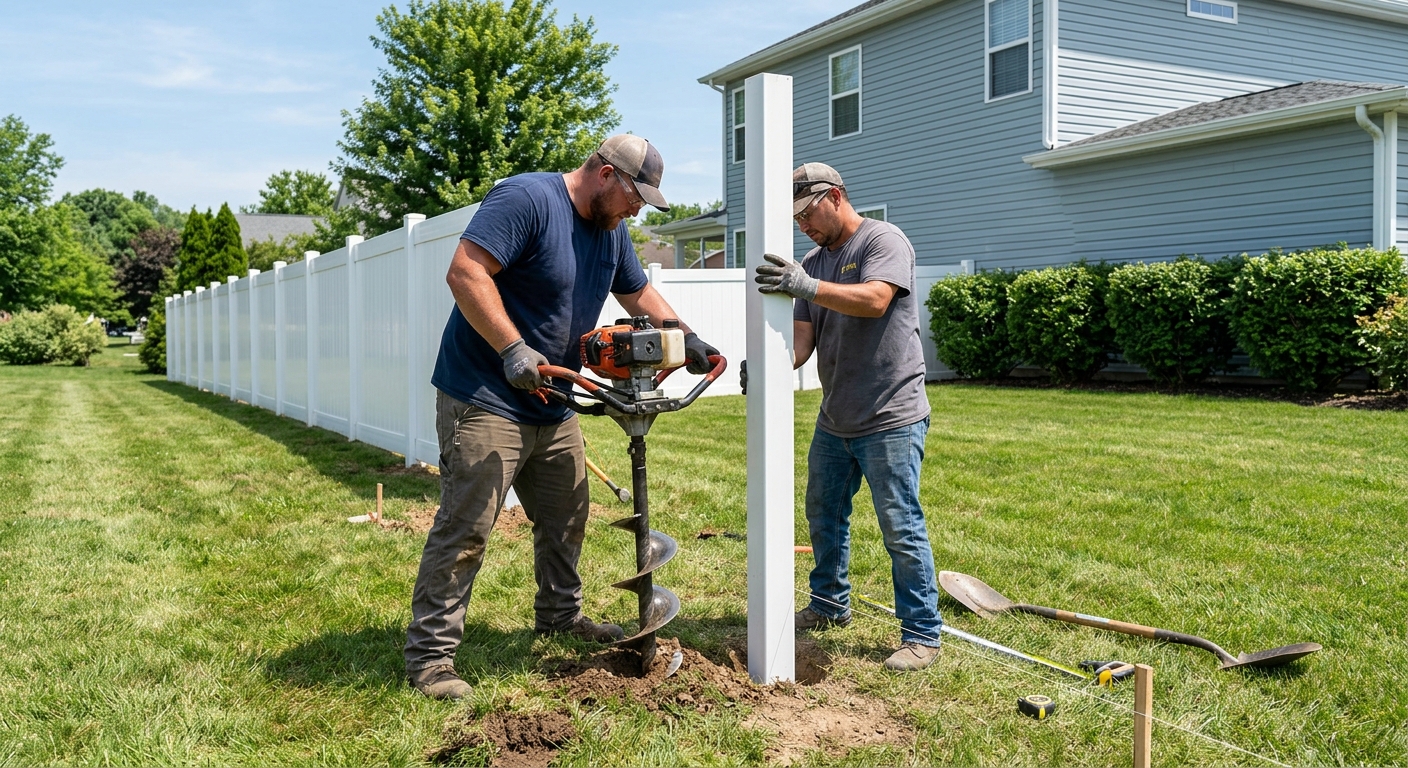
Fencing options and costs in College Park
College Park homeowners typically shop for fencing with two goals in mind: reliable privacy and a fence that survives Toronto’s freeze–thaw cycles. With a local population of 4,072 (Statistics Canada, 2021 Census), demand concentrates around older residential pockets where backyards and corner lots are common, and where neighbours value consistent sightlines. In practical terms, that makes each replacement project feel competitive on scheduling—especially during spring and early summer when crews are busiest. The Toronto economic region’s climate also plays a major role in pricing: frost in Southern Ontario is commonly planned at about 42"–48", so posts for taller fences are usually set deeper to reduce heave risk. For 6–8 ft privacy fences, that commonly means concrete-set posts rather than simple driven posts, which increases labour time and ready-mix costs but improves long-term stability.
On top of that, wind still matters even in the GTA—solid panels rack, and taller fences need heavier posts and closer spacing (often 6–8 ft centres) to stay straight after winter storms and spring thaws. In College Park, fence demand is especially noticeable in the older residential streets near community-serving parks, where backyard layouts and lot lines tend to create more shared boundary work. Those variables are exactly what you’ll see reflected in the comparison below.
| Material |
Lifespan |
Maintenance |
Privacy Rating |
Price per Linear Foot |
Price Range |
| Pressure-treated pine (standard wood) |
10–15 years |
Stain/seal every 2–3 years |
High (solid panels) |
$14–$24 |
$65 – $120 |
| Cedar (natural rot resistance) |
15–25 years |
Light stain as needed (often every 3–4 years) |
High (solid panels) |
$17–$28 |
$75 – $130 |
| Vinyl / PVC (no-maintenance) |
20–30 years |
Occasional rinse only |
High (solid/board style) |
$18–$32 |
$75 – $130 |
| Chain-link (galvanized steel) |
25–35 years |
Wash down; treat damage only |
Low (visible through) |
$10–$16 |
$45 – $85 |
| Aluminum ornamental |
25–40 years |
Rinse; repair small sections if hit |
Medium–Low (open pickets) |
$17–$30 |
$90 – $160 |
| Composite / recycled material |
20–30 years |
Minimal (wash/spot clean) |
High (board style) |
$20–$34 |
$80 – $150 |
Prices are estimates only and vary by project scope, site access and material selection.
What affects the price of fencing in College Park
In College Park, it’s common to see quotes for the “same” fence swing by 30–50% across Toronto and Ontario because the scope rarely matches: post style and depth, hardware upgrades, rail spacing, and disposal all change the real build time. Climate is a big driver here. The frost line in Southern Ontario is often planned around 42"–48", and best practice commonly sets posts about 4–6" below the design frost depth—meaning hole depths that can easily land in the 1.5–2.0 m range. That pushes contractors toward longer posts and concrete-set installation, which increases labour and ready-mix costs. Even though the GTA isn’t as extreme as Prairie wind, tall solid fences still need stronger framing to prevent racking, which can raise material costs compared with lighter designs.
Concrete examples from Toronto-area builds: if your backyard is clay-heavy, excavating to frost-safe depth can take longer and consume more gravel and concrete to achieve straight, stable posts—often nudging wood pricing toward the upper part of the $65 – $120 band. On a vinyl privacy fence, the posts and heavier bracing for wind stability can reduce the “savings” you’d expect versus basic fencing, but the no-maintenance benefit can justify the $75 – $130 range when you factor in years of staining labour avoided. Meanwhile, chain-link can look inexpensive on paper (often within $45 – $85), but adding privacy slats, increasing height, or securing to existing structures can close the gap.
Finally, the job economics depend on access and yard conditions. A fenced lot with narrow gates or steep driveways can add hauling time; older fencing removal also increases disposal and labour, especially when material is mixed (wood, wire, and hardware) and needs separation.
| Price Factor |
Why It Matters |
Cost Impact |
| Fence length in linear feet |
The biggest cost driver: posts, rails, panels, and materials scale directly with length. |
High (often 40–70% of total cost) |
| Post depth required |
Frost depth determines hole depth and post length for stability through freeze–thaw. |
Medium–High |
| Post setting method |
Concrete-set posts resist frost heave better than driven posts, but use more labour and materials. |
Medium–High |
| Material choice |
Vinyl and cedar cost more upfront; chain-link and aluminum can change labour and hardware needs. |
Medium (shifts the whole budget band) |
| Gate count and type |
Gates require heavier frames, hinges, latches and often reinforced posts. |
Medium |
| Grade and terrain |
Sloped yards need stepped panels or raked installation, affecting layout and material waste. |
Low–Medium |
| Old fence removal and disposal |
Demolition time, dump fees, and handling mixed materials add cost. |
Medium |
| Permit fees and survey / property line locate |
Locates reduce dispute risk; permits may be required for taller rear fences. |
Low–Medium (can be high if issues arise) |
Permits & regulations in Ontario
In Ontario, fence rules are tied to both height limits and property-line setbacks, and permits can apply depending on where the fence sits. As a practical threshold, many municipalities treat taller fences—often around 2.0 m (6.5 ft) at the rear and about 1.0–1.2 m (3–4 ft) at the front or corner—as the point where a building permit may be required. Your local bylaw can vary, so the safe approach is to confirm the limit for your exact address before digging. Regardless of height, all fences must respect property lines and any municipal setback bylaws.
Before installing any posts, you also need to plan for utility locates. Use Ontario One Call so technicians can mark buried cables, gas lines, and other services—this is essential prior to hole digging. If you don’t have clear property line markers, get a survey or a proper property line locate to avoid encroachment disputes with neighbours.
Shared fence ownership is handled by Ontario’s line-fence approach: if a fence is on the boundary, neighbours typically share responsibility. If the fence is entirely on your property, you’re responsible for that section’s maintenance and replacement.
To verify a contractor properly in College Park and across Ontario, ask for: (1) an Ontario business registration and the contractor’s proof of identity, (2) a current Certificate of Insurance showing liability coverage, and (3) proof of WSIB clearance/coverage where applicable (you can request their WSIB account number and clearance status). Keep copies of all certificates and ensure the insurance covers fencing installation work.
Choosing the right fence material for College Park
Choosing the right fence in College Park comes down to how you use your yard: privacy for backyards, durability through winter, and how much maintenance you’re willing to do. Pressure-treated pine is the budget-friendly option and installs efficiently, but it needs staining or sealing every 2–3 years to reduce grey weathering and keep the wood from drying and splitting. Cedar gives a nicer look and naturally resists rot, often lasting longer, but it still benefits from periodic maintenance to keep colour consistent and protect exposed ends. Vinyl/PVC is the low-hassle choice—no staining—and it resists rot, but it can be vulnerable to cracking if installed with poor spacing or if panels flex too much in cold snaps, so proper post depth and bracing matter. Chain-link lasts well and is usually the most economical, but it won’t give true privacy unless you add slats or a privacy screen (which changes both performance and cost). Aluminum ornamental is corrosion-resistant and good for curb appeal; however, privacy is typically medium-to-low due to its open design.
Because Southern Ontario frost depth is commonly planned around 42"–48", Toronto-area builds typically require concrete-set posts for 6–8 ft fence heights to prevent frost heave. That means your cost isn’t just about the material—it’s also about getting the post length and hole depth right for stable panels and consistent spacing against wind and snow loads. In exposed corners and near more open areas, heavier posts and tighter centres are often specified.
A simple dollar example: if you’re choosing between wood and vinyl privacy, it’s common to pay around the difference between the $65 – $120 wood band and the $75 – $130 vinyl band, but the justification is maintenance. If you’d otherwise budget staining labour and materials every 2–3 years, vinyl can “earn back” the upgrade over time—especially when you’d rather spend weekends enjoying the yard than re-staining fence boards.
| Material |
Cold Tolerance |
Lifespan |
Annual Maintenance |
Best For |
Price Band |
| Pressure-treated pine |
Good when posts are concrete-set and boards are protected |
10–15 years |
Low seasonal checks; stain/seal typically every 2–3 years |
Budget privacy with straightforward upkeep |
$65 – $120 |
| Cedar |
Good in freeze–thaw; performs well with proper framing |
15–25 years |
Occasional staining as needed, often every 3–4 years |
Better appearance and rot resistance |
$75 – $130 |
| Vinyl / PVC |
Very good; requires proper spacing and secure posts in cold |
20–30 years |
Near-zero (rinse/spot clean) |
Low-maintenance privacy and clean look |
$75 – $130 |
| Chain-link |
Excellent; galvanized steel handles Ontario winters |
25–35 years |
Minimal (wash down; repair damaged areas) |
Security and long life without privacy |
$45 – $85 |
| Aluminum ornamental |
Excellent; won’t rust like steel |
25–40 years |
Minimal (rinse and tighten hardware if needed) |
Curb appeal and boundary definition |
$90 – $160 |
| Composite / recycled |
Good; stable boards in cold when installed correctly |
20–30 years |
Low (wash/spot clean) |
Durable privacy with reduced upkeep |
$80 – $150 |
How to choose a fencing contractor in College Park
Choosing the right fence contractor in College Park starts with proof and clarity. In Ontario, fencing contractors should carry liability insurance (so you’re not exposed if something is damaged), and they should be able to confirm WSIB coverage or provide the appropriate clearance status for their workers. To check: request their Certificate of Insurance and ensure it names you as the certificate holder if your contract requires it; ask for their WSIB clearance letter or account status. If they can’t provide these documents readily, move on. Also verify you’re dealing with a legitimate Ontario business—clear contact details, a real mailing address, and a written quote.
Next, get 2–3 itemised written quotes. A proper quote breaks down labour, concrete/post setting, materials (rails, panels, fasteners), gate hardware, and any removals/disposal. Avoid lump-sum quotes with vague inclusions. Read the scope for exclusions: is the permit pull included or extra? Is old fence demolition included? Who disposes of materials and pays dump fees? Confirm whether property line locate or survey is included if needed.
Warranty matters too: ask for the workmanship warranty length (often separate from product warranties) and whether it’s transferable if you sell your home. Payment schedule should be conservative—never pay more than 10–15% upfront. Hold back the remainder until the final walkthrough confirms alignment, post stability, gate operation, and clean-up.
Finally, insist on a start date and completion estimate in writing. In the Toronto market, crews can get booked quickly, and a written schedule protects you from delays and change-order confusion.
- Confirm they provide an itemised quote (labour vs materials vs concrete setting).
- Ask for proof of liability insurance and request the COI details.
- Request WSIB clearance/coverage confirmation in writing.
- Verify who pulls any permit and whether it’s included in the price.
- Ensure utility locates are included before post-hole digging.
- Check whether they set posts in concrete for privacy height fences.
- Ask about post spacing and panel bracing for wind stability.
- Confirm how they handle slopes (stepped vs raked panels) and grading.
- Review gate details: hinges, latch type, and reinforced posts.
- Clarify old fence removal and disposal inclusions.
- Confirm cleanup standards (haul-away, leveling, and final site walk-through).
- Get warranty terms for both workmanship and product, in plain language.
Red flags in College Park include: refusing to provide insurance/WSIB documents, quoting without specifying post depth and setting method for tall privacy fences, using unclear “allowances” instead of itemised line items, demanding large upfront payments, and starting work before utility locates or without a clear plan for property lines.
Frequently asked questions — fencing in College Park
Who owns and maintains a shared fence?
In Ontario, shared fences generally fall under the concept of line fences and boundary responsibility. If the fence is truly on or designated along the property line, neighbours commonly share maintenance and replacement, and disputes are handled through provincial line-fence rules. If a fence is entirely on your side, you’re responsible for that portion. For homeowners in College Park, the easiest way to avoid issues is to get a property line locate (or use your survey pins) before upgrading height or replacing damaged sections. When discussing repairs, ask your contractor to measure from identifiable boundaries and document the layout so both parties understand what’s being replaced. Also keep written agreements if the neighbour is contributing to costs, so there’s no confusion later.
How do I find my property line before fencing?
Before you install posts, confirm where your property line sits to prevent encroachment. Start by locating your survey documents or your property pins—many older College Park homes have markers tied to a survey, but they can be hard to see once yards settle. If you don’t have clear markers, hire a surveyor for a locate, or request a property line locate through a qualified professional. Then ensure your contractor measures off the located pins, not off a guess based on “it looks right.” Also schedule utility locates through Ontario One Call before anyone digs. For tall fences, this step matters even more because post placement depth (often driven by frost considerations) means you’ll be disturbing ground well beyond a simple surface adjustment.
What's the most low-maintenance fence?
For most Ontario homeowners, vinyl/PVC is the lowest-maintenance option because it doesn’t need staining and generally only requires occasional washing. Cedar and pressure-treated wood can look great but still require periodic sealing/staining to manage weathering and splitting, particularly through Toronto’s wet freeze–thaw cycles. Chain-link is also low maintenance in terms of materials, but it offers little privacy unless you add slats or a screen system. If you want privacy without annual upkeep, vinyl privacy typically lands in the Toronto-area band of about $75 – $130 installed, depending on height, gates, and how deep the concrete-set posts must go. In windy pockets or where fences need extra bracing, the cost can move toward the upper end of the range.
How tall can my fence be in College Park?
Height limits are usually tied to where the fence sits (rear yard versus front/corner) and local bylaws. In Ontario, many municipalities treat fences around 2.0 m (6.5 ft) at the rear and about 1.0–1.2 m (3–4 ft) at the front or corner as the point where permits may be required, but you must confirm the exact rule for your address. For College Park homeowners, the safer approach is to ask your contractor to confirm local requirements before ordering materials—because the moment you exceed the threshold, your project may need a building permit and more documentation. If you’re adding privacy, remember that taller solid fences need heavier posts and closer spacing for wind stability, so even when height is allowed, your quote may change.
Should fence posts be set in concrete here?
For tall privacy fences in College Park, concrete-set posts are usually the best practice because frost heave risk in Southern Ontario can loosen or shift posts if you use gravel packs or driven posts only. The typical planning is that frost depth is around 42"–48", and contractors often set posts about 4–6 inches below the design frost line—commonly putting post holes around 1.5–2.0 m deep. That depth is why concrete is frequently used: it creates a stable footing through freeze–thaw cycles and supports heavier panel loads. For budget chain-link fencing, some jobs can use alternative setting methods, but for 6–8 ft privacy, concrete is often part of the reason wood and vinyl projects sit in the higher bands, commonly $65 – $120 for wood and $75 – $130 for vinyl/PVC.
What's the best fence for privacy?
For real privacy, look for solid panel styles: board-on-board wood, cedar privacy boards, vinyl privacy panels, or composite board systems. Chain-link generally won’t provide privacy unless you add slats or a screen, and aluminum ornamental is usually open and more decorative than private. In College Park and the Toronto area, the best privacy fence isn’t only about the material—it’s also about structural stability for winter conditions. Tall solid fences rack under wind and can shift if posts aren’t set correctly. That’s why concrete-set posts and appropriate post sizing/spacing matter as much as choosing between pressure-treated pine versus cedar or vinyl. If you want low-maintenance privacy, vinyl privacy often fits the $75 – $130 installed band; if you prefer a natural look and can manage periodic staining, pressure-treated wood commonly fits around the $65 – $120 band.