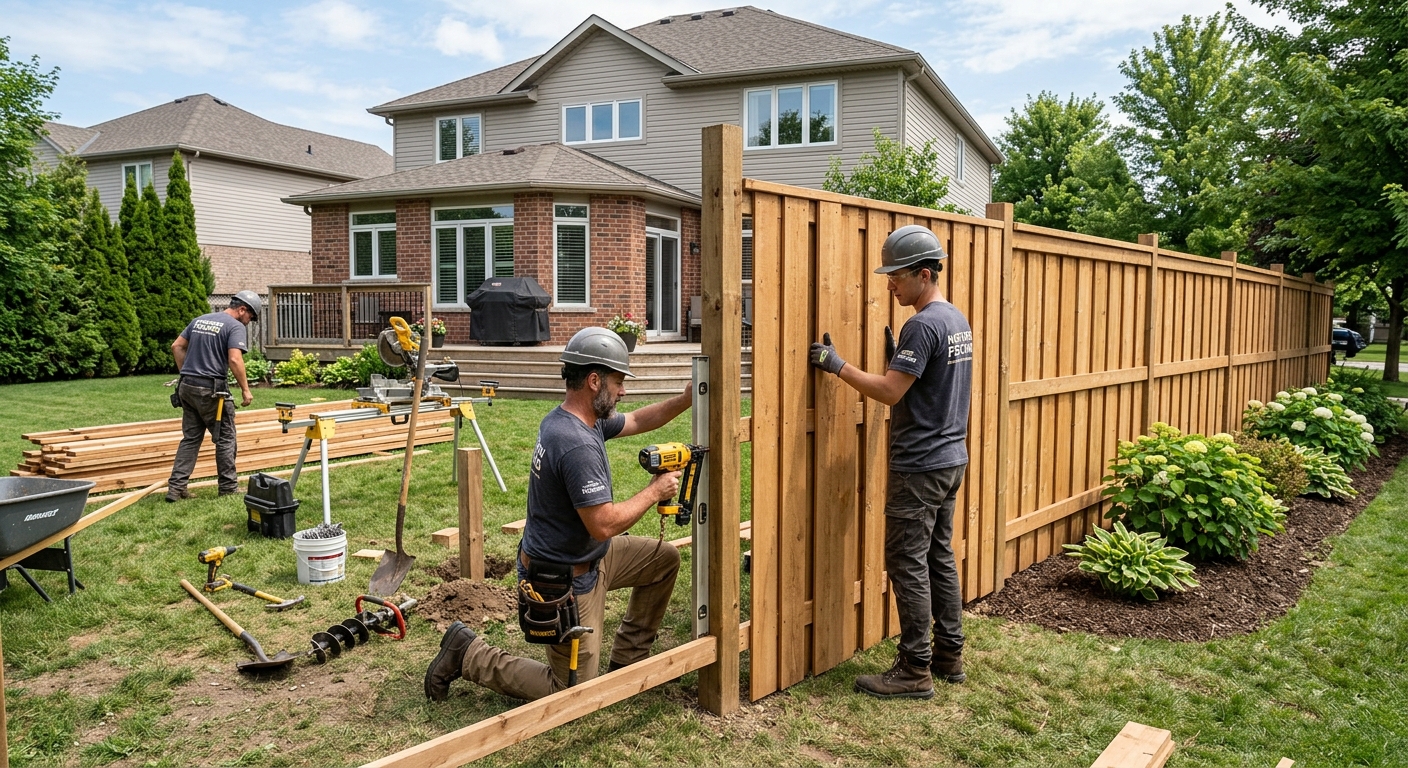
Fencing options and costs in Tecumseh
Tecumseh homeowners usually start their fence search with two questions: “What do I get for my budget?” and “How long will it last in our weather?” With Tecumseh at about 23,300 people and roughly 7,945 homeowner households (88.8% of households own) (Statistics Canada, 2021 Census), the demand pattern is steady: detached neighbourhoods, plus family yards that need back-gates and pool-area barriers, create consistent work for fence crews. Tecumseh also has a lot of older housing stock (40.2% of homes built before 1981) (Statistics Canada, 2021 Census), which often means more mature trees, settled grading, and more frequent fence replacement—plus a higher chance of needing careful line-matching to existing boundaries.
In the Windsor–Sarnia corridor, frost behaves like a southern Ontario “hard stop,” even if we don’t get the extremes you see farther north. Our frost line is roughly 1.2 m (about 4 ft), so post holes and structural footings must be set below the heaving zone. That depth is a major cost driver because it increases digging time, concrete volume, and labour—especially on tight lots or where access is limited. We also see meaningful wind loads in exposed areas near open fields and the Lake Erie/Lake Huron corridor; that’s why we tighten post spacing and choose sturdier rails and posts for taller privacy styles. In Tecumseh, this trade is especially active around neighbourhoods like “Walkerville” style street grids and the Lakeshore Road corridor where lots are often longer and gates are common.
Below is a practical comparison of common materials you’ll see in Tecumseh quotes, along with typical lifespan, maintenance expectations, and price ranges before site-specific adjustments.
| Material |
Lifespan |
Maintenance |
Privacy Rating |
Price per Linear Foot |
| Pressure-treated pine (standard wood) |
10–15 years |
Stain or seal every 2–3 years (weathering/graying common if neglected) |
Good (solid boards) |
$17 – $30 |
| Cedar (natural rot resistance) |
15–25 years |
Light staining every 2–4 years to maintain colour and reduce surface checking |
Good to very good (board-on-board) |
$22 – $38 |
| Vinyl / PVC (no-maintenance) |
20–30 years |
Occasional rinse; no painting, but inspect for cracking in extreme cold and adjust fasteners if needed |
Good (solid infill) |
$25 – $45 |
| Chain-link (galvanized steel) |
20–35 years |
Minimal; hose-off and occasional tension/hardware checks |
Low (can add privacy slats if desired) |
$13 – $26 |
| Aluminum ornamental |
25–40 years |
Wash yearly or as needed; inspect for loose brackets after freeze-thaw |
Low to medium (open pickets) |
$28 – $50 |
| Composite / recycled material |
20–30 years |
Minimal; clean as needed; follow fastening guidance to avoid flexing in cold snaps |
Good (solid panels) |
$30 – $55 |
Prices are estimates only and vary by project scope, site access and material selection.
What affects the price of fencing in Tecumseh
In Tecumseh and the Windsor–Sarnia region, two contractors can quote the “same” fence and still end up 30–50% apart. Most of that difference comes down to how each company accounts for the realities of setting posts below the frost line, handling wind load, and building around your site constraints. In Ontario, we design around a southern frost line of about 1.2 m (4 ft). To prevent frost heave, posts typically go at least 3 ft deep, and we often plan 4 ft embedment in exposed or clay-heavy soils—so digging time, concrete volume, and the labour for longer posts all increase. That’s why a wood privacy job can look like a simple “materials + labour” task, yet the foundation work becomes the biggest cost driver.
Wind also shapes pricing here, even though we’re not the open-sky Prairies. In more exposed areas—near the Lake Erie/Lake Huron corridor and open fields—we tighten post spacing and may upsize posts, which increases material. Open styles (like chain-link or aluminum pickets) can relieve wind load compared to solid boards, but they still need structural posts for bracing and gate loads.
Concrete examples from Tecumseh: (1) clay-heavy yards near settled neighbourhoods often require more concrete setting for stability; that can move a pressure-treated wood installation from roughly the $45 – $80 labour band toward the higher end of that range once deeper holes are confirmed. (2) If you’re replacing an old fence with heavy leaning posts, the demo and disposal can add labour on top of your base $65 – $110 vinyl/PVC material selection. (3) A multi-gate pool side can add hundreds to thousands in hardware and stronger framing.
| Price Factor |
Why It Matters |
Cost Impact |
| Fence length in linear feet — the primary cost driver |
More panels mean more posts, rails, fasteners, and labour time |
High (directly scales the total) |
| Post depth required — frost line determines post length and hole depth |
Deeper holes reduce heaving risk but increase excavation and concrete |
High |
| Post setting method — concrete vs. gravel pack vs. driven posts |
Concrete adds materials and labour; driven posts reduce concrete but require proper soil conditions |
Medium to high |
| Material choice — vinyl vs. cedar vs. chain-link |
Material costs vary, and some systems need more structural components for rigidity |
Medium to high |
| Gate count and type — walk-through vs. drive-through (double) |
Gates add hardware, heavier posts, and often diagonal bracing |
Medium to high |
| Grade and terrain — sloped yards require stepped or raked panels |
Slopes can increase labour for layout and sometimes add custom cuts |
Medium |
| Old fence removal and disposal |
Leaning posts, broken rails, and hauling add time and dump fees |
Medium |
| Permit fees and survey / property line locate |
Locates and permits prevent encroachment disputes and delays |
Low to medium |
Permits & regulations in Ontario
In Ontario, fence rules can vary depending on where the fence sits on your property and how tall it is, but there is a common permit threshold homeowners should plan for. As a practical rule of thumb, fences above roughly 2.0 m (6.5 ft) at the rear and around 1.0–1.2 m (3–4 ft) at the front or corner often trigger a building permit requirement. Even when a permit isn’t required, all fences must respect property lines and any municipal setback requirements.
Before any post hole is dug, utility locates are non-negotiable. In Ontario, call Ontario One Call so locators can mark underground services. If you don’t already have accurate boundary information, get a survey or at least a property pin locate before installing—especially if you’re replacing an older fence that may not be perfectly aligned. Shared fence ownership is handled under Ontario line-fences principles, so where the fence is built (and who pays) should be confirmed early.
To verify a contractor, take these steps: (1) ask for their Ontario business details and check their licensing where applicable through the appropriate Ontario sources; (2) request a current certificate of liability insurance showing adequate coverage for fencing work; and (3) confirm WSIB coverage (or discuss the equivalent clearance documentation if they’re exempt). For clarity, ensure the certificate lists your address and the job scope, and keep a copy in your project file.
Choosing the right fence material for Tecumseh
Choosing a fence material in Tecumseh is mostly matching your priorities to how our freeze-thaw cycle and wind affect performance. Pressure-treated pine is the budget-friendly choice, but it’s not “set and forget.” If you want it to look good (and reduce grey weathering and surface splitting), plan to stain or seal every 2–3 years. Cedar is often a step up: it has better natural rot resistance and a warmer appearance, but it still benefits from periodic maintenance to preserve colour and limit surface checking.
For low effort, vinyl/PVC is a strong option. It doesn’t need painting and typically cleans up easily, though in extreme cold it can become brittle if fasteners and rails aren’t installed correctly—so the system must be installed with expansion allowance. Chain-link is usually the lowest upfront price and has the longest “service life per dollar,” but privacy is limited unless you add slats or plant screening. Aluminum ornamental offers a clean, rust-resistant look and mid-range cost, but it’s inherently open for visibility. Composite/recycled boards can deliver solid privacy with minimal upkeep, but they’re often priced closer to vinyl depending on the board profile.
Post depth matters for every material in the Windsor–Sarnia market. With frost line planning around 1.2 m and typical 3–4 ft embedment, concrete-set posts are common where soil is clay-heavy or exposed. The “best value” example: if a pressure-treated pine privacy fence is within the lower wood installation range (often around $45 – $80 labour pricing), spending toward cedar or vinyl only makes sense if you want longer appearance life and you’re willing to maintain wood properly. If you truly want minimal maintenance, vinyl/PVC can justify its higher upfront price (commonly within $65 – $110) because you’re paying to avoid repeated staining cycles.
| Material |
Cold Tolerance |
Lifespan |
Annual Maintenance |
Best For |
Price Band |
| Pressure-treated pine |
Good (may check/split if neglected) |
10–15 years |
Low to moderate: inspection; light touch-ups; stain every 2–3 years |
Budget privacy with planned upkeep |
$45 – $80 |
| Cedar |
Good (natural oils resist rot) |
15–25 years |
Low to moderate: stain/seal every 2–4 years |
Better look + natural rot resistance |
$60 – $100 |
| Vinyl / PVC |
Very good if installed correctly with proper expansion allowance |
20–30 years |
Very low: rinse; check posts/hardware after freeze-thaw seasons |
Low-maintenance solid privacy |
$65 – $110 |
| Chain-link |
Excellent (galvanized coating holds up) |
20–35 years |
Very low: occasional clean and tension checks |
Security with long service life |
$30 – $55 |
| Aluminum ornamental |
Excellent (no rust) |
25–40 years |
Low: wash and tighten hardware as needed |
Attractive perimeter with openness |
$70 – $130 |
| Composite / recycled |
Good (performance depends on fastening detail) |
20–30 years |
Low: clean as needed; inspect for warping or loosened brackets |
Solid privacy with minimal upkeep |
$75 – $125 |
How to choose a fencing contractor in Tecumseh
In Ontario, a legitimate fencing contractor should be easy to verify and should be comfortable showing documentation. Start by requesting proof of liability insurance (a current certificate of insurance is the standard). For work involving risks at your property (excavation, heavy materials, lifting gates), insurance protects both you and their crew. Next, ask about WSIB coverage: if they’re required to carry it, they should provide a clearance letter or the documentation that confirms current status. If they’re not required, they should explain why and provide supporting information.
For pricing, ask for 2–3 itemised quotes that separate labour, posts/footings, materials, gates, hardware, and disposal. Avoid “all-in” lump sums when you can—fencing costs are sensitive to foundation depth, post spacing, and the number of gates. Make sure the quote states whether permits are included or handled by the contractor, and whether old fence removal and hauling are included or billed separately. Clarify what happens if locates reveal conflicts or if the ground conditions differ from assumptions.
On warranty, request: (1) a workmanship warranty length and what it covers (posts, rails, alignment, gate swing), (2) the product/manufacturer warranty for the material system, and (3) whether warranties are transferable to future owners.
Finally, payment should be structured responsibly: never pay more than 10–15% upfront, and use a holdback until the job is fully completed and inspected. Ask for a written start date and a realistic completion estimate based on fence length and gate complexity.
- Confirm liability insurance (certificate is current and includes fencing work)
- Verify WSIB coverage or provide the appropriate clearance documentation
- Ask for an Ontario-ready itemised quote: labour, materials, posts/footings, and gates
- Confirm if permits are included for fences at or above the height threshold (as applicable)
- Check whether utility locates are booked and whether markups are protected during digging
- Ensure the quote states post depth/embedment approach consistent with frost heave prevention
- Clarify post setting method: concrete vs gravel pack vs driven posts (and why)
- List exclusions: tree removal, stump grinding, landscaping repairs, and concrete patching
- Confirm disposal/hauling for old fence materials is included or has a line item
- Get gate hardware details (hinges, latches, closures) and confirm gate count
- Ask for warranty terms in writing (workmanship + product coverage, and transferability)
- Use a conservative payment schedule: small deposit, progressive payments, holdback until completion
Red flags I see in Tecumseh include: quotes that don’t specify post depth or setting method, refusing to provide insurance/WSIB documentation, vague scopes that omit gate hardware details, high deposits (more than 15% up front), and “we’ll figure it out later” language around permits, locates, or boundary alignment.
Frequently asked questions — fencing in Tecumseh
What's the most low-maintenance fence?
For most Tecumseh homeowners, vinyl/PVC is the lowest-maintenance option because it doesn’t require staining and typically only needs occasional rinsing and hardware checks after winter freeze-thaw. If you’re aiming for solid privacy without yearly upkeep, vinyl often hits the sweet spot between cost and effort, and it commonly sits around the $65 – $110 pricing band depending on height, post type, and whether gates are included. Composite/recycled materials can also be low maintenance, but they’re not always cheaper. For very minimal maintenance, choose a system with proper expansion allowance and check that posts are installed to local frost-depth best practice. If you prefer wood, cedar can run smoother than pine aesthetically, but you still need periodic maintenance to keep it looking its best.
How tall can my fence be in Tecumseh?
In Ontario, the “how tall can I go?” answer depends on where the fence sits (front/corner vs rear) and whether it triggers a permit threshold. A common guideline used in practice is that rear fences above about 2.0 m (6.5 ft) and front/corner fences around 1.0–1.2 m (3–4 ft) may require a building permit. Even when a permit is or isn’t required, the fence must respect property lines and municipal setbacks. In Tecumseh, the practical approach is to tell your contractor the exact location and height you want (including the first panel from the corner), then ask them to confirm whether permits apply before any digging. Getting it wrong can lead to redesign delays, so it’s worth verifying early.
Should fence posts be set in concrete here?
Often, yes—especially in Tecumseh where frost heave prevention is a core design concern. Windsor–Sarnia best practice typically puts posts at least 3 ft deep, with about 4 ft embedment recommended in exposed or clay-heavy soils, because our frost line is roughly 1.2 m. Concrete setting is a common choice for stability, consistent alignment, and resistance to lift during freeze-thaw cycles. That said, the “right” method depends on soil conditions, fence height, and load (including gates). A quote should clearly state post depth and setting method, not just the material. If your yard has sandy soil and the fence is short/open, some contractors may use alternative methods, but for tall privacy fences and heavier gates, concrete-set posts are usually the safest route.
What's the best fence for privacy?
For privacy in Tecumseh, solid board styles do best—whether they’re cedar, pressure-treated pine, vinyl/PVC, or composite. Among these, vinyl/PVC and composite commonly provide the strongest “no-maintenance” privacy experience because they don’t require staining, and they look consistent after winters. If budget is the driver, pressure-treated pine privacy can be a practical start, but it typically needs staining every 2–3 years to avoid rapid grey weathering. If you want longer-lasting appearance with less frequent maintenance, cedar can be a better middle ground. The “best” choice also depends on wind: in more exposed areas, we tighten post spacing and strengthen rails so the fence doesn’t flex as much. If you’re near open fields or the lake-influenced gust areas, we’ll design for that movement from day one.
How do I compare fencing quotes?
Start by comparing like-for-like scope, not just totals. Ask each contractor for an itemised breakdown: labour, material type, number of posts, post depth/embedment method, rail configuration, and gate count/type. Confirm whether old fence removal and disposal are included, and whether concrete footings are part of the plan. Compare warranty terms separately from product warranties. Pay attention to permit handling—if your fence height triggers a permit threshold in Ontario, you want that accounted for in the timeline and price. In Tecumseh, I also recommend checking that their plan respects frost-depth best practice; a quote that doesn’t mention embedment depth or concrete setting is incomplete. If one bid looks much lower, it’s usually because post depth, hardware quality, or disposal scope were reduced.
How long does fence installation take in Tecumseh?
Most residential fences in Tecumseh take a few days once materials are on site, but the timeline depends heavily on foundation work, gate complexity, and whether there’s old fence removal. Post digging tied to frost-depth embedment can be slower in clay-heavy soil, and concrete setting typically requires additional time for curing before final alignment and hardware adjustments. A simple run with no gates or slopes can be quicker, while a privacy fence with multiple gates and stepped panels can stretch longer. Weather also matters: freeze-thaw conditions and wet ground can slow excavation. When you get quotes, request a written start date and completion estimate based on linear footage and gate count. As a rule of thumb, more linear feet and more gates increase both crew time and the number of waiting periods for concrete work.