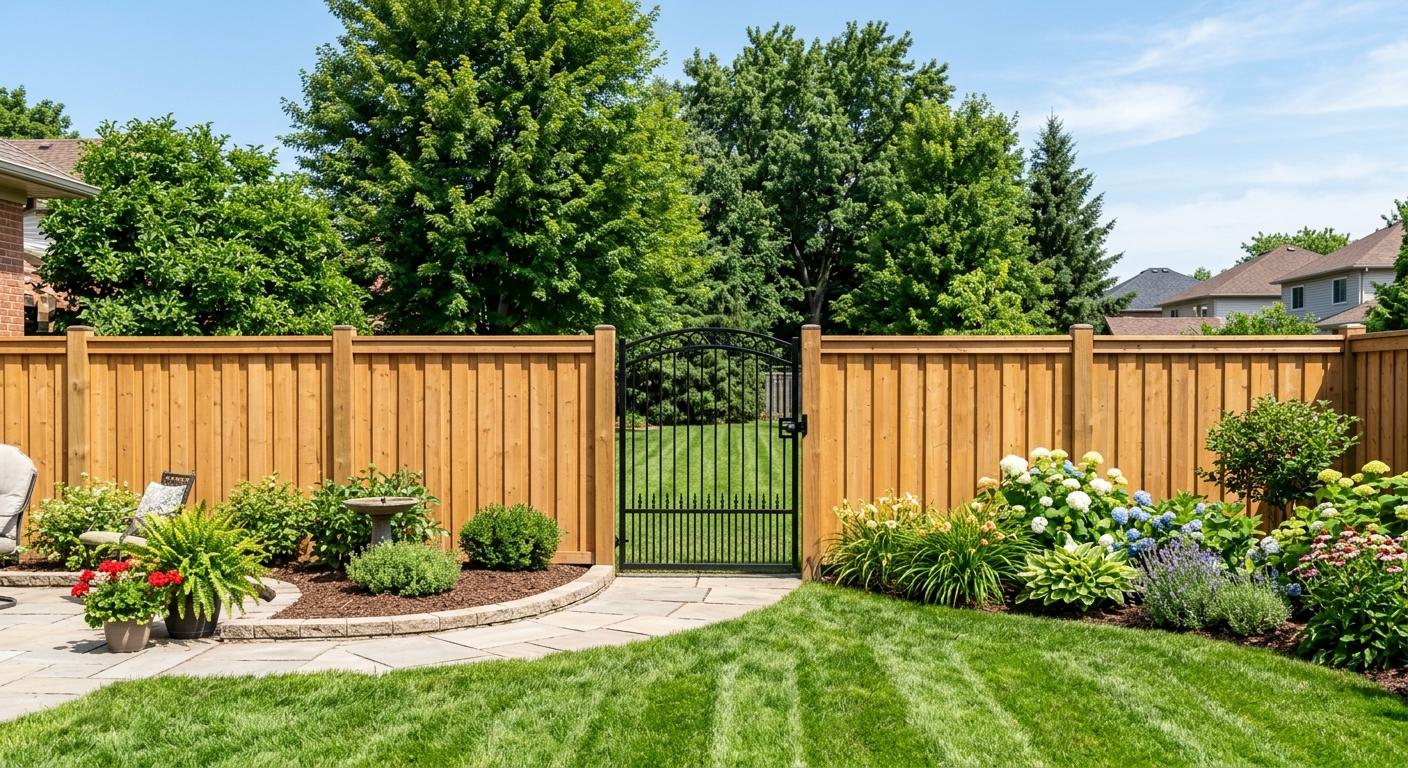
Fencing options and costs in Goderich
Goderich homeowners have a wide range of fencing choices, but the “right” option usually comes down to how much maintenance you’re willing to do versus how sturdy you want the fence to be through our winters. With 65.6% of dwellings in the area being single-detached homes, there’s steady demand for boundary fencing as more properties refresh side yards, pools, and dog runs year after year (Statistics Canada, 2021 Census). That demand matters locally—contractors in and around Goderich’s residential pockets often have enough crews available, but the cost still rises when a job requires deeper frost protection, more concrete setting, or upgraded hardware for windy open lots.
In the Stratford–Bruce Peninsula region, frost depth is a primary cost driver because fence posts must be set below the winter frost line to prevent heaving in clay and mixed soils common across Perth, Grey, and Bruce counties. In practice, residential installs typically set posts about 0.9–1.2 m (3–4 ft) deep, and heavier systems in exposed areas often go to around 4 ft with full concrete-set posts. Wind exposure—especially on farm-edge properties and open shoreline lots—also pushes costs up: contractors tighten post spacing and increase structural sizing so panels resist lateral loads. One area that often sees active fencing upgrades is the inner-city and older residential streets near Victoria Street and the Harbour area, where lots are mature and access can be tight for heavier materials.
Below is a quick comparison of common materials you’ll see in Goderich quotes—use it as a baseline before you request a site-specific measurement and post-depth plan.
| Material |
Lifespan |
Maintenance |
Privacy Rating |
Price per Linear Foot |
| Pressure-treated pine (standard wood) |
10–15 years |
Stain or seal every 2–3 years |
High (solid pickets) |
$18–$28 |
| Cedar (natural rot resistance) |
15–25 years |
Optional stain; often every 3–4 years |
High (solid boards) |
$22–$36 |
| Vinyl / PVC (no-maintenance) |
20–30 years |
Rinse as needed |
High (solid privacy styles) |
$25–$40 |
| Chain-link (galvanized steel) |
20–40 years |
Occasional wash; check tension |
Low–Medium (open mesh) |
$12–$20 |
| Aluminum ornamental |
25–40 years |
Rinse; touch-up rarely |
Low–Medium (open pickets) |
$18–$30 |
| Composite / recycled material |
20–35 years |
Minimal; periodic cleaning |
Medium–High (solid panels) |
$25–$45 |
Prices are estimates only and vary by project scope, site access and material selection.
What affects the price of fencing in Goderich
Fence quotes in Goderich can differ by 30–50% even when the homeowner thinks the job is “the same,” because crews price the hard parts differently across lots. A simple 50 ft boundary can still require deeper post holes, extra labour for line-up and levelling, and higher material spend when the site has clay, a slope, or limited access for equipment. In Ontario, the biggest cost swings come from how frost protection is engineered, how wind load is handled, and whether the contractor includes removal/disposal and property line locating.
First, frost line depth sets how deep posts must be set to prevent heaving. While southern Ontario’s practical residential installs often aim around 4 ft (about 1.2 m) deep with concrete footings, clay and mixed soils can demand full concrete-set posts at that depth to keep panels plumb year after year. That increases material cost (longer posts, more concrete) and labour time (deeper holes, more rig time). Second, wind exposure on open rural edges around North Perth and parts of the Bruce area can require tighter post spacing and heavier rails—especially for privacy wood and vinyl that behave like solid sails. Third, steel and vinyl behave differently in extreme cold snaps: vinyl can become brittle if it’s a low-quality product, while wood needs a maintenance plan to avoid premature weathering.
In Goderich, you’ll typically see higher costs on older lots where fences were originally installed shallow and now need to be rebuilt on proper frost depth. For example, a typical wood installation budget in the region is around $55–$85 per linear foot, but switching to vinyl often moves you into the $75–$115 band. Costs also climb by real dollars when a yard has steep grades (stepped panels) or when a contractor must upgrade hardware at corners and gate lines for stiffness. Conversely, if you’re replacing a chain-link section with a similar post layout on flat ground, pricing can stay closer to the lower chain-link band of $35–$55, because the excavation and hardware are less complex.
| Price Factor |
Why It Matters |
Cost Impact |
| Fence length in linear feet |
Most labour and materials scale directly with total length |
High (primary driver) |
| Post depth required |
Frost protection determines post length and hole depth |
High (more concrete, deeper excavation) |
| Post setting method |
Concrete vs gravel pack vs driven posts changes labour and materials |
Medium–High |
| Material choice |
Vinyl/cedar are costlier than chain-link; structural rails differ by system |
Medium–High |
| Gate count and type |
Drive-through and wider gates require stronger posts, hinges, and bracing |
Medium |
| Grade and terrain |
Sloped yards require stepping or raked sections, plus more layout time |
Medium |
| Old fence removal and disposal |
Haul-off and labour add time, especially with concrete bases |
Medium |
| Permit fees and survey / property line locate |
Locates and paperwork protect you from encroachment and rework |
Low–Medium |
Permits & regulations in Ontario
In Ontario, whether you need a permit often depends on fence height and placement. As a rule of thumb used by many municipalities and inspectors, fences above roughly 2.0 m (6.5 ft) at the rear and around 1.0–1.2 m (3–4 ft) at the front or corner commonly trigger a building permit requirement. Even when a permit isn’t required, you still must respect property lines and any municipal setback rules.
Before digging post holes, call for utility locates through Ontario One Call so contractors (and you, if you’re doing any digging) don’t hit buried services. Also, get your property pins located or obtain a survey/locate before you start—this prevents disputes with neighbours and avoids the expensive situation of rebuilding sections because the fence was set a foot over.
Shared fence boundaries are handled by provincial line-fences principles, but in practice you should confirm ownership expectations in writing and agree on maintenance responsibilities for the portion that sits on the shared line. If a fence is placed on a shared boundary, you’ll want clarity on who pays for repairs and which side is responsible for upkeep.
Concrete work that DOES require a permit: if your fence height exceeds the typical threshold (around 2.0 m rear / 1.0–1.2 m front or corner), plan for permit processing for that fence system. Work that typically does NOT: replacing a lower fence within allowable height and setbacks usually falls under general property maintenance, but you still must follow utility-locate and property-line requirements.
To verify a contractor in Goderich: ask for (1) their Ontario licence/registration details where applicable, (2) a current certificate of insurance naming you as additional insured where required, and (3) WSIB/WCB clearance (or evidence of coverage). Look for an insurance certificate that lists liability limits and active status, and request WSIB/WCB proof—your contractor should be able to provide a clearance letter or equivalent verification quickly.
Choosing the right fence material for Goderich
Choosing fencing in Goderich is easiest when you match the material to your priorities: privacy, low maintenance, budget, and how long you want to stay within the same system. Pressure-treated pine is the common budget choice, but you should plan on staining or sealing every 2–3 years to reduce grey weathering and keep boards looking uniform. Cedar has a more natural rot-resistant profile and typically looks better for longer, but it still benefits from periodic maintenance to keep colour and limit surface cracking. Vinyl/PVC offers no-sanding, no-staining convenience, which many homeowners prefer—just be sure the system is installed with proper spacing and quality components, because extreme cold can make cheaper vinyl brittle. Chain-link is the lowest upfront option and very long-lasting, but it offers little privacy unless you add slats or screening. Aluminum ornamental gives a clean look with excellent rust resistance, but it’s still more decorative than private.
On frost protection, the Stratford–Bruce Peninsula market typically expects posts to be set deep enough to sit below winter frost movement. That usually means concrete-set posts at deeper depths (often about 0.9–1.2 m, and sometimes around 4 ft for heavier, exposed installations), regardless of material. Heavier wood, vinyl privacy styles, and ornamental metal systems often benefit from concrete-set posts and stronger rails in windy open areas, especially where Lake Huron exposure or farm-field winds increase lateral load on panels.
For a simple cost justification: if you’re choosing between pressure-treated wood and vinyl, you might be deciding between the wood band of $55–$85 versus vinyl at $75–$115 for labour-plus-installation style pricing in this region. If you’d rather spend your time enjoying the yard than maintaining staining, that incremental vinyl cost is often worth it. If your budget is tighter and you’re comfortable re-staining on a regular schedule, cedar or pressure-treated wood can make more sense.
| Material |
Cold Tolerance |
Lifespan |
Annual Maintenance |
Best For |
Price Band |
| Pressure-treated pine |
Good (use proper grade and finish) |
10–15 years |
Low–moderate (stain/seal every 2–3 years) |
Budget privacy fences |
$55–$85 |
| Cedar |
Very good (natural oils help) |
15–25 years |
Low–moderate (often every 3–4 years) |
Natural look with better rot resistance |
$65–$95 |
| Vinyl / PVC |
Good if quality components are used |
20–30 years |
Very low (rinse as needed) |
Low-maintenance privacy |
$75–$115 |
| Chain-link |
Excellent (steel remains stable) |
20–40 years |
Very low (tension and rinse) |
Security with minimal cost |
$35–$55 |
| Aluminum ornamental |
Excellent (no rust) |
25–40 years |
Very low (rinse occasionally) |
Decorative fencing and curb appeal |
$90–$150 |
| Composite / recycled |
Good (install with correct expansion gaps) |
20–35 years |
Very low (clean as needed) |
Long-life privacy with minimal upkeep |
$95–$160 |
How to choose a fencing contractor in Goderich
Choosing a fencing contractor in Goderich comes down to verifying that they’re insured, properly covered, and clear in writing about what you’re getting. Start with Ontario licence/registration details where applicable, then ask for (1) liability insurance and (2) WSIB/WCB coverage proof. You can check the certificate of insurance for active dates, liability limits, and the contractor’s legal entity name matching the quote. For WSIB/WCB, request a current clearance letter or verification statement—if they can’t provide it promptly, that’s a major red flag for jobsite risk.
Next, request 2–3 itemised written quotes instead of a single lump sum. A good quote breaks out labour and materials: rails, pickets/panels, posts, concrete, hardware (hinges/latches/bracing), gates, and any line preparation like levelling or stepped/raked sections. Make sure it also notes whether posts are concrete-set to the required depth for frost protection, and whether they include cleanup and disposal. Ask whether permits are included if your fence height falls into the range that may require one, and confirm who handles the utility-locate call logistics.
Warranty matters too. You want a workmanship warranty (often measured in years) and a separate manufacturer product warranty for materials. Confirm if warranties are transferable to the next owner, especially for cedar/vinyl systems with brand-specific guarantees. On payment schedule, never pay more than 10–15% upfront. Hold back the remainder until the job is complete, straight, and fully cleaned. Finally, get a start date and a completion estimate in writing so you can plan around winter frost and material lead times.
- Provide certificate of insurance and confirm it matches the quoted company name
- Show current WSIB/WCB clearance or proof of coverage
- Bring the quote with post-depth assumptions tied to frost protection
- Confirm gate hardware upgrades (hinges, latches, bracing) included in the price
- Itemise labour vs materials—no “mystery amounts”
- Specify whether concrete-set posts are used where required
- Clarify disposal: old fence removal haul-away included or extra
- Confirm property-line plan: pins locate or survey locate responsibility
- Note site prep steps (grading, trenching, levelling, stepped sections)
- List warranty terms for workmanship and product separately
- Use a written payment schedule with a holdback until final walkthrough
- Provide an estimated start date and realistic completion timeline
Red flags I see in the Goderich market include: refusing to provide insurance/WSIB proof, quoting with only a lump sum and no post-depth or gate hardware detail, promising “no need for concrete” on deeper frost sites without justification, starting without utility locates, and offering a very low price that excludes disposal, permits (if needed), or concrete post setting.
Frequently asked questions — fencing in Goderich
Wood vs vinyl vs aluminum fence — which is best?
In Goderich and the surrounding Stratford–Bruce Peninsula region, the “best” choice usually depends on whether you want privacy, appearance, and how much maintenance you’ll tolerate. Wood (pressure-treated or cedar) can deliver strong privacy at a lower starting point; wood installation pricing in this market is commonly in the $55–$85 band, but you should plan on staining or sealing every couple of years for consistent appearance. Vinyl is typically higher upfront (often $75–$115), but many homeowners prefer the very low maintenance—just rinse and inspect hardware. Aluminum ornamental is usually mid-to-high cost (often $90–$150) and is best if you want curb appeal and a more open style. For all three, remember that frost-depth post setting is a cost driver in Ontario; the fence will only perform well if posts are set correctly and panels are properly braced.
Do I need a permit to build a fence in Ontario?
Ontario fence permits often depend on height and location, not just the material. In many municipalities, a permit is commonly required when fence height exceeds about 2.0 m (6.5 ft) at the rear, or when a fence in a front/corner area is roughly above 1.0–1.2 m (3–4 ft). Even if a permit isn’t required, you still must respect property lines and local setback rules. Before digging, call for utility locates through Ontario One Call. For your contractor verification in Goderich, ask whether the quote includes handling permit steps (if needed) and ensure their paperwork and insurance are up to date. If your proposed fence is close to a line or near a driveway, confirm the plan is compliant before posts go in to avoid costly rework.
How long does a wood fence last in Goderich?
A wood fence in Goderich commonly lasts 10–15 years for standard pressure-treated pine, and 15–25 years for cedar when installed with proper frost-depth post setting and correct ventilation. The limiting factors in our Ontario climate are weathering and finish breakdown, along with any post movement from freeze–thaw cycles. That’s why contractors often set posts deep enough to sit below the winter frost line (frequently about 0.9–1.2 m / 3–4 ft), using concrete for stability in clay or mixed soils. Maintenance also matters: to avoid greying and early splitting, stain or seal is typically needed every 2–3 years for pressure-treated wood. Cedar can still benefit from periodic maintenance, even though it’s more naturally rot-resistant.
Who owns and maintains a shared fence?
Shared fence ownership and responsibilities are guided by Ontario line-fences principles, but the real-world answer depends on where the fence sits relative to your property boundary and how neighbouring owners agree to share costs. In many cases, the portion of fence on the boundary is treated as shared, and repairs or replacements may be split based on the agreement or rule set applicable to your location. The key step is to confirm the boundary location (pins or survey locate) before assuming ownership. For homeowners in Goderich, it’s also wise to put cost-sharing agreements in writing—especially for upgrades like changing a damaged wood section to vinyl or replacing sagging posts. If a fence is fully on one property (not on the shared line), maintenance responsibility usually stays with that owner.
How do I find my property line before fencing?
Before any post holes are dug in Ontario, you should confirm your property line location using your property pins (or a survey). Start by locating the property pins with a surveyor or an appropriate locate service, then compare their positions to any existing boundary features or prior fence posts. If you don’t have a recent survey, order a survey or request a professional property locate so you don’t build into a neighbour’s yard. This is especially important in Goderich because older housing stock (73.7% of homes built before 1981) often means earlier boundary fences were installed with varying accuracy. Also, call Ontario One Call for utility locates before digging, even if you’re confident about the boundary—buried services can be near fence lines.
What's the most low-maintenance fence?
For low maintenance in Goderich’s Ontario winters and freeze–thaw cycles, vinyl/PVC and aluminum are usually the easiest to live with. Vinyl privacy styles are popular because they don’t require staining and typically just need periodic rinsing and hardware checks; pricing in this region is often in the $75–$115 band, reflecting the material and installation system. Aluminum ornamental is also low maintenance because it won’t rust; it’s commonly priced around the $90–$150 range. The “secret” isn’t just material—it’s correct installation. Even the lowest-maintenance fence needs properly set posts for frost movement and sturdy bracing for wind on exposed lots near open fields and waterfront areas. Avoid shortcuts on post depth and corner/gate reinforcement if you want a truly hassle-free fence.