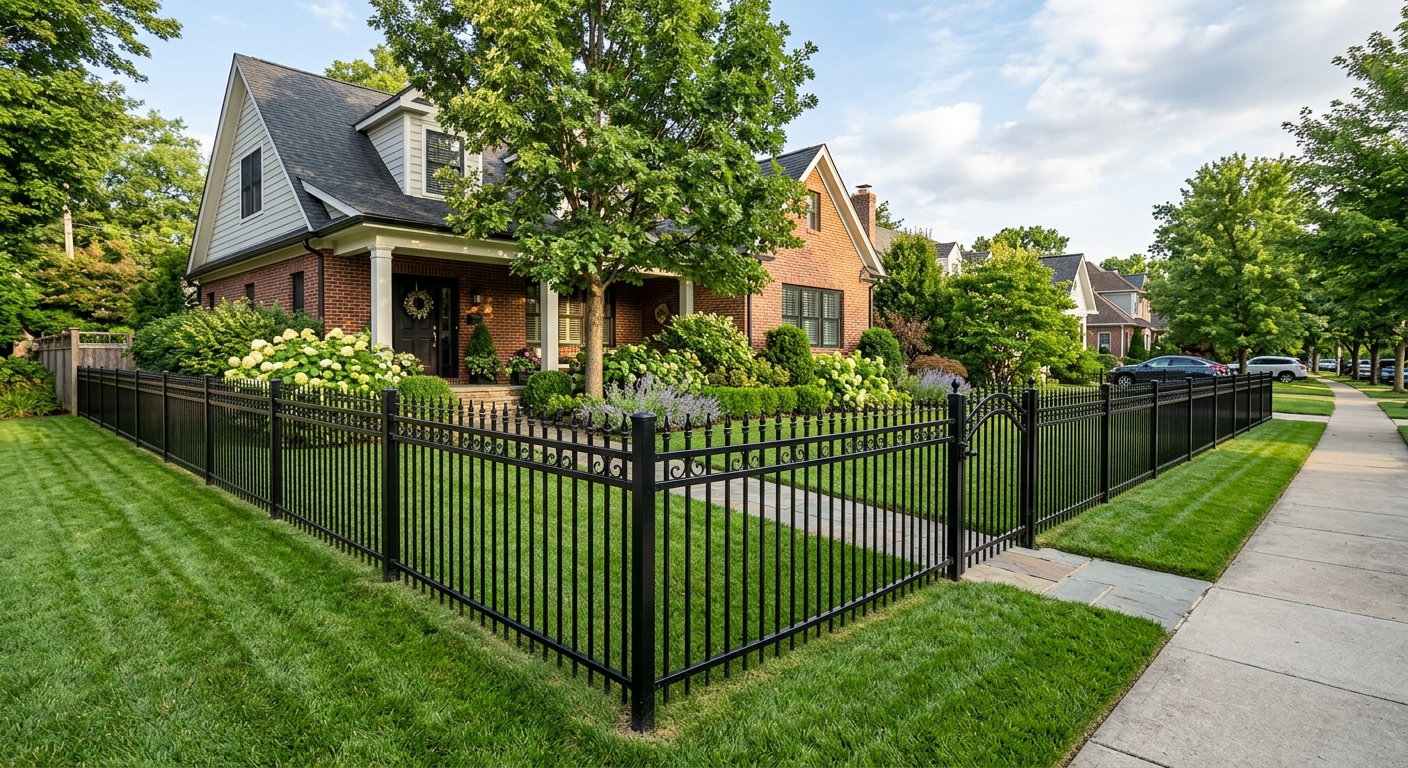
Fencing options and costs in Midland
Midland homeowners typically choose fencing based on privacy needs, yard layout, and maintenance comfort—especially because so many local properties are single-detached homes (65.0% of dwellings). With 17,817 residents and 5,155 homeowner households (65.7% of households own) (Statistics Canada, 2021 Census), there’s consistent demand for backyard and side-yard fencing throughout town, including family neighbourhoods like Perkinsfield and the older built-up pockets near downtown where lot lines are well established.
In the Kitchener–Waterloo–Barrie economic region, fencing costs are shaped by freeze–thaw cycles and the practical frost-line requirement. Contractors generally set posts deeper than in milder parts of Ontario to reduce heaving; for most 6 ft privacy builds, this translates into deeper augers and concrete-set posts for wood, vinyl, and aluminum. Wind is less extreme than the Prairies, but Midland yards can still see gusts off open lots or new subdivisions, so privacy fences often get tighter post spacing (commonly 6–8 ft centres) and more robust rails to limit racking.
Labour availability also matters: privacy fences with gate work and dense post layout take longer to install and often require more material handling, so quotes can shift quickly when weather is wet or when contractors are busy. If you’re planning a boundary refresh or upgrading from an older fence built in the 1960s and 1970s (61.6% of homes built before 1981) (Statistics Canada, 2021 Census), the base cost can jump due to removal, disposal, and post replacement. Use the table below to compare common materials and typical pricing per linear foot for Midland projects.
| Material |
Lifespan |
Maintenance |
Privacy Rating |
Price per Linear Foot |
Price Range |
| Pressure-treated pine (standard wood) |
10–15 years |
Stain/seal every 2–3 years; fastener checks |
High (solid panels) |
$20–$30 |
$3,200–$5,500 |
| Cedar (natural rot resistance) |
15–20 years |
Light staining or clear coat every 2–4 years |
High (solid panels) |
$26–$40 |
$4,200–$7,000 |
| Vinyl / PVC (no-maintenance) |
20–30 years |
Rinse annually; inspect for flex/impact damage |
High (solid privacy styles) |
$28–$45 |
$4,400–$8,500 |
| Chain-link (galvanized steel) |
20–30 years |
Occasional cleaning; tension and hinge checks |
Low–Medium (see-through) |
$17–$25 |
$2,500–$4,800 |
| Aluminum ornamental |
25–40 years |
Rinse and inspect hardware |
Low–Medium (ornamental spacing) |
$26–$40 |
$4,800–$9,500 |
| Composite / recycled material |
20–30 years |
Rinse; avoid impacts at post locations |
High (solid styles) |
$30–$48 |
$5,200–$10,500 |
Prices are estimates only and vary by project scope, site access and material selection.
What affects the price of fencing in Midland
In Midland, two “similar” fence jobs can land 30–50% apart because the real drivers—post depth, soil conditions, gate complexity, and removal—don’t scale evenly from one yard to the next. Even within the broader Kitchener–Waterloo–Barrie market, contractors price deeper augering and longer days of labour differently depending on access and whether crews can work efficiently. That’s why one quote for a basic privacy run can be closer to the Ontario wood band (for example $45–$70) while another lands nearer the higher end once concrete-set posts and heavier rails are included.
Frost depth is the big technical reason. Here, posts are typically set about 4–6 inches below the design frost depth to prevent heaving, which often means 1.5–2.0 m into the ground in colder parts of Southern Ontario. Practically, that requires longer posts, deeper holes, and more concrete per post—raising material and labour costs. Wind exposure also affects design: we usually still brace and rail privacy fences more than homeowners expect, and you may see tighter post spacing (6–8 ft centres) to reduce blow-outs and racking. By comparison, coastal BC’s mild but wet climate accelerates wood rot without proper treatment, while Prairies wind typically drives heavier systems and different post patterns; Ontario sits in between but still demands solid installation for longevity.
In Midland specifically, cost can rise if you have rocky soil that slows augering, if there’s a sloped backyard requiring stepped or raked panels, or if you’re replacing an older fence where posts are failing and holes need re-done. It can drop when the line is straight, access is easy for a skid-steer/auger, and you’re installing over a clean, measured run with minimal gates—especially if you stay closer to budget options like chain-link (often $35–$60) instead of a 6 ft privacy system.
| Price Factor |
Why It Matters |
Cost Impact |
| Fence length in linear feet |
Most materials and labour scale directly with total run |
High (largest driver) |
| Post depth required |
Frost protection determines hole depth and post length |
High (more concrete, longer posts) |
| Post setting method |
Concrete-set vs gravel pack vs driven posts affects stability |
Medium–High (concrete-set usually costs more) |
| Material choice |
Vinyl/cedar/aluminum differ in hardware, panel cost, and installation time |
Medium–High (shifts you across $ bands) |
| Gate count and type |
Double-drive gates require stronger frames and hinges |
Medium–High (gate hardware is pricey) |
| Grade and terrain |
Slopes require stepping, racking, or more fittings |
Medium (more labour and waste) |
| Old fence removal and disposal |
Hauling and salvage time varies; rotted posts increase labour |
Medium (can add thousands on older builds) |
| Permit fees and survey / property line locate |
Administration and locating costs depend on height and boundary clarity |
Low–Medium (often optional but important) |
Permits & regulations in Ontario
In Ontario, fences above a height threshold commonly require a building permit—typically 2.0 m (6.5 ft) at the rear and 1.0–1.2 m (3–4 ft) at the front or corner. Even when a permit isn’t required, every fence must follow property line rules and municipal setback bylaws. Because fence lines are legal boundaries, it’s also important to confirm exactly where your property starts and ends before any digging.
Before you install any posts, call for utility locates via Ontario One Call to mark buried services. Then, arrange a survey or a property pin locate (if pins are unclear) so your contractor can measure from the correct boundary. This reduces the risk of encroachment disputes—an issue that shows up often when homeowners are upgrading older fences from the pre-1981 housing stock, where original alignment may be imperfect.
Shared fence ownership is handled under Ontario line-fences principles: if a fence is treated as a shared boundary, neighbours may have responsibilities for maintenance or costs, depending on how the fence functions and what has been agreed historically.
What does require a permit (commonly): new fence builds over the typical height thresholds, and certain corner/front installations depending on local bylaw interpretation. What typically does not require a permit: like-for-like replacements under the threshold that stay within the allowed height and setbacks.
To verify your contractor in Midland, ask for: a valid Ontario contractor licence (if applicable for your type of work), a certificate of liability insurance naming you as additionally insured if possible, and confirmation of workers’ compensation coverage (WSIB) and/or the relevant coverage documentation for their workforce. You can request the certificate of insurance directly and check dates/coverage limits; for clearance letters, ask for the clearance letter and verify it matches your contractor’s legal name.
Choosing the right fence material for Midland
Choosing a fence in Midland is about matching your priorities—privacy, low maintenance, budget, and lifespan—to local conditions. With Southern Ontario’s freeze–thaw cycles, your post system matters as much as the material. For privacy, homeowners often start with pressure-treated pine because it’s the most budget-friendly upfront, but it needs staining or sealing every 2–3 years to avoid fast grey weathering and to maintain surface protection. Cedar looks great and resists rot better naturally, yet it still benefits from periodic sealing for best appearance and longevity.
Vinyl/PVC offers true low-maintenance in day-to-day life (no staining), but extreme cold can make boards feel more brittle if impacts occur, so post anchoring and rail rigidity become important. Chain-link is the lowest-cost option and can last a long time, but it’s not a privacy solution unless you add slats/vegetation. Aluminum ornamental is rust-resistant and easy to maintain, but it’s typically mid-range and not ideal if you want a solid screen. Composite/recycled materials provide a more modern privacy finish with less upkeep than wood, but they’re usually higher upfront and should be installed with careful alignment and impact-safe edges.
Post depth: for Midland projects in the Kitchener–Waterloo–Barrie region, concrete-set posts are commonly used for wood and vinyl privacy fences in 6 ft installations to resist heaving—holes are typically made deep enough to sit below the design frost depth, and concrete helps stabilize in freeze–thaw soil. If your yard is sloped, stepped rails or raked panels are usually required, which adds labour regardless of material. In a typical privacy comparison, upgrading from pressure-treated pine to vinyl often costs more upfront—e.g., a fence in the wood band ($45–$70) might become closer to the vinyl band ($55–$90) once deeper concrete-set posts, tighter centres, and solid privacy rails are included. That added spend is justified if you want fewer maintenance weekends and a cleaner long-term look.
| Material |
Cold Tolerance |
Lifespan |
Annual Maintenance |
Best For |
Price Band |
| Pressure-treated pine |
Good when posts are properly set |
10–15 years |
2–3 year staining cycle; seasonal inspections |
Budget privacy with solid installation |
$45–$70 |
| Cedar |
Good; handles cold well |
15–20 years |
Every 2–4 years sealing; check hardware |
Appearance-first privacy and better rot resistance |
$55–$80 |
| Vinyl / PVC |
Good; can crack from impacts in extreme cold |
20–30 years |
Rinse and inspect hinges/rails; low upkeep |
Low-maintenance privacy |
$55–$90 |
| Chain-link |
Very good |
20–30 years |
Occasional cleaning and tension checks |
Security on a tighter budget |
$35–$60 |
| Aluminum ornamental |
Very good; no rust |
25–40 years |
Rinse; tighten hardware |
Front/side curb appeal and safety |
$60–$110 |
| Composite / recycled material |
Good with solid post alignment |
20–30 years |
Rinse; periodic checks after freeze–thaw cycles |
Modern privacy with reduced wood care |
$65–$110 |
How to choose a fencing contractor in Midland
When you hire a fencing contractor in Midland, verify credentials and insist on clarity. In Ontario, start with licensing/registration requirements that apply to their trade category, then confirm liability insurance. Ask for their certificate of insurance—verify limits, expiry date, and that it’s issued under their legal business name. For coverage of workers on your site, ask whether they carry WSIB (for eligible workers) and request the clearance letter when available; reputable crews can provide it without hesitation.
Next, get 2–3 itemised written quotes. Look for a breakdown that separates labour (footing/post setting, framing, rails, installation) from materials (posts, pickets/panels, concrete, hardware) and includes gates as their own line items. Avoid lump-sum only quotes unless the scope is extremely detailed, because fencing projects can change quickly when post holes run into rock or when measurements aren’t confirmed. Ensure the quote states what’s excluded: permit pulling, utility locate coordination, site grading work, and disposal/hauling of the old fence.
Warranty matters too. Ask for the workmanship warranty length and whether it applies to post setting and panel alignment issues (not just surface defects). Confirm the manufacturer/product warranty terms for rails, pickets, and hardware, and ask if it’s transferable if you sell the home.
For payment schedule, don’t let anyone request more than 10–15% upfront. Hold back a portion until the fence is complete and cleaned up. Finally, require a written timeline with a start date, weather contingency notes, and a completion estimate.
- Request their insurance certificate and verify dates and business name
- Ask for WSIB coverage documentation/clearance letter
- Get itemised pricing: labour, materials, concrete, and gates
- Confirm post depth and post-setting method (concrete-set for privacy builds)
- Ask how they handle sloped yards (stepped vs raked panels)
- Confirm post spacing (especially for privacy fences: typically 6–8 ft centres)
- Verify whether permit pull is included or your responsibility
- Check whether utility locates are coordinated before digging
- Ensure old fence removal and disposal is either included or listed as add-on
- Review warranty: workmanship term + product term, and transferability
- Avoid paying more than 10–15% upfront; use a holdback
- Get start and completion dates in writing, including weather pauses
Red flags I commonly see in Midland include: quotes that don’t specify post depth or concrete-set details, missing gate hardware brands/specs, vague “materials included” wording that hides concrete/posts/hardware costs, refusal to provide insurance/WSIB documentation, and payment requests of large upfront deposits with no signed scope of work.
Frequently asked questions — fencing in Midland
Who owns and maintains a shared fence?
In Midland and across Ontario, shared fence ownership typically depends on how the fence is treated along the boundary—especially whether it’s on the property line and how it has been used historically. Ontario’s line-fences rules can affect maintenance responsibilities when a fence functions as a shared boundary structure. If you’re planning an upgrade, start by confirming the fence location with a survey or property pin locate so you’re not assuming shared ownership incorrectly. Then, have the neighbour discussion documented: who pays for materials, who pays labour, and whether you’re replacing the whole section or just repairing portions. If the fence is deteriorated and impacts safety (loose posts, sagging panels), courts and disputes often focus on who benefits from the fence and what the original agreement or long-term practice was.
How do I find my property line before fencing?
Before digging a single post hole in Midland, verify your boundary. First, locate your property pins through a professional property pin survey or a locate service that identifies the pins so your contractor can measure accurately. This matters because older fences in the 1960s/1970s housing stock sometimes don’t align perfectly with current survey records, and you don’t want to rebuild a fence on the wrong line. Also, call Ontario One Call to mark buried utilities before any augering—utility locates prevent expensive damage and delays. When you get your survey information, ask your contractor how they’ll set benchmarks (string lines) and how they’ll keep the fence within allowable setbacks and off structures. Taking these steps early reduces rework, which can otherwise add thousands to the final price.
What's the most low-maintenance fence?
For low day-to-day maintenance in Midland, vinyl/PVC privacy fences are usually the top choice. They don’t require staining, and you typically only need an occasional rinse and a quick inspection of hinges and rail connections after heavy weather. If you want a budget-friendly option that still needs less care than wood, chain-link is also easy to maintain, but it won’t provide privacy unless you add slats or plant screening. As a reference, many vinyl installations land in the vinyl/ PVC price band of $55–$90 per linear foot—so you pay more upfront than pressure-treated pine ($45–$70) to reduce future labour. If your goal is “install once and forget,” vinyl is hard to beat, provided posts are correctly set for Ontario freeze–thaw conditions.
How tall can my fence be in Midland?
Fence height rules in Ontario generally depend on where the fence sits on your property and whether it exceeds common thresholds. A permit is often required once you go beyond roughly 2.0 m (6.5 ft) at the rear and about 1.0–1.2 m (3–4 ft) at the front or corner, but local bylaw interpretation matters. For Midland homeowners, the practical step is to confirm your proposed height with your municipal bylaw requirements before ordering materials—especially if you’re planning a 6 ft privacy fence. If you’re unsure whether a permit is needed, ask your contractor whether they include permit coordination in the quote and ensure the final drawings/scope match what you plan to build. This avoids “order now, permit later” problems that can delay your project.
Should fence posts be set in concrete here?
For most fencing projects in Midland—especially 6 ft privacy fences—concrete-set posts are commonly recommended due to Ontario freeze–thaw and heaving risk. In cold Ontario, posts generally need to sit below the design frost depth, which typically means deeper post holes and longer posts (often roughly 1.5–2.0 m into the ground for many residential layouts). Using concrete helps stabilize the post in winter conditions and reduces the likelihood of leaning or movement over time. While some installers use gravel pack or other methods, homeowners usually get the best long-term result when concrete-set is included for privacy installations where stability is critical. If your soil is rocky or drains poorly, concrete and correct depth can actually reduce long-term repair costs—so it’s worth discussing with your contractor before choosing the cheapest post method.
What's the best fence for privacy?
The best privacy fence for Midland is typically a solid-panel system: pressure-treated pine, cedar, vinyl/PVC, or composite/recycled privacy styles with tight post spacing. Because our winters create freeze–thaw movement, privacy fences need sturdy rails and reliable post installation—not just “solid-looking” panels. If you want maximum privacy and don’t mind regular upkeep, wood privacy fences (in the $45–$70 wood band) are a common fit; cedar costs more but typically looks better with improved rot resistance. If you want privacy with minimal maintenance, vinyl/PVC privacy fences (often in the $55–$90 band) are a popular choice since you avoid staining cycles. In yards exposed to gusty conditions, choose systems designed to resist racking and blow-outs, and confirm post depth and spacing in the quote.