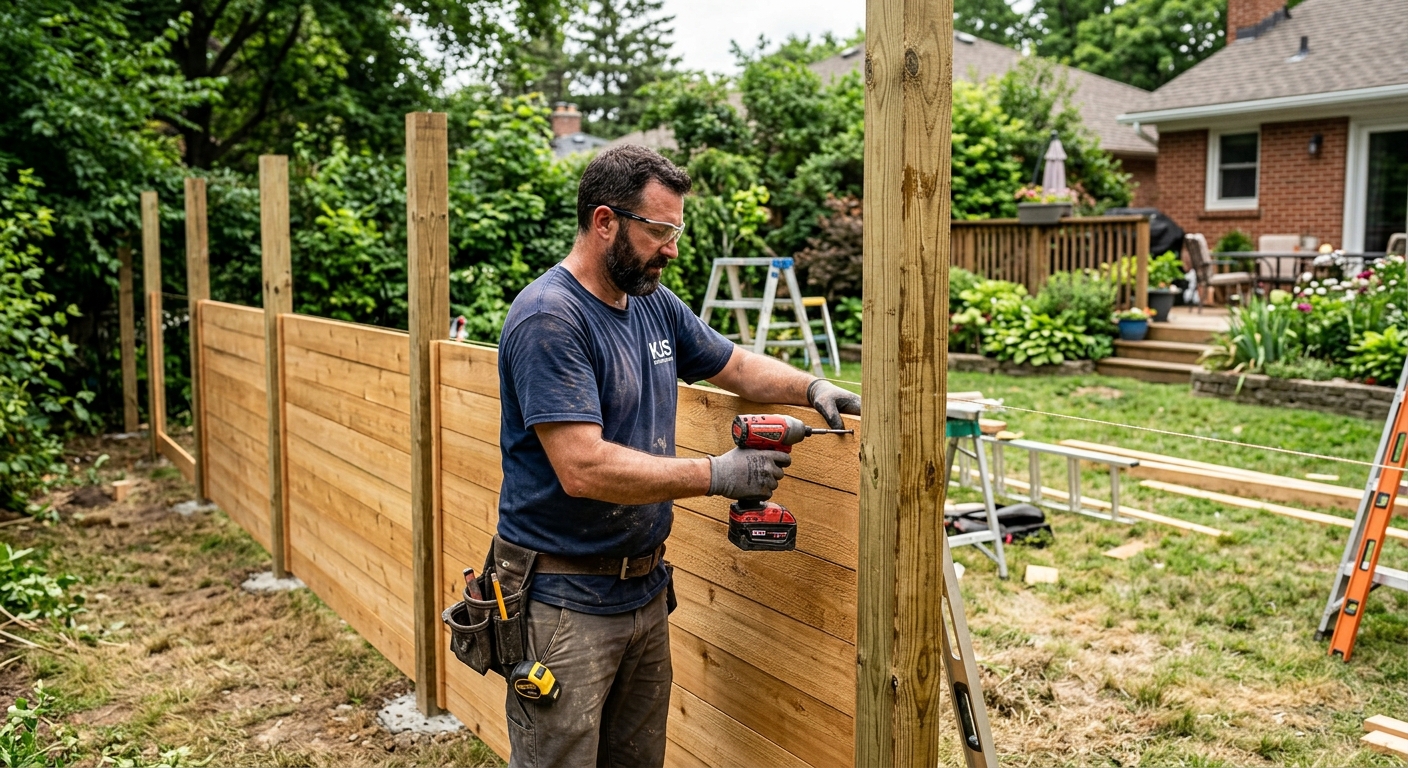
Fencing options and costs in Newtonbrook East
Newtonbrook East is a mature, family-oriented part of Toronto, and that matters when you’re pricing a fence. With a 2021 population of 16,097 (Statistics Canada, 2021 Census), there’s steady demand for both front-yard boundary work and back-yard privacy upgrades. Just as importantly, most homeowners in this area are in long-established housing stock where fences are replaced more often than “first-time” installs—because decks, pools, and garden renovations tend to outlast the original rails and posts. That means your fencing quote is usually shaped by how many sections need replacing, not just material choice.
In the Toronto market, frost protection is a major cost driver. Southern Ontario’s frost line is commonly estimated around 42"–48", so for a 6–8 ft privacy fence, posts typically need to be set roughly 3.5–4 ft deep using concrete-set footings. This increases labour time, requires longer posts, and adds concrete and delivery costs. Around neighbourhood pockets with heavier winds or more exposed back yards, contractors also build sturdier gate hardware and tighter panel spacing to reduce racking.
In Newtonbrook East, the trade is especially active around the older residential streets near Newcastle Drive and the Finch Avenue area, where many properties have mature trees and established lot lines. If you’re comparing options, the table below shows typical lifespan, maintenance expectations, privacy performance, and installed pricing for the Newtonbrook East tier.
| Material |
Lifespan |
Maintenance |
Privacy Rating |
Price per Linear Foot |
| Pressure-treated pine (standard wood) |
10–15 years |
Stain/paint every 2–3 years; annual inspection |
High (solid pickets/boards) |
$65 – $120 |
| Cedar (natural rot resistance) |
15–25 years |
Seal/stain every 2–4 years; periodic checks |
High (solid pickets/boards) |
$85 – $135 |
| Vinyl / PVC (no-maintenance) |
25–35 years |
Rinse annually; no staining; inspect fittings |
High (solid vinyl panels) |
$75 – $130 |
| Chain-link (galvanized steel) |
25–40 years |
Occasional wash; tighten hardware as needed |
Low–Medium (privacy slats optional) |
$45 – $85 |
| Aluminum ornamental |
25–40 years |
Wash as needed; inspect for loose caps |
Low–Medium (open picket style) |
$90 – $160 |
| Composite / recycled material |
20–30 years |
Low; clean with mild soap; inspect posts |
High (solid composite boards) |
$100 – $170 |
Prices are estimates only and vary by project scope, site access and material selection.
What affects the price of fencing in Newtonbrook East
In Newtonbrook East, it’s common to see fencing quotes for “the same look” land 30–50% apart across the wider Toronto area. The reason is that material is only part of the equation—labour logistics, post depth requirements, gate complexity, and how a contractor handles uneven ground often swing the final number more than the board colour. One contractor may price a standard 6 ft privacy run with gravel backfill, while another prices the same run with concrete-set posts and a stepped layout for grade changes. The work is noticeably different, even if the fence height looks identical on paper.
Ontario’s frost line sets how deep posts must be set. In cold Ontario winters, posts typically need to go 1.5–2.0 m into the ground to reduce frost heave risk; contractors often set between 4–6 inches below the design frost depth, which means longer posts and deeper holes. Concrete setting is also the norm for long-term stability in local clay and mixed soils, and that drives up material (ready-mix/fast-setting concrete) and labour time. Wind still matters in the GTA—while it’s not Prairies-level open exposure, taller solid fences can rack, so panel style, post size, and spacing become more rigid (and hardware costs rise) for 6–8 ft privacy fences.
Two local examples: (1) If you’re replacing fence sections near mature tree roots, contractors may need extra excavation time and stronger post bracing, which pushes the job toward the upper end of wood pricing (for instance, closer to the $65–$120 band). (2) If you’re building in a sloped backyard with stepped rails, you may effectively add a “hidden” run length; in those cases, vinyl or cedar can become more cost-effective than repeatedly patching wood—especially when you’d otherwise re-stain every 2–3 years. In exposed corner lots, heavier post spacing and better gate bracing are often what justify moving from chain-link at $45–$85 toward privacy options.
| Price Factor |
Why It Matters |
Cost Impact |
| Fence length in linear feet |
Most costs scale directly with footage (posts, rails, labour, materials) |
Highest impact |
| Post depth required |
Frost depth affects hole size, post length, and stability in freeze–thaw cycles |
Moderate to high impact |
| Post setting method |
Concrete-set posts improve long-term performance in Toronto soils |
Moderate impact (often increases cost) |
| Material choice |
Vinyl/PVC and cedar have higher upfront costs than chain-link |
Can be high impact depending on selection |
| Gate count and type |
Double gates and swing gates require heavier hardware and tighter alignment |
High impact on privacy fences |
| Grade and terrain |
Slopes require stepping, raking, and extra layout labour |
Moderate impact |
| Old fence removal and disposal |
Demolition time, hauling fees, and disposal rules affect labour and overhead |
Moderate to high impact |
| Permit fees and survey / property line locate |
Boundary confirmation reduces encroachment disputes and rework |
Low to moderate impact (but can prevent costly mistakes) |
Permits & regulations in Ontario
In Ontario, fencing is usually subject to municipal by-laws and property-line rules, and higher fences can trigger permitting. As a practical rule for many residential contexts, fences above a threshold—commonly around 2.0 m (6.5 ft) at the rear and about 1.0–1.2 m (3–4 ft) at the front or corner—often require a building permit. The exact threshold can vary by municipality and your lot location (corner lots, through streets, and near intersections), so your contractor should confirm requirements before ordering materials.
Before digging any post hole in Newtonbrook East, arrange utility locates through Ontario One Call. Even if your fence line “seems clear,” it’s a must—gas, hydro, and telecom lines can run near property edges. Also, obtain a survey or at least a professional locate of your property pins before installing. That’s how you avoid encroachment disputes when neighbours interpret the fence line differently.
Shared fence ownership is governed by Ontario’s line-fences principles. If you’re replacing a shared boundary fence, confirm how the cost will be allocated before demolition—otherwise you risk being stuck paying for more than you expected.
To verify a fencing contractor, ask for (1) Ontario licence proof where applicable, (2) certificate of insurance showing liability coverage, and (3) proof of WSIB/WCB coverage. You can check insurance directly via the certificate (and confirm the named insured matches their business), and request a clearance letter or coverage documentation before work starts.
Choosing the right fence material for Newtonbrook East
Choosing a fence material in Newtonbrook East is really about matching your priorities—privacy, low maintenance, budget, and lifespan—to Toronto’s freeze–thaw weather and typical soil conditions. Pressure-treated pine is the budget-friendly option upfront, but it usually needs staining or sealing about every 2–3 years to prevent grey weathering and water-penetration at joints. Cedar looks great and resists rot better, yet it still benefits from regular sealing so it doesn’t warp or dull quickly.
Vinyl/PVC is a strong choice if you want low maintenance and steady appearance. In extreme cold snaps, some vinyl products can become brittle if the wrong grade is used or if posts aren’t installed properly with the right spacing and secure footing—this is why concrete-set posts matter even for “no-maintenance” systems. Chain-link is typically the lowest cost with long service life, but it doesn’t provide privacy unless you add slats or a privacy screen. Aluminum ornamental offers a tidy, rust-resistant look, but it’s not a privacy fence.
With Toronto’s frost line commonly estimated at 42"–48", taller privacy fences usually require deeper concrete-set footings to reduce frost heave. In most Newtonbrook East backyards, that means planning on concrete-set posts regardless of material if you’re building 6–8 ft privacy. Heavier snow loads and winter wind gusts can also stress larger panels, so solid fences generally need sturdier posts and closer spacing to reduce racking.
As a concrete value example: if chain-link costs roughly $45–$85 per linear foot but still won’t give you privacy, switching to vinyl privacy at roughly $75–$130 can be justified because you’re paying for years of usable outdoor space—not ongoing treatment. If you want privacy without repainting, vinyl is often the trade-off that holds up.
| Material |
Cold Tolerance |
Lifespan |
Annual Maintenance |
Best For |
Price Band |
| Pressure-treated pine |
Good with correct sealing and post footing |
10–15 years |
Inspect; light cleaning; plan for staining every 2–3 years |
Best budget privacy with acceptable upkeep |
$65 – $120 |
| Cedar |
Good; performs better in wetting/drying cycles |
15–25 years |
Wash and seal/maintain every 2–4 years |
Appearance-focused privacy homeowners |
$85 – $135 |
| Vinyl / PVC |
Very good when installed on solid, concrete-set posts |
25–35 years |
Low: rinse annually; check caps and alignment |
Low-maintenance privacy in freeze–thaw climates |
$75 – $130 |
| Chain-link |
Excellent in cold; minimal structural issues |
25–40 years |
Low: inspect tension and wash if needed |
Security/perimeter fencing on a budget |
$45 – $85 |
| Aluminum ornamental |
Excellent; not affected by rot |
25–40 years |
Low: occasional wash and hardware check |
Front appearance and boundary definition |
$90 – $160 |
| Composite / recycled |
Good; stable boards but still needs correct footings |
20–30 years |
Low: wash; inspect posts and fasteners |
Solid privacy with fewer paint cycles |
$100 – $170 |
How to choose a fencing contractor in Newtonbrook East
Choosing a fencing contractor in Newtonbrook East starts with verification. Ask for their liability insurance certificate (confirm the coverage is active and the business name matches what they operate under), and request proof they carry WSIB/WCB coverage. In Ontario, coverage documents should be provided before work begins so you’re not exposed if an injury happens on site. Also, ask for their licence information where applicable and how they handle permits if your fence height triggers one.
Next, get 2–3 itemised written quotes. You want line items that break down labour, materials, footing method (concrete-set vs alternatives), gate hardware, and demolition/disposal. A lump-sum quote that doesn’t name footing depth, fence height, and post spacing is harder to compare. Scope clarity matters: confirm what’s included or excluded—permit pull, survey/property pin locate, topsoil reinstatement, fence staining/finishing (for wood), and waste hauling.
Warranty should be in writing. There are usually two pieces: the workmanship warranty (how long they stand behind installation) and the manufacturer warranty (boards, fasteners, and sometimes rails). Confirm whether the warranty is transferable if you sell the home. For payment scheduling, a safe approach is to never pay more than 10–15% upfront, and use a holdback until the job is complete and you’re satisfied with alignment and final cleanup. Ask for a start date and completion estimate in writing, including weather contingencies.
- Confirm insurance certificate is current and matches their legal business name
- Request WSIB/WCB clearance or coverage documentation
- Verify fence height and style match your approval drawing/photo
- Ask for post spacing and post size details (especially for 6–8 ft privacy)
- Confirm footing approach and frost-depth target for Newtonbrook East conditions
- Ensure quotes include gate hardware and swing direction
- Confirm whether demolition and disposal of the old fence is included
- Ask if permit pull is included (if applicable) and who submits the paperwork
- Check how they handle property line locate/survey if boundary is unclear
- Get a written workmanship warranty length and what it covers
- Use a payment schedule with a holdback until final inspection and cleanup
- Request a start date and completion timeline in the contract
Red flags I commonly see in Newtonbrook East: (1) they quote “driven posts only” for tall privacy fences without discussing frost depth; (2) they won’t provide insurance/WSIB documents on request; (3) quotes omit gate hardware or footing details; (4) they ask for large deposits upfront (beyond 10–15%); and (5) they refuse to put key terms in writing, especially warranty and disposal scope.
Frequently asked questions — fencing in Newtonbrook East
Can I install a fence on a slope in Newtonbrook East?
Yes, you can install a fence on a slope in Newtonbrook East, but the method matters for both appearance and stability. Contractors typically use stepped sections (individual fence sections level with each other, stepped up/down) or raked panels (bottom rail follows the slope). In freeze–thaw conditions, stepped layouts often perform better because rails don’t force uneven stress into posts. Before installing, ensure your quote addresses grade changes explicitly—especially if you’re building 6–8 ft privacy panels. Also confirm boundary lines with a survey/property pins so the stepped layout doesn’t accidentally extend onto your neighbour’s side.
What is the most weather-resistant fence for Newtonbrook East's climate?
For Newtonbrook East and southern Ontario winters, weather-resistance usually comes down to how the fence is built for frost and moisture—not only the material. In my experience, vinyl/PVC and properly installed cedar are strong performers when posts are concrete-set to reduce frost heave around the frost line. Vinyl generally resists rot and needs little upkeep, while cedar handles moisture better than pressure-treated pine. Chain-link is also very durable for perimeter security, but it won’t give privacy unless you add slats. Pricing varies, but vinyl privacy often lands around the $75 – $130 per linear foot range, reflecting stronger posts/footings and hardware needed for solid panels.
How do I prevent wood fence rot in Newtonbrook East?
To prevent wood rot in Newtonbrook East, focus on where water collects: the bottom ends of boards, post bases, and fastener points. Rot usually accelerates when posts sit too shallow or are set in a way that holds moisture. That’s why, for taller privacy fences near Toronto’s frost line, concrete-set posts are a common best practice. Keep wood elevated where possible, use exterior-rated fasteners, and make sure there’s proper drainage around the base. For maintenance, plan staining or sealing every 2–3 years for pressure-treated pine to reduce grey weathering and water penetration. If you neglect it, you’ll often see early board warping and loosened pickets that allow water intrusion.
What is the cost per linear foot for fencing in Newtonbrook East?
Typical installed costs in Newtonbrook East depend on material, privacy level, post depth, and gate count. As a baseline, wood privacy fencing commonly ranges from $65 – $120 per linear foot, while vinyl/PVC privacy is often about $75 – $130 per linear foot. Chain-link security fencing can be lower, roughly $45 – $85 per linear foot, and ornamental aluminum generally sits higher, around $90 – $160. Taller solid fences usually require heavier posts, closer spacing, and concrete-set footings in the Toronto frost environment, which is why your quote can shift when the same footage includes additional gates or more complex footing on uneven ground.
Should I repair or replace my old fence in Newtonbrook East?
Repairing can make sense if the posts are sound and the damage is limited to a few boards or rails. Replace instead when you see widespread leaning, multiple loose posts, heavy rot at the post bases, or rails that have pulled away. In Ontario’s freeze–thaw climate, failing post foundations often get worse season by season—so a “quick fix” can cost more if the fence starts moving again after snowmelt and temperature swings. If your fence is over 10–15 years old and you’re already planning upgrades (privacy, gates, or layout changes), replacement is often the more predictable route. Your contractor should inspect footing stability before deciding whether you’re in a repair or replacement situation.
How do I handle a fence dispute with a neighbour in Ontario?
Start by confirming the facts: property line location (pins/survey), the original agreement (if it was shared), and what was built where. In Ontario, fence ownership and shared boundary cost considerations are governed by line-fences principles, but disputes usually come down to boundary interpretation and responsibility for maintenance. In Newtonbrook East, I recommend a calm, documented approach: request a contractor or surveyor verify the fence line, then propose a written solution—either shared replacement costs or a defined boundary repair plan. Avoid removing panels or changing the fence alignment before you understand where the legal boundary sits. If you can, resolve it before major demolition so both parties have the same reference points and expectations.