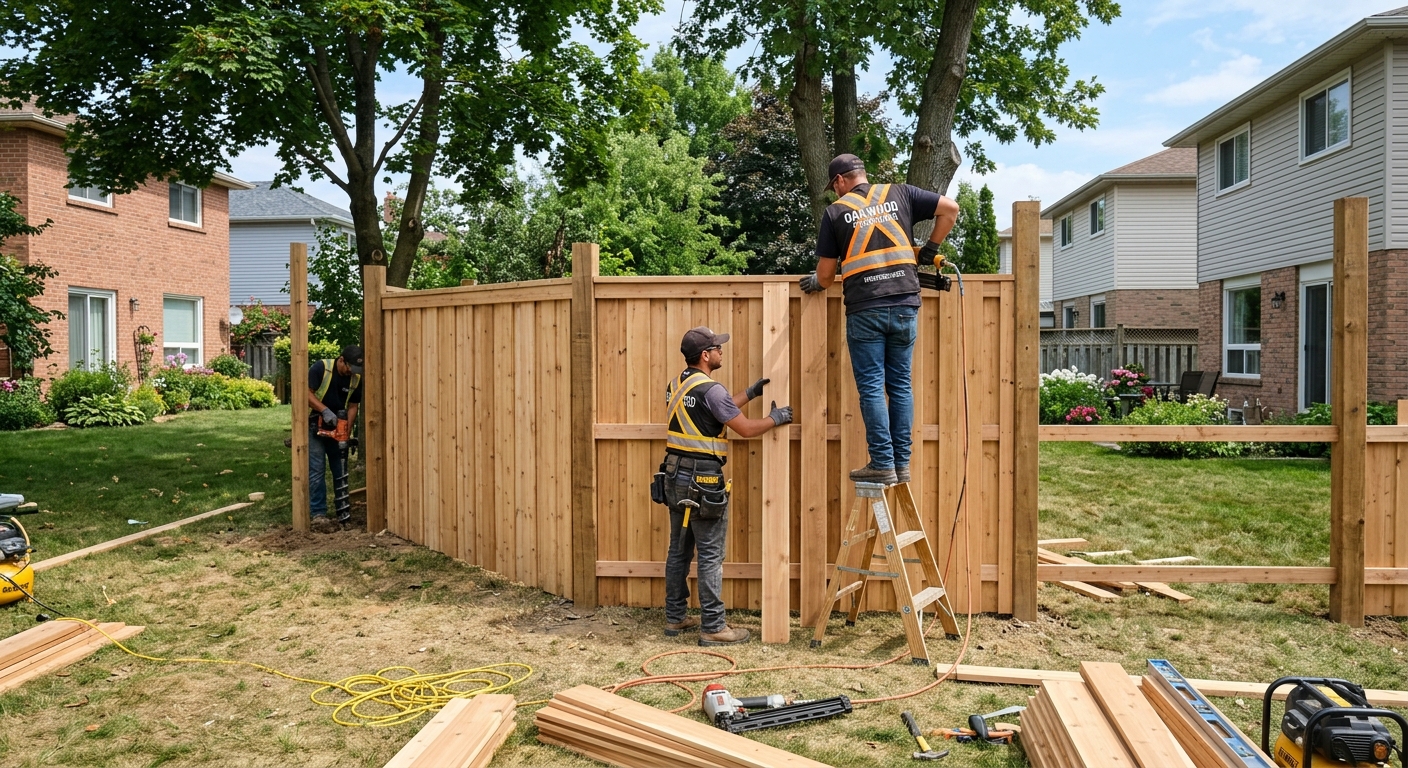
Fencing options and costs in Shelburne
In Shelburne, fencing is one of those home-improvement projects where expectations are usually clear (more privacy, better curb appeal), but the final price swings based on site conditions and post installation requirements. Shelburne has 8,994 residents, and most properties are owner-occupied—2,425 homeowner households (80.2% of households own) help explain why privacy upgrades and rear-yard replacements are steady year-round. The housing mix also matters: single-detached homes make up 72.9% of dwellings, meaning more properties need panel-by-panel fencing that matches lot layouts and driveways.
In the Kitchener–Waterloo–Barrie economic region, the climate and soils drive the cost structure. Freeze–thaw cycles and frost heave risk typically push contractors to set posts deeper with concrete for most wood, vinyl, and aluminum privacy fences—especially the common 6 ft (1.8 m) height. Labour availability can also tighten during spring and early summer installs, when many older fences (Shelburne has a large pre-1981 housing stock: 38.5%) are due for replacement at the same time. If your yard is near more open areas with limited tree cover, installers often account for gusts by using sturdier rails and tighter post spacing (commonly 6–8 ft centres for privacy runs).
Below is a realistic comparison for materials you’ll see quoted in Shelburne, Ontario, followed by typical price bands per linear foot.
| Material |
Lifespan |
Maintenance |
Privacy Rating |
Price per Linear Foot |
| Pressure-treated pine (standard wood) |
10–15 years |
Stain/seal every 2–3 years |
High (good for 6 ft privacy) |
$45 – $70 |
| Cedar (natural rot resistance) |
15–25 years |
Seal/stain every 2–4 years |
High (thicker boards look best) |
$60 – $85 |
| Vinyl / PVC (no-maintenance) |
20–30 years |
Rinse only; occasional cleaning |
High (solid-board panels) |
$55 – $90 |
| Chain-link (galvanized steel) |
20+ years |
Minimal; occasional tightening |
Low (privacy requires slats/mesh) |
$35 – $60 |
| Aluminum ornamental |
25+ years |
Wash annually; touch-ups rarely |
Medium (decorative spacing) |
$60 – $110 |
| Composite / recycled material |
25+ years |
Low; rinse and inspect |
High (solid composite boards) |
$70 – $115 |
Prices are estimates only and vary by project scope, site access and material selection.
What affects the price of fencing in Shelburne
Two neighbours in Kitchener–Waterloo–Barrie can receive very different fencing quotes for what looks like the same job. A 30–50% swing is common because post installation depth, concrete quantity, gate complexity, and removal/disposal costs change from yard to yard. In Shelburne, the typical driver is how frost impacts your ground: the frost line in this part of Ontario often means posts must be set with extra depth (commonly extending 4–6 inches below the design frost depth) to prevent heaving. Practically, that translates to deeper augering, longer posts, and more concrete per post compared with warmer regions.
Wind isn’t as extreme as open Prairie sites, but local installers still plan for gusts near newer subdivision edges and open farmland pockets by tightening post spacing and using sturdier rails on 6 ft privacy runs. That’s one reason wood pricing usually sits in the $45–$70 range and vinyl commonly lands in the $55–$90 band—materials and framing are both chosen to resist racking and panel blow-out.
Here are concrete examples of how Shelburne conditions affect costs. First, if your soil is heavy clay that doesn’t drain well, auger time and concrete volume often increase because holes must be stable and true. Second, if your fence line runs near buried services (storm water connections or older drainage), you may get slower, more careful digging, which adds labour. Third, yards with steep grades often need stepped rails or raked sections; that can raise panel pricing even if the linear footage is the same.
As a rule of thumb, for an average privacy run, switching from chain-link’s $35–$60 band to a concrete-set wood privacy fence usually costs more upfront, but it’s justified when your priority is real sightline privacy and long-term alignment through freeze–thaw seasons.
| Price Factor |
Why It Matters |
Cost Impact |
| Fence length in linear feet |
More runs require more posts, rails and labour time |
Highest driver; directly scales total price |
| Post depth required |
Frost depth determines how far posts must go to prevent heaving |
Deeper holes mean longer posts, more augering and concrete |
| Post setting method |
Concrete set resists shifting better than dry-set in freeze–thaw soils |
Concrete-set typically increases cost vs. gravel pack |
| Material choice |
Vinyl, cedar, chain-link, and aluminum vary in component cost and framing |
Switching materials can change total by 20–60% |
| Gate count and type |
Gates need extra hardware, bracing and sometimes heavier frames |
Each gate can add significant labour and materials |
| Grade and terrain |
Slopes require stepped or raked panels to keep top lines straight |
More cutting, fitting and higher labour time |
| Old fence removal and disposal |
Debris handling, load-out and dump fees vary by site |
Can add a noticeable amount to total price |
| Permit fees and survey / property line locate |
Locates prevent encroachment and disputes over boundary placement |
Optional in some cases, but can add cost and schedule time |
Permits & regulations in Ontario
In Ontario, fences can fall under the permit process depending on height and location. As a practical homeowner guideline, fences above a height threshold—commonly around 2.0 m (6.5 ft) at the rear and roughly 1.0–1.2 m (3–4 ft) at the front or corner—often require a building permit. Even when a permit isn’t required, all fencing must be placed within property lines and comply with municipal setback bylaws.
Before you dig any post holes, you also need to call for utility locates through Ontario One Call (a locate ticket is the safety baseline). If you plan to fence along a boundary or near a shared area, get a survey or at least confirm property pins/locates so you’re not building across a neighbouring parcel line. Disputes are harder (and costlier) to resolve after posts are set.
Shared fence ownership and maintenance responsibilities are handled under Ontario’s line-fence framework; if a boundary fence is deemed shared, neighbours may have differing expectations about who maintains it and when replacements are required. When in doubt, keep communication clear in writing before work begins.
To verify your contractor in Shelburne: request (1) an Ontario licence/registration where applicable for fencing/contracting activity, (2) WSIB/WCB coverage documentation for worker protection, and (3) liability insurance (certificate of insurance naming you or showing adequate limits). You should also receive clearance/COI details that match your project dates. Ask them for proof—don’t rely on verbal assurances.
Choosing the right fence material for Shelburne
Choosing the right fence in Shelburne comes down to matching material to your priorities: privacy, low maintenance, budget, and how long you want the fence to look “straight and solid” through Ontario’s freeze–thaw seasons. Because the frost line drives deeper post-setting in Kitchener–Waterloo–Barrie, the framing quality and post installation matter as much as the surface material. For most privacy projects, concrete-set posts are the standard approach to resist shifting and leaning.
Pressure-treated pine is the most budget-friendly path, but it needs staining/sealing about every 2–3 years to slow weathering and grey fading. Cedar offers better natural rot resistance and a more attractive grain; it still benefits from periodic sealing, but it often holds up beautifully for longer. Vinyl/PVC is popular for low maintenance—typically just rinsing—yet it can get brittle if the product is low quality and exposed to repeated extreme cold without proper installation practices (correct post support and expansion considerations). Chain-link is the lowest initial cost and long-lasting, but it won’t provide privacy unless you add slats or privacy mesh. Aluminum ornamental gives a clean, no-rust look with mid-range cost, but it’s usually not “privacy grade” because of the open picket design. Composite/recycled boards sit at the higher end and can be a strong choice when you want low maintenance plus more solid privacy.
In Shelburne’s winter conditions, deeper holes and solid post-setting generally remain essential for all privacy fences at 6 ft. If you compare, for example, a wood privacy run around $45 – $70 per linear foot versus vinyl at $55 – $90, the extra upfront vinyl cost is often justified when you don’t want to schedule staining every few years and want consistent colour.
| Material |
Cold Tolerance |
Lifespan |
Annual Maintenance |
Best For |
Price Band |
| Pressure-treated pine |
Good with proper sealing and concrete-set posts |
10–15 years |
1–2 hours for inspection; stain as needed every 2–3 years |
Budget privacy with a classic look |
$45 – $70 |
| Cedar |
Excellent rot resistance in damp freeze–thaw zones |
15–25 years |
Check yearly; seal/stain every 2–4 years |
Premium appearance and natural longevity |
$60 – $85 |
| Vinyl / PVC |
Good; relies on correct installation and quality components |
20–30 years |
Rinse/clean 1–2 times per season as needed |
Low maintenance and consistent look |
$55 – $90 |
| Chain-link |
Very good; galvanized hardware handles winter well |
20+ years |
Minimal; occasional tightening and check tension |
Security on a tight budget |
$35 – $60 |
| Aluminum ornamental |
Excellent; no rust and stable in cold weather |
25+ years |
Wash annually; inspect for hardware tightness |
Curb appeal with moderate boundary definition |
$60 – $110 |
| Composite / recycled |
Good; depends on product design and fastener system |
25+ years |
Low; rinse and inspect occasionally |
Low maintenance privacy with a modern finish |
$70 – $115 |
How to choose a fencing contractor in Shelburne
When you’re choosing a fencing contractor in Shelburne, verify coverage and credentials before you sign. In Ontario, ask for proof of liability insurance (certificate of insurance), and confirm workers are protected through WSIB/WCB coverage (documentation should match your job dates and project location). If the contractor is using subcontractors, their coverage should still be clear in writing. You can typically check credentials through the contractor’s own documents and, where applicable, relevant provincial/industry registration pathways; for insurance, the COI details are what you should rely on.
Next, get 2–3 itemised written quotes. The best quotes separate labour from materials and list what’s included: post depth, concrete amount allowances, rail design, gate hardware, and whether disposal is included. Avoid “lump sum only” proposals that don’t show assumptions—especially around how they handle difficult soils, slopes, and old fence removal. Ask whether a permit pull (if required due to height) is included or billed separately, and confirm who does the utility locate ticket process coordination.
Warranty matters too. Look for a workmanship warranty stated in writing (often a defined number of years), and separate product/manufacturer warranty terms. Ask whether warranties are transferable if you sell the home. Payment schedules should be conservative: never pay more than 10–15% upfront, and hold back funds until the job is complete and you’ve confirmed alignment and hardware operation.
Finally, request a start date and completion estimate in writing, along with what weather stoppages mean for your timeline.
- Written quote with itemised labour/materials (not just one total).
- Post depth and setting method stated explicitly (e.g., concrete-set).
- Included gate hardware spec (hinges, latch type, bracing).
- Clear scope for old fence removal and disposal.
- Utility locate responsibility confirmed before digging.
- Permit responsibility spelled out (if your height triggers it).
- Survey/property line locate assumed vs. excluded.
- Workmanship warranty length in writing.
- Manufacturer warranty details and transferability.
- Proof of liability insurance certificate on request.
- WSIB/WCB coverage proof for workers.
- Payment schedule with a small deposit and a completion holdback.
In Shelburne, red flags I see often include: quotes that ignore frost-depth and simply say “standard post holes,” refusal to provide COI/WSIB paperwork, missing gate bracing details (a common failure point), vague disposal language for old fence removal, and proposals that change price after posts are already installed with no written change order.
Frequently asked questions — fencing in Shelburne
Do I need a permit to build a fence in Ontario?
In Ontario, permits are often triggered by fence height and location, especially when the fence is taller than typical thresholds. A common homeowner guideline is that rear fences above about 2.0 m (6.5 ft) and front/corner fences around 1.0–1.2 m (3–4 ft) may require a building permit. Regardless of permit requirements, the fence still has to meet property line placement and municipal setback rules. For Shelburne homeowners, it’s smart to confirm this in your quote because some contractors include permit handling while others charge extra. Also, before any digging, make sure utilities are located through Ontario One Call and confirm your property line (survey or pins) to reduce the chance of encroachment.
How long does a wood fence last in Shelburne?
A properly installed wood fence in Shelburne—especially one that uses concrete-set posts where frost heave is a risk—typically lasts about 10–15 years for standard pressure-treated pine, and closer to 15–25 years for cedar. The difference comes from rot resistance and how well the fence is maintained through Ontario’s freeze–thaw winters. Pressure-treated pine usually needs staining or sealing every 2–3 years to reduce grey weathering and surface breakdown. If your quote targets the wood privacy band of $45 – $70 per linear foot, ask whether the installer is specifying post depth and concrete setting, not just board type. Poor post installation is what most commonly shortens lifespan in the Kitchener–Waterloo–Barrie region.
Who owns and maintains a shared fence?
Ontario’s line-fence framework governs shared fence situations, but the practical answer depends on whether the boundary fence is recognized as shared and what was agreed previously between neighbours. In general, where a fence is determined to be a boundary/party fence, both neighbours may have responsibilities related to maintenance and cost, but details can vary by circumstances. For Shelburne homeowners, keep expectations grounded early: take photos, confirm boundary placement, and ask your contractor to document what they’re building where (survey locate vs. assumed line). If you’re planning repairs or a full replacement, discuss cost sharing in writing before work starts. A well-documented install also protects you if there’s later disagreement about materials, placement, or timing.
How do I find my property line before fencing?
The safest method is to use a survey or property pin locate before any posts go in. In practice, you can start by checking your property documents and locating your survey plan, then confirm the pins or boundary markers on-site (or hire a professional locate if they’re missing). For Shelburne and the Kitchener–Waterloo–Barrie region, this matters because correcting an encroachment after concrete is poured is expensive. When you get quotes, ask whether the contractor assumes pins are accurate and whether they recommend a locate/survey. Utilities also must be located before digging through Ontario One Call, since buried services can limit where you’re able to set posts safely even if you’re on the correct boundary.
What's the most low-maintenance fence?
For most Shelburne households, vinyl/PVC is usually the “lowest ongoing effort” choice: wash/rinse periodically and you’re done, with no staining cycle like wood. Vinyl is commonly quoted in the higher upfront range of $55 – $90 per linear foot compared with pressure-treated wood, which can be around $45 – $70. Chain-link can be very low-maintenance too, but it won’t provide true privacy unless you add slats or privacy mesh. For winter performance, the key isn’t only the material—it’s also concrete-set posts and proper spacing so the fence stays aligned through Ontario’s freeze–thaw cycles.
How tall can my fence be in Shelburne?
Fence height rules depend on whether the fence is in the front/corner versus the rear yard, and whether it falls under the permit threshold. As a homeowner guideline in Ontario, front/corner fences often sit in the 1.0–1.2 m (3–4 ft) range, while rear fences may be permitted up to around 2.0 m (6.5 ft) depending on conditions and municipal bylaws. In Shelburne, don’t assume “everyone else built it this tall” means it’s compliant. Before you order materials, confirm the height you want with your contractor’s permit guidance and check your local setback requirements. If your plan is 6 ft (1.8 m) privacy at the rear, it may still be close enough to trigger specific review depending on location and exact configuration.