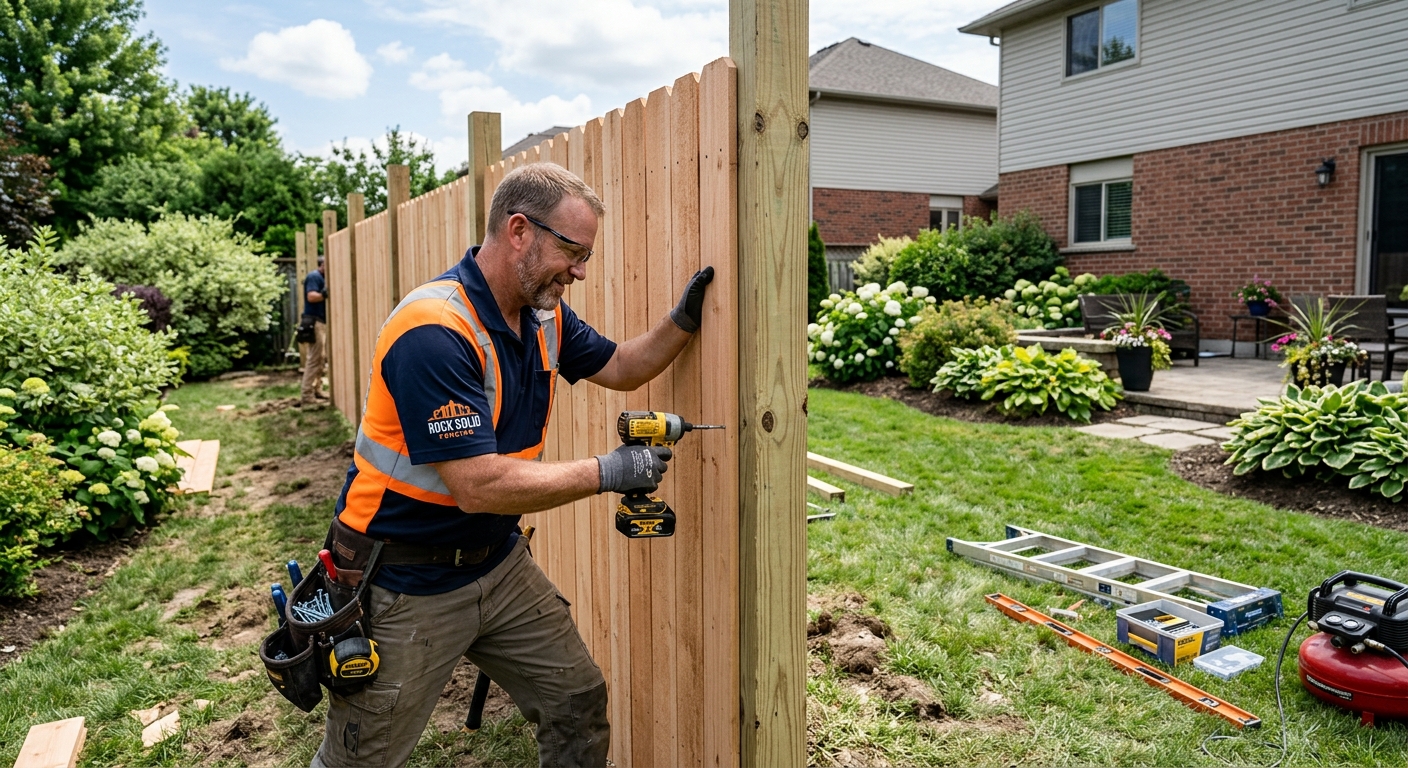
Fencing options and costs in Guildwood
Guildwood homeowners often want a fence that looks good on day one and holds up through Ontario freeze–thaw cycles. With a population of 9,917 in 2021 (Statistics Canada, 2021 Census), demand is steady, and most projects come from the area’s established residential patterns. For many buyers, the strongest predictor of local fencing work is the sheer number of single-detached households typical in mature GTA neighbourhoods—each property is a potential privacy, yard-safety, or pet-control upgrade.
In Toronto’s climate, the big cost driver is how fence posts are installed. The frost line in Southern Ontario is commonly managed at about 42"–48", so posts for 6–8 ft privacy fences usually need to be set roughly 3.5–4 ft deep in concrete to reduce frost heave and long-term lean. That labour and ready-mix cost is why a “same-length” fence can land far apart between quotes even when materials look similar.
Access and neighbourhood demand also matter. Trades are especially busy around the Guildwood bluffs and creek-adjacent streets where yards can be tight, soil can be mixed, and crews often need to work around grade changes. If you’re comparing options now, the table below summarises typical lifespan, maintenance expectations, privacy level, and installed price ranges for Guildwood.
| Material |
Lifespan |
Maintenance |
Privacy Rating |
Price per Linear Foot |
Price Range |
| Pressure-treated pine (standard wood) |
10–15 years |
Stain/seal every 2–3 years |
High (solid boards) |
$65–$95 |
$2,600–$4,800 |
| Cedar (natural rot resistance) |
15–20 years |
Light staining every 2–4 years |
High (boards close-set) |
$80–$115 |
$3,000–$6,300 |
| Vinyl / PVC (no-maintenance) |
20–30 years |
Wash as needed |
High (solid panels) |
$75–$130 |
$3,100–$7,200 |
| Chain-link (galvanized steel) |
25–35 years |
Occasional rinse |
Low–medium (open mesh) |
$45–$70 |
$1,800–$3,900 |
| Aluminum ornamental |
25–40 years |
Occasional cleaning |
Low (decorative) |
$90–$160 |
$3,600–$9,000 |
| Composite / recycled material |
20–30 years |
Low; occasional wash |
High (solid styles) |
$100–$150 |
$4,000–$8,500 |
Prices are estimates only and vary by project scope, site access and material selection.
What affects the price of fencing in Guildwood
In Guildwood and across the Toronto economic region, two quotes for what looks like the “same” fence can differ by 30–50% because the hidden work changes: footing depth, post spacing, gate hardware, demolition, and how crews handle clay/mixed soils. Toronto-area labour rates and scheduling also influence cost—when contractors have more start-ready crews booked (common in summer), prices can tighten, while off-season work may trade price for availability.
The frost line governs post depth. In cold Ontario, posts are typically set 4–6 inches below the design frost depth; practically, that often means driving the hole deeper and installing longer posts. For a 6–8 ft privacy run, many crews recommend concrete-set posts rather than gravel-only or driven posts, which increases labour time and ready-mix but reduces the risk of frost heave and early leaning. Wind is less punishing than the Prairies, but taller solid fences still need heavier posts and closer spacing to limit racking and uplift.
Two concrete examples from Guildwood-type sites: if you’re replacing an old fence that’s sitting on shallow footings, demolition and deeper re-drilling can add material and labour because the ground conditions won’t “match” the new design. If your yard is slightly sloped near a backyard boundary, stepping panels (or using a raked design) increases measuring, cutting, and hardware time—often pushing the project toward the higher end of a wood range (for example, mid-to-high $65–$120 style pricing), while a vinyl privacy project tends to hold steadier at the higher band because posts and panel systems are more rigid (roughly $75–$130 per linear foot).
Finally, fence length, gate count, and accessibility decide the overall spend quickly. A short run can stay near the budget end, but longer privacy lines plus gates typically move the total into the mid-to-upper $ ranges.
| Price Factor |
Why It Matters |
Cost Impact |
| Fence length in linear feet |
Most material and most labour scale directly with linear footage. |
High (primary driver) |
| Post depth required |
Frost line determines hole depth, post length, and excavation time. |
High |
| Post setting method |
Concrete-set posts cost more than gravel pack; driven posts often fail sooner in frost. |
Medium–High |
| Material choice |
Vinyl/cedar costs more upfront; chain-link is often cheapest while still durable. |
Medium–High |
| Gate count and type |
Drive-through gates and double gates require heavier frames and stronger hinges/latches. |
Medium–High |
| Grade and terrain |
Slopes require stepped or raked panels and more layout time. |
Medium |
| Old fence removal and disposal |
Haul-away and disposal, plus extra labour for removing fasteners and posts. |
Medium |
| Permit fees and survey / property line locate |
Some installs need municipal approval; locating pins prevents boundary disputes. |
Low–Medium |
Permits & regulations in Ontario
In Ontario, fence rules are tied to height limits, location (front vs rear/corner), and setbacks from property lines. As a practical guideline used by many Ontario municipalities, fences above about 2.0 m (6.5 ft) at the rear and roughly 1.0–1.2 m (3–4 ft) at the front or corner may trigger a building permit requirement. Even when a permit is not needed, your fence still must respect property lines and local setback bylaws.
Before you dig a single post hole in Guildwood, call for utility locates. In Ontario, that means contacting Ontario One Call so locators can mark buried services. Also, if you’re unsure where your property line sits, get a survey or at least locate your pins—encroaching on a neighbour’s lot is one of the quickest ways to create long, expensive disputes.
Shared fences (where applicable) follow provincial line-fences principles, usually built around shared responsibility and cost sharing rules between adjoining landowners.
To verify an Ontario contractor, take three steps. First, check their licensing/registration status through the appropriate online registry for your scope of work. Second, request a clear certificate of liability insurance showing active coverage and the project address (ask for the COI number and expiry date). Third, confirm WSIB coverage (or WCB coverage where applicable) directly on the certificate or with a clearance letter so you’re not responsible if a worker is injured.
Choosing the right fence material for Guildwood
Choosing a fence in Guildwood is mostly about matching material performance to Toronto freeze–thaw and your tolerance for upkeep. Pressure-treated pine is the budget-friendly start, but you should plan to stain or seal every 2–3 years to prevent fast weathering and graying. Cedar looks great and resists rot better than many standard woods, but it still benefits from periodic maintenance to keep colour and surface integrity.
For low-maintenance owners, vinyl/PVC is a strong fit: it typically needs only washing and won’t rot. The trade-off is that in extreme cold, vinyl can become more brittle, and you must use the correct post depth and mounting system so panels stay straight through winter expansion and contraction. Chain-link is the longest-life low-cost option, but it offers little privacy unless you add slats or a privacy screen. Aluminum ornamental provides rust resistance and curb appeal, yet it’s not a privacy solution for backyards.
Regardless of material, Toronto’s frost line means you often can’t “half-build” the footing. Many privacy fences end up with concrete-set posts because the hole depth tied to frost heave risk is what keeps the fence standing. That’s why a solid privacy project can cost more than you expect even before you pick premium boards.
As a money example: if a pressure-treated pine privacy run lands around the low end of wood pricing (roughly $65–$95 per linear foot), cedar or vinyl can add material and system cost toward the mid-to-high band. That difference can be justified when you want fewer maintenance weekends and a longer service life, especially on longer backyards where repairs are disruptive.
| Material |
Cold Tolerance |
Lifespan |
Annual Maintenance |
Best For |
Price Band |
| Pressure-treated pine |
Good with correct concrete-set posts |
10–15 years |
Low seasonally; plan 2–3 year stain cycles |
Best budget privacy with a DIY maintenance willingness |
$65–$120 |
| Cedar |
Good; performs well in mixed soil moisture |
15–20 years |
Light wash; stain every 2–4 years |
Premium look and better natural rot resistance |
$80–$120 |
| Vinyl / PVC |
Good when installed with proper hardware spacing |
20–30 years |
Wash as needed; no staining |
Low-maintenance privacy |
$75–$130 |
| Chain-link |
Excellent (metal holds up through freeze–thaw) |
25–35 years |
Rinse occasionally; inspect hardware |
Security and pet containment on tighter budgets |
$45–$85 |
| Aluminum ornamental |
Excellent (no rust when powder-coated) |
25–40 years |
Occasional cleaning |
Front curb appeal and durability |
$90–$160 |
| Composite / recycled |
Very good; stable colour with correct installation |
20–30 years |
Low; wash and inspect fasteners |
Privacy with an “upgrade” feel and minimal work |
$100–$150 |
How to choose a fencing contractor in Guildwood
When you’re hiring a fencing contractor in Ontario, verify three things early: licensing/registration, liability insurance, and WSIB/WCB coverage. Start by requesting their insurance certificate before any site measurement. Your certificate should show active general liability with your project address or at least “additional insured” details. For workers’ coverage, don’t rely on verbal promises—ask for a WSIB clearance letter or proof of coverage on the certificate, including policy number and expiry. A reputable contractor in the GTA will provide these documents quickly because it protects their crew and you.
Next, get 2–3 itemised written quotes. Look for a breakdown that separates materials (posts, rails, panels, gate hardware), labour (demo, excavation, concrete set), and extras (haul-away, disposal, property line locate). Avoid lump-sum “all-in” quotes that don’t specify whether permits are included, what’s excluded, and whether the quote assumes concrete-set posts throughout.
Warranty matters, too. Ask for the workmanship warranty length and confirm whether it’s tied to installation standards (like correct post depth and spacing). Also note the product/manufacturer warranty and whether it’s transferable to you if you sell the home.
For payment schedules, plan to never pay more than 10–15% upfront. Use a holdback until the job is complete and any punch-list items are finished. Finally, demand a start date and completion estimate in writing so you can plan around neighbour access, gate timing, and any seasonal limitations due to ground conditions.
- Confirm insurance is current (expiry date) and request the COI for your address.
- Ask for WSIB clearance or proof of coverage before work begins.
- Require a written itemised quote (materials vs labour vs extras).
- Check that post depth and setting method are explicitly stated (concrete-set where needed).
- Confirm gate hardware grade (hinges, latches, frames) and number of gates.
- Verify whether old fence demolition and disposal are included.
- Ask how they handle slopes: stepped vs raked panel plan.
- Confirm who pulls permits (if required) and whether permit fees are included.
- Review warranty terms in writing: workmanship and product coverage.
- Use a payment schedule with holdback until final inspection/punch-list completion.
- Get a detailed schedule: start date, cure time for concrete, and completion target.
- Ensure they will protect landscaping/driveways during excavation and concrete pour.
Red flags I often see with less reliable fence contractors in Guildwood include: (1) refusing to provide WSIB/COI documents, (2) vague quotes that don’t specify post depth or concrete-set footing decisions, (3) pushing for high upfront payments (more than 10–15%), (4) skipping utility locates or fencing layout by property pins, and (5) offering warranties that only cover product defects while excluding workmanship installation.
Frequently asked questions — fencing in Guildwood
How deep should fence posts be for Guildwood's frost?
In Guildwood, Ontario projects are typically planned around Southern Ontario frost conditions, where the design frost depth is commonly managed around 42"–48". In practice, that usually means setting posts about 3.5–4 ft deep for privacy fence heights (6–8 ft), with concrete-set posts preferred to reduce frost heave and long-term leaning. The typical rule of thumb used by most installers is to place the bottom of the post roughly 4–6 inches below the design frost depth, then match post size and spacing to the wind and panel loads. If you choose driven posts or only a gravel pack in freeze–thaw clay, the fence may look fine early and then shift after multiple winters—resulting in costly realignment.
Wood vs vinyl vs aluminum fence — which is best?
“Best” depends on what you value most. Wood (pressure-treated pine) is often the lowest upfront option and commonly sits in the $65–$120 per linear foot band, but it needs staining/sealing every 2–3 years to avoid rapid weathering. Cedar is a step up in appearance and rot resistance, usually costing more, but still benefits from periodic maintenance. Vinyl/PVC is the low-maintenance privacy favourite for many Toronto-area homeowners; it typically falls around the $75–$130 per linear foot band, and it won’t rot like wood. Aluminum is durable and rust-resistant, often mid-range to higher (roughly $90–$160), but it’s usually ornamental and not a true privacy solution. For most backyards needing privacy in Guildwood, vinyl or cedar with concrete-set posts is the most consistent long-term choice.
Do I need a permit to build a fence in Ontario?
Ontario permit needs depend on fence height and location. A common guideline used in Ontario is that fences above about 2.0 m (6.5 ft) at the rear and roughly 1.0–1.2 m (3–4 ft) at the front or corner may require a building permit, subject to local setback rules. Even if a permit is not required, you still must keep the fence within property lines and comply with municipal setback bylaws. Before any digging in Guildwood, don’t forget utility locates via Ontario One Call, and confirm your boundary (survey or pin locate) if there’s any uncertainty—this helps avoid encroachment disputes that can stall projects. If your contractor can’t clearly explain whether a permit is expected for your specific height and placement, ask them to specify it in writing.
How long does a wood fence last in Guildwood?
A well-installed wood fence in Guildwood—especially one built with correct post depth and concrete-set posts where frost heave risk is high—typically lasts around 10–15 years for pressure-treated pine, with cedar often closer to 15–20 years depending on maintenance. Lifespan shortens when posts are set too shallow, the wood isn’t properly sealed, or the fence is built with inadequate drainage behind solid panels. Maintenance is the other half of the equation: if you stain/seal every 2–3 years, you slow grey weathering and protect against moisture cycling. If you’d rather spend more upfront to reduce upkeep, vinyl privacy projects in the Toronto region often land in the $75–$130 per linear foot band, with less routine work afterward.
Who owns and maintains a shared fence?
Shared fence ownership and cost responsibilities in Ontario generally fall under provincial line-fences principles between adjoining landowners. In simple terms, if the fence is truly a boundary/shared structure, both owners may have responsibilities, but the exact arrangement can depend on how the fence sits relative to the property line and what agreements existed when it was built. For homeowners in Guildwood, the safest approach is to confirm the location (survey/pins) and discuss in writing who maintains and pays for repairs or replacement—especially if you’re adding height, upgrading materials, or replacing damaged sections. A good contractor should help document the existing alignment and provide photos and measurements for your records. If there’s uncertainty, get legal guidance; don’t assume a fence is shared just because it “runs along the boundary.”
How do I find my property line before fencing?
The best method in Ontario is to use a surveyor or locate your property pins, especially if you’re replacing a fence or changing its alignment. In many Guildwood cases, homeowners discover the old fence was installed a little in or out over the years—then the “new fence” becomes the dispute. Before digging holes, you should also request utility locates through Ontario One Call so you’re not guessing around buried services. Practically, start by finding the boundary evidence (survey documents, pin locations), then mark an intended line with a contractor’s measurement. If you don’t have reliable survey information, arrange a property locate/survey before ordering materials, because relocating after you’ve already excavated can cost far more than doing it right the first time. This is one reason itemised quotes matter.