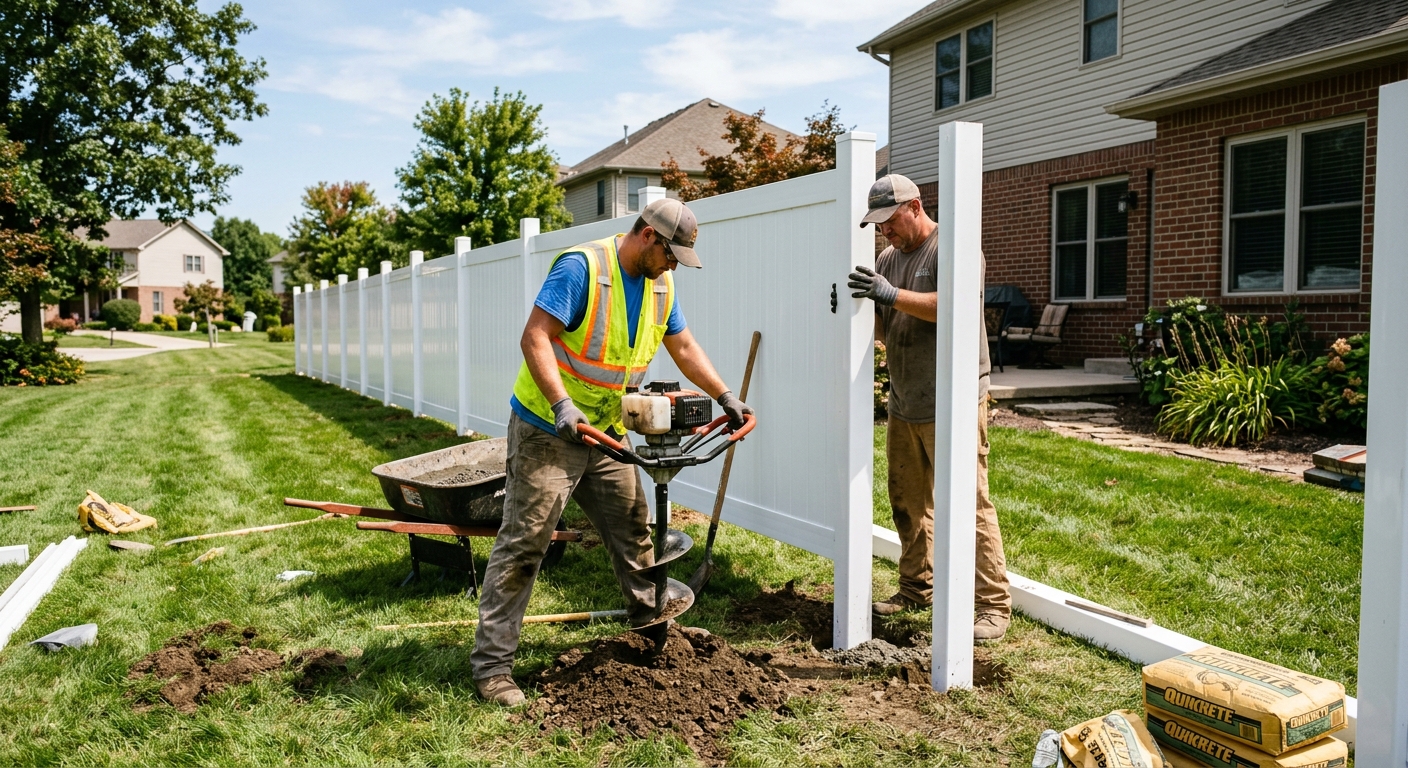
Fencing options and costs in Briar Hill-Belgravia
Briar Hill-Belgravia is one of those Toronto-area neighbourhoods where fencing isn’t just a nice-to-have—it’s a daily-use boundary for yards, pets, and kids. With a local population of 14,257 (Statistics Canada, 2021 Census), demand stays steady across the year, especially around the older residential pockets near Bayview Avenue where homeowners tend to upgrade aging boundary fences. Also, the Toronto region’s housing stock is heavily dominated by detached properties, which matters because each detached lot is effectively a fencing job waiting to happen (Statistics Canada, 2021 Census). That mix of lot sizes, plus the number of corners and driveways, keeps trades busy and influences quote turnaround times.
Cost in Toronto is shaped by our cold winters and how contractors build for them. In Southern Ontario, frost depth is commonly treated at about 42"–48", which means fence posts often need to be set roughly 3.5–4 ft down to limit frost heave—particularly for 6–8 ft privacy fences. This drives more concrete-set labour and longer posts, so the “same fence” can price higher than you’d expect in milder climates. In Briar Hill-Belgravia, you’ll also see added variability from soil type (clay and mixed soils), wind loads that can rack taller panels, and access constraints around mature landscaping in established yards.
Below are practical option ranges to help you compare apples to apples before you ask for itemised quotes.
| Material |
Lifespan |
Maintenance |
Privacy Rating |
Price per Linear Foot |
| Pressure-treated pine (standard wood) |
10–15 years |
Stain or seal every 2–3 years |
High (solid boards) |
$18 – $32 |
| Cedar (natural rot resistance) |
15–25 years |
Light stain/seal every 2–4 years |
High (solid boards) |
$22 – $38 |
| Vinyl / PVC (no-maintenance) |
20–30 years |
Occasional wash only |
High (solid privacy panels) |
$26 – $42 |
| Chain-link (galvanized steel) |
20–35 years |
Rinse/inspect tension; rare repairs |
Low to medium (adds visibility) |
$12 – $21 |
| Aluminum ornamental |
25–40 years |
Minimal cleaning; occasional touch-ups |
Low (open pickets) |
$22 – $48 |
| Composite / recycled material |
20–35 years |
Wash; no staining |
High (board-style systems) |
$30 – $55 |
Prices are estimates only and vary by project scope, site access and material selection.
What affects the price of fencing in Briar Hill-Belgravia
If you’re comparing quotes for the same 6 ft fence line in Briar Hill-Belgravia, it’s not unusual to see a 30–50% spread across Toronto-area contractors. The difference usually comes down to how deeply they set posts (and how they do it), how wind-stable the framing is, and whether the quote includes real-world items like disposal, locates, and panel bracing on corners.
In Southern Ontario, the frost line is commonly handled at about 42"–48". Best practice is to set posts about 4–6 inches below the design frost depth to help prevent heaving; in practice that often means roughly 1.5–2.0 m into the ground for fence runs, especially where clay and mixed soils hold moisture. That depth translates into longer posts, deeper holes, more concrete work, and more labour. For privacy fences (wood or vinyl), wind also pushes loads higher on taller solid panels, so you typically need heavier posts (like 4x4 wood or larger structural posts in vinyl/PVC) and closer spacing (often 6–8 ft centres) to reduce racking and uplift.
Here are concrete examples of how Toronto conditions change the cost in your neighbourhood: (1) A backyard run with concrete-set posts will often land in the higher band—wood privacy commonly starts around the $65–$120 range per total installed project budget tier, while vinyl/pvc tends to sit higher (commonly $75–$130). (2) If you’re replacing an old fence with broken posts, disposal and additional excavation can add hours and dump fees. (3) If your yard has sloped grade near a boundary, stepped or raked panel setups require extra material planning and installation time.
In short: the same “linear feet” number can become two different jobs depending on frost-safe footing, framing strength, and how the contractor handles terrain and removal.
| Price Factor |
Why It Matters |
Cost Impact |
| Fence length in linear feet |
Most materials and labour scale directly with run length |
Largest driver of total cost |
| Post depth required |
Frost protection dictates hole depth and often longer posts |
Higher excavation and material cost |
| Post setting method |
Concrete-set posts resist frost heave better than gravel pack alone |
Concrete increases labour and ready-mix costs |
| Material choice |
Vinyl and cedar cost more but reduce certain maintenance needs |
Shifts you across wood/vinyl/chain-link bands |
| Gate count and type |
Drive-through double gates need more hardware and stronger framing |
Can add significant install time and hardware cost |
| Grade and terrain |
Slope requires raked/stepped panels and tighter layout work |
Extra labour and sometimes extra materials |
| Old fence removal and disposal |
Removal includes hauling, sorting (when applicable), and resetting lines |
May increase cost even if new fence length matches |
| Permit fees and survey / property line locate |
Locates prevent encroachment disputes and reduce rework |
Small-to-moderate add depending on scope |
Permits & regulations in Ontario
In Ontario, permits can apply when a fence exceeds certain height thresholds. As a practical rule of thumb used in many municipalities, fences above about 2.0 m (6.5 ft) at the rear and about 1.0–1.2 m (3–4 ft) at the front or corner often trigger permit requirements. Even if a fence is under those heights, you still must respect property lines and any municipal setback bylaws that apply in your area.
Before digging any post hole, always call for utility locates through Ontario One Call (and your local utility if requested). Then get a survey or confirm property pins/locate your boundary if there’s any doubt—encroaching on a neighbour’s yard is one of the most common causes of disputes and costly rework. Shared fence ownership is governed by provincial line-fences legislation, so boundary clarity matters.
To verify whether the work itself needs a permit, ask the contractor (or check with the municipality) specifically about proposed height, front/corner placement, and whether you’re building a solid privacy barrier. Typically, what often does not require a permit is small, lower-height fencing in the rear within common limits—however, this can vary by municipality, so don’t rely on generic advice.
For contractor due diligence in Briar Hill-Belgravia: confirm their licence (where applicable in Ontario), request a certificate of insurance, and verify workers are covered under WSIB. Look for a current WSIB clearance letter or proof of coverage on request, and ensure the certificate of insurance lists you (or includes general liability appropriate for the job) for the work period. Always ask for these documents before work starts.
Choosing the right fence material for Briar Hill-Belgravia
Choosing the right material in Briar Hill-Belgravia comes down to balancing privacy, maintenance, budget, and how the fence performs through Toronto’s winter freeze-thaw cycles and spring thaw moisture. Pressure-treated pine is the lowest upfront option, but it usually needs staining or sealing every 2–3 years to prevent grey weathering and to slow down surface cracking. Cedar offers better natural rot resistance and looks great, but it still benefits from maintenance to keep colour and reduce checking. Vinyl/PVC is popular for no-fuss ownership—no staining, just occasional washing—yet it can become brittle if panels are installed without proper framing or if the system isn’t rated for cold snaps. Chain-link is the longest-life budget choice, but it won’t give you privacy unless you add slats or planting.
Post depth is where “material choice” meets Toronto climate reality. Because Southern Ontario frost depth is commonly treated at about 42"–48", posts usually need to be set roughly 3.5–4 ft down, often with concrete-set installation for stability in clay/mixed soils. That foundation work is a big reason vinyl and wood can look close on paper yet diverge in total installed cost—solid privacy systems require stronger posts and bracing to handle wind-driven racking. Snow and ice also add temporary loads, so a rigid, properly fastened frame matters.
A good way to see value: if pressure-treated pine privacy is priced in the wood band (often about $65–$120 in typical installed budget tiers), moving to cedar can be justified where you want a longer-looking fence—expect higher per-foot material and install, but better appearance and durability. Vinyl often costs more upfront (commonly $75–$130 in typical installed budget tiers), yet can pencil out if you don’t want to re-stain and you want consistent look over years.
| Material |
Cold Tolerance |
Lifespan |
Annual Maintenance |
Best For |
Price Band |
| Pressure-treated pine |
Good (when properly sealed/installed) |
10–15 years |
1–3 small touch-ups; stain/seal every 2–3 years |
Lowest initial cost privacy |
$65 – $120 |
| Cedar |
Good (natural oils help) |
15–25 years |
Wash + stain/seal every 2–4 years |
Premium look with manageable maintenance |
$75 – $130 |
| Vinyl / PVC |
Very good (with correct cold-rated system) |
20–30 years |
Occasional wash and hardware checks |
Low maintenance privacy |
$75 – $130 |
| Chain-link |
Very good (steel resists cold) |
20–35 years |
Inspect tension; rinse/spot-repair |
Security with long service life |
$45 – $85 |
| Aluminum ornamental |
Excellent (coated metal) |
25–40 years |
Minimal cleaning |
Front-yard aesthetics without rust |
$90 – $160 |
| Composite / recycled |
Good (depends on system rating and install) |
20–35 years |
Wash; inspect fasteners |
Long life with no staining |
$90 – $160 |
How to choose a fencing contractor in Briar Hill-Belgravia
Picking the right fencing contractor in Briar Hill-Belgravia is mostly about checking proof of coverage and matching how they build to local frost and wind conditions. In Ontario, ask for three items before you sign anything: (1) liability insurance—request a certificate of insurance showing it’s current and appropriate for fencing work; (2) workers’ compensation coverage—verify WSIB registration and obtain a WSIB clearance letter or proof of coverage; and (3) licence/registration details where applicable in Ontario. A reputable company will provide these without hesitation and will tie them to your project dates.
Next, require 2–3 itemised written quotes. “Itemised” should mean a breakdown of labour (including post holes and setting), materials (posts, rails, panels, pickets), gates and hardware, and any site work such as old fence removal/disposal. Confirm whether permit pull and property line locate (survey/municipal locate) are included or excluded. For warranty, look for both workmanship coverage (how long they stand behind installation) and product/manufacturer warranty. Ask if warranties are transferable to a new homeowner—this matters if you’re selling in the next few years.
Payment schedule: never pay more than 10–15% upfront for materials and mobilization. Use a holdback until the gate swings properly, panels are level, and cleanup is complete. Also, insist on a written start date and completion estimate. In Toronto-area winters, a clear timeline helps avoid incomplete installs where materials are left exposed before final trimming and hardware adjustments.
- They provide WSIB proof (clearance letter or coverage documentation) before scheduling starts.
- Liability insurance certificate is current and matches your project term.
- Quote includes post depth, setting method (concrete-set vs driven/gravel), and hole details.
- Itemised labour + materials, not a single “lump sum” number.
- Gate hardware is listed (hinge type, latch, reinforcement) and included in the scope.
- Old fence removal and disposal are explicitly stated (and where debris goes).
- Permit responsibility is stated: who pulls it, if required.
- Utility locates and property line locate/survey are covered or your responsibility is clearly written.
- Warranty terms are specific (workmanship duration and exclusions) and not just “call us.”
- Payment schedule stays at 10–15% maximum deposit with a holdback.
- They confirm grade handling (raked vs stepped) for sloped yards.
- They include cleanup and final site grading/patching where post holes were excavated.
Red flags I see too often around Briar Hill-Belgravia: they won’t provide insurance/WSIB documentation; they promise “driven posts” for tall privacy fences without discussing frost depth; their quote hides post-setting details under vague language; they ask for a large upfront payment (beyond 15%); or they won’t put the start date, completion timeframe, and warranty in writing.
Frequently asked questions — fencing in Briar Hill-Belgravia
How do I handle a fence dispute with a neighbour in Ontario?
In Briar Hill-Belgravia, fence disputes usually come down to boundaries and shared responsibility. Start by confirming where the property line actually is: use your survey or property pins and, if needed, request a locate rather than guessing off measurements. Keep everything calm and in writing—photos of the fence condition, dates of damage, and any previous agreements help. Ontario line-fences legislation can govern shared fence ownership, but the practical first step is to agree on the boundary and responsibility for repairs or replacement. If the issue involves height or placement, consider whether a permit is required. If you can’t resolve it, mediation through community services or legal advice is often faster than escalating by phone-only arguments.
What fence style offers the best wind resistance in Briar Hill-Belgravia?
For Briar Hill-Belgravia’s mix of suburban wind and taller privacy panels, the most wind-stable approach is typically a solid fence built with strong posts, proper spacing, and rigid bracing—usually a wood privacy style or a properly engineered vinyl/PVC privacy system. The biggest factor is not the “look,” but whether the contractor frames it to resist racking: heavier posts, correct rail/fastener choices, and tighter spacing (often around 6–8 ft centres) on longer runs. Equally important is frost-safe construction: posts set deep enough (roughly 3.5–4 ft down in Southern Ontario practice) and often concrete-set for stability in clay/mixed soils. A well-built wood or vinyl privacy fence will usually outperform a lightweight panel system in high wind moments.
How much does a fence cost in Briar Hill-Belgravia?
Fence pricing in Briar Hill-Belgravia depends on length, material, gate count, post depth, and removal/disposal. As a starting point, wood fencing installation often falls around $65 – $120 in typical installed cost bands, while vinyl/PVC commonly lands higher around $75 – $130 because of material and framing requirements for tall panels. Chain-link is usually the lowest, often $45 – $85. Aluminum ornamental is mid-to-higher, often $90 – $160. In Toronto-area markets, don’t forget that concrete-set posts (required for frost stability) can increase labour versus simple driven posts, especially for 6–8 ft privacy runs.
How deep should fence posts be for Briar Hill-Belgravia's frost?
Southern Ontario practice usually treats frost depth at about 42"–48", and contractors commonly set posts so they sit roughly 4–6 inches below the design frost depth. In real terms for many Briar Hill-Belgravia projects, that often means about 1.5–2.0 m into the ground (roughly 3.5–4 ft down), especially for 6–8 ft privacy fences. For stability on clay and mixed soils, concrete-set posts are generally the recommended best practice rather than simple driven posts. The exact depth can vary by soil moisture and local site conditions, so a good contractor should explain their post-hole depth and setting method clearly in the written quote.
Wood vs vinyl vs aluminum fence — which is best?
“Best” depends on your priority. If you want privacy and a solid boundary, wood or vinyl privacy styles usually fit best. Wood (pressure-treated pine) is typically the lowest upfront option, often in the $65 – $120 band, but it generally needs staining or sealing every 2–3 years to manage weathering. Vinyl/PVC is often in the $75 – $130 band and is more consistent long-term with minimal maintenance—just wash and occasional hardware checks. If you want curb appeal and durability without rust but don’t need privacy, aluminum ornamental fences can be excellent, typically around $90 – $160. For winter performance, all three can work well when posts are set correctly for frost and the fence is framed for wind.
Do I need a permit to build a fence in Ontario?
In Ontario, permits can apply based on fence height and location (rear vs front/corner). A common threshold used in many municipal contexts is about 2.0 m (6.5 ft) for rear fences and about 1.0–1.2 m (3–4 ft) for front or corner areas—above those levels, you may need a building permit. Even when a permit isn’t required, you still must follow property line rules and any municipal setback bylaws. In Briar Hill-Belgravia, don’t start digging without utility locates (Ontario One Call) and ideally confirm property pins/survey before installing. Before hiring, ask your contractor whether they pull permits (if needed) and ensure it’s spelled out in the written scope.