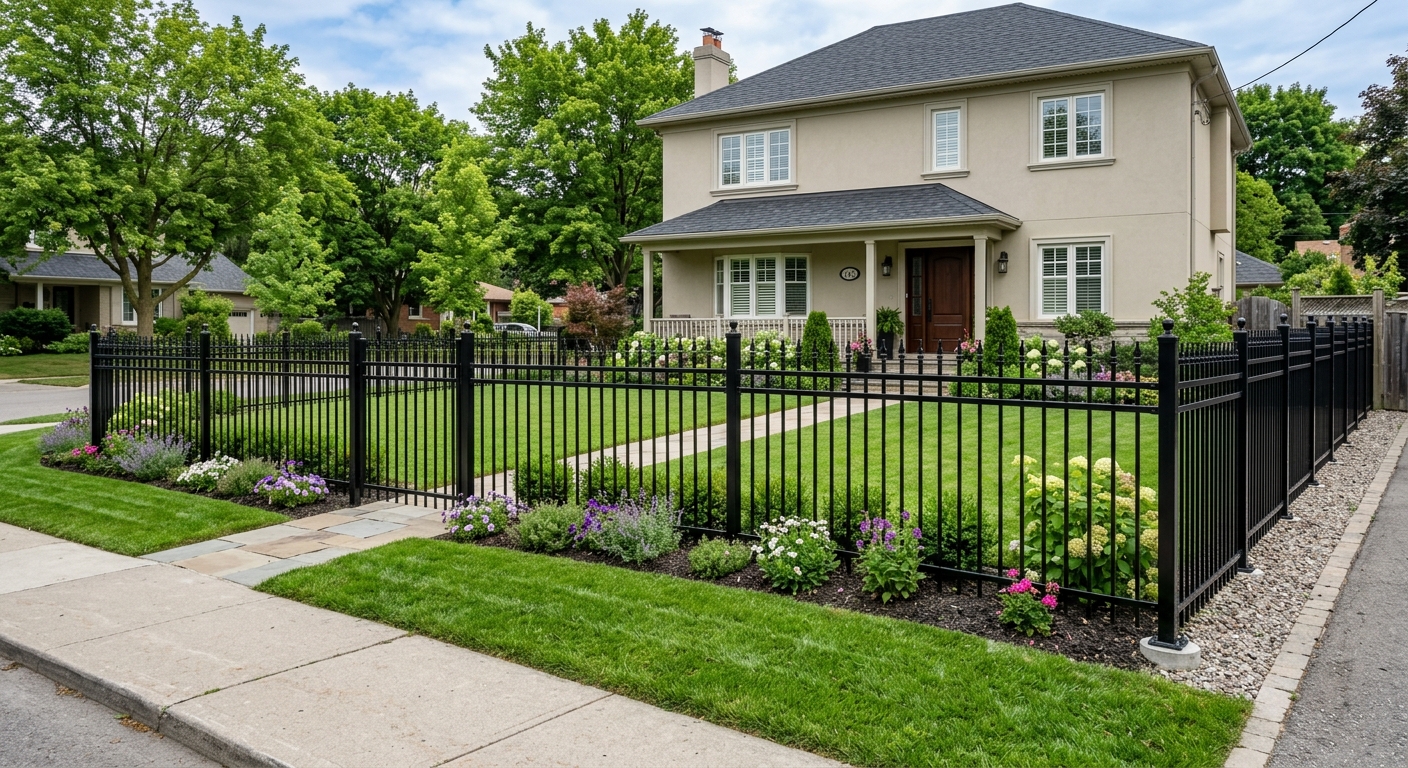
Fencing options and costs in Dorset Park
Dorset Park, Ontario is a classic GTA neighbourhood setting where homeowners often upgrade fencing as properties change hands, mature trees are managed, and backyard living becomes more of a year-round routine. With a population of 25,003 (Statistics Canada, 2021 Census), there’s steady demand for contractor availability, especially around privacy and boundary definition. Also, the surrounding Toronto-area housing mix means many yards border active streets and collector roads, so panels need to hold up to Toronto’s freeze–thaw cycle and regular winter freeze effects.
In the Toronto economic region, your fencing cost is shaped less by “style” alone and more by how contractors build for frost and wind resistance. Best practice in Southern Ontario commonly assumes a frost line around 42"–48", which pushes post holes deeper than homeowners expect. For 6–8 ft privacy fences, that usually means concrete-set posts and heavier hardware to prevent racking and uplift in gusty conditions. Access matters too—narrow side yards, landscaping, and old fence removal can add labour even when the fence length is the same.
In Dorset Park specifically, trades are especially busy on streets with higher back-lot visibility toward nearby collector roads and parks, where privacy upgrades and gate replacements are common. If you’re comparing options now, start with the material and lifespan trade-offs below, then we’ll break down why Dorset Park quotes can swing dramatically from one contractor to another.
| Material |
Lifespan |
Maintenance |
Privacy Rating |
Price per Linear Foot |
| Pressure-treated pine (standard wood) |
10–15 years |
Stain/paint every 2–3 years; inspect posts annually |
8/10 (solid boards) |
$12 – $20 |
| Cedar (natural rot resistance) |
15–20 years |
Light staining every 2–4 years; seal end grain |
9/10 (solid boards) |
$14 – $25 |
| Vinyl / PVC (no-maintenance) |
20–30 years |
Rinse annually; replace rare damaged sections |
9/10 (solid privacy styles) |
$16 – $27 |
| Chain-link (galvanized steel) |
20–30 years |
Occasional rinse; tighten hardware as needed |
3/10 (security, not privacy) |
$9 – $16 |
| Aluminum ornamental |
25–40 years |
Wash when needed; repaint only if desired |
4/10 (semi-open) |
$18 – $33 |
| Composite / recycled |
20–30 years |
Low-maintenance wash; check for structural fasteners |
8/10 (solid panels) |
$17 – $30 |
Prices are estimates only and vary by project scope, site access and material selection.
What affects the price of fencing in Dorset Park
In Dorset Park and the broader Toronto economic region, two contractors can quote the “same” fence and end up 30–50% apart because the scope is never truly identical. One quote may include deeper concrete-set footings and proper post sizing, while another may assume lighter hardware, simpler bracing, or excludes demolition and disposal. Labour availability in the GTA also shifts seasonally, and winter access constraints can increase day rates for hauling and material staging.
Frost line depth is the main driver in Southern Ontario. While many homeowners think post holes are “standard,” Toronto best practice often aims to set posts at least 3.5–4 feet deep for privacy fences to avoid frost heave, translating to roughly 1.5–2.0 m depending on soil and grade. That depth typically requires longer posts, more auger time, and ready-mix/concrete setting—so even if your material is mid-range, your installed price moves toward the higher end of the wood or vinyl bands.
Local wind and yard exposure also affect cost. Solid privacy panels (wood/vinyl/composite) generally need heavier posts (and sometimes closer spacing, around 6–8 ft centres) to resist racking. In colder months, freeze–thaw expands and contracts fasteners and boards, so good quotes include proper hardware and bracing.
Concrete examples in Dorset Park: (1) A 60 ft cedar privacy fence installed on a slight slope often requires stepped panels, extra layout time, and additional hardware to keep tops level—commonly adding labour that pushes the job from the low end of the $65–$120 wood band toward the upper side. (2) If you’re replacing an older fence with buried posts, excavations and debris hauling increase the total cost, sometimes outweighing a material swap between pressure-treated pine and cedar by several hundred dollars. (3) If you choose vinyl for a 6 ft run with concrete-set posts, the higher material cost usually justifies itself over 10+ years, particularly when you compare the installed bands for vinyl/PVC vs. chain-link.
| Price Factor |
Why It Matters |
Cost Impact |
| Fence length in linear feet |
Most materials, posts, and labour scale directly with length |
Large (typically the biggest swing on your quote) |
| Post depth required |
Frost line determines hole depth and post length to prevent heaving |
Medium to large (concrete + longer posts) |
| Post setting method |
Concrete-set posts stabilize against freeze–thaw; gravel pack/driven methods vary by soil |
Medium (concrete and extra labour/time) |
| Material choice |
Vinyl/PVC and cedar cost more per linear foot than chain-link or basic wood |
Medium (material can dominate the estimate) |
| Gate count and type |
Double drive-through gates need heavier framing and more hardware |
Medium to large |
| Grade and terrain |
Sloped yards require raked/stepped panels and extra layout time |
Small to medium |
| Old fence removal and disposal |
Demolition, post extraction, and dump fees add labour and handling |
Medium |
| Permit fees and survey / property line locate |
Some higher fences and corner/side conditions need approvals or documented boundaries |
Small to medium (but important if required) |
Permits & regulations in Ontario
In Ontario, fence permitting is usually tied to height and location. As a practical rule of thumb for many municipalities, fences above about 2.0 m (6.5 ft) at the rear and around 1.0–1.2 m (3–4 ft) at the front or corner often require a building permit. Even when a permit isn’t required, you must still respect property lines and any municipal setback requirements, particularly near intersections and driveways. If you’re unsure, it’s worth verifying before posts are dug—because once concrete is poured, revisions become costly.
Before any post-hole work, call for utility locates using Ontario One Call to reduce the risk of damaging buried services. You should also obtain a survey or locate your property pins to confirm your fence line. This matters in Dorset Park because boundary disputes tend to surface during upgrades—especially when an older fence was set “close enough” and the new one must be accurate.
Shared fence ownership and responsibilities generally follow line-fences concepts under provincial legislation, so if your fence will be on or near a shared boundary, clarify who pays for what before construction.
For contractor verification: (1) confirm your fencing contractor’s Ontario business registration details where applicable via online listings, (2) request a current certificate of liability insurance showing adequate coverage, and (3) ask for WSIB clearance (or the appropriate WCB coverage proof for their scope). A reputable contractor will provide clear documents before work starts and will list permit/disposal responsibilities in writing.
Choosing the right fence material for Dorset Park
The right fence material in Dorset Park should match how you live: privacy needs, how much time you want to spend maintaining it, your budget, and how long you want it to look sharp. Pressure-treated pine is the entry point in most Toronto jobs, but it typically needs staining or painting every 2–3 years to avoid grey weathering and to slow moisture-driven deterioration. Cedar naturally resists rot and looks warmer, but it still benefits from periodic sealing, especially at post tops and board ends where water traps.
Vinyl/PVC is the low-maintenance choice—typically no annual painting, just occasional rinsing. That said, in extreme cold snaps, you want quality rails, solid post setting, and proper expansion planning; cheaper vinyl can crack if the system is undersized or posts aren’t properly secured below frost depth. Chain-link is usually the most affordable and long-lived, but it provides security rather than true privacy unless you plan add-ons like lattice or privacy slats. Aluminum ornamental is attractive and rust-resistant, but it’s not designed for full privacy.
For Toronto’s freeze–thaw cycle, your post-depth strategy matters more than people expect. With frost line considerations commonly taken around 42"–48", concrete-set posts are often recommended for 6–8 ft privacy fences to reduce heaving risk. That approach applies across wood, vinyl, and composite systems and improves long-term stability during winter ground movement and spring thaw.
A concrete cost example: if you’re choosing between pressure-treated pine and cedar for a typical 50 ft run, cedar often costs roughly $14–$25 per linear foot versus pine around $12–$20. On paper that can be a difference of about $250–$750 on material alone, and the premium is usually justified when you want better aesthetics and fewer “looks tired” cycles over 10–15+ years—especially if you don’t want to stain aggressively every season.
| Material |
Cold Tolerance |
Lifespan |
Annual Maintenance |
Best For |
Price Band |
| Pressure-treated pine |
Good with concrete-set posts and proper sealing |
10–15 years |
1–2 inspections; stain/paint every 2–3 years |
Budget privacy runs with realistic maintenance plan |
$65 – $120 |
| Cedar |
Very good; handles moisture swings well |
15–20 years |
Rinse/inspect; seal lightly every 2–4 years |
Privacy with a premium look and better rot resistance |
$75 – $130 |
| Vinyl / PVC |
Good; choose quality system and solid post setting |
20–30 years |
Occasional rinse; check posts/hardware after storms |
Low-maintenance privacy and clean curb appeal |
$75 – $130 |
| Chain-link |
Excellent when galvanized properly |
20–30 years |
Minimal (inspect tension and wash as needed) |
Security, pet containment, budget boundary fencing |
$45 – $85 |
| Aluminum ornamental |
Excellent; rust-resistant in winter conditions |
25–40 years |
Low; wash and optional touch-up every few years |
Attractive boundaries and airflow with moderate definition |
$90 – $160 |
| Composite / recycled |
Good; stable panels with correct fastening |
20–30 years |
Low; inspect fasteners and wash periodically |
Privacy with wood-like look and reduced upkeep |
$80 – $140 |
How to choose a fencing contractor in Dorset Park
When you pick a contractor for Dorset Park, don’t rely on photos alone—verify licensing, insurance, and coverage so you’re protected if something goes wrong. In Ontario, ask for their liability insurance certificate (to confirm they’re insured for property damage and bodily injury). For worker coverage, request proof of WSIB clearance or appropriate WCB coverage, depending on their work arrangement and trade status. Then confirm their business information through online registries and ensure the name on the insurance certificate matches the company on the estimate and contract. A reputable fencing contractor will provide documents quickly and consistently.
Next, get 2–3 itemised written quotes with a breakdown that shows labour, materials, and the post system. For fencing, itemisation should include: post size, post setting method (concrete-set vs gravel pack), hardware/bracing type, panel spacing, and gate framing. Also check what’s excluded—often demolition, disposal, stump/grub work, and the cost of locating property line pins or permits. If a quote says “permit included,” ask what permits and who submits them; if it’s not spelled out, assume you’ll be responsible.
Warranty should be clear: workmanship warranty length (for example, post movement, loose panels, or improper installation) and separate manufacturer/product warranty terms. Confirm whether the warranty is transferable to future homeowners. For payment scheduling, avoid large deposits—typically no more than 10–15% upfront—and hold back a portion until completion and cleanup are done. Finally, insist on a written start date and completion timeline that accounts for Ontario weather delays and cure time for concrete-set posts.
- Ask for insurance certificate and verify it’s current before signing.
- Request WSIB/WCB clearance proof and match it to the contractor/company name.
- Get a written scope that lists post depth and the setting method.
- Confirm panel spacing and bracing for privacy-height fences (6–8 ft).
- Ensure gate hardware is included (hinges, latches, self-closing if requested).
- Require a disposal/dump fee line item if you have an old fence to remove.
- Check whether permit handling is included or your responsibility.
- Confirm property line verification approach (survey locate vs visual boundary).
- Ask how they handle sloped yards (stepped vs raked panels).
- Verify they’ll do utility locates before digging post holes.
- Read the warranty terms for both workmanship and materials.
- Use a payment schedule that never exceeds 10–15% deposit; holdback at the end.
Red flags I see in Dorset Park: (1) quotes that don’t specify post depth or concrete setting for privacy fences, (2) “lump sum” pricing with vague scope and no mention of disposal or gates, (3) contractors who won’t provide a certificate of liability insurance or WSIB/WCB proof, (4) start dates that change repeatedly without weather/access explanations, and (5) warranties that only cover materials but not workmanship.
Frequently asked questions — fencing in Dorset Park
What's the most low-maintenance fence?
In Dorset Park and across Ontario’s GTA, vinyl/PVC is usually the most low-maintenance option for homeowners who want privacy without annual staining. A quality vinyl privacy system, properly installed on stable concrete-set posts (especially for taller runs), typically requires only occasional rinsing and hardware checks after wind events. Chain-link is also low-maintenance but it won’t give you privacy unless you add slats or another privacy layer. Wood can be “manageable” if you’re willing to stain every 2–3 years to prevent weathering and moisture issues, and cedar tends to look better longer but still benefits from periodic sealing. If you’re comparing budgets, vinyl pricing commonly lands in the higher Toronto band (for example, around the $75–$130 range depending on height, style, and gate count), while chain-link often sits lower (around $45–$85) but won’t satisfy privacy needs.
How tall can my fence be in Dorset Park?
Fence height rules in Ontario generally depend on where the fence sits (front/corner versus rear) and local bylaw thresholds. As a practical guideline, many municipalities treat fences over about 2.0 m (6.5 ft) in the rear and roughly 1.0–1.2 m (3–4 ft) at the front or corner as likely requiring a building permit. In Dorset Park, the safest approach is to confirm the exact municipal bylaw for your address before you buy materials or dig post holes. Also keep in mind sightline concerns near intersections and driveways—height that might be allowed elsewhere can be restricted at corners. If you tell your contractor the proposed height and location (front, side, rear), they should help you determine whether a permit is required and how to document the property line to avoid encroachment issues.
Should fence posts be set in concrete here?
Often, yes—especially for privacy fences (6–8 ft) in Dorset Park where Toronto’s freeze–thaw cycle is a real factor. With frost line considerations commonly taken around 42"–48", post holes are typically excavated to about 3.5–4 feet deep so posts sit below the freeze heave zone. When you set posts deeper, many contractors also recommend concrete-set posts to stabilize them in clay/mixed soils and maintain alignment across winter movement. Gravel pack methods can work in certain soil conditions, but the “safe default” for tall solid fencing is concrete setting. The cost impact is usually in the labour and ready-mix portion of your quote, not just the posts. For homeowners comparing options, remember that a correctly installed wood or vinyl privacy system may cost more up front than a minimal installation, but it’s far less likely to lean or rack after a few seasons.
What's the best fence for privacy?
For privacy in Dorset Park, look first for a solid panel style: wood (pressure-treated pine or cedar), vinyl/PVC privacy boards, or composite panels. These typically provide a privacy rating of 8–9/10 when installed with minimal spacing and proper top alignment. The second key is structural: taller solid fences need heavier posts and reliable bracing to reduce racking in wind gusts. Because Southern Ontario experiences regular winter freezing and spring thaw, privacy fences perform best when posts are set below the design frost depth, and the system is built for Ontario conditions—not just “installed quickly.” If you’re comparing budgets, pressure-treated pine privacy tends to sit around the $65–$120 range, while vinyl privacy often lands in the $75–$130 band. Cedar can be slightly higher but offers a premium look and good rot resistance when maintained.
How do I compare fencing quotes?
Compare quotes like you’re comparing apples to apples, not just totals. Ask each contractor to provide itemised pricing that separates labour, materials, gates, post type, and the post-setting method. Confirm post depth and whether they recommend concrete-set posts for your fence height (especially if you’re building 6–8 ft). Ensure disposal/removal of the old fence is either included with a line item or clearly excluded. Ask whether permits are included and who handles the submission if needed. Then compare warranty terms: workmanship coverage (for leaning posts, loose panels, and installation defects) should be clearly stated, separate from manufacturer warranties. Pricing bands in the Toronto area can overlap, so a “lower” quote may omit concrete setting, bracing, or disposal. A quote that’s detailed usually costs more upfront but avoids surprise add-ons later.
How long does fence installation take in Dorset Park?
Most straightforward fence projects in Dorset Park are completed faster than homeowners expect, but the schedule depends on length, gate count, and how much site prep is needed. For a typical residential run with standard access, installation often lands in a few working days, while projects with old fence demolition, uneven grade, multiple gates, or complex boundaries can take longer. Concrete-set posts also influence timing: crews may install quickly, but concrete curing and final alignment checks need to be considered so the finished fence doesn’t shift. Weather is another factor—Ontario rain and freeze conditions can slow excavation and affect concrete work. If your quote includes concrete and proper post depth below the frost zone, it’s usually worth allowing extra time for a durable result.