Fencing options and costs in Victoria Village
Victoria Village, Ontario is a neighbourhood where fencing demand stays steady year-round, largely because so many properties are family homes that need clear boundaries, safe yards, and privacy. With a 2021 population of 17,510 (Statistics Canada, 2021 Census), local streets are busy with detached and mid-sized lots, and that typically means frequent fence replacements as existing boards age, warp, or loosen. In practice, each detached property is a potential fencing customer, so ownership patterns and ongoing home maintenance translate directly into consistent installer availability.
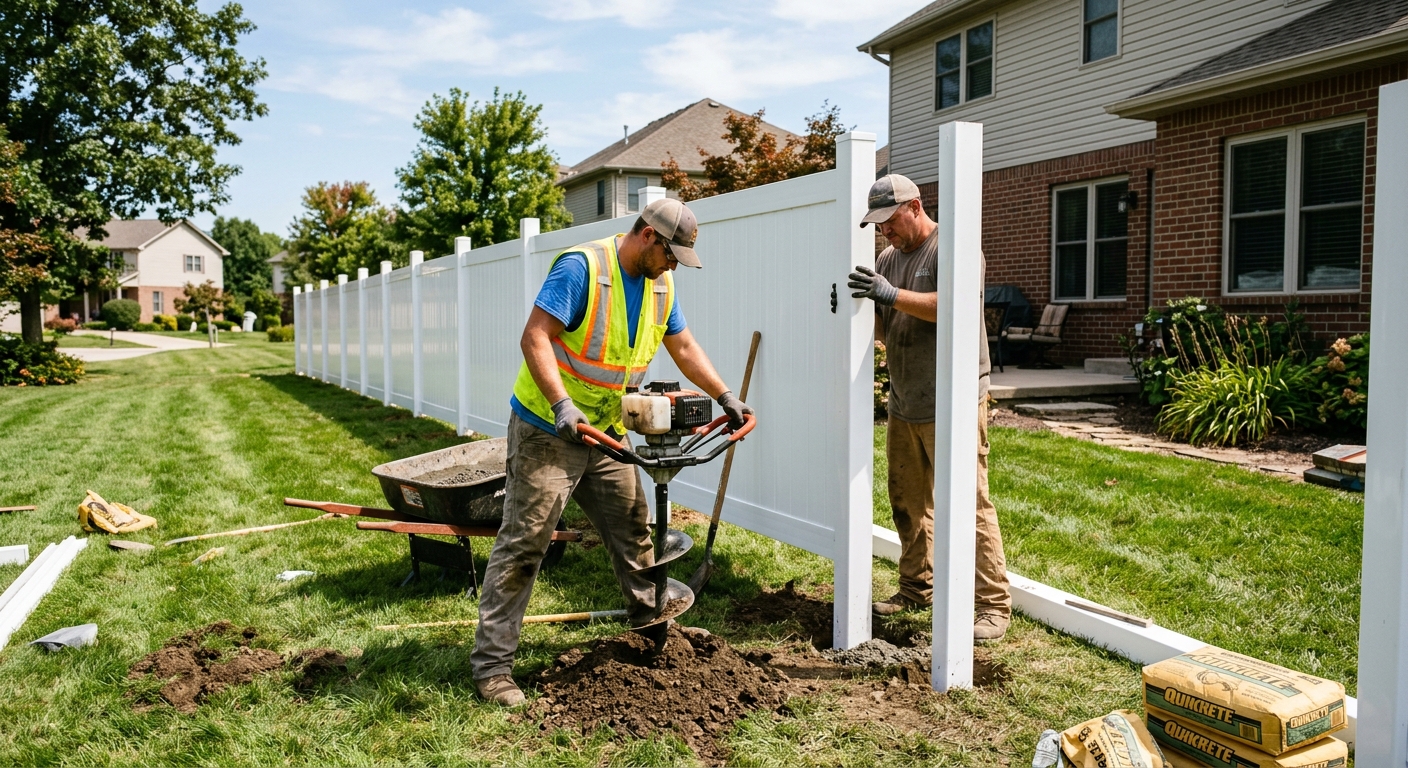
In the Toronto economic region, fencing costs are shaped by Southern Ontario freeze-thaw cycles. The design frost line is commonly taken at about 42"–48", so posts are usually set deeper—often 3.5–4 ft—to reduce frost heave. For 6–8 ft privacy fences, that “extra depth” affects everything: labour time (digging and setting), ready-mix usage, and how long crews take to square the line and brace panels. Wind still matters, but compared with prairie exposure, the GTA typically sees more issues from snow load, seasonal soil movement in clay/mixed soils, and the freeze-thaw rhythm than from extreme open-field winds.
In Victoria Village, we often see the highest demand around McNicoll Avenue and the surrounding residential blocks where lots back onto streets and school-adjacent areas—privacy and boundary control are a priority. Use the table below to compare typical options and what you’re really paying for per linear foot.
| Material |
Lifespan |
Maintenance |
Privacy Rating |
Price per Linear Foot |
| Pressure-treated pine (standard wood) |
10–15 years |
Stain/seal every 2–3 years; replace damaged boards as needed |
High (solid/close board) |
$65 – $120 |
| Cedar (natural rot resistance) |
15–25 years |
Light staining or oiling every 2–3 years; monitor rails and posts |
High (solid/close board) |
$75 – $130 |
| Vinyl / PVC (no-maintenance) |
20–30 years |
Rinse/wash as needed; no staining |
High (solid privacy panels) |
$75 – $130 |
| Chain-link (galvanized steel) |
20–30 years |
Occasional rinse; tighten hardware if needed |
Low to Medium (security only) |
$45 – $85 |
| Aluminum ornamental |
25–40 years |
Occasional wash; inspect for impact damage |
Low (open pickets) |
$90 – $160 |
| Composite / recycled material |
20–30 years |
Minimal; periodic cleaning |
Medium to High (depends on slat style) |
$95 – $155 |
Prices are estimates only and vary by project scope, site access and material selection.
What affects the price of fencing in Victoria Village
In Victoria Village and across the Toronto economic region, it’s common to see fence quotes for what looks like the “same” fence come in 30–50% apart. That gap usually isn’t because one contractor is trying to be unfair—it’s because the scope details differ: post depth, rail design, gate hardware, how removal is handled, and whether the fence is installed on concrete-set footings or lighter methods. Two homeowners can both choose a privacy fence, but one lot has easier access and straight runs, while another has a sloped yard, mature trees, and a gate swing that forces heavier bracing. In an area with steady demand, labour availability and the contractor’s schedule can also influence turnaround and crew efficiency.
Local frost protection is a major driver. In cold Ontario conditions, posts are typically set about 1.5–2.0 m into the ground to account for the design frost depth (often about 42"–48"), which means longer posts, larger holes, and concrete setting for stability. As soon as you’re building a 6–8 ft privacy run, this becomes a meaningful cost item—often pushing wood or cedar privacy projects closer to the upper part of the $65–$120 and $75–$130 ranges. Wind exposure isn’t as extreme as the Prairies, but GTA neighborhoods still experience racking forces; that can require closer post spacing, heavier rails, and better fasteners, especially for solid panel styles.
Here are a few real Victoria Village examples of how local conditions move the budget up or down: (1) clay-heavy soil that holds water can make post holes harder to dig and require better drainage and concrete placement; (2) a backyard with a sidewalk close to the fence line often limits machinery access, increasing labour time; (3) lots with mature shrubs or retaining features can force additional demo, haul-away, and re-planning. If you’re comparing options, remember that chain-link can start around $45–$85 per linear foot, while privacy-grade vinyl often sits nearer $75–$130 because it pairs higher materials with the same frost-depth install requirements.
| Price Factor |
Why It Matters |
Cost Impact |
| Fence length in linear feet — the primary cost driver |
More linear footage means more posts, rails, panels and fastening |
Large (often the biggest swing in total price) |
| Post depth required — frost line determines post length and hole depth |
Deeper set reduces heaving and improves long-term alignment |
Medium to Large (adds concrete, labour, and materials) |
| Post setting method — concrete vs. gravel pack vs. driven posts |
Concrete-set posts stabilize in mixed/clay soils |
Medium (concrete + longer install time) |
| Material choice — vinyl vs. cedar vs. chain-link |
Materials have different pricing and performance in freeze-thaw |
Medium (chain-link is lower; vinyl/cedar privacy is higher) |
| Gate count and type — walk-through vs. drive-through (double) |
Gates require heavier frames, latching, hinges, and often stronger posts |
Medium to Large (gates can add disproportionately) |
| Grade and terrain — sloped yards require stepped or raked panels |
Slopes change rail heights, bracket design, and panel cutting |
Small to Medium (usually increases labour and waste) |
| Old fence removal and disposal |
Demolition, disposal fees, and salvage decisions affect labour |
Small to Medium (can be large if heavy/complex) |
| Permit fees and survey / property line locate |
Fence location and setbacks may require documentation |
Small (but varies by scope) |
Permits & regulations in Ontario
In Ontario, fencing rules are typically tied to height and placement. As a practical benchmark, fences above about 2.0 m (6.5 ft) at the rear and above about 1.0–1.2 m (3–4 ft) at the front or corners often trigger a building permit requirement, depending on the municipality’s by-laws and the fence location. Regardless of height, your fence must respect property lines and municipal setback requirements. In shared boundary situations, fence ownership and responsibility are generally governed by Ontario’s line-fence legislation (how disputes and cost-sharing are handled can vary by circumstances and proof of shared use).
Before digging any post holes in Victoria Village, you must call for utility locates through Ontario One Call (1-800-400-2255) or your relevant local service. Even if you’re sure there are no services, it’s the standard step that prevents expensive surprises. Also, if you don’t have recent survey information, get a survey or property-pin locate before installation so your contractor can measure from actual pins rather than assumptions.
To verify your contractor, ask for: (1) their Ontario business registration and any applicable trade licensing (where required for the work they perform), (2) proof of liability insurance with a clear certificate of insurance showing your address as additional insured if offered, and (3) WSIB coverage (or WCB clearance letter where applicable). A homeowner-level check is simple: confirm the insurance certificate is current, review the WSIB clearance/coverage status, and verify the company name matches the quote and paperwork.
Choosing the right fence material for Victoria Village
Choosing a fence material in Victoria Village is mainly about matching your priorities to Toronto-area freeze-thaw conditions, snow exposure, and yard moisture. Pressure-treated pine is the budget-friendly option and works well for privacy if it’s installed with proper concrete-set posts at frost depth, but wood still needs ongoing care. Expect staining or sealing every 2–3 years to limit grey weathering and to slow surface fibre breakdown. Cedar offers better natural rot resistance and typically looks better longer than pine, but it still benefits from periodic staining or oiling and good end-grain protection at posts and rails.
For low maintenance, vinyl/PVC is a strong choice because it doesn’t require painting and typically wipes clean after winter slush. That said, extreme cold snaps can make some PVC components less forgiving if they’re improperly installed (for example, without correct thermal expansion allowances). Chain-link is usually the least expensive and longest lasting, but it won’t give the privacy most Victoria Village homeowners expect unless you add privacy slats or mesh. Aluminum ornamental fencing is rust-resistant and elegant, yet it’s open by design, so it won’t function as a true privacy barrier. For recycled/composite products, the best results usually come when the system includes sound posts and quality joinery to handle Toronto’s seasonal movement.
On the frost-depth question: regardless of material, Toronto best practice typically calls for posts set to about 3.5–4 ft deep (often guided by ~42"–48" design frost depth), so concrete-set posts are common for 6–8 ft fences. In neighbourhoods with heavier snow accumulation against solid runs, sturdier posts and closer rail spacing reduce racking over time.
Example: if a chain-link run comes in around $45–$85 per linear foot, a comparable vinyl privacy run often lands in the $75–$130 range. That difference can be justified if you’re replacing a neglected boundary and want real privacy with minimal yearly effort, but if your goal is security only, chain-link is usually the smarter value.
| Material |
Cold Tolerance |
Lifespan |
Annual Maintenance |
Best For |
Price Band |
| Pressure-treated pine |
Good (with proper staining and solid post setting) |
10–15 years |
Low to moderate (seal/stain cycle every 2–3 years) |
Budget privacy with a traditional look |
$65 – $120 |
| Cedar |
Good (rot-resistant timber, but still needs finishing) |
15–25 years |
Low to moderate (typically 2–3 year staining/oiling) |
Appearance and rot resistance |
$75 – $130 |
| Vinyl / PVC |
Very good (install correctly for thermal expansion) |
20–30 years |
Minimal (wash/rinse as needed) |
Low-maintenance privacy |
$75 – $130 |
| Chain-link |
Very good (galvanized steel handles freeze-thaw) |
20–30 years |
Minimal (occasional inspection/tightening) |
Security on a budget |
$45 – $85 |
| Aluminum ornamental |
Very good (powder-coated; no rust) |
25–40 years |
Minimal (wash and inspect after impacts) |
Front-yard curb appeal with defined boundaries |
$90 – $160 |
| Composite / recycled material |
Good (varies by product—proper spacing is key) |
20–30 years |
Minimal (periodic cleaning) |
Durable privacy with reduced upkeep |
$95 – $155 |
How to choose a fencing contractor in Victoria Village
Choosing the right fencing contractor in Victoria Village starts with checking credentials and then validating the details in the quote. For Ontario work, verify liability insurance first—ask for a current certificate of insurance showing your property/address and the coverage limits. Next, confirm WSIB coverage and obtain a clearance status letter (or equivalent proof where applicable) so you’re not left dealing with workplace injuries. Ask also for proof of the company’s legitimacy (registered business details matching the quote, and a real physical address or service location). If they can’t provide these documents promptly, treat it as a serious warning.
Then request 2–3 itemised written quotes. You want line items that break down labour and materials: fence panels/rails, post size, concrete/footings, gate framing and hardware, and removal/disposal. Avoid “lump sum” quotes that don’t explain how the contractor plans to handle frost-depth settings, spacing, and any slope adjustments. Scope exclusions matter: confirm whether a permit pull is included (when required), whether old fence removal and dump fees are covered, and what happens if the soil is wetter/softer than expected once holes are opened.
Look at warranty terms too. A workmanship warranty should be stated in writing (and ideally include how defects are repaired). Separate product/manufacturer warranty coverage should be clear, and you should know whether it’s transferable if you sell the home. Payment should stay controlled: never pay more than 10–15% upfront, and use a holdback until completion and final walkthrough.
Finally, get timeline details in writing—start date, inspection steps, and a realistic completion estimate based on linear footage and gate count.
- Confirm liability insurance is current and certificate matches the legal company name on your contract.
- Request WSIB coverage proof/clearance letter before work starts.
- Ask for the exact post size and spacing, not just the fence height.
- Confirm concrete-set post plan and post-hole depth consistent with Toronto frost protection.
- Ensure the quote includes gate frame build quality and specific latch/hinge hardware.
- Get an itemised labour + materials breakdown (no vague “materials included”).
- Check what’s excluded: permit pull, utility locate, survey pins, or disposal.
- Ask how they handle slopes (stepped vs. racked panels) and document the method.
- Confirm access plan for tight backyards (no machinery access can increase labour).
- Verify warranty length for workmanship and whether it covers post movement or racking.
- Ask for proof of prior nearby projects in the GTA (photos and address range).
- Use a payment schedule: 10–15% deposit max; holdback until final completion.
Red flags in Victoria Village: a contractor who won’t provide insurance/WSIB documents; quotes that use shallow post depth or “driven only” methods for tall privacy fences; vague warranties (no written workmanship term); pressure for large upfront payments; and refusing to itemise removal, disposal, and hardware for gates.
Frequently asked questions — fencing in Victoria Village
How do I compare fencing quotes?
To compare fencing quotes in Victoria Village, focus on apples-to-apples details, not just the bottom line. Ask for an itemised breakdown: material type (pine vs cedar vs vinyl), post size, post depth, setting method (typically concrete-set for frost stability), rail design, and the exact gate hardware. Confirm whether old fence removal and disposal are included, and whether a permit pull is part of the scope where required. If one quote is “cheaper” but uses lighter posts, different spacing, or less concrete, it may not hold up through Toronto’s freeze-thaw cycles. For pricing reference, a chain-link job often falls in the $45–$85 per linear foot range, while privacy vinyl is commonly $75–$130 per linear foot, so material differences should be clearly reflected in the quote.
How long does fence installation take in Victoria Village?
In Ontario’s GTA, most fence installs take anywhere from 1 to 5 days depending on length, terrain, and gate count. A straightforward back-yard run with consistent grade and one gate can move quickly, especially when site access is good and materials are staged. Longer privacy fences take extra time because concrete-set posts must be dug to frost-depth planning and set accurately for line and tension. Weather also matters—heavy rain can slow excavation and concrete placement, while winter conditions can require scheduling changes. If your project includes demolition, hauling, and disposal, that can add a day. For an average home, it’s reasonable to expect a multi-day schedule rather than a “one afternoon” install, especially for 6–8 ft privacy fences common in Victoria Village.
Can I install a fence on a slope in Victoria Village?
Yes, you can install a fence on a slope in Victoria Village, but it should be done correctly so the fence stays level and doesn’t rack. There are two common approaches: stepping the fence in sections (maintains panel level while stair-stepping up/down) or using a raked design (panel angles match the slope). The right choice depends on the material and the fence style; for privacy panels, stepping often looks cleaner and is easier to verify for alignment. The quote should specify whether the contractor will step or rake and how they’ll handle uneven ground at corners and gate openings. Because Ontario freeze-thaw can exaggerate movement in soft soil, proper post depth and bracing matter even more on sloped yards.
What is the most weather-resistant fence for Victoria Village's climate?
For Victoria Village’s freeze-thaw winter conditions, the “most weather-resistant” usually comes down to how well the fence is installed—particularly the post depth and setting method—followed by material choice. Vinyl/PVC privacy fences are often a top pick for low weathering because they don’t rot or require staining, and they can last 20–30 years when installed with proper spacing. Cedar is also very resilient and rot-resistant, but it still needs maintenance to look its best and to protect end grain. Pressure-treated pine can perform well too, but it typically needs periodic staining/sealing every 2–3 years to slow deterioration. If you only need security and durability rather than privacy, galvanized chain-link is highly durable (often $45–$85 per linear foot) and long-lived. In all cases, concrete-set posts to frost-depth guidance are the foundation of long-term performance.
How do I prevent wood fence rot in Victoria Village?
Preventing wood rot in Ontario, especially around Victoria Village where moisture and freeze-thaw cycles are frequent, is mostly about reducing wood contact with wet soil and sealing the right surfaces. First, ensure posts and rails are installed with the correct frost-depth setting so water doesn’t pool at the base and the fence doesn’t sag over time. Second, use a proper treatment system: pressure-treated wood should be stained/sealed on schedule (often every 2–3 years) to limit grey weathering and moisture uptake. For cedar, periodic oiling or staining helps protect vulnerable areas. Third, check hardware and ventilation—stagnant trapped moisture can accelerate rot at rails and near the ground. Finally, address small damages early (a single split board left unsealed can become a rot pathway).
What is the cost per linear foot for fencing in Victoria Village?
Fencing costs per linear foot in Victoria Village generally align with the Toronto region pricing bands. For example, chain-link commonly falls in the $45–$85 per linear foot range, making it the lowest-cost option. Pressure-treated wood privacy fences often price around $65–$120 per linear foot depending on height and post/rail build. Vinyl/PVC privacy fences are frequently in the $75–$130 per linear foot range because they pair higher material costs with the same frost-depth post installation requirements. Cedar and composite can land in similar mid-to-upper ranges, while aluminum ornamental is typically higher—often $90–$160 per linear foot. Always confirm whether your quote includes concrete-set posts, gate hardware, removal/disposal, and any permit-related scope, since those details can change the effective per-foot cost.