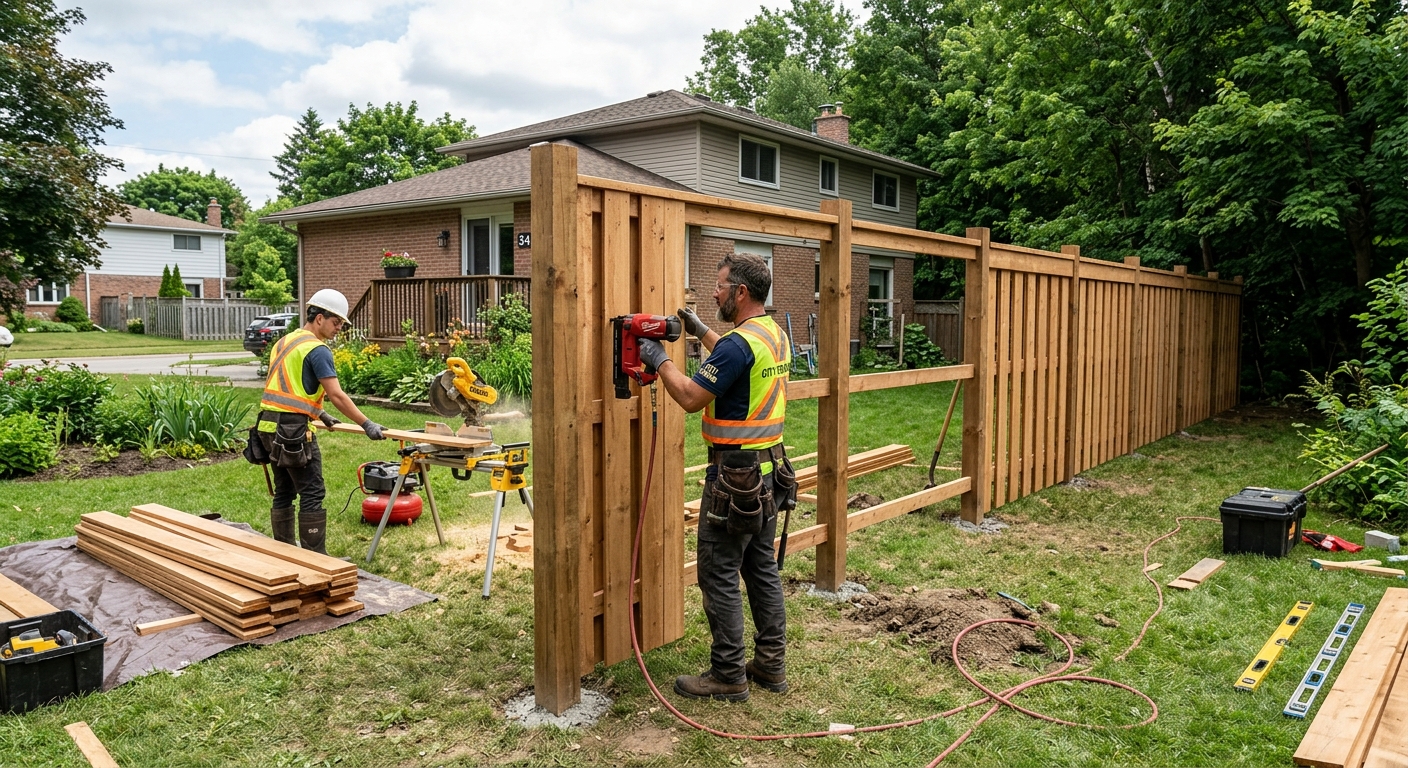
Fencing options and costs in Bayview Woods-Steeles
In Bayview Woods-Steeles, your choice of fencing usually starts with the look you want and how much effort you’re willing to put in each spring. With a population of 13,154 (Statistics Canada, 2021 Census), this is a neighbourhood where plenty of detached homes mean active demand for side-yard privacy and boundary fencing year-round. Toronto’s mix of older housing stock and infill development also keeps contractors busy, especially around seasonal peak months when landscaping crews and fencing crews overlap.
Cost in the Toronto economic region is strongly shaped by frost depth and local installation practice. In Southern Ontario, the design frost line is commonly treated as about 42"–48", so most privacy fences need posts set at least 3.5–4 feet down to reduce frost heave—especially for 6–8 ft solid fences. That typically pushes the market toward concrete-set posts rather than simple driven posts, because longer excavation time and ready-mix are part of the “right way” to build for long-term stability.
You’ll also see differences based on wind and neighbourhood exposure. While the GTA isn’t as harsh as the Prairies, taller solid panels can still rack without proper post size and spacing (often 6–8 ft centres). In Bayview Woods-Steeles, demand is often especially noticeable near the Bayview Avenue corridor where properties back onto lanes, parks, or busier edges needing durable boundary fencing.
Below is a practical comparison of common materials you’ll see quoted in the area, with typical lifespan, maintenance expectations, and Toronto-aligned budget ranges to help you benchmark proposals.
| Material |
Lifespan |
Maintenance |
Privacy Rating |
Price per Linear Foot |
Price Range |
| Pressure-treated pine (standard wood) |
10–15 years |
Stain/paint every 2–3 years |
8–10/10 (solid boards) |
$65–$120/lf |
$65 – $120 |
| Cedar (natural rot resistance) |
15–25 years |
Seal/stain every 3–4 years |
8–10/10 (solid boards) |
$75–$130/lf |
$75 – $130 |
| Vinyl / PVC (no-maintenance) |
20–30 years |
Rinse occasionally; no staining |
7–10/10 (solid styles) |
$75–$130/lf |
$75 – $130 |
| Chain-link (galvanized steel) |
25–40 years |
Occasional wash; check tension |
2–4/10 (open mesh) |
$45–$85/lf |
$45 – $85 |
| Aluminum ornamental |
25–35 years |
Wash once a year |
3–5/10 (open pickets) |
$90–$160/lf |
$90 – $160 |
| Composite / recycled material |
25–35 years |
Wash as needed; no staining |
7–10/10 (solid boards) |
$95–$155/lf |
$95 – $155 |
Prices are estimates only and vary by project scope, site access and material selection.
What affects the price of fencing in Bayview Woods-Steeles
In Bayview Woods-Steeles and across the Toronto economic region, it’s common to see quotes for the “same length and height” differ by 30–50%. That’s usually not because contractors have different opinions—it’s because frost-proof installation details, post construction, and how much site work is needed vary from yard to yard. Even small changes in gate count, panel style, or whether concrete is used can move your budget quickly, particularly during peak season when excavation crews and ready-mix deliveries are in higher demand.
Here’s the big driver: Southern Ontario’s frost line is often handled as roughly 42"–48". To prevent frost heave, posts typically need to be set 4–6 inches below the design frost depth, which translates to about 1.5–2.0 m into the ground on many Toronto-area jobs. That usually means longer posts, deeper holes, more concrete, and additional labour—so a “budget” fence can move upward fast once you’re building for longevity.
Wind and panel rigidity also matter. While the GTA doesn’t get the open-field wind loads you’d plan for in prairie regions, taller privacy fences still need correctly sized posts and tighter spacing to limit racking and uplift. Concrete-set posts and heavier hardware help maintain the fence’s alignment after freeze-thaw cycles.
Two examples of how local conditions affect cost in Bayview Woods-Steeles: (1) a 6 ft solid privacy fence that requires concrete footings and 6–8 ft spacing can land near the upper end of wood pricing (around $65–$120/lf), while vinyl might price into the $75–$130/lf band because of both materials and the same frost-depth excavation; (2) yards with slopes often require stepped rails or raked panel sections, increasing fabrication and labour compared with flat runs. Use those price bands as a baseline when comparing proposals.
| Price Factor |
Why It Matters |
Cost Impact |
| Fence length in linear feet — the primary cost driver |
Labour, materials, and hardware scale directly with linear footage; waste also increases on longer runs. |
High |
| Post depth required — frost line determines post length and hole depth |
Deeper holes and longer posts increase excavation time and ready-mix usage for stability in freeze-thaw cycles. |
High |
| Post setting method — concrete vs. gravel pack vs. driven posts |
Concrete-set posts reduce movement but require more material handling and labour. |
Medium–High |
| Material choice — vinyl vs. cedar vs. chain-link |
Upfront material costs and hardware requirements vary widely; privacy styles also need more rigidity. |
Medium–High |
| Gate count and type — walk-through vs. drive-through (double) |
Gates require heavier framing, hinges, latches, and often additional posts. |
Medium |
| Grade and terrain — sloped yards require stepped or raked panels |
Special cutting, alignment labour, and sometimes extra posts/rails increase installation time. |
Medium |
| Old fence removal and disposal |
Demolition, haul-away, and salvage decisions can add significant time and dump fees. |
Medium–High |
| Permit fees and survey / property line locate |
Planning and compliance items depend on height/location and whether a locate/survey is already on file. |
Low–Medium |
Permits & regulations in Ontario
In Ontario, fencing rules are a mix of municipal bylaws and broader property-line expectations. In practice, fences above a height threshold—typically around 2.0 m (6.5 ft) at the rear and about 1.0–1.2 m (3–4 ft) at the front or corner—often require a building permit. The threshold can vary depending on location (rear vs. front/corner) and the fence’s relationship to any property access, so you should confirm with your local municipality before you schedule excavation.
Whatever the height, fences must respect property lines and local setback rules. Before any post hole is dug, you must call for utility locates through Ontario One Call. That step prevents expensive damages to buried services and protects everyone on site.
Step-by-step for Bayview Woods-Steeles: (1) Verify your property boundaries—ideally with a survey or at least by locating your property pins; (2) Ask the contractor whether they will mark the proposed fence line and confirm it matches your survey; (3) Check whether the fence height and placement trigger a permit; (4) Clarify shared fence ownership expectations—line-fences legislation governs common scenarios where boundaries are shared.
To verify your contractor: confirm they have valid Ontario licensing (where applicable), ask for a certificate of insurance (liability) with active dates, and request documentation for WSIB coverage (or a WCB equivalent where relevant). You can also ask for a clearance letter and confirm dates and project scope on the certificate before work begins.
Choosing the right fence material for Bayview Woods-Steeles
Choosing the right fence in Bayview Woods-Steeles comes down to balancing privacy, maintenance, and budget against the local freeze-thaw cycle. Pressure-treated pine is usually the lowest upfront option, but it benefits from a staining/finishing schedule every 2–3 years to limit grey weathering and surface wear. Cedar looks great and naturally resists rot better than standard pine, yet it still needs periodic sealing or staining to keep the colour and slow deterioration. Vinyl/PVC is the low-maintenance favourite for many homeowners, but it has to be installed correctly and it can become more brittle in extreme cold if the system is poorly built (for example, wrong hardware or flexing rails). Chain-link is typically the best value for a long-lasting barrier, but it provides limited privacy unless you add a privacy screen or grow-through options. Aluminum ornamental fencing offers a rust-resistant, tidy look with moderate cost, though it’s not a privacy fence style in most layouts. Composite and recycled boards sit in the “premium low-maintenance” category with solid appearance for privacy runs.
Because Toronto frost depth is commonly treated around 42"–48", most taller privacy fences benefit from concrete-set posts and properly spaced panels to reduce movement during winter expansion and thawing. Wind isn’t typically “Prairie-level,” but taller solid fences still need rigid post/panel systems to manage racking and uplift after storms and snow events.
A specific budgeting example: if you’re replacing a run of solid privacy fence and you’re deciding between pressure-treated pine and vinyl, the vinyl option often costs more but can justify the difference when you factor in maintenance time and re-staining cycles. In this market, you’ll commonly see pine pricing aligned with the $65–$120/lf band, while vinyl/PVC often lands in the $75–$130/lf range—so paying more can be reasonable if you want to reduce yearly upkeep.
| Material |
Cold Tolerance |
Lifespan |
Annual Maintenance |
Best For |
Price Band |
| Pressure-treated pine |
Good with proper finishing and concrete-set posts |
10–15 years |
Low–moderate (stain/inspect every 2–3 years) |
Budget-friendly boundary and privacy |
$65–$120/lf |
| Cedar |
Good; handles freeze-thaw better than untreated softwood |
15–25 years |
Moderate (seal/stain every 3–4 years) |
Better appearance with natural rot resistance |
$75–$130/lf |
| Vinyl / PVC |
Very good when installed with correct spacing and hardware |
20–30 years |
Very low (wash/rinse as needed) |
Low-maintenance privacy runs |
$75–$130/lf |
| Chain-link |
Excellent (galvanized steel resists winter corrosion) |
25–40 years |
Low (check tension/coating; occasional wash) |
Security and boundary marking |
$45–$85/lf |
| Aluminum ornamental |
Excellent (powder-coated finish) |
25–35 years |
Low (annual wash) |
Attractive front-yard boundaries |
$90–$160/lf |
| Composite / recycled |
Good; stable board system with correct installation |
25–35 years |
Very low (rinse; inspect posts/hardware) |
Premium privacy with minimal upkeep |
$95–$155/lf |
How to choose a fencing contractor in Bayview Woods-Steeles
Start by verifying licensing and coverage the same way you would for any major exterior build. In Ontario, ask for proof of WSIB (or WCB coverage where applicable) and a current certificate of liability insurance before anyone steps on your property. You can usually check the contractor’s status through official online resources, and your certificate of insurance should clearly list the policyholder, coverage limits, expiry date, and whether you’re named as an interested party (if requested). Don’t rely on verbal assurances—collect documents before signing.
Next, request 2–3 itemised written quotes. You want a breakdown that separates labour from materials (posts, concrete, rails, pickets/panels, gates, hardware, and fasteners) rather than a single lump sum. Confirm what’s excluded: permit pull responsibilities, utility locate costs, and disposal/haul-away. If you’re replacing an older fence, insist on explicit wording for demolition limits and where debris will be dumped.
Warranty matters in fence work. Ask for the workmanship warranty length (how long the contractor stands behind alignment, fastening, and post setting) and the product/manufacturer warranty for panels and hardware. Also ask whether warranties are transferable if you sell your home.
For payment, never pay more than 10–15% upfront. Hold back a portion until the job is complete and you’ve reviewed key items like post depth installation, gate operation, and final grading/clearances. Get a written start date and completion estimate, and make sure the scope matches your approved line and height.
- Request proof of Ontario coverage: WSIB/WCB and liability insurance (with valid dates).
- Get the fencing line marked on-site relative to your survey/property pins.
- Ask how deep posts will be set and whether concrete-set posts are included for privacy height.
- Confirm panel spacing and post size for wind resistance (6–8 ft centres for many privacy builds).
- Require itemised labour/materials (no “materials included” mystery lines).
- Clarify permit pull responsibility and whether it’s included or extra.
- Confirm utility locate responsibility: “call before you dig” before holes are dug.
- Specify gate count, gate type (walk-through vs. double/drive), and hardware grade.
- Ask how slopes are handled: stepped vs. raked sections and how height is measured.
- Check disposal/haul-away wording for old fence removal.
- Review workmanship warranty term and what defects are covered.
- Use a payment schedule with a small upfront deposit and a holdback to final inspection.
In Bayview Woods-Steeles, red flags I’ve seen from poor fencing contractors include: promising “driven posts only” for tall privacy without accounting for frost-depth stability; quoting a low number without itemising concrete, posts, or hardware; skipping utility locate steps; providing a vague scope that doesn’t mention permit pull (when required) or disposal; and pushing for large upfront payments well beyond 10–15%.
Frequently asked questions — fencing in Bayview Woods-Steeles
How do I find my property line before fencing?
In Bayview Woods-Steeles, the safest way to confirm your property line is to use your survey (if you have one) or locate your property pins before any fence posts are set. A contractor should be able to help you mark the intended fence line, but you should still verify the boundary through your documentation. If you don’t have a current survey, consider ordering a locate/survey through a qualified professional—this is especially important for corner lots and rear-yard runs where fencing height rules may differ. Also remember that Ontario One Call must be used before digging post holes to prevent hitting buried services.
What's the most low-maintenance fence?
For low maintenance in Ontario, vinyl/PVC and aluminum ornamental are usually the easiest to live with—no staining and minimal seasonal work. Vinyl/PVC in particular is popular for privacy-style fences because you can avoid repeat finishing, and it’s typically priced in the $75–$130 per linear foot band in the Toronto market. That said, “low maintenance” doesn’t mean “no installation details”: for tall fences, posts still need to be set deep enough for Southern Ontario freeze-thaw performance, often with concrete-set posts to reduce frost movement. If you want the lowest upkeep plus solid privacy, vinyl/PVC is commonly the top choice.
How tall can my fence be in Bayview Woods-Steeles?
In Ontario, fence height limits are often tied to where the fence sits (rear vs. front/corner) and may trigger permitting. A common threshold used in planning is about 2.0 m (6.5 ft) for the rear, and roughly 1.0–1.2 m (3–4 ft) at the front or corner—fences above these levels often require a building permit. Because the exact rules can depend on municipal bylaws and your fence’s location relative to lot access, confirm height requirements with your municipality before installation. If you’re planning a tall 6–8 ft privacy fence in Bayview Woods-Steeles, be prepared for permit steps and frost-depth post work, which can affect overall cost.
Should fence posts be set in concrete here?
For tall privacy fences in Bayview Woods-Steeles, I generally recommend concrete-set posts rather than driven posts. The reason is Southern Ontario’s freeze-thaw cycle: posts often need to be set about 4–6 inches below the design frost depth, commonly treated at 42"–48". That typically means posts go roughly 1.5–2.0 m into the ground and require deeper holes and concrete. Concrete doesn’t make a fence “stronger by branding”—it improves long-term stability by reducing movement during frost heave. Yes, concrete-set posts raise labour and ready-mix costs, but they usually prevent the leaning and sagging that drive repairs later.
What's the best fence for privacy?
For privacy, you’ll usually want a solid board style (wood/cedar, vinyl/PVC, or composite) with tight panel spacing and appropriately sized posts. In Bayview Woods-Steeles, the Toronto market often prices wood privacy and cedar in the broader $65–$120 to $75–$130 per linear foot bands, while vinyl/PVC also frequently lands around $75–$130 per linear foot depending on height and gate count. The “best” privacy fence is the one that matches your maintenance tolerance and stays straight in winter—so concrete-set posts and correct post spacing matter as much as the material. If wind exposure is higher along your yard edge, heavier posts and closer spacing are the difference between a fence that holds alignment and one that racks.
How do I compare fencing quotes?
To compare fencing quotes in Bayview Woods-Steeles, insist on itemised written pricing and like-for-like scope. Look for an explicit breakdown of labour and materials (posts, rails, panels/pickets, hardware, concrete, gates) rather than a lump sum. Confirm post depth and setting method—especially whether concrete is included—since frost-depth installation is a major cost driver. Check if disposal/haul-away is included for old fence removal, and whether a permit pull is included when required for your height/location. Finally, compare warranty terms: workmanship warranty length and product/manufacturer warranty. If one quote is dramatically lower than the $45–$85 chain-link band or the $75–$130 vinyl/wood band without explaining the difference in scope, treat that as a warning sign.