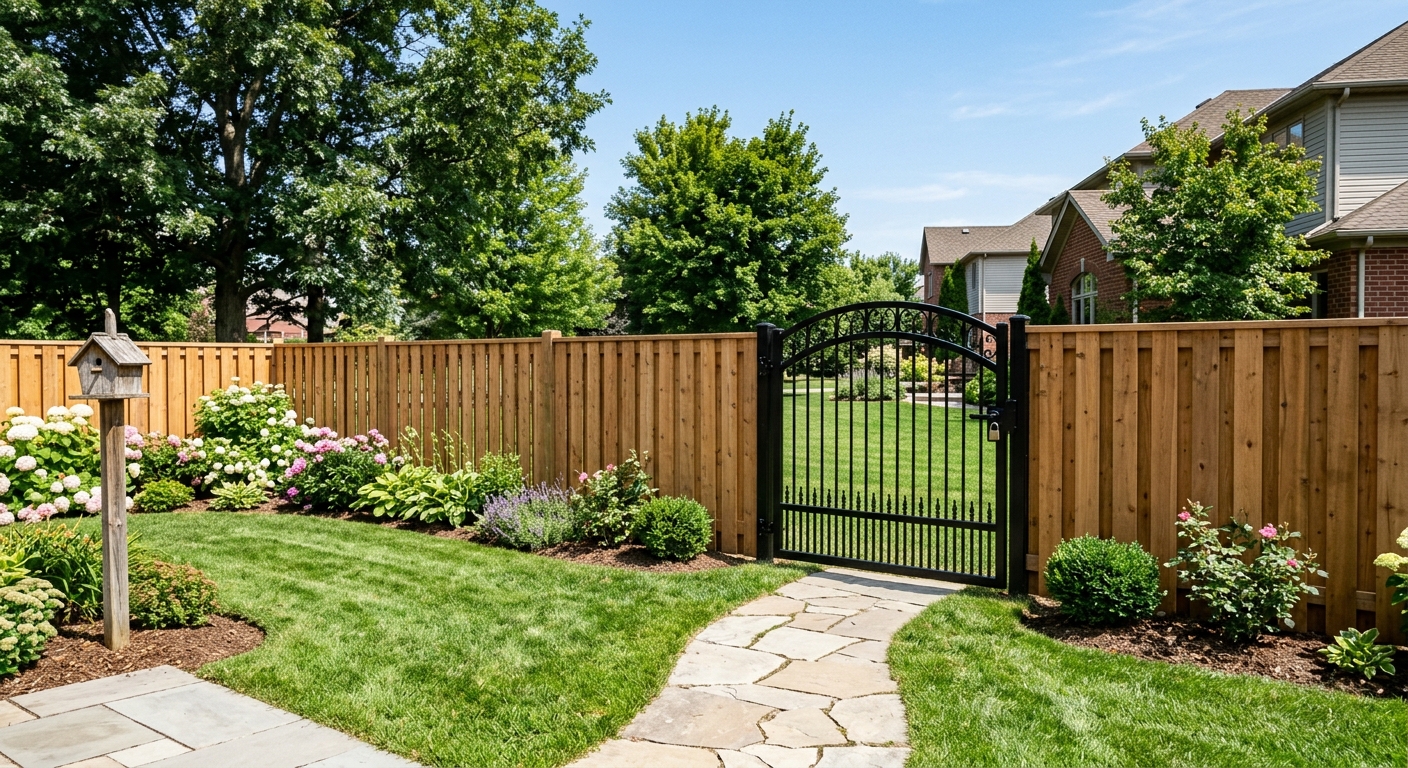
Fencing options and costs in Embrun
Embrun is a growing community in eastern Ontario, and with a population of 8,680 (Statistics Canada, 2021 Census), steady new-home buildouts and backyard upgrades keep fencing demand consistent year-round. In practice, most fencing work follows where homeowners have the most “visible” yard space—front lots and the perimeter edges of detached properties—because fencing affects day-to-day privacy, pets, and seasonal use. That’s why trade activity is especially noticeable around the newer residential pockets and infill streets near the village core, where schedules can stack up as spring ground conditions improve.
In the broader Toronto economic region, your fence price is strongly shaped by how deep posts must be set. Southern Ontario commonly uses a frost line of about 42”–48”, and best practice typically means setting posts around 3.5–4 feet deep to reduce frost heave risk—particularly for 6–8 ft privacy fences. For most Embrun projects on clay and mixed soils, contractors usually recommend concrete-set posts instead of driven posts. That choice increases labour time and ready-mix costs, but it improves long-term stability through freeze-thaw cycles.
Material selection also matters for Embrun’s wet springs and cold winters. Solid fences catch wind; taller panels need heavier posts and closer spacing to limit racking. The good news is that once your posts and spacing are done right, you can steer your budget toward the material that matches your priorities—privacy, lifespan, or low maintenance. Use the comparison table below to line up options with realistic price expectations.
| Material |
Lifespan |
Maintenance |
Privacy Rating |
Price per Linear Foot |
| Pressure-treated pine (standard wood) |
10–15 years |
Stain/seal every 2–3 years |
High (solid boards) |
$65 – $90 |
| Cedar (natural rot resistance) |
15–20 years |
Light stain/finish every 2–4 years |
High (solid boards) |
$85 – $115 |
| Vinyl / PVC (no-maintenance) |
20–30 years |
Minimal (wash as needed) |
High (solid or lattice) |
$90 – $125 |
| Chain-link (galvanized steel) |
20–30 years |
Occasional tension/hardware checks |
Low–Medium (visibility) |
$45 – $75 |
| Aluminum ornamental |
25–40 years |
Wash periodically |
Low (open pickets) |
$95 – $160 |
| Composite / recycled material |
20–25 years |
Low (wash; follow manufacturer care) |
High (solid panels) |
$110 – $145 |
Prices are estimates only and vary by project scope, site access and material selection.
What affects the price of fencing in Embrun
It’s common to see fencing quotes vary by 30–50% for what looks like the same job on paper—especially across the Toronto area where crew availability, excavation conditions, and local “best practice” footing standards differ from one contractor to another. In Embrun, that variance often comes down to how each quote handles frozen ground planning, the required post depth for Southern Ontario frost conditions, and the way they price labour-intensive items like concrete-set posts, gate installs, and old fence removal.
Here’s the big driver: frost line depth. Even though you’re not digging below the frost line “as a rule,” posts typically need to be set about 4–6 inches below design frost depth to prevent heaving. In cold Ontario winters, that often means hole depths in the 1.5–2.0 m range, longer posts, and concrete setting—so the material bill goes up and labour time increases. That’s why a well-installed 6–8 ft privacy fence can land closer to the higher end of wood and vinyl bands (for example, wood at the $65–$120 range depending on style and hardware; vinyl/PVC typically $75–$130).
Wind and panel engineering still matter even when Embrun doesn’t experience the extreme prairie gusting. Taller solid fences can rack under wind loads, so better quotes specify heavier posts (often 4x4 or 6x6 depending on height and spacing) and tighter centres (commonly 6–8 ft). By contrast, the chain-link option stays in the lower band—often $45–$85—because it’s quicker to install and doesn’t require the same level of panel bracing.
Two common Embrun examples: (1) a long run across a yard with clay soil and poor drainage usually requires more concrete setting time and careful alignment; (2) a corner lot with higher wind exposure often needs closer post spacing and upgraded hardware. If your property has newer construction grading and straighter access lanes, excavation can be faster—pushing your project toward the low end of the price bands.
| Price Factor |
Why It Matters |
Cost Impact |
| Fence length in linear feet |
Every additional foot adds materials and posts |
Largest driver; scales directly with labour and hardware |
| Post depth required |
Frost line determines hole depth and post length |
Deeper holes increase excavation, concrete, and waste |
| Post setting method |
Concrete vs. gravel pack vs. driven posts affects stability |
Concrete-set posts cost more upfront but reduce future movement |
| Material choice — vinyl vs. cedar vs. chain-link |
Different material density, rail systems, and hardware needs |
Vinyl/cedar and solid panels typically cost more than chain-link |
| Gate count and type |
Walk-through vs. double drive-through needs framing |
Gates add structural bracing, hinges, and alignment labour |
| Grade and terrain |
Sloped yards require stepped or raked panels |
More measuring, custom cuts, and additional rails |
| Old fence removal and disposal |
Demolition time and haul-off requirements |
Can add substantial labour and dump fees |
| Permit fees and survey / property line locate |
Protection against encroachment disputes |
Varies by situation; survey is often a one-time add-on |
Permits & regulations in Ontario
In Ontario, fences above a height threshold typically require a building permit—commonly around 2.0 m (about 6.5 ft) at the rear and about 1.0–1.2 m (roughly 3–4 ft) at the front or corner. Local municipal setback bylaws still apply, so even if a fence is under the height threshold, it may need to be positioned a specific distance from the property line and corner sightlines. The safest approach in Embrun is to confirm the applicable height and placement requirements for your lot before you order materials.
What usually requires a permit: taller fences that exceed the typical rear/front thresholds, fences with unusual heights or configurations, and projects that may affect safety visibility near driveways and intersections. What often does NOT require a permit: like-for-like replacements of standard-height fences that stay within typical local limits, provided you don’t change the location relative to the property line and you’re not adding significant height.
Before digging any post holes, call Ontario One Call to get utility locates. If you’re relying on pins, consider obtaining a survey or a property line locate so your posts aren’t placed on a neighbour’s land. Shared fence ownership is handled under provincial line-fences rules, but disputes are usually far easier to avoid when the property line is verified.
To verify an Ontario contractor, ask for: (1) their Ontario licence/registration status (check the relevant provincial registry online), (2) proof of liability insurance with an active certificate of insurance naming you as needed, and (3) proof of WSIB/WCB coverage where applicable. I also recommend requesting a written clearance letter where contractors provide labour coverage documentation.
Choosing the right fence material for Embrun
Choosing the right fence material in Embrun comes down to matching your priorities—privacy, low maintenance, budget, and lifespan—to what our winters do to fence posts and boards. Pressure-treated pine is typically the lowest-cost wood option, but it needs staining or sealing every 2–3 years to slow grey weathering and moisture penetration at the fasteners. Cedar looks better and resists rot longer, yet it still benefits from periodic sealing—especially where snowmelt sits against the boards. Vinyl/PVC offers the simplest upkeep, but in Ontario’s cold snaps it can crack if installed with poor expansion allowance or lightweight posts that can’t resist wind racking. Chain-link is usually the most economical and durable, but it won’t give privacy unless you add privacy slats or grow-in screening. Aluminum provides a clean ornamental look and won’t rust, though it is designed for visibility rather than full privacy.
Because Southern Ontario frost conditions are commonly taken around 42”–48”, fence posts for most solid privacy fences should be set deep enough to avoid frost heave—often 3.5–4 ft deep with concrete-set footings for stability on clay/mixed soils. That means even “cheaper” materials can end up in a similar installed price if the project requires deeper holes and concrete setting. For Embrun homeowners, wind and snow load also influence spacing and panel size: taller solid fences usually demand heavier posts and tighter centres.
To see where the price difference is justified: if pressure-treated wood is priced around the low-to-mid end (roughly $65–$90 per linear foot), vinyl may run higher (often $90–$125). Spending that extra can be worthwhile when you want near-zero maintenance and you’re planning to stay put for the long haul, especially because the post install (where most structural cost sits) will be similar regardless of cladding.
| Material |
Cold Tolerance |
Lifespan |
Annual Maintenance |
Best For |
Price Band |
| Pressure-treated pine |
Good if sealed and fasteners are maintained |
10–15 years |
0–$50 materials/time (stain 1–3 year cycle) |
Budget privacy with standard design |
$65 – $90 |
| Cedar |
Very good; better natural rot resistance |
15–20 years |
Light re-seal/clean once per 2–4 years |
Appearance-focused privacy |
$85 – $115 |
| Vinyl / PVC |
Good with correct post sizing and expansion gaps |
20–30 years |
Wash as needed; inspect brackets yearly |
Low-maintenance privacy |
$90 – $125 |
| Chain-link |
Excellent; galvanized steel tolerates cold well |
20–30 years |
Occasional tension/hardware check |
Security on a budget |
$45 – $75 |
| Aluminum ornamental |
Excellent; powder-coated protection |
25–40 years |
Wash periodically |
Curb appeal with visibility |
$95 – $160 |
| Composite / recycled |
Good; depends on manufacturer formula |
20–25 years |
Low—follow manufacturer care guidance |
Solid look with long life |
$110 – $145 |
How to choose a fencing contractor in Embrun
When you’re hiring a fence contractor in Embrun, I treat verification like part of the job scope—because a fence is only as good as the footings, alignment, and hardware choices made on install day. Start by confirming Ontario licencing/registration status through the appropriate provincial registry (the contractor should give you their business details and you should be able to match them). Next, request a certificate of liability insurance and make sure the coverage is active; it should clearly show the insurer, policy dates, and limits. For worker protection, ask for WSIB/WCB coverage proof—then verify it matches the company doing the work, not just a subcontractor’s paperwork.
For pricing, don’t accept a vague lump sum. Ask for 2–3 itemised written quotes with labour and materials broken out: post material and spacing, concrete quantity allowance, rail system, picket/board size, gate hardware, and any rail reinforcements. Check inclusions and exclusions: permit pull, utility locate scheduling, demolition removal, and waste disposal are often the difference between “close” quotes and a surprise bill. Warranty terms should be in writing—separate workmanship coverage from the product/manufacturer warranty, and clarify if warranties are transferable if you sell the home.
Payment matters. Never pay more than 10–15% upfront. Hold back a portion until the gate swings properly, the fence line is straight, and final grade/cleanup is complete. Also request a written start date and completion estimate that reflects weather delays—especially when ground is thawing and re-freezing.
- Provide proof of active insurance and WSIB/WCB coverage before work begins
- Show their Ontario registration/licence information on the quote
- Give itemised labour vs. material pricing (no “mystery totals”)
- Specify post spacing and post size in writing
- State post-depth approach for frost stability and whether holes are concrete-set
- Confirm gate type and hardware (hinges, latch, reinforcement) in the scope
- Include utility locate responsibility and scheduling
- Clarify demolition and disposal inclusions (dump fees, haul-off, recycling)
- List fence height, style, and number of rails/board thickness
- Describe how they handle sloped ground (stepped vs. raked panels)
- Provide a written workmanship warranty length and what it covers
- Use a payment schedule with a small deposit and holdback until final inspection
In my experience, four red flags in Embrun are: (1) quotes that ignore concrete-set posts while promising “no frost issues,” (2) no written permit responsibility when a fence likely crosses height thresholds, (3) no itemised breakdown for gates and hardware, and (4) demanding large upfront payments (more than 10–15%).
Frequently asked questions — fencing in Embrun
How do I prevent wood fence rot in Embrun?
To prevent rot in Embrun, focus on where wood stays wet: bottom rails, post-to-rail joints, and screw/fastener penetration. A contractor should use pressure-treated lumber rated for ground contact where appropriate, keep boards off the ground, and seal cut ends (not just paint the surface). Concrete-set posts help because the post stays stable through freeze-thaw, reducing gaps that hold moisture. Also ensure proper spacing for drainage and avoid trapping water behind lattice too tightly. If your fence is already grey and soft at the base, plan for board-level replacement rather than waiting for full post failure. For typical projects, wood fencing often lands around $65–$90 per linear foot; spending a bit more on correct installation details usually costs less than repeated board replacements.
What is the cost per linear foot for fencing in Embrun?
In Embrun, pricing generally follows the Toronto economic region bands because your costs are driven by the same realities: frost-depth post setting, labour time, and material pricing. As a practical guide, wood fences commonly land in the $65–$120 per linear foot range, vinyl/PVC is often $75–$130 per linear foot, chain-link can be $45–$85, and aluminum/metal frequently sits around $90–$160. Your exact number depends on how many feet you’re fencing, whether you’re adding a gate (walk vs. double drive-through), how sloped your yard is, and whether old fencing needs removal and disposal. If your quote includes concrete-set posts due to frost stability (very common in this region), it usually pushes the project toward the higher end of the wood or vinyl ranges.
Should I repair or replace my old fence in Embrun?
Repair can make sense if posts are solid and the fence line hasn’t shifted. In Embrun winters, the usual failure points are rotted bottoms on posts/rails, loose hardware, and sections that sag after freeze-thaw movement. If only a few panels are weathered, replace boards/rails and re-tighten hardware to restore line and height. Replacement is more cost-effective when multiple posts have softened, when the fence is leaning, or when repairs would still leave you with weak attachment points for gates. Also consider whether your old fence height or location no longer meets current expectations—especially if you’re changing beyond “like-for-like.” A proper quote will tell you whether they’re pricing a localized repair or a full tear-down, and that decision strongly affects total cost per linear foot.
How do I handle a fence dispute with a neighbour in Ontario?
Start by verifying the property line—Ontario disputes often come down to posts being installed even a small distance off. Request a property line locate or survey based on your pins before any major changes. In Ontario, shared fence rules are addressed by provincial line-fences legislation, but outcomes are typically improved by documenting who built/maintained the boundary fence and what each party agreed to. Communicate in writing, include photos, and keep records of quotes if you’re considering replacement. If you need to adjust the fence for height or setback, align on the plan before work begins. Because fence disputes can trigger delays, it’s smart to choose a contractor who will clearly mark proposed post locations and confirm measurements—especially in areas near corners and driveways where placement matters.
What fence style offers the best wind resistance in Embrun?
For wind resistance in Embrun, the best results usually come from solid privacy designs installed with adequate post size, correct spacing, and stable footings. Solid boards create more wind load, so the structure has to be stronger: heavier posts (often 4x4 or 6x6 for wood depending on height), closer spacing (commonly 6–8 ft centres), and solid concrete-set foundations to prevent movement during freeze-thaw. If you want better wind performance with less structural demand, consider semi-open designs that reduce uplift pressure, but note you’ll sacrifice some privacy. Chain-link is durable and generally handles wind loads well but doesn’t block visibility. When quotes mention concrete-set posts and engineered spacing for the specific fence height, that’s usually a sign they understand wind and racking risk in Southern Ontario.
How much does a fence cost in Embrun?
The total cost in Embrun depends mostly on linear feet, fence height, gate count, and whether the install needs concrete-set posts for frost stability. As a ballpark, homeowners often see wood installations around $65–$120 per linear foot and vinyl/PVC around $75–$130 per linear foot, with chain-link typically lower at $45–$85 and aluminum higher at $90–$160. For a quick example, a 40-linear-foot run of basic wood privacy could land roughly in the $2,600–$4,800 range before site-specific extras, while vinyl for the same length might be closer to about $3,000–$5,200. Add gates, demolition, disposal, or stepped/raked panels and the total rises quickly. The most accurate estimate comes from an itemised quote that accounts for post depth, concrete setting, and hardware.