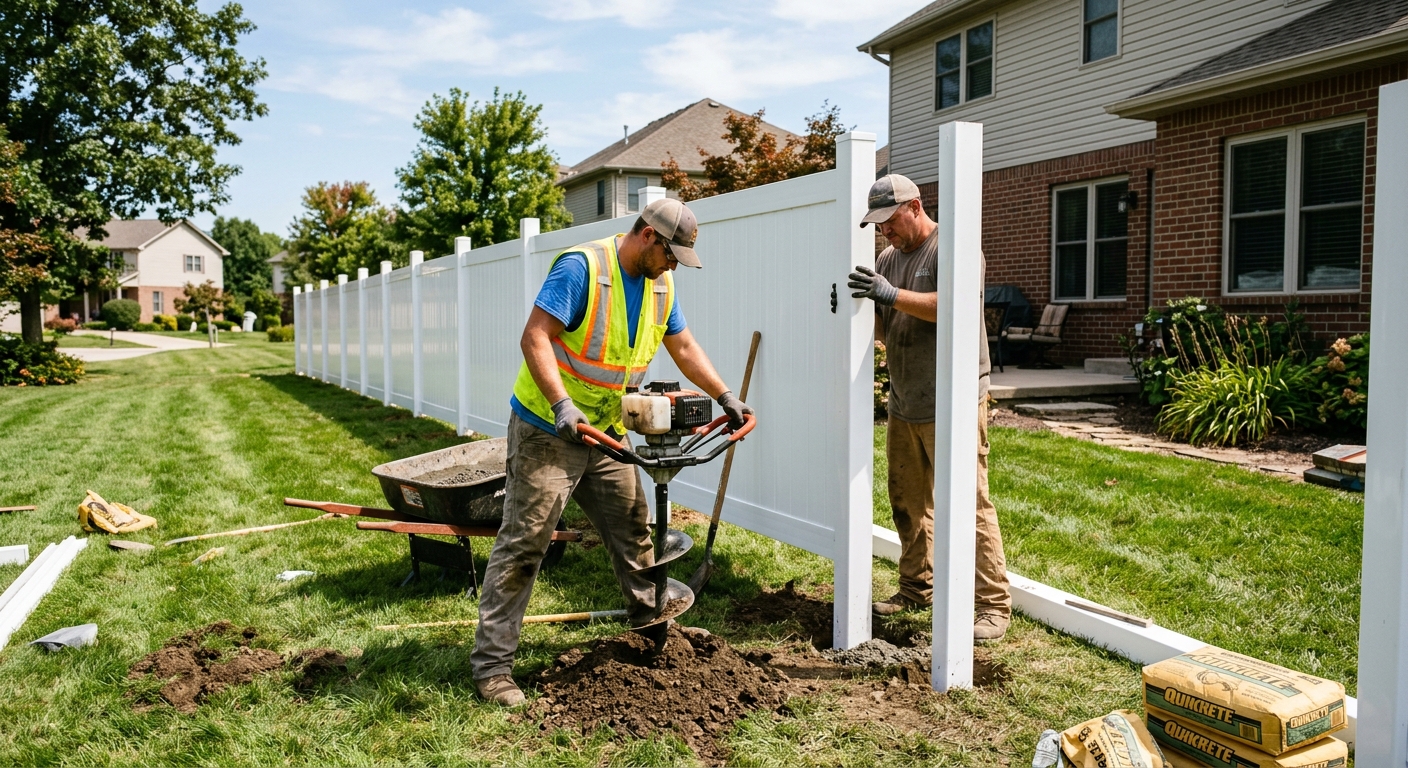
Fencing options and costs in Nipigon
Nipigon homeowners have a wide choice of fencing materials, but the “right” option usually comes down to climate tolerance, privacy needs, and how often you’re willing to maintain boards and rails. With 93.2% of households in town owning their homes (Statistics Canada, 2021 Census), demand is steady for backyard and side-yard fencing around the year, especially on single-detached properties where boundaries are more visible and family-use is higher (single-detached houses make up 94.7% of dwellings). Northwest Ontario also sets the price floor: deeper frost penetration means fence posts often need to be set about 4 ft (1.2 m+) or deeper below grade, commonly with concrete, to reduce the risk of frost heave and leaning. On top of that, wind exposure along open rural stretches and near highway corridors pushes many jobs toward heavier panels and closer post spacing for a straighter, longer-lasting fence.
In Nipigon, this trade is particularly in demand in the more residential built-up areas and along lakeside and higher-exposure routes where fences need to resist gusts and drifting snow. I see this most often around the Nipigon town core and the Marbury/Red Rock Road-side properties, where lot access and soil conditions affect how quickly we can dig below frost and backfill properly. Those factors, plus your material choice, are why you’ll see different quotes for the “same” fence layout.
Use the table below as a practical starting point for comparing lifespan, upkeep, privacy, and typical pricing per linear foot before we refine your scope.
| Material |
Lifespan |
Maintenance |
Privacy Rating |
Price per Linear Foot |
Price Range |
| Pressure-treated pine (standard wood) |
10–15 years |
Stain/seal every 2–3 years; inspect posts annually |
Medium–High (good with solid boards) |
$55–$90 |
$55 – $90 |
| Cedar (natural rot resistance) |
15–25 years |
Light sealing or staining every 3–4 years |
High (solid boards) |
$70–$105 |
$70 – $105 |
| Vinyl / PVC (no-maintenance) |
20–30 years |
Rinse as needed; check for cracking in extreme cold |
Medium–High (solid-slat styles) |
$70–$110 |
$70 – $110 |
| Chain-link (galvanized steel) |
25–40 years |
Occasional rinse; tighten hardware |
Low (security only) |
$35–$65 |
$35 – $65 |
| Aluminum ornamental |
25–35 years |
Minimal (wash; inspect gates and latches) |
Low–Medium (open pickets) |
$80–$140 |
$80 – $140 |
| Composite / recycled material |
20–30 years |
Wash; avoid hard impacts near corners |
Medium–High (board-style privacy) |
$95–$135 |
$95 – $135 |
Prices are estimates only and vary by project scope, site access and material selection.
What affects the price of fencing in Nipigon
In Nipigon, you can easily see 30–50% swings in fencing quotes for what looks like the same job on paper. The biggest reason is that frost-depth and wind conditions change the true cost of “standard installation” here. Northwest Ontario posts usually need to be set well below the frost line—often roughly 4–6 inches below the design frost depth—so that water movement and freeze/thaw cycles don’t heave the posts and rack the fence. In cold Ontario and Alberta-style conditions, that commonly means posts in the neighborhood of 1.5–2.0 m into the ground, concrete setting, and longer posts, which increases both material and excavation labour. Wind exposure also pushes design choices: areas with stronger gusts call for tighter post spacing and heavier panels, which raises the quantity of lumber or metal components.
Concrete examples from Nipigon: (1) If your soil is mixed clay and gravel, we often spend longer excavating and may need more backfill work than on sandy sites, which can push a typical wood install toward the upper end of the $55–$90 band. (2) If your fence line runs through a wet, low spot near drainage, we may need careful sequencing to avoid unstable footing; that can make vinyl/PVC come closer to the $70–$110 installed range because we’re still building deep, wind-stable foundations. (3) If you’re replacing an older fence, disposal and salvage time can add meaningful labour regardless of whether you choose chain-link at $35–$65 or a privacy material at the higher end.
Finally, housing age matters. With 87.1% of homes built before 1981 (Statistics Canada, 2021 Census), many lots have established boundaries, mature trees, and older underground services that can affect excavation time. That’s one more reason your “per-foot” number can move even before we talk about whether you choose cedar or chain-link.
| Price Factor |
Why It Matters |
Cost Impact |
| Fence length in linear feet |
Every additional foot adds posts, rails, and labour |
Largest driver; typically determines most of the total |
| Post depth required |
Frost line determines hole depth and post length |
Major increase; deeper holes mean more excavation and concrete |
| Post setting method |
Concrete vs. gravel pack vs. driven posts affects stability |
Concrete setting usually costs more but reduces future shifting |
| Material choice |
Vinyl/PVC and cedar generally cost more than chain-link |
Can change price by $15–$75 per linear foot depending on material |
| Gate count and type |
Drive-through double gates require more framing and hardware |
Often adds a noticeable premium beyond the fence line |
| Grade and terrain |
Slopes require step-racking or custom panel spacing |
Medium increase due to labour and material waste |
| Old fence removal and disposal |
Haul-away, scrap handling, and time at site |
Can add several hours or a half-day of labour |
| Permit fees and survey / property line locate |
Professional locate protects against boundary disputes |
Variable; can add fixed costs plus scheduling time |
Permits & regulations in Ontario
In Ontario, fences above a height threshold typically require a building permit—commonly around 2.0 m (6.5 ft) at the rear and about 1.0–1.2 m (3–4 ft) at the front or corner, depending on location and how your municipality defines “front yard.” Even when a permit isn’t required, every fence must stay within property lines and follow local setback rules. Before any post holes are dug, call Ontario One Call to have buried utilities located; you don’t want to discover a line after excavation. If boundary lines are uncertain, get a survey or a property pin locate before installing, especially for replacement fences where older stakes may be inaccurate.
Shared fence rules in Ontario are governed by provincial line-fences legislation, so it’s wise to confirm who owns the boundary and how maintenance responsibility is handled before you sign a contract—particularly if you’re upgrading a shared privacy fence.
Steps to verify your contractor in Nipigon: (1) Check their Ontario business/contractor registration in the appropriate online registry, if applicable to their business type. (2) Ask for a current certificate of insurance showing general liability (and any required endorsements for fencing work). (3) Confirm WSIB/WCB coverage or a clearance letter, depending on their coverage requirements and employment status. Then keep copies with your contract so any future dispute has documentation. On paperwork, insist the scope clearly states whether permit pulling is included or excluded.
Choosing the right fence material for Nipigon
Choosing a fence in Nipigon is mostly about matching the material to how you use your yard and how the Northwest weather treats it. Pressure-treated pine is the budget-friendly approach, but it still needs staining or sealing every 2–3 years to prevent grey weathering and protect fasteners. Cedar naturally resists rot and looks better for longer, yet it still benefits from periodic treatment to slow down surface wear. Vinyl/PVC is genuinely low-maintenance—often just a rinse—but extreme cold can make some products more brittle, so proper installation and hardware quality matter. Chain-link is the longest-lasting low-cost option, but it offers limited privacy unless you add screening. Aluminum ornamental fences give a clean, rust-resistant look and are mid-range in cost, yet they’re not privacy-focused.
Northwest frost rules influence all of these choices: because posts need deep embedment, concrete-set posts are usually the practical standard in this region. That means material savings won’t help much if your foundations aren’t built for freeze/thaw movement—especially on longer runs where minor post shifts become obvious. Wind and snow load also matter; open-style fences may need sturdier bracing, while solid board privacy fences often require more robust post spacing to resist pushing.
For example, if your goal is privacy and you’re comparing pine versus cedar, you might spend about $55–$90 per linear foot for standard wood versus roughly $70–$105 for cedar (installed). That extra $15–$25 per foot can be justified if you want fewer re-stain cycles and a longer “nice-looking” period in a town where most homes are older and landscaping matures over time.
| Material |
Cold Tolerance |
Lifespan |
Annual Maintenance |
Best For |
Price Band |
| Pressure-treated pine |
Good (with proper treatment and fasteners) |
10–15 years |
Check posts/rails; plan staining every 2–3 years |
Budget privacy with regular upkeep |
$55–$90 |
| Cedar |
Very good (naturally rot-resistant) |
15–25 years |
Light sealing/staining about every 3–4 years |
Premium look and longer service life |
$70–$105 |
| Vinyl / PVC |
Good (best with quality components) |
20–30 years |
Low: rinse; inspect for rare cracking at impact points |
Low-maintenance privacy |
$70–$110 |
| Chain-link |
Excellent (galvanized steel) |
25–40 years |
Minimal: tighten hardware; rinse |
Security, pets, and long-term durability |
$35–$65 |
| Aluminum ornamental |
Excellent |
25–35 years |
Minimal: wash and inspect gates |
Attractive boundary with curb appeal |
$80–$140 |
| Composite / recycled |
Good (avoid hard impacts) |
20–30 years |
Wash; occasional hardware checks |
Privacy with low upkeep |
$95–$135 |
How to choose a fencing contractor in Nipigon
Start by verifying the basics for fencing contractors working in Nipigon, Ontario. Ask for proof of general liability insurance (certificate of insurance showing coverage effective dates and the work/location). For coverage and compliance, confirm they have WSIB/WCB clearance where required for their employment structure—either a clearance letter or documentation of the correct coverage status. If they provide subcontract labour, ask how coverage is handled for everyone on site. Don’t accept “we’re insured” without paperwork you can review.
Next, request 2–3 itemised, written quotes. A fair quote separates labour from materials (posts, rails, panel type, hardware, concrete, gate framing) rather than bundling everything into one number. Read the scope carefully for exclusions such as permit pull responsibility, utility locating coordination, old fence removal, disposal/haul-away, and any steps required for sloped ground or “raked” sections.
Warranty should be clear: look for a workmanship warranty period (how long they stand behind installation), plus any product/manufacturer warranty for boards, vinyl components, or metal finishes. Confirm if warranties are transferable to future owners.
For payment, keep it modest: never pay more than 10–15% upfront, and hold back until the fence is complete and final grade adjustments are done. Get a start date and completion estimate in writing so you’re not left waiting through the weather window when ground conditions change.
- Ask who will pull permits (if needed) and confirm it in writing.
- Verify WSIB/WCB clearance or coverage documentation before work starts.
- Request a current certificate of insurance with the correct business name.
- Require an itemised quote showing posts, concrete amount, rails, and hardware.
- Confirm post depth approach for Nipigon frost conditions (deep embedment + concrete setting where specified).
- Check how the contractor handles gate framing and latching hardware.
- Clarify whether old fence removal and disposal is included.
- Ask about utility locate responsibility (Ontario One Call scheduling/coordination).
- Ensure slope handling is described (stepped vs. raked panels).
- Confirm warranty terms: workmanship duration and manufacturer warranty coverage.
- Set payment milestones; avoid large upfront deposits.
- Get a written schedule with start date and completion target.
Red flags in Nipigon to watch for: (1) “Shallow posts” promises or refusal to set below frost depth; (2) quotes that omit concrete/footings or can’t explain how posts will be straight after freeze/thaw; (3) no proof of insurance or WSIB/WCB clearance; (4) a lump-sum estimate with no itemisation for gates, rails, and disposal; (5) pushing for a large upfront payment before any measurements or locates are complete.
Frequently asked questions — fencing in Nipigon
Do I need a permit to build a fence in Ontario?
In Ontario, a permit is often required for fences above commonly used height thresholds, typically around 2.0 m (6.5 ft) at the rear and about 1.0–1.2 m (3–4 ft) at the front or corner, depending on where the fence sits. For Nipigon homeowners, the practical approach is to confirm your fence height and location (front, side, rear, and any corner visibility) before you buy materials. Even where a permit isn’t required, you still must follow property line rules and municipal setback bylaws. Also, before any digging, call Ontario One Call for utility locates—postholes are where mistakes get expensive. A reputable contractor will state clearly whether permit pull is included in the quote or your responsibility, and it should be written in the contract.
How long does a wood fence last in Nipigon?
A pressure-treated pine fence in Nipigon commonly lasts about 10–15 years when posts are set for Northwest frost conditions and maintenance is done on schedule. If the fence is installed with deeper below-frost embedment (often around 1.2 m+ and sometimes deeper depending on frost depth design) and concrete setting where needed, the fence is far less likely to lean from freeze/thaw movement. Cedar can push the lifespan closer to 15–25 years thanks to better rot resistance, but it still benefits from periodic staining. If you’re comparing costs, remember that the initial price range for wood installation often starts around $55–$90 per linear foot—choosing a cheaper install that cuts corners on footings can shorten lifespan and raise long-term repair costs.
Who owns and maintains a shared fence?
Shared fence ownership and responsibilities in Ontario are generally handled under provincial line-fences legislation. In practice for Nipigon homeowners, this means you should confirm whether the fence lies exactly on the boundary and whether both properties contribute to construction and upkeep. If you’re replacing or upgrading a shared fence, it’s important to talk with the neighbour early, document agreements, and define what’s changing (height, material, gate locations). Contractors can install the work, but the legal and cost-sharing arrangement is something you should clarify upfront to prevent disputes later. Before any work starts, verify property pins or get a locate—because a fence that’s slightly off the line can turn a maintenance disagreement into an encroachment issue.
How do I find my property line before fencing?
The safest way to find your property line in Nipigon is to locate your property pins with a professional surveyor or survey locate service, especially if you’re replacing an older fence where stakes may have moved or become inaccurate. Many disputes happen because someone assumes a line based on a previous fence alignment, tree line, or visual guess. If you can’t confidently identify boundary markers, get a locate before posts go in. Your contractor should also document the agreed fence line in writing. Separately, remember that you must call Ontario One Call before digging postholes so utility locate marks are visible on site. With deeper frost embedment requirements in Northwest Ontario, you’ll be digging significant holes—so verifying the line before installation protects both your fence and your relationship with neighbours.
What's the most low-maintenance fence?
For low-maintenance in Ontario’s colder climates, vinyl/PVC is usually the top choice for homeowners who want minimal seasonal work, and chain-link is also very low upkeep with long service life. In Nipigon, however, installation quality matters as much as material: posts still must be set correctly for below-frost stability, even if the panels themselves don’t require staining. Vinyl commonly falls around the $70–$110 installed range per linear foot depending on style and site conditions, while chain-link is typically lower at about $35–$65 for installed projects. If you want privacy with the least maintenance, vinyl privacy styles are often the best balance; if security-only is acceptable, chain-link will keep costs down with the fewest ongoing tasks.
How tall can my fence be in Nipigon?
Fence height limits depend on where the fence sits on your lot (front, corner, side, or rear) and whether the fence triggers permit requirements in Ontario. As a rule of thumb used by many homeowners planning projects, rear fences around 2.0 m (6.5 ft) often fall into the “permit may be required” category, while front or corner fences are frequently restricted to roughly 1.0–1.2 m (3–4 ft). In Nipigon, the best way to avoid mistakes is to confirm your fence plan with your contractor and the applicable local rules before ordering material. Also consider wind: taller solid fences act like sails, so stronger wind-conscious layouts and robust post spacing help prevent racking and leaning during Northwest storms.